
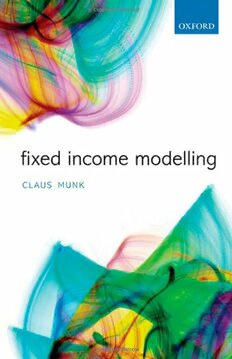
Download Fixed Income Modelling PDF Free - Full Version
Download Fixed Income Modelling by Claus Munk in PDF format completely FREE. No registration required, no payment needed. Get instant access to this valuable resource on PDFdrive.to!
About Fixed Income Modelling
Fixed Income Modelling offers a unified presentation of dynamic term structure models and their applications to the pricing and risk management of fixed income securities. It explains the basic fixed income securities and their properties and uses as well as the relations between those securities. The book presents and compares the classical affine models, Heath-Jarrow-Morton models, and LIBOR market models, and demonstrates how to apply those models for the pricing of various widely traded fixed income securities. It offers a balanced presentation with both formal mathematical modelling and economic intuition and understanding. The book has a number of distinctive features including a thorough and accessible introduction to stochastic processes and the stochastic calculus needed for the modern financial modelling approach used in the book, as well as a separate chapter that explains how the term structure of interest rates relates to macro-economic variables and to what extent the concrete interest rate models are founded in general economic theory. The book focuses on the most widely used models and the main fixed income securities, instead of trying to cover all the many specialized models and the countless exotic real-life products. The in-depth explanation of the main pricing principles, techniques, and models as well as their application to the most important types of securities will enable the reader to understand and apply other models and price other securities. The book includes chapters on interest rate risk management, credit risk, mortgage-backed securities, and relevant numerical techniques. Each chapter concludes with a number of exercises of varying complexity.Suitable for MSc students specializing in finance and economics, quantitatively oriented MBA students, and first- or second-year PhD students, this book will also be a useful reference for researchers and finance professionals and can be used in specialized courses on fixed income or broader courses on derivatives.
Detailed Information
| Author: | Claus Munk |
|---|---|
| Publication Year: | 2011 |
| ISBN: | 9780199575084 |
| Pages: | 573 |
| Language: | English |
| File Size: | 3.149 |
| Format: | |
| Price: | FREE |
Safe & Secure Download - No registration required
Why Choose PDFdrive for Your Free Fixed Income Modelling Download?
- 100% Free: No hidden fees or subscriptions required for one book every day.
- No Registration: Immediate access is available without creating accounts for one book every day.
- Safe and Secure: Clean downloads without malware or viruses
- Multiple Formats: PDF, MOBI, Mpub,... optimized for all devices
- Educational Resource: Supporting knowledge sharing and learning
Frequently Asked Questions
Is it really free to download Fixed Income Modelling PDF?
Yes, on https://PDFdrive.to you can download Fixed Income Modelling by Claus Munk completely free. We don't require any payment, subscription, or registration to access this PDF file. For 3 books every day.
How can I read Fixed Income Modelling on my mobile device?
After downloading Fixed Income Modelling PDF, you can open it with any PDF reader app on your phone or tablet. We recommend using Adobe Acrobat Reader, Apple Books, or Google Play Books for the best reading experience.
Is this the full version of Fixed Income Modelling?
Yes, this is the complete PDF version of Fixed Income Modelling by Claus Munk. You will be able to read the entire content as in the printed version without missing any pages.
Is it legal to download Fixed Income Modelling PDF for free?
https://PDFdrive.to provides links to free educational resources available online. We do not store any files on our servers. Please be aware of copyright laws in your country before downloading.
The materials shared are intended for research, educational, and personal use in accordance with fair use principles.

