
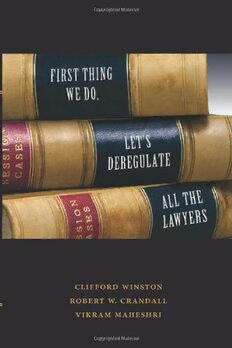
Download First Thing We Do, Let's Deregulate All the Lawyers PDF Free - Full Version
Download First Thing We Do, Let's Deregulate All the Lawyers by Clifford Winston, Robert W. Crandall, Vikram Maheshri in PDF format completely FREE. No registration required, no payment needed. Get instant access to this valuable resource on PDFdrive.to!
About First Thing We Do, Let's Deregulate All the Lawyers
Not many Americans think of the legal profession as a monopoly, but it is. Abraham Lincoln, who practiced law for nearly twenty-five years, would likely not have been allowed to practice today. Without a law degree from an American Bar Association-sanctioned institution, a would-be lawyer is allowed to practice law in only a few states. ABA regulations also prevent even licensed lawyers who work for firms that are not owned and managed by lawyers from providing legal services. At the same time, a slate of government policies has increased the demand for lawyers' services. Basic economics suggests that those entry barriers and restrictions combined with government-induced demand for lawyers will continue to drive the price of legal services even higher. Clifford Winston, Robert Crandall, and Vikram Maheshri argue that these increased costs cannot be economically justified. They create significant social costs, hamper innovation, misallocate the nation's labor resources, and create socially perverse incentives. In the end, attorneys support inefficient policies that preserve and enhance their own wealth, to the detriment of the general population. To fix this situation, the authors propose a novel solution: deregulation of the legal profession. Lowering the barriers to entry will force lawyers to compete more intensely with each other and to face competition from nonlawyers and firms that are not owned and managed by lawyers. The book provides a much-needed analysis of why legal costs are so high and how they can be reduced without sacrificing the quality of legal services.
Detailed Information
| Author: | Clifford Winston, Robert W. Crandall, Vikram Maheshri |
|---|---|
| Publication Year: | 2011 |
| ISBN: | 9780815721901 |
| Pages: | 121 |
| Language: | English |
| File Size: | 0.946 |
| Format: | |
| Price: | FREE |
Safe & Secure Download - No registration required
Why Choose PDFdrive for Your Free First Thing We Do, Let's Deregulate All the Lawyers Download?
- 100% Free: No hidden fees or subscriptions required for one book every day.
- No Registration: Immediate access is available without creating accounts for one book every day.
- Safe and Secure: Clean downloads without malware or viruses
- Multiple Formats: PDF, MOBI, Mpub,... optimized for all devices
- Educational Resource: Supporting knowledge sharing and learning
Frequently Asked Questions
Is it really free to download First Thing We Do, Let's Deregulate All the Lawyers PDF?
Yes, on https://PDFdrive.to you can download First Thing We Do, Let's Deregulate All the Lawyers by Clifford Winston, Robert W. Crandall, Vikram Maheshri completely free. We don't require any payment, subscription, or registration to access this PDF file. For 3 books every day.
How can I read First Thing We Do, Let's Deregulate All the Lawyers on my mobile device?
After downloading First Thing We Do, Let's Deregulate All the Lawyers PDF, you can open it with any PDF reader app on your phone or tablet. We recommend using Adobe Acrobat Reader, Apple Books, or Google Play Books for the best reading experience.
Is this the full version of First Thing We Do, Let's Deregulate All the Lawyers?
Yes, this is the complete PDF version of First Thing We Do, Let's Deregulate All the Lawyers by Clifford Winston, Robert W. Crandall, Vikram Maheshri. You will be able to read the entire content as in the printed version without missing any pages.
Is it legal to download First Thing We Do, Let's Deregulate All the Lawyers PDF for free?
https://PDFdrive.to provides links to free educational resources available online. We do not store any files on our servers. Please be aware of copyright laws in your country before downloading.
The materials shared are intended for research, educational, and personal use in accordance with fair use principles.

