Table Of ContentAir Accident Investigation Unit - (Belgium)
CCN
Rue du Progrès 80 Bte 5
1030 Brussels
Safety Investigation Report
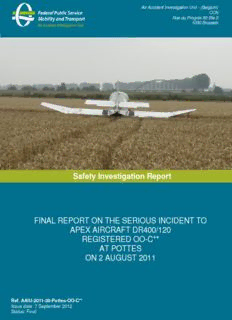
FINAL REPORT ON THE SERIOUS INCIDENT TO
APEX AIRCRAFT DR400/120
REGISTERED OO-C**
AT POTTES
ON 2 AUGUST 2011
Ref. AAIU-2011-20-Pottes-OO-C**
Issue date: 7 September 2012
Status: Final
AAIU 2011-20-Pottes-OO-C**
FOREWORD .................................................................................................. 3
SYNOPSIS ..................................................................................................... 4
1 FACTUAL INFORMATIONS.................................................................. 5
1.1 HISTORY OF FLIGHT .................................................................................. 5
1.2 INJURIES PERSONS ................................................................................... 5
1.3 DAMAGE TO AIRCRAFT ............................................................................... 6
1.4 OTHER DAMAGE ....................................................................................... 6
1.5 PERSONNEL INFORMATION ........................................................................ 6
1.6 AIRCRAFT INFORMATION ............................................................................ 6
1.7 METEOROLOGICAL CONDITIONS ............................................................... 12
1.8 ADDITIONAL INFORMATION ....................................................................... 12
2 ANALYSIS ........................................................................................... 13
2.1 CARBURETTOR CONTAMINATION EXAMINATION .......................................... 13
2.2 MAINTENANCE ........................................................................................ 16
2.3 CERTIFICATION CONSIDERATIONS............................................................. 18
2.4 CARBURETTOR CONTAMINATIONS AND AIRWORTHINESS DIRECTIVES .......... 20
2.5 SHROUD ANALYSIS BY THE AIRPLANE MANUFACTURER (CEAPR) ................ 21
2.6 ANALYSIS OF THE NEW SHROUD AS INSTALLED IN OO-C** AFTER THE FORCED
LANDING ................................................................................................ 21
3 CONCLUSION ..................................................................................... 22
3.1 FINDINGS ............................................................................................... 22
3.2 CAUSE ................................................................................................... 22
4 SAFETY RECOMMENDATION ........................................................... 23
4.1 RECOMMENDATION NUMBER 2011-P-23 TO EASA. .................................. 23
4.2 RECOMMENDATION NUMBER 2011-P-24 TO EASA. .................................. 23
5 ENCLOSURES .................................................................................... 24
5.1 DGAC AD 1999-114(A) R3 ................................................................... 24
5.2 AVIONS ROBIN SERVICE BULLETIN N°160 REV.1 ..................................... 25
5.3 EXTRACTS OF THE INSPECTION SCHEDULE CONCERNING AIR INTAKE AND
EXHAUST SYSTEM ................................................................................... 27
Page 2 of 30 7 September 2012
AAIU 2011-20-Pottes-OO-C**
FOREWORD
This report is a technical document that reflects the views of the investigation
team on the circumstances that led to the accident.
In accordance with Annex 13 of the Convention on International Civil
Aviation, it is not the purpose of aircraft accident investigation to apportion
blame or liability. The sole objective of the investigation and the Final Report
is the determination of the causes, and define recommendations in order to
prevent future accidents and incidents.
In particular, Article 16 of the EU regulation EU 996/2010 stipulates that the
safety recommendations made in this report do not constitute any suspicion
of guilt or responsibility in the accident.
Unless otherwise indicated, recommendations in this report are addressed to
the Regulatory Authorities of the State having responsibility for the matters
with which the recommendation is concerned. It is for those Authorities to
decide what action is taken.
The investigation was conducted by Henri Metillon and Sam Laureys
The report was compiled by Henri Metillon and was published under the
authority of the Chief Investigator.
NOTES:
For the purpose of this report, time will be indicated in UTC, unless otherwise
specified.
ICAO document 9859 “Safety Management Manual” was used to identify the
hazard and the consequences related to the accident.
Page 3 of 30 7 September 2012
AAIU 2011-20-Pottes-OO-C**
SYNOPSIS
Date and hour of the accident: 02 August 2011 at 13:30 UTC
Aircraft: Robin Aviation / Apex Aircraft DR400/120
Accident location: On a field in the Commune of Pecq N 050°
43.446’, E 003° 22.712’
Aircraft owner: Private
Type of flight: Private
Persons on board: 1
Abstract:
At the end of a gliding flight exercise the engine did not respond to the
command when the pilot pushed the throttle forward. The pilot moved the
throttle several times forward causing the engine to revive briefly before
returning to low speed. At 400 ft, the pilot selected a wheat field adequate for
a forced landing and landed the airplane successfully.
Cause(s):
The cause of the incident is an engine failure due to the presence of a small
insect (fly) inside the carburettor, blocking the fuel feed to the main nozzle.
The insect found its way through openings in the carburettor heater air
induction system and entered by inertia into the vertical channel of the
carburettor bowl vent before ending in the float chamber.
Hazard identified during the investigation 1:
Carburettor contamination.
Consequence 2:
Engine failure (SCF-PP)
1 Hazard – Condition or object with the potential of causing injuries to personnel, damage
to equipment or structures, loss of material, or reduction of ability to perform a prescribed
function.
2 Consequence – Potential outcome(s) of the hazard
Page 4 of 30 7 September 2012
AAIU 2011-20-Pottes-OO-C**
1 FACTUAL INFORMATIONS
1.1 History of flight
After 3 weeks of no flying, the pilot decided to make a local flight from the
airfield of Kortrijk.
After flight preparation and fuelling, the airplane took off from EBKT at 12:08
UTC. The pilot performed 3 touch and goes and also requested to carry out
an exercise of simulated forced landing; it was refused due to traffic at the
airfield.
He flew further to the south.
After half an hour of flight and the airplane flying at 1400 ft, the pilot decided
to perform a gliding flight exercise. He retarded the throttle to idle, switched
the electrical fuel pump on and selected the carburettor heater on. The
airplane flew at a stabilized 80 Kt. At 800 ft, he decided to open the throttle,
after having switched the carburettor heater off.
The engine did not respond to the command, and remained at low rpm. The
pilot moved the throttle several times forward causing the engine to revive
briefly before returning to low speed. At 400 ft, the pilot selected a wheat field
adequate for a forced landing.
The pilot landed the airplane successfully at 12:45 UTC, with minimal
damage.
The pilot climbed out of the airplane, uninjured.
The Air Accident Investigation Unit (Belgium) was notified of the accident by
the representative of the owner. The investigation team arrived at the
accident site the next morning.
1.2 Injuries persons
Injuries Pilot Passenger Others Total
Fatal 0 0 0 0
Serious 0 0 0 0
Minor 0 0 0 0
None 1 0 0 1
Total 1 0 0 1
Page 5 of 30 7 September 2012
AAIU 2011-20-Pottes-OO-C**
1.3 Damage to aircraft
Minor
1.4 Other damage
The cultivated field was damaged by the forced landing and by land vehicles
used for the recovery of the airplane.
1.5 Personnel information
Pilot:
Sex: Male
Age: 62 years old
Nationality: Belgian
License: Private Pilot Aeroplane license delivered on 15 July
1996, valid up to 02 October 2013.
Ratings: SEP (Land), valid up to 30 September 2011.
Medical certificate: Class II, issued on October 2010. Valid up to 15
October 2011.
Pilot’s experience: The pilot had more than 750 flight hour’s experience,
mostly gained flying on DR400 series airplanes.
1.6 Aircraft information
The Robin DR400 is a wooden sport monoplane, conceived by Pierre Robin
and Jean Délémontez. The Robin DR400 first flew in 1972. It has a tricycle
undercarriage, and can carry four people. The DR400 aircraft have the
'cranked wing' configuration, in which the dihedral angle of the outer wing is
much greater than the inboard section.
The airplane type was manufactured and delivered to customers over the
years under different names as for example “ROBIN”, “Avions Pierre Robin”,
APEX, CEAPR and “Robin Aircraft”.
Page 6 of 30 7 September 2012
AAIU 2011-20-Pottes-OO-C**
General characteristics
Capacity: 4
Length: 6.96 m
Wingspan: 8.72 m
Height: 2.23 m
Wing area: 14.20 m2
Empty weight: Around 600 kg
Maximum take-off weight: 900 kg
Power plant: Lycoming O-235-L2 flat-four piston engine, 120 hp
Fuel Capacity: 110 l from which 10 l are unusable
Page 7 of 30 7 September 2012
AAIU 2011-20-Pottes-OO-C**
Maintenance of the airplane
The airplane was regularly maintained by a Part M Subpart F Approved
Maintenance Organisation.
The maintenance of the airplane was performed following a BCAA approved
“Aircraft Maintenance Program” (ref: AMP/OO-C** Revision 01 dated 28
January 2011).
This “Aircraft Maintenance Program” refers, for the scheduled maintenance,
to the “CEAPR” manufacturer “Maintenance Schedule” document number
1001586GB Ed 4 Revision 4 dated 16 May 2008 or later revision.
The following last maintenances were performed, beginning December 2010:
28/12/2010 100 h inspection A/C TT: 8003 h
14/02/2011 50 h inspection A/C TT: 8050 h
04/04/2011 200h inspection A/C TT: 8111 h
28/04/2011 50h inspection A/C TT: 8155 h
01/06/2011 Airworthiness Review A/C TT: 8169 h
14/06/2011 500 h inspection A/C TT: 8197 h
28/07/2011 50 h inspection A/C TT: 8252 h
Among other tasks, the following recurrent Airworthiness Directives
concerning the engine air intake were performed during the last 500h
inspection dated 14/06/2011:
DGAC AD 1999-053 R1: Paint of the carburettor heat box (Rec. 100h)
DGAC AD 1999-470: Air intake duct (Rec. 100h)
DGAC AD 2001-036: Air intake valve (Rec. 100h and 12 months)
Findings on the airplane
The on-site examination by the investigation team was supported by the
technicians of another maintenance organisation. The following checks were
made:
Position of the engine controls; (they were in the off position)
Presence of fuel by draining the fuel pump and the carburettor, (60 l
remaining in the fuel tank)
Working of the electrical fuel pump
Fuel pressure
Flushing of the carburettor float chamber through the drain plug using the
electrical fuel pump. No contamination was found in the drained fuel.
General inspection of the engine
Inspection of the air filter for function and proper installation
Page 8 of 30 7 September 2012
AAIU 2011-20-Pottes-OO-C**
Working of the magneto’s, and measuring of the timing (25°). NB: the
timing as mentioned on the engine Data Plate is 20°
Mechanical integrity of the engine internal rotating parts
Condition of the spark plugs
Engine exhaust for obstructions
Engine controls
As these inspections did not reveal obvious evidence of malfunction that
could have led to the engine failure, the investigation team decided to
attempt to start the engine.
All parts were reinstalled and after setting the fuel pump on, magnetos on,
etc... and having pushed the throttle forward 3 times, the starter was
engaged.
The engine started immediately, and went to 1400 rpm, but very rapidly the
rpm decreased, and the engine could only be kept running, very roughly, by
continuously pushing the throttle back and forth, activating the accelerator
pump.
The airplane was disassembled and transported to the supporting
maintenance organisation.
The investigation team inspected the engine further, and proceeded with the
disassembly of the carburettor.
Before opening the carburettor bowl, the fuel inlet strainer was inspected and
found in good condition. No contamination was found.
Then the carburettor was disassembled and contamination deposits of small
metallic non magnetic particles and black undetermined particles were found
on the bottom of the float chamber). However, it was determined that those
small metallic particles did not affect the carburettor’s working.
Page 9 of 30 7 September 2012
AAIU 2011-20-Pottes-OO-C**
Figure 1: contamination particles Figure 2: insect contamination
Further inspection found a small dead insect inside the fuel feed tube
(housing the metering valve), at its bottom, leading to the main fuel nozzle.
The insect was blocking the fuel flow to the main fuel nozzle.
Figure 3: picture of the insect
Page 10 of 30 7 September 2012
Description:5.2 AVIONS ROBIN SERVICE BULLETIN N°160 REV.1 Position of the engine controls; (they were in the off position). Presence of fuel by draining