Table Of ContentWetland Ecosystem Series 5
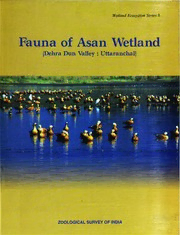
Fauna of Asan Wetland
(Debra Dun Valley: Uttaranchal)
Edited by the Director, Zoological Survey of India, Kolkata
ZOOLOGICAL SURVEY OF INDIA
KOLKATA
CITATION
Editor- Director, 2003. Fauna ofA san Wetland, Wetland Ecosystem Series, 5 : 1-56
Published: June, 2003
ISBN-81-8171-003-7
Project Coordinators
P.C. TAK AND J.P. SATI
Zoological Survey of India, Northern Regional Station, Dehra Dun
© Government of India, 2003
ALL RIGHTS RESERVED
• No part of this publication may be reproduced, stored in a retrieval system or
transmitted in any form or by any means, electronic, mechanical, photocopying,
recording or otherwise without the prior permission of the publisher.
• This book is sold subject to the condition that it shall not, by way of trade, be
lent, resold hired out or otherwise disposed of without the publisher's consent,
in any form of binding or cover other than that in which it is published.
• The correct price of this publication is the price printed on this page. Any revised
price indicated by a rubber stamp or by a sticker or by any other means is
incorrect and should be unacceptable.
PRICE
Indian Rs. 400.00
Foreign : $25 £ 20
Published at the Publication Division by the Director, Zoological Survey of India, 234/4, AJe Bose
Road, 2nd MSO Building (13th Floor), Nizam Palace, Kolkata-700020 and printed at Shiva Offset
Press, Dehra Dun.
Fauna of Asan Wetland
Wetland Ecosystem Series
No.5 2003 1-56
CONTENTS
Acknowledgements
INTRODUCTION 1-5
P.C. Tak and J.P. Sati
FAUNA
Invertebrata
Annelida 7-10
K.R. Halder and C.K. Mondal
Odonata 11-13
Arun Kumar and Gaurav Sharma
Coleoptera (Aquatic beetles) 15-17
P. Mukhopadhyay and S.K. Ghosh
Mollusca (Freshwater) 19-22
S. C Mitra, A. Dey and Ramakrishna
Vertebrata
Pisces 23-26
Akhlaq Husain
Amphibia 27-28
Akhlaq Husain
Reptilia 29-30
Akhlaq Husain
Aves 31-38
P.C. Tak and J.P. Sati
Mammalia 39-42
J.P. Sati and N.K. Sinha
Species Richness and Seasonal Population Change in Waterfowls 43-52
P. C. Tak, J.P. Sati and Arun Kumar
Assessment and Monitoring of a Migratory Waterfowl 53-56
Habitat Using Remote Sensing Techniques
Arun Kumar
ACKNOWLEDGEMENTS
The coordinators are deeply indebted to Dr. J. R.B. Alfred, Director, Zoological Survey of India,
Kolkata, for permitting the scientists to undertake the present studies and for his valuable guidance,
support and direction throughout the project.
We are further thankful to Dr. Arun Kumar, Additional Director & Officer-in-Charge, Northern
Regional Station, Zoological Survey of India, Dehra Dun, for reposing his faith in our capability and
assigning us the responsibility of coordinating the project and submission of the docunlent within allotted
time-frame. Beyond doubt, the difficult task would not have been possible without his active support,
supervision, foresightedness and long term-planning
We shall be failing in our duties if we do not acknowledge the authorities of Uttaranchal Irrigation
Department, Uttaranchal Forest Department, Authorities of Asan Barrage and Garhwal MandaI Vikas
Nigam (GMVN), Dehra Dun for extending various facilities and unflinching support to scientists in the
field surveys.
Our sincere thanks are also due to the survey parties in having surveyed the reservoir area
throughly during various season and comming out with fruitful results.
Thanks are also due to the scientists of the Northern Regional Station, Dehra Dun for minutely
studying the nlaterial, consulting literature critically and submitting their reports in the desired format
efficiently.
We should not let the apportunity go without having acknowledged the help of our various colleagues
in the technical and administrtive section at Northern Regional Station. Our special thanks are also due
to our two staff car drivers, namely Shri Nag Cha~d and Shri Sidhartha Mondal for their all times
preparedness during the surveys.
Zoological Survey of India
Northern Regional Station P.C. Tak
218, Kaulagarh Road J.P. Sati
Dehra Dun 248 195 UTT ARANCHAL Project Coordillators
Zool. Surv. India
Fauna of Asan Wetland, Wetland Ecosystem Series 5 : 1-5, 2003
FAUNA OF ASAN WETLAND: AN OVERVIEW
P.C. TAK, J.P. SATI AND ARUN KUMAR
Zoological Survey of India, Northern Regional Station, Dehra Dun
INTRODUCTION recently (Alfred and Nandi, 2001) includes 34
groups of animal kingdom, comprising nearly 17,853
Wetlands occur extensively throughout the species.
world in all climatic zones and are estimated to
It is only in the last few decades that the role
cover about 06% of earth's surface They include
& value of wetlands are recognised as they
a wide variety of habitats, which exhibit major
support a wide range of functions that are essential
differences in their characteristics and have
for plant, animal & human life for maintaining
supported the mankind since historical time. They
quality of environment. They can also work as
provide us a variety of resources such as food,
ground water chargers, as t11ters for sediments
fodder, fiber, fuel etc. One of the wetland plant,
& pollutants, and as breeding and/or nursery
the rice was domesticated and is today the staple
grounds for aquatic fauna in general and for
food of more than half of world's
waterfowl in particular (Tak et al., 1997).
human population (Gopal, 1995). These
waterbodies are of immense use to mankind both From the faunal resources point of view, the
economically and ecologically. They are unique interest on Indian wetlands is quite recent and in
habitats that sustain substantial biodiversity. A large, fact very little information is available (Biswas,
number of animal and plant species are restricted 1974; Gopal, 1982; Trisal and Zutshi, 1985;
only to wetlands, their survival depending totally Fernandes, 1987; Ghosh, 1989; Balakrishnan Nair,
on the existence of these habitats. If managed 1989; Anonymous, 1989; Ramakrishna, 1990).
with appropriate conservation measures, coupled
with generation of sufficient public awareness, This infonnation is too inadequate to understand
the wetlands can become productive and useful their ecological significance; socio-economic
ecosystems. relation and conservation values. Realizing the
importance of wetlands in the ecology of any area
the Zoological Survey of India carried out an
HISTORICAL RESUME
inventorisation of the faunal resources of Asan
reservoir and its environs.
The directory of wetland prepared by Ministry
of Environment and Forests, Govt. of India
PHYSIOGRAPHY
(MOEF, 1990) reveals 2,175 natural and 65,254
artificial wetlands in the country, located in
Location : The Asan reservoir is a man
different geographical regions.
made wetland of ca 3.2 sq. Ian area, located 40
The species richness in wetlands varies Ian west of Debra Dun (Uttaranchal), on Debra
depending upon the period of flooding (hydrology) Dun-Paonta road. Geographically, it is situated
and transporation of chemicals in the systems. between latitude 30024' -300 28' N and longitude
Diversity in Indian wetlands as estimated 77040' -77044' E, near confluence of the rivers
2 Wetland Ecosystem Series 5, Fauna ofA san Wetland
Asan and Yamuna. The barrage is 287.5 m long with distinct summer and winter months. Temp.
and the river bed is 389.4 m above sea level, with summer, max. 38°C, min. 14°C; winter, max. 21°C,
minimum and maximum water levels at 402.4 m min. 2°C; average rainfall 250 cm; sw monsoon
and 403.3 m asl respectively. during June to September.
Profile: The Asan reservoir exists throughout Vegetation : The aqatic vegetation of the
the year and is fed by the river Asan and the reservoir consists of Eichhornia crassipes,
discharge channel of Yamuna through Dhalipur Photamogeton pectinatus, Typha elepantina,
Power House (Maps 1, 2 & 3). Although the and Ceratophyllum demersum. The surrounding
water lavel is controlled, it often goes down, and bushes include Xanthium strumarium, Eclipta
swampy islands in the middle become visible, prostrata, Ipomoea Jistulosa, Cyperus spp.,
attracting a variety of marsh-loving birds like Ocimum sanctum, Euphorbia sp., Mimosa
egrets, herons, lapwings, etc. pudica, Achyrantus aspera, Polygonum
glabrum, P. lanigerum, Aeschyonomene sp.,
The different hydrological parameters
Ageratum conyzoides, Phyllanthus sp.,
recorded during the study period are summarized
Monochoria hastata, Mosla dianthera and
(Table 1) below.
Lantana camara. On the southeren side, the
reservoir is sorrounded by agricultural fields.
Biogeographic province : Indian wetlands
Further south there is mixed forest in Siwaliks
have been biogeographic ally categorized by
comprising principally Shorea robusta,
Hussain & De Roy (1993). They include Asan
Anogeissus latifolia, Lannea coromandelica,
wetland in the biogeographic province 4.8.4 (Indo
Dalbergia sissoo, and Bombax ceiba.
gangetic monsoon forest).
MATERIAL AND METHODS
Wetland type : Asan wetland belongs to Type
17 (water-storage reservoirs, dams) (Hussain &
De Roy, 1993). Field observations and collection were made
from the reservoir and its environs during the years
Climate : North Indian monsoon climate 1994-97. A total of 31 intensive and 5 extensive
Table 1
Months Water Temp. Transparency DO Free CO pH
2
(00 C) (cm) (mg/lit) (mg/lit)
May 25.0 31.0 11.7 2.8 8.5
June 26.0 35.5 11.9 3.8 9.0
July 25.8 36.5 12.0 3.9 9.0
August 25.5 36.0 11.1 4.0 9.0
September 23.0 38.0 10.8 3.8 8.0
October 24.0 35.0 10.9 3.3 8.0
November 20.5 34.5 10.2 3.7 8.0
December 11.5 35.0 09.5 3.9 8.0
January 09.0 36.0 08.2 3.9 7.0
February 12.1 38.0 09.9 4.l 8.0
March 18.2 35.0 11.9 4.0 8.0
April 22.0 33.0 11.2 3.8 9.0
Source: Amit Mitra, 1999
T AK et al. : An Overview 3
surveys 'were conducted in the area. Data on some mm Qestar). A 2x converter was also used as
environmental and hydrological parameters and when required.
(vegetation, temperature, pH, dissolved oxygen
etc.) were noted. FAUNAL ANALYSIS
Collections were made by using nets (insect
Wetland fauna are herein considered those
net, water net, cast net, drag net etc.) as well as
animals residing permanently or temporarily in and
by hand picking. Both dry and wet specimens
around the wetlands or aquatic ecosystems for
were preserved in the appropriate laboratory
food, shelter and/or roosting. Most of them are
reagents such as 4% Formalin' and Rectified
aquatic and live in water, while some others live
Spirit. Identification of such specimens were carried
on land or trees or both, and depend on the
out at the respecitive laboratories of the Zoological
wetlands for fishes and other aquatic organisms
Survey of India.
as their food. Still some others are associated
Observations on vertebrates, viz., mammals, with wetlands as marsh dwellers, reed dwellers
birds and reptiles were made with the aid of living/staying on marshes, on ground or vegetation.
prismatic field binoculars(7x35, 10x50 and All these three categories of wetland fauna viz.
20x60). Information on animals using the wetland (i) aquatic, (ii) wetland dependent and (iii) wetland
and its environ were gathered through observations associated are included to have a complete and
as well as local inquires. Field data thus collected precise picture of the faunal composition in
were recorded in the data sheets and were later wetland scenario (Nandi et al., 1993).
analyzed at leisure.
The fauna of Asan wetland exhibit a
A photographic record of the above activities considerable diversity comprising nine groups of
was maintained throughout the study with the aid invertebrates and vertebrates. A total of 238
of sIr canleras of Ashai Pentax, Canon and Nikon species belonging to 159 genera and 71 families
make, having normal (50mm), wide angle (28mm) have so far been recorded from the wetland (Table
and telelens (80-230 mm zoom, 300, 500 and 1000 2).
Table 2. Faunal diversity of Asan wetland
SI. No Group Families Genera Species
Invertebrata
1. Odonata 7 29 43
2. Coleoptera 3 6 9
3. Annelida 3 8 12
4. Mollusca 8 10 14
21 53 78
Vertebrata
5. Pisces 10 25 40
6. Amphibia 3 3 4
7. Reptilia 1 1 1
8. Aves 19 59 95
9. Mammalia 17 18 20
50 106 160
Total: 71 159 238
Wetland Ecosystem Series 5, Fauna ofA san Wetland
4
Of the 238 species (78 invertebrates and 160 freshwater wetlands in converting plant food into
vertebrates) belonging to nine animal groups, the animal protein of insectivorous animals in the
invertebrate faunal groups comprise Odonata (43 ecosystem.They also playa significant role as
species), Coleoptera (aquatic) (9), Annelida (12) consumers of organic wastes in the freshwater
and Mollusca (fresh water-14), while the habitats and even serve as a source of natural
vertebrates include Mammals (20 species), birds food for fishes. But they are known to compete
(95), Reptilia (1), Amphibia (4) and Pisces (40). for food with the fingerlings sharing the same
Among invertebrates insects show maximum habitat and often cause much damage to
diversity having 52 species (Odonata 43 species hatchery. Therefore, they are considered crucial
and Coleoptera 09), followed by Mollusca (14 in ecology and management of wetland
species) and Annelida (9 species). ecosystems. Though they are a diversified
group co~prising about eleven orders which are
The insects constitute one of the major faunal
known to spend at least part of their life cycle in
component of wetland ecosystems. They playa
water, only water bugs and water beetles inhabit
very vital role in the trophic structure of
the water.
REFERENCES
Alfred, 1.R.B. and Nandi, N.C 2001. Wetland: Freshwater. In Ecosystems of India. ENVIS Zool.
Surv. India: 165-193.
Anonymous, 1989. Conservation of Wetland Ecosystem. Ministry of Environment and Forests, New Delhi.
Balakrishnan Nair, N. 1989. Wetlands of India: Need for coservation and management. Proc. Indo
US, Workshop on Wetland, Mangroves and Reserves New Delhi, pp. 16-29.
Biswas, B. 1974. Conservation of wetlands and waterfowl: India. Proc. International Confernce of
Conservation of Wetlands and Waterfowl. Heiligenhafen Federal Republic of Germany, 2-
6, December, 1974, pp. 108-109.
Fernandes, 1. (ed.), 1987. Wetlands, status and management in India : an overview. Pp.I-81,
Environmental Services Group, New Delhi.
Ghosh, A. K. 1989. Wetland ecosystem in India: an overview. Management of Aquatic Ecosystems,
pp. 141-153.
Gopal, B. 1982. Ecology and management of freshwater wetlands in India. SCOPE, vol. 1 : 27-162.
Gopal, B. (compiler) 1995. Handbook of Wetland Management, WWF- India, New Delhi, India.
Government of India. 1990. Wetlands of India-A Directory. Ministry of Environment and Forests,
New Delhi.
Hussain, S.A. and De Roy, Rashmi 1993. Directory of Indian Wetlands. xxvi +263 pp. WWF- India,
New Delhi and A WB, Kuala Lumpur.
Mitra, A. 1999. Studies on the behavioural pattern and seasonal ecology of some species of Dragonflies
(Odonata : Insecta) in Asan reservoir (Debra Dun: India). Ph. D. Thesis submitted to the
H.N.B. Garhwal University, Srinagar (Garhwal) 1999.
Nandi, N.C., Das, S.R., Bhuinya, S. and Dasgupta, 1.M. 1993. Wetland Faunal Resources of West
Bengal. I. North and South 24- Parganas Districts. Rec. z~ol. Surv. India, Occasional Paper
No. 150 pp. 1-50.
TAl( et af. : An Overview 5
Ramakrishna, 1990. Species diversity and management in wetland ecosystems. In Taxonomy in
Environment and Biology, Zoological Survey of India, Calcutta, pp. 243-255.
Tak, P.C., Sati, J.P. and Kumar, A. 1997. Waterfowl potential of Asan reservoir (Dehra Dun Valley),
India. Zoology, 5(2): 111-132.
Trisal, C.L. and Zutshi, D.P. 1985. Ecology and Management of Wetland Ecosystem in India. MAB.
Department of Environment, Government of India, pp. 1-27.