Table Of ContentETC/ICM Technical Report – 2/2016 1
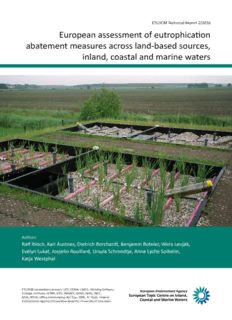
Cover photo: Biological sewage treatment plant (Pflanzenkläranlage) Langenreichenbach, Germany,
May 2001
© photo: Norma Neuheiser, Helmholtz Centre for Environmental Research GmbH – UFZ
Layout/editing: Miluše Rollerová
Legal notice:
The contents of this European Topic Centre on Inland, Coastal and Marine Waters (ETC/ICM) Technical
Report do not necessarily reflect the official opinions of the EEA, European Commission or other
institutions of the European Communities. Neither the ETC/ICM nor any person or company acting on
behalf of the ETC/ICM is responsible for the use that may be made of the information contained in this
report. This report provides an overview on the range of successful eutrophication abatement strategies
and remaining implementation gaps but does not aim to present the most recent technological
developments.
Copyright notice:
© ETC/ICM, UFZ, 2016
Reproduction is authorized, provided the source is acknowledged, save where otherwise stated.
Information about the European Topic Centre on Inland, Coastal and Marine Waters is available on the
internet at: water.eionet.europa.eu.
ISBN 978-3-944280-55-4
Author affiliation:
Ralf Ibisch, Katja Westphal, Dietrich Borchardt – Helmholtz Centre for Environmental Research GmbH –
UFZ, Germany
Josselin Rouillard, Evelyn Lukat, Benjamin Boteler – Ecologic Institute, Germany
Anne Lyche Solheim, Kari Austnes – Norwegian Institute for water research (NIVA), Norway
Wera Leujak, Ursula Schmedtje – Umweltbundesamt (UBA), Germany
EEA Project Manager:
Peter Kristensen, European Environment Agency, Denmark
Editor:
Anita Künitzer – Helmholtz Centre for Environmental Research GmbH – UFZ, Germany
Corrigendum in March 2017:
Figure 3.4 has been exchanged with a corrected version and the reference replaced.
Page 27: Ireland has been deleted from a sentence.
Page 70: A citation of Riemann et al., 2016 has been added.
European Topic Centre on Inland, Coastal and Marine Waters
Helmholtz Centre for Environmental Research GmbH – UFZ
Brückstr. 3a
39114 Magdeburg
Germany
Web: water.eionet.europa.eu
ETC/ICM Technical Report – 2/2016 1
Glossary
BQE Biological Quality Element
CAP Common Agricultural Policy
CIS Common Implementation Strategy
EAP European Environmental Action Programme
EU European Union
HELCOM Helsinki Convention on the Protection of the Marine Environment of the Baltic
Sea Area
LRTAP Long-range Transboundary Air Pollution
MSFD Marine Strategy Framework Directive
N Nitrogen
NAP Nitrate Action Programme
ND Nitrates Directives
NVZ Nitrate Vulnerable Zone
OSPAR Convention for the Protection of the Marine Environment of the North-East
Atlantic
P Phosphorous
p.e. Population Equivalent
RBMP River Basin Management Plan
UWWTD Urban Waste Water Treatment Directive
WFD Water Framework Directive
WWTP Wastewater treatment plant
ETC/ICM Technical Report – 2/2016 2
Contents
1 INTRODUCTION ..................................................................................................................................... 7
1.1 Eutrophication – still a problem in Europe´s waters.................................................................... 7
1.2 Eutrophication and sources of nutrient pollution ....................................................................... 7
1.3 Motivation for this report ............................................................................................................ 9
2 EUROPEAN POLICIES AND OTHER LEGISLATIVE FRAMEWORKS ......................................................... 11
2.1 An overview of European policies for eutrophication abatement ............................................ 11
2.2 Key features of European policies for eutrophication abatement ............................................ 15
2.3 National policies for eutrophication abatement ....................................................................... 17
3 OBJECTIVES AND TARGETS FOR EUTROPHICATION ABATEMENT ....................................................... 18
3.1 Characterising objectives and targets for eutrophication abatement ...................................... 18
3.1.1 The process of setting objectives and their importance for policy implementation ............ 18
3.1.2 Setting eutrophication targets in-line with the WFD good ecological status objective ........ 19
3.2 Setting nutrient standards as targets for eutrophication abatement ....................................... 19
3.2.1 Nutrient standards in rivers and lakes ................................................................................... 19
3.2.2 Nutrient standards in coastal and marine waters ................................................................. 21
3.2.3 Aligning nutrient boundaries for freshwater and saline waters ........................................... 23
3.3 Use of quantitative nutrient load reduction targets .................................................................. 24
3.3.1 Nutrient load reduction targets in rivers and lakes ............................................................... 24
3.3.2 Nutrient load reduction targets in coastal and marine waters ............................................. 26
4 INDICATORS TO MEASURE CHANGE IN STATE AND PRESSURES ......................................................... 31
4.1 Indicators as management tools ................................................................................................ 31
4.2 Pressure indicators ..................................................................................................................... 32
4.3 State indicators .......................................................................................................................... 32
4.4 Impact indicators ....................................................................................................................... 33
5 MEASURES AND MANAGEMENT PLANNING TO REDUCE NUTRIENT INPUT ...................................... 36
5.1 Establishment of Programmes of Measures – from quantitative targets to measures ............ 36
ETC/ICM Technical Report – 2/2016 3
5.2 Nutrient reduction measures in European policies ................................................................... 38
5.3 Measures to reduce nutrient input form point sources ............................................................ 39
5.4 Measures to reduce nutrient input from diffuse sources .......................................................... 43
5.5 Measures to reduce internal nutrient inputs and enhance self-purification ............................ 46
5.6 Supplementary instruments ...................................................................................................... 48
5.7 Success of eutrophication abatement measures and policies ................................................... 49
5.7.1 Abatement of phosphorus pollution ..................................................................................... 49
5.7.2 Abatement of nitrate pollution ............................................................................................. 50
5.7.3 Common Agricultural Policy (CAP) ........................................................................................ 52
6 LESSONS LEARNT AND FUTURE CHALLENGES IN EUTROPHICATION ABATEMENT ............................. 54
6.1 Lessons learnt from case studies ............................................................................................... 54
6.2 Implementation gaps and future perspectives .......................................................................... 56
ANNEX 1 CASE STUDIES ON EUTROPHICATION ABATEMENT IN EUROPE ............................................ 69
ETC/ICM Technical Report – 2/2016 4
Executive Summary
Rivers, lakes and groundwater as well as coastal and marine waters have suffered from nutrient pollution
already since the 1950s. Excessive nutrient releases from agricultural and urban areas contribute to
water quality degradation in many parts of Europe. Eutrophication is the result of excessive nutrient
enrichment, which may cause accelerated growth of algae and plants and a wide range of impacts on
aquatic ecosystems such as the loss of aquatic biodiversity and proliferation of toxic algal blooms.
European policy has consistently identified eutrophication as a priority issue for water protection, in
particular through the Urban Wastewater (UWWTD) and the Nitrates Directives (NiD), as well as the
more recent Water Framework Directive (WFD) adopted in 2000, and the Marine Strategy Framework
Directive (MSFD) adopted in 2008. In addition to EU legislation, there are a number of international
conventions on river basin management e.g. for the protection of the River Rhine (ICPR) or the Danube
River (ICPDR) as well as conventions for the protection of the marine environment, e.g. for the North-
East Atlantic (OSPAR), the Baltic Sea Area (HELCOM), the Black Sea (Bucharest Convention) and the
Mediterranean Sea (Barcelona Convention). These conventions are complemented by the UNECE
Convention on Long-range Transboundary Air Pollution (LRTAP) and the EU Directive on national
emission ceilings for atmospheric pollutants. All of these conventions aim at controlling pollution from
land-based sources, air pollution and for the marine areas also for controlling pollution from maritime
transport. These international frameworks are supplemented by national legislation.
The general objectives of European and national policies, such as good ecological status under the WFD
or the good environmental status under the MSFD, need to be broken down to more specific objectives
and quantitative targets to guide eutrophication abatement. This includes the setting of nutrient load
reduction targets, such as the 50 % reduction target that was set by the countries cooperating under
OSPAR for the Greater North Sea region. Nutrient concentration targets, also termed nutrient standards
are important management tools, when linked to direct and indirect ecological impacts of
eutrophication, such as algal blooms and oxygen depletion. In water bodies currently exceeding the
nutrient standards, these must be translated into targets for nutrient load reductions. Nutrient load
reduction targets, using the desired state of the water body as the aim, are more ecologically sound than
targets set with respect to some reference year. This is the basis for the movement away from
aspirational targets to more ecologically based targets seen in e.g. the HELCOM, OSPAR and major river
conventions.
Indicators are a widely used instrument for monitoring the eutrophication status and to document the
progress of policy implementation over time. Eutrophication indicators comprise pressure indicators
(nutrient emissions and loads), state indicators (nutrient concentrations in the water) and impact
indicators describing the health of aquatic ecosystems (such as biological indicators, oxygen and
chlorophyll-a concentration, or Secchi depth).
A targeted program of measures to reduce nutrient pollution pressures can be established once the most
significant pressures in relation to eutrophication have been identified. The program of measures is the
central element of an integrated water resources management plan that ideally fulfils the requirements
of different water related policies like WFD, UWWTD, NiD and national legislation. The program of
measures has to be cost-effective and consulted with stakeholders to become operational. This report
provides an overview of measures to reduce nutrient pollution from point and diffuse sources.
In order to exemplify different eutrophication abatement strategies eight case study regions (territory of
Member States or river basins) were selected for a detailed analysis: Denmark, Finland, the Po river
basin, the Ebro river basin, the Rhine river basin, Lake Constance, the Danube river basin and the Baltic
Sea. Eutrophication was a significant problem in these regions and they illustrate how the responsible
authorities approached the pollution problem, and how they developed and implemented
ETC/ICM Technical Report – 2/2016 5
eutrophication control programmes. The case study regions cover i) different European regions, ii) lakes,
rivers, coastal and marine waters, iii) national and transboundary settings, and iv) examples of
interlinkages between freshwater and coastal / marine water management.
The case studies are analysed in view of different aspects such as governance issues (cooperation
between sectors and the role of river basin commissions), the role of research, stakeholder participation,
choice of measures and funding instruments (e.g. voluntary versus mandatory measures) and time lag
effects of measures taken. The report demonstrates the lessons learnt from the case studies and
concludes with an analysis of progress achieved and remaining implementation gaps.
Overall, the implementation of European and national policies over the past decades has greatly reduced
the levels of nutrients in Europe´s waters. Nevertheless, eutrophication is still considered as a major
threat to significant parts of Europe’s waters. Strong and coordinated actions are needed in the future to
combat the eutrophication problem in order to reach the ambitious goals of WFD and MSFD. This
includes better cross-sectoral integration of water policies, stronger enforcement, burden sharing
between sectors, innovative instruments, and alternative concepts such as payment for ecosystem
services.
ETC/ICM Technical Report – 2/2016 6
1 Introduction
1.1 Eutrophication – still a problem in Europe´s waters
Eutrophication is a major problem in Europe´s waters despite substantial management efforts in the last
decades (EEA, 2012; EEA, 2015a). The concentrations of nutrients in many European waters are still
excessively high which promotes eutrophication in surface waters with a series of negative impacts and
consequences. Starting with an increasing anthropogenic nutrient input in the 1950s and 1960s, partly
caused by the application of phosphate-containing detergents, the resulting unnaturally high loads led in
many waters to eutrophication, associated with a significant increase of high nutrient concentrations.
Eutrophication and associated negative symptoms were recognized in the 1970s as a socially relevant
problem and first policies tackling nutrient pollution were adopted. The following examples highlight that
important European lake, sea and river basins are affected by eutrophication:
Eutrophication of European lakes began in the 1960s as a result of population and industrial
growth. In many cases, water quality deteriorated to a critical level within only one decade with
frequently occurring massive algal blooms and depleted oxygen levels. This was in many cases
the primer for the development of policies and implementation of measures. Yet in 2009, around
20% of European lakes suffered from nutrient enrichment (EEA, 2012).
First signs of eutrophication in the Baltic Sea were visible already in the 1950s and the ecosystem
changed from an oligotrophic clear-water sea into a highly eutrophic marine environment with
wide-spread algal blooms (Andersen et al., 2014). In the North Sea, eutrophication effects
peaked in the 1970s and continue to be a significant problem in the coastal areas, enclosed
estuaries and embayments (OSPAR, 2010).
The Mediterranean which is generally regarded as a highly oligotrophic sea receives excessive
loads of nutrients from sewage effluents, riverine inputs, aquaculture farms, fertilizers and
industrial facilities especially in the northern parts of the basin leading to intense eutrophic
phenomena in the coastal zones with many adverse effects for the marine ecosystem and
humans (UNEP, 2007; Kyradis and Kitsiou, 2012). Similar concerns exist for the Black Sea
environment which has been severely damaged by eutrophication since the 1970s (UNDP-GEF,
1999).
Large and important European river basins such as the River Rhine, River Elbe, Po River or River
Danube were affected by excessive nutrient input resulting in eutrophication symptoms
especially during the 1970s and 1980s (Wilken, 2006; Hardenbicker et al., 2014; Pirrone et al.,
2005; UNDP-GEF, 2006). Despite major improvements, nutrient pollution continues to be a
significant pressure to the aquatic ecosystem.
Additionally, high concentrations of nitrates are a widespread phenomenon in Europe´s
groundwater resources showing that diffuse pollution, particularly from agriculture, continues to
be a problem (EEA, 2012). High nitrate concentrations in groundwater impair the use of the
resource for human consumption and were therefore not in the centre of this report.
1.2 Eutrophication and sources of nutrient pollution
Eutrophication is the result of excessive nutrient enrichment of water resources and this may cause
accelerated growth of algae and higher forms of plants resulting in a wide range of impacts on aquatic
ecosystems (Carpenter et al., 1998; Smith, 2003; Smith et al., 2006; Schindler, 2006; Dodds, 2007; Dupas
et al., 2015). This includes the loss of aquatic biodiversity, toxic algal blooms and dead zones. High
phytoplankton concentration leads to reduced water transparency and once algae are dying the
degradation of biomass causes oxygen depletion in deeper zones of lake and seas. In addition, an
increase of dissolved organic carbon and bacteria concentrations lead to poor water quality associated
ETC/ICM Technical Report – 2/2016 7
with odour and taste disturbances. Eutrophic water bodies are therefore only limited useable for local
recreation, and drinking water purification gets more cost intensive. The final stage of eutrophication is a
hypertrophic water body, with depleted oxygen content causing the death of fish and other organisms.
To understand the nutrient enrichment problem, it is important to understand where the pollution
originates and through which pathways nutrients are transported to aquatic ecosystems (Figure 1.1).
Nutrients can enter water bodies through different pathways, arising from point and diffuse sources.
Point sources have a distinct point of discharge such as inflows of urban wastewater, industry and fish
farms. In contrast to this, diffuse source do not have a distinct point of discharge, such as nutrient losses
from agriculture, nutrient releases from scattered dwellings and atmospheric deposition on surface
waters. The actual contribution of different sources to the total amount of nutrients entering waters is
done during source apportionment studies (EEA, 2005).
Figure 1.1: Nitrogen cycle in the aquatic environment, where all relevant sources and pathways are
shown. The phosphorous cycle shows similar sources and pathways, though phosphorus is not emitted
to the air, which is why anthropogenic deposition is of no importance.
Source: Ærtebjerg et al., 2003.
Agriculture is the most important sector for nitrogen releases to aquatic systems and contributes
typically 50-80 % to the total load (Table 1.1; EEA, 2005). Modern agricultural practices very often involve
an intense use of mineral fertilisers and manure, leading to high nutrient surpluses that are released to
aquatic ecosystems. The more intensive agricultural areas are managed the higher is the total area-
specific load. The hot-spot areas in Europe with the highest N-fertilizer applications are the agricultural
areas in the Western parts of Europe (Bouraoui et al., 2009; EEA, 2012).
Households and industry are the most significant source for phosphorus inputs to aquatic systems. While
urban wastewater sources constitute about 50-90% of the point source discharges (Table 1.1), industrial
sources constitute about 17% (EEA, 2005). However, due to improved wastewater treatment of
municipal and industrial wastewater, the amount of discharged pollutants has decreased significantly
since the 1970s. Both, treatment technologies and the number of inhabitants connected to sewer and
wastewater treatment systems have increased markedly. As these point source discharges have been
reduced during the last previous years, agriculture becomes in some regions the most important
phosphorus source (EEA, 2005). Here, soil erosion and diffuse emissions of phosphorus bound to soil
particles becomes the most important pathway.
ETC/ICM Technical Report – 2/2016 8
Description:ANNEX 1 CASE STUDIES ON EUTROPHICATION ABATEMENT IN EUROPE .. What qualitative objectives and quantitative targets have been set in