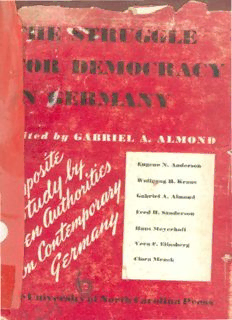
Table Of ContentEugene N. Anderson
\\·olfgt ug B. Kraus
\
Gabriel A. Almond
Fred D. Sumlerson
Hans 1Ueyerhoff
Vera 1''. Eliusberg
Cluru lU.-nek
Jft. S COMMUNIST expansionism pro
..t\1.
gressively menaces a peaceful Euro
pean settlement, concerned people. are look
ing at Germany as ,the.last dike against the
Red flood. The authors of this book assert
that in spite ·of th~ Soviet-Western ~ension,
the first duty of the Am~ican ~cc_,\1pation
is still to make Germany into a~ working.
democracy. But this objective must be won
against two threats: the first, historic Ger
man authoritarianism and nationalism; and
the second, Communist infiltration and
Soviet expansionism.
The Struggle for Democracy in Germany
emphasizes the twofold natur~ 'of the occu
pation problem-the reconstruction of Ger
man ideology and the rebuilding of sound
institutional routines of living. Part I is con
cerned with the uphill struggle of liberalism
against traditional Junker authoritarianism,
as exemplified in the Bismarck era, and the.
fate of liberal tendencies under Nazi repres
sion and terror. This includes a graphic ac
count of the anti-Nazi underground before
and during the war, culminating in the July
20, I 944 attempt on Hitler's life.
Part U • discusses the most significant
phases of' occupation policy=-economic,
governmental, ·political, cultural, and psy
chological-and their impact on the future ·
of Germany and its political potential. This
involves problems . ranging· from the im
provement of the housing situation and em
ployment conditions to the execution of a
program for denazification. These problems
are placed in the context of the East-West
struggle.
Each of the seven contributors. to this
volume is a specialist in the particular aspect
of the German problem for which he as
sumed responsibility.
THE STRUGGLE FOR DEMOCRACY
IN GERMANY
THE STRUGGLE
FOR
DEMO~RA~Y
IN GERMANY
Edited by
GABRIEL A. ALMOND
Eugene N. Anderson \\'o lfgang D. Kraus
Gabriel A. Almond Fred D. Sanderson
Dans Meyerhoff Vera F. EUasberg
Clara lUenck
1949
The University of North Carolina Press
CHAPEL DILL
Copyright, 1!}4!}, by
THE UNIVERSITY OF NORTH CAROLINA PRESS
Manufactured in the United States of America
by
THE WILLIAM BYRD PREss, INCORPORATED
RICHMOND, VIRGINIA
Preface
JN THE FIRST MONTHS after the defeat of Germany it appeared, at
least on the surface, that the primary criterion for the solution of
the German question was the elimination of Germany's physical and
psychological capacity to make war. This was the spirit of the
Potsdam Agreement, concluded in the flush of victory, and in the
mood of Allied amity which followed. Western opinion has ex
perienced a profound disillusionment ~ the three years which have
followed this era of sanguine expectations. Each phase of the peace
settlement and each step in the program of bringing international
politics within the framework of effective law and organization has
been assimilated to the over-all struggle between East and West.
The collapse of the Conference of Foreign Ministers at London in
November, 1947 put an end to hopes that a peaceful and stable
German settlement could be reached in the present state of inter
national relations. Subsequent developments indicate that the divi
sion of Germany has become a practical if not a juridical reality.
The solution to the German question contemplated in the Pots
dam accords and earlier agreements, rested on the expectation of
a stable "concen of power'' in the postwar period. It was assumed
that the German problem could be settled largely in its own terms
that of destroying once and for all Germany's capacity to make
war and laying the basis for a peaceful and democratic polity. Three
years after Potsdam finds us subordinating these problems to the
more urgent question of whether German power is to be included
in the So.viet orbit or integrated with the surviving democratic
strength of Western Europe.
This shift in emphasis in the German question confronts us with
a. very real danger. In the atmosphere of tension between the Soviet
Union and the Western powers there is an obvious temptation to
attempt to maximize anti-Soviet strength regardless of its character
and consequences.- Thus, a reactionary and nationalist Western
Germany would be more anti-Communist than a moderate demo-
v
Preface
VI
cratic one and might therefore seem more desirable from a security
point of view. But the development of such a Western Germany
would endanger the American interest in Europe in at least three
ways: (I) such a. Germany might be provocatively hostile to the
Soviet Union and might force the hand of American policy; ( 2) the
emergence of a new German nationalism would create disunity in
the Western camp by raising the spectre of German aggression and
expansionism; ( 3) a reactionary and nationalist Western Germany
would be opposed by a substantial proportion of the German popu
lation and consequently would be vulnerable to Communist infiltra
tion and Soviet propaganda.
These considerations suggest that the general change in the inter
national situation should not be permitted to suppress the original
aims of the German occupation. Our primary concern ought still
to be German "democratization." But it is necessary to face the
threat to democracy in Germany on two fronts: (I) the threat of
historic German authoritarianism and nationalism; ( 2) the threat
of Communist infiltration and Soviet expansionism.
To counteract this twofold threat the earlier primarily negative
approach to the German problem has had to give way to a positive
and constructive emphasis in which the key concept is "integra
tion." If the larger part of German strength is to be employed _in
the interest of the democratic and liberal world the postwar status
of Germany and Germans will have to be revised. Perhaps the main
objective of such a policy would be to give the Germans a sense
of participation in the values and programs of the Western com
munity of nations. The main problem of German politics is that
most of the Germans, and particularly the youth, are "hold-outs."
The present strength of the moderate Socialist and Christian parties
is largely a surface manifestation. To the historic political indif
ference of the German masses there has been added a widespread
mood of bitterness and futility, a mood which deprives the existing
party elites of any right to speak with full authority for Germany,
and which provides extremists and authoritarians of a right or left
coloration with the kind of spiritual vacuum which has always
facilitated their success.
Preface
Vll
The United States has a very real security interest in integrating
that part of Germany which we can influence into the Western
community of effort. This is not merely the economic question
of utilizing German resources, equipment, and manpower in the
European Recovery Program, although that is an important part of
it. American policy should add social, cultural, and psychological
reintegration, to its present economic emphasis.
Two objectives are suggested here: ( 1) the elimination of the
moral cordon sanitaire; and (z) the initiation of steps that will
hasten the processes of social integration. In connection with the
first objective, German representation in the various Western
European organizations will constitute a symbolic modification
of the pariah status to which postwar Germans have been con
demned. Equally important, a substantial program of cultural inter
change and exchange of personnel, might be undertaken on a
collaborative basis between the interested Western powers. Such
measures, if applied to university youth, and the emergent political,
intellectual, and cultural elites, may go far toward "sparking" the
regeneration of Western cultural and spiritual values in Germany.
The second objective requires a broad set of means, ranging all
the way from the improvement of the housing situation and employ
ment conditions in order to make a satisfactory family life possible,
to the rapid execution and termination of the program of denazifica
tion. These and similar measures, which will have the effect of
stabilizing and normalizing the institutional routines of living, may
give content to the present "formal'' democracy of Western Ger
many, and thereby give Western policy strong roots in a most
critical area.
The present book makes a contribution toward understanding
the twofold nature of the German problem. Part I is concerned with
the strength and composition of liberal and democratic tendencies
in German history and with the extent of their survival in the anti
Nazi resistance. This part of the book represents an effort to correct
the erroneous history of the war period which placed Germany
entirely outside the pale of Western historical and politico-moral
development. It is suggested here that this policy was based on an
Preface
VIU
exaggeration of historical trends, and that it is now the task of
policy-makers .to discover and strengthen that part of the German
heritage which inclines toward liberalism and democracy. Part II
discusses the most significant phases of occupation policy-eco
nomic, governmental, political, cultural, and psychological-and
their impact on the future of Germany. Each functional problem
is placed in the context of the East-West struggle, and the various
issues are evaluated in terms of their implications for the outcome.
A symposium always presents problems of consistency and
coherence. The participants in this symposium in most cases had
the advantage of having shared in common or related work during
the war years, and of having discussed their general approach with
one another as the project developed. While it is possible to speak,
therefore, of a common approach to the German problem as under
lying the various contributions, each writer has assumed respon
sibility only for his own section.
Those contributors now in government service wish to express
their gratitude to the State Department for its clearance of their
~ontributions. Needless to say, the opinions expressed are those of
the writers. The authors of the chapters on the German resistance
wish to record their appreciation to the many officials of the Amer
ican, British, and French military governments in Germany for the
courtesy and helpfulness shown them in their studies of the German
resistance. Special thanks are due Professor Waldemar Gurian of
Notre Dame University for his .~houghtful reading and criticism
of a part of the manuscript and Professor C. B. Robson of the
University of North Carolina to whose original suggestion this
book owes its inception and whose subsequent sponsorship brought
the project to fruition.
Contents
L TilE DISTOBIC POY.ENTIAL
Chapter Page
FREEDOM AND AUTHORITARIANISM IN
1
GERMAN HISTORY 3
EuGENE N. ANDERSON, Professor of History, University
of Nebraska
z RESISTANCE AND REPRESSION UNDER THE
NAZIS 33
WoLFGANG H. KRAus, George Washington University,
and GABRIEL A. ALMoND, Research Associate, Institute of
•
International Studies, Yale University
THE SOCIAL COMPOSITION OF THE GER-
3
MAN RESISTANCE .
GABRIEL A. ALMoND and WoLFGANG H. KRAus
D. OC(;IJPA TION POLICY
GERMANY'S ECONOMIC SITUATION AND
4
PROSPECTS . 111
FRED H. SANDERSON, Chief, Western European Economic
Branch, Division of Research for Europe, Department of
State
s
THE RECONSTRUCTION OF GOVERNMENT
AND ADMINISTRATION 185
HANs MEYERHOFF, University of California at Los Angeles
6 POLITICAL PARTY DEVELOPMENTS u1
VERA F. ELIASBERG, Research Director, American Associa-
tion for a Democratic Germany
7 THE PROBLEM OF REORIENTATION z81
CLARA MENCK, Die Neue Zeitung, U. ~ Zpne, Germany
NOTES
INDEX JH
Description:historic German authoritarianism and nationalism; ( 2) the threat of Communist The present book makes a contribution toward understanding ernment so firmly that nothing less than defeat in World War I dis- .. Cbap. 2 Resistance and Repres· sion Under the Nazis. WOLFGANG D. KRAUS and.