Table Of ContentThe Challenge of Designing Blended Courses: from Structured Design to Creative
Faculty Support!
Les beaux défis du design de cours hybrides : du design structuré à
l’accompagnement créatif !
Catherine Carré
Abstract
This case study deals with the implementation of an e-learning program in a business
school in Canada. Cabot Business School decided to offer the program in a blended
format so as to increase the flexibility of the program for clientele enrolled in the
undergraduate certificate program. A pilot was initiated in 2009 starting with four hybrid
courses. Now, three years later, 35 courses are being offered in blended mode by
lecturers and a handful of professors who, for the most part, had no previous experience
teaching online. Given the rapid development of this program, this case deals with how
the instructional designer, without the benefit of any additional resources, managed to
juggle both the development of the certificate program as well as parallel projects. The
issues encountered deal with the extent to which the instructional designer can support
faculty who are converting their courses from in-class to online, one of the main design
challenges encountered by faculty. This case describes training strategies and
implemented solutions provided by the instructional designer as well as the results
obtained, faculty perceptions, and food for thought on the possible evolution of the role
of the instructional designer.
Key words: Canada – certificate program – blended learning – alternate design model –
course conversion – training strategies – instructional designer workload
1
The institutional setting
The Cabot Business School, part of a large Canadian university, has enrollments of
12,000 students with about half these enrollments in an undergraduate certificate
program. The certificate program director has the mandate to develop the online
component. The idea of using a blended approach, which combines the advantages of on-
campus teaching and the flexibility of online learning, has been fully adopted. Blended
courses provide students with the kind of flexibility they need to juggle work, study and
family lives.
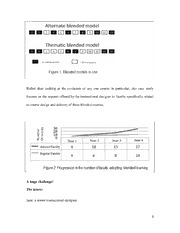
Within the blended approach, two different models have been implemented in the pilot
project, a thematic model and an alternate model (see figure 1). Starting with the
alternate model, an on-campus class is followed by an online class right up to the end of
the course. In the thematic model, blocks of two on-campus classes are followed by a
block of three online classes. A new virtual classroom system has been added to other
asynchronous technologies available at the university.
During the first year, the development of the blended courses was in full swing. The first
four blended courses included three courses in the field of management and one in the
field of logistics. Four faculty members were involved. In year two, six new faculty
members joined the project. In year three, eight new faculty members joined and in year
four, ten new faculty (see figure 2), mostly seasoned lecturers. Simultaneously, several
other projects linked to online learning were also underway in other faculties and schools.
2
Rather than looking at the evolution of any one course in particular, this case study
focuses on the support offered by the instructional designer to faculty specifically related
to course design and delivery of these blended courses.
A huge challenge!
The actors:
Jane: a senior instructional designer
3
Sandra: an instructional designer
Faculty: Year 1: Bernard, Julia, Natasha (adjuncts); Andrew (full time lecturer)
Faculty: Year 2: George, Vivian, Alexander, Adrian (lecturers); Eve, Lewis (full time
lecturer)
When Jane joined the instructional team in November, the first four blended courses were
already being offered as part of the pilot project. Jane, as a former senior designer for a
private instructional design company, had previously worked on a number of online
training projects including in-class training, virtual classroom training, multimedia
training, simulations, as well as electronic performance support systems. She was used to
developing training strategies, structured development methodologies, designing online
courses (both asynchronous and synchronous); she was also used to managing budgets,
human resources, working with a multidisciplinary team, as well as supporting clients
from virtually every field. She also had experience at the college and university levels,
specializing in distance education where project management was her forte. Now, in her
new position, she was discovering a new reality. Sandra, Jane’s colleague, was working
with her on this new pilot project, and brought her up to speed on how things worked at
Cabot Business School:
“For this blended courses pilot, we’re using regular tools for asynchronous
delivery: Zonecours, which is an online course syllabus tool, Jive, which is
a forum tool, QuestionMark, the tool for developing quizzes and Drupal for
our blog. We’re also using a new tool, VIA, which is a virtual classroom
solution. With VIA, faculty can make presentations online, interact with
their students, and use tools such as the microphone, chat, surveys, and
whiteboard. Since June, I’ve been in charge of training and supporting our
faculty members. For instance, Andrew has already offered distance courses
4
at another university. As for the others, it’s a totally new experience. Julia is
used to using technology, even Web 2.0 tools. In fact, I’ve mostly worked
with Bernard and Natasha to help them redesign their courses. And I’m also
helping Natasha get up to speed using the virtual classroom. In addition to
this, there are two other pilot projects which have been taking a lot of my
time. We are experimenting with a lecture capture tool called Tegrity, which
records in-class lectures for subsequent online viewing by the students. We
are also testing the delivery of optional help sessions in virtual classrooms.”
Sandra was a member of the committee in charge of the pilot project, monitoring various
pedagogical, organizational, and administrative aspects of online learning at the
university. She also had produced technical documentation on the tools being used, as
well as having designed and facilitated training sessions for students about how to use the
virtual classroom. Jane was really impressed with Sandra’s work! How could she have
done so much in so little time? “Well, to be honest, I’ve lost sleep over this as well as
quite a few weekends. I’m at the point where I’m not counting my hours anymore!”
Over the course of the following year, it had been decided that the blended courses
project would be expanded, especially given how well things had gone that year. At the
same time, another international online training project for a graduate program was
starting to gather steam. Yet another challenge on the horizon!
Meta-reflection: cultural shock
Jane was thinking to herself: “I think I’m experiencing cultural shock! I’m finding that
the kind of work I’m doing now is quite different from the kind of work I’ve previously
done in the private sector and in institutions that are solely involved in distance
education. I am used to developing courses with a multidisciplinary team, using a project
management approach and a structured process with deliverables and clearly established
outcomes.
In this university, it is like we are pioneers having to cut down entire forests when
implementing a blended approach; the course design has to be ultra-rapid, done within
5
one term, without a multimedia development team, without any resources, simply an
instructional designer working with a faculty member. I’ll just have to adapt or …maybe
I can propose a slightly different approach...”
Year one
Course Design
With regard to instructional design, each of the courses developed used a different
approach. Andrew opted for the alternate model. His sessions combined both
asynchronous and synchronous activities. His course was based on a case study approach;
the students, after completing the readings, had to solve the case by working in teams
within an online forum. The follow-up, virtual classroom session was devoted to
discussing the case studies. Students could ask questions in order to clarify their
understanding of content (Figure 3).
6
Bernard, on the other hand, opted for the thematic model and his virtual sessions took
place in asynchronous mode over a three-week period. His course content was broken up
into blocks and modules; students were expected to view the PowerPoint presentations
with an audio track at their leisure and then, to do an online quiz within a period of three
weeks (figure 4).
Julia and Natasha both opted for the alternate model with both synchronous and
asynchronous activities, with Julia also adopting Web 2.0 tools. Students used
collaborative tools such as Google Group and Google Docs (which became Google Drive
later) to work together, and then attended weekly virtual classes (figure 5). Finally,
Natasha posted weekly readings and case studies that she expected her students to do on
their own. Then she used a virtual classroom to deliver her course, returning to the case
studies for discussion. After the virtual class, students were expected to write a private
blog entry on which they would receive feedback (Figure 6).
7
An initial progress report
At the end of the fall term, Jane and Sandra decided to assess the online courses by
asking students to fill out a questionnaire that was designed specifically for each of the
blended courses. They also asked faculty members to complete a questionnaire. After
receiving student feedback, Jane met with each of the faculty members to discuss the
results and to assess whether, or how, to make adjustments to the blended courses. It was
Sandra’s first contact with Bernard and Andrew.
In Bernard’s course, over one third of the students said they felt isolated and they wanted
to have more contact with their peers. Jane suggested that Bernard add an optional
weekly synchronous virtual class to allow students to interact with one another. In
Andrew’s course, it was realized that case study discussions in the forums were not very
lively. Jane queried, “Would adding a few points for such activities motivate the students
to get involved?” As for Natasha’s course, students responded by saying that they felt a
little lost: there were many tools to use and there were many activities to do. Jane
suggested adding clearer guidelines to help students figure out what they had to do.
Finally, in Natasha’s course, technical problems occurred during the virtual classroom,
most of them related to sound quality; these technical problems were upsetting to
everyone and had to be solved. Moreover, some students had enrolled without knowing
that this course was being offered in blended mode. Everyone agreed that more
information was needed at the time of registration to better inform potential students.
8
A progress report of the first year of activities
At the end of the winter term, student feedback improved; they were generally satisfied
with the hybrid courses. Jane met with faculty members individually to go over the
progress reports. Faculty also were fairly satisfied with their experience. They were quite
proud of having met this challenge, of having used a new pedagogical approach, of
having learned about new tools, of having experienced a new level of flexibility provided
by the blended approach. However, they had a few critiques:
“We often did not have a clear idea of where our project was going, and that was
frustrating!”
“I spent a lot of time adjusting and readjusting my course, and I did so without any added
compensation. I agreed to participate in this project mainly because I was afraid I would
not be given this course to teach if I refused”.
“I felt rather isolated during the process, I would have liked to have known what my
colleagues were doing, and what colleagues and other universities are doing.
Communications were really faulty...”
The pilot project was continued for a second year. During the month of April, six new
courses were added to the program with a delivery date of September 1. Six new faculty
members came on board.
Meta-reflection: a huge challenge
Jane was wondering to herself: “How am I supposed to assist the six new faculty
members, all new to online learning, in redesigning their courses? How can I provide
them with quality feedback and support? How can I personalize my feedback and adapt it
to their teaching styles? How can I help them develop expertise and autonomy in learning
how to teach online? How can I increase communications and share information between
all of the people involved in these pilot projects? And moreover, how can I manage even
more projects?”
9
Year two
Jane’s strategy
What Jane found stimulating about this project was that they were virtually starting from
scratch! Individually assisting faculty members was fine, but maybe not the best way.
Based on her experience from year one, some faculty members preferred to work alone
whereas some had very little availability. Moreover, she realized that communications
were an important component in any project of this kind: wouldn’t it be nice if the faculty
members could get together and share what they’d learned? Moreover, how is it possible
to design an online or hybrid course without a set methodology? Without any tools?
Without even a model? So, besides simply assisting faculty members, Jane thought it’d
be useful to add a few activities and to develop some additional resources for them.
Regular checks among faculty members should allow her to adjust her work based on
their needs (figure 7).
10