Table Of ContentDOCUMENT RESUME
ED 477 514
IR 021 901
AUTHOR
Zhou, Yiping, Ed.; Gitta, Cosmas, Ed.
Designing the Future: South-South Cooperation in Science and
TITLE
Technology.
INSTITUTION
United Nations Development Programme, New York, NY.
ISSN-0259-3882
ISSN
PUB DATE
2000-00-00
NOTE
129p,; Selected papers from the Forum on South-South
Cooperation in Science and Technology (Seoul, South Korea,
FebruafT 14-17, 2000). Published by the Special Unit for
Technical Cooperation among Developing Countries. Theme
issue. Published biannually.
AVAILABLE FROM
For full text:
http://tcdc.undp.org/tcdcweb/coop_south_journal/ index.html/.
PUB TYPE
Collected Works
Serials (022)
JOURNAL CIT
Cooperation South; nl 2000
EDRS PRICE
EDRS Price MF01/PC06 Plus Postage.
DESCRIPTORS
Developing Nations; *Economic Development; Foreign Countries;
*International Cooperation; Policy Formation; *Science and
Society; *Technology; Technology Transfer
IDENTIFIERS
India; Latin America; Science Policy; Technology Policy;
*Technology Role
ABSTRACT
This journal special issue contains the following articles on
the role of science and Technology in accelerating sustainable development in
the countries of the South:
"The History and Urgency of South-South
(1)
Cooperation in Science and Technology" (John F.E. Ohiorhenuan, Amitav Rath);
(2) "Challenges, Opportunities and Strategies: South-South Cooperation in
Science and Technology in the 21st Century" (Mohamed H.A. Hassan);
(3)
"Change of Paradigm in Science and Technology Policy" (Carlota Perez);
(4)
"How Can South-South Cooperation Contribute to a Knowledge-Based Development
Strategy?" (Clive Thomas);
(5) "Some Principles, Criteria and Priorities for
Knowledge Sharing in Science and Technology" (Jorge Ahumada-Barona);
(6)
"Some Priority Sectors and Specific Actions for South-South Science and
Technology Cooperation" (Ousmane Kane);
(7) "Knowledge-Based Industrial
Development and South-South Cooperation" (Lynn K. Mytelka, John F.E.
Ohiorhenuan);
(8) "Cooperation in Science and Technology: Definitions,
Questions and Visions" (Joseph 0. Okpaku, Sr.);
"From Imitation to
(9)
Innovation: Technology Transfer and Adaptation North-South and South-
South" (Hokoon Park);
(10) "S&T Innovation and Cooperation in Latin
America" (Guilherme Ary Plonski); and (11) "India's Experience with
TCDC" (Ashok Parthasarathi). A summary of current trends, perspectives, and
events is also included.
(MES)
Reproductions supplied by EDRS are the best that can be made
from the original document.
ogeration
CO
outh
U.S. DEPARTMENT OF EDUCATION
Office of Educational Research
and Improvement
PERMISSION TO REPRODUCE AND
DISSEMINATE THIS MATERIAL AS
H
vip This document
has been reproduced
BEEN GRANTED BY
as
received from the person
or organization
originating it.
C. Gitta
CI Minor changes have
been made to
improve reproduction quality.
Points of view or opinions
stated in this
TO THE EDUCATIONAL RESOURCES
document do not necessarily
represent
official OERI position
INFORMATION CENTER (ERIC)
or policy.
rP
V11
f"
.
11 a 11-.1%L.,-..a-
IS
11!!
O DESIGNING THE FUTURE:
CI\
South-South Cooperation in Science and Technology
!UMBER ORE
14
2 0 0 0
O
OVERVIEW
INNOVATION AND COOPERATION
EXPERIENCE FROM THE REGIONS
UNITED NATIONS DEVELOPMENT PROGRAMME
SPECIAL UNIT FOR TECHNICAL COOPERATION AMONG DEVELOPING COUNTRIES
__THE
EDITOR-IN-CHIEF
CREATIVITY
JOHN OHIORHENUAN
OF 4.7
DESIGNS USED
BILLION
ON ISSUES OF
EDITORS
PEOPLE
THIS JOURNAL
YIPING ZHOU
PRESENT ARTIFACTS
COSMAS GITTA
OR ARTWORKS THAT DEMONSTRATE THE
CREATIVITY AND CONNECTIVITY OF
PRODUCTION MANAGER
PEOPLE ACROSS THE SOUTH.
MAUREEN LYNCH
DESIGN
KAYLEY LEFAIVER
Pitch, Metal and Power
MARY VENGROFSKI ZEHNGUT
In ancient China,
EDITORIAL ASSISTANT
ROGEL NUGUID
orderly generation
of musical sounds was
CIRCULATION ASSISTANT
LOURDES HERMOSURA-CHANG
equated with order in
EDITORIAL ADVISORY
the universe and the
BOARD
security of the state. An official state bell or
SALAH BOURJINI
"chung" was the foundation of the whole
PAUL BOYD
SHARON CAPELING-ALAKIJA
system of standard weights and measures.
BABASHOLA CHINSMAN
The length of a tuning device was adjusted
DJIBRIL DIALLO
CARLOS DI CERISANO
to give exactly the same note as the bell.
WALTER FRANCO
That length was the state unit of measure-
KERSTIN LEITNER
ment, which spurred development of sophisti-
CARLOS LOPES
RAMADHAR
cated metal working to produce bells with
MICHAEL SAKBANI
perfect pitch. Correct pitch standards were so
ODILE SORGHO-MOULINIER
important that an Imperial Bureau of Music
was created as part of the Imperial Bureau of
Weights and Measures. Power and bells went
together, as shown by a 1977 archaeological
The emblem of Technical
Cooperation among Developing
discovery of 65 tuned bells weighing 2 1/2
Countries (TCDC) displays
a
symbolic bridge joining the coun-
metric tons, and mounted on racks 465 feet
tries and people of the Southern
hemisphere.
long in a nobleman's tomb dating to about
The centre of the emblem
where the Southern, Northern,
500 B.C. This was two millennia before the
Eastern and Western parts of the
world joinsymbolizes a further
first carillons were made in Europe. The six
and ultimate objective of TCDC:
the promotion of a truly global
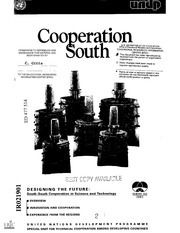
graduated bronze bells on the cover are
partnership for development.
also from the 6th century B.C.
-,Tintgnkm
ARTA RV A 71)17 TT:g
ifg/TINITITRT
We're glad you've enjoyed receiving our publication. It would help us to serve you better if you could answer
the few questions below, and return this form to our office (see address and fax below). Thank you in advance.
We always look forward to serving you better.
How long have you been receiving COOPERATION SOUTH?
1.
Less than 1 year
0 3 to 5 years
More than 5 years
1 to 3 years
What are your views about the content of COOPERATION SOUTH as a source of information and current thinking
on cooperation among developing countries? Specifically:
How much do you use COOPERATION SOUTH as a reference for current research/discussion on development (with respect to
2.
your interests)? (1 = heavily; 2 = very much; 3 = somewhat; 4 = little to none, it's just additional information)
(Explain, if necessary)
Please rate COOPERATION SOUTH on each of the following criteria as (1) excellent, (2) good, (3) fair, or (4) poor:
3.
Meeting your research needs
Meeting your practical needs
Covering current and most relevant development issues of the South
Overall performance as an international publication
What topics does COOPERATION SOUTH cover well?
4.
What topics does COOPERATION SOUTH need to cover better?
5.
What is an acceptable subscription rate for your organization to continue receiving COOPERATION SOUTH (as a biannual journal)?
6.
0 $75
0 More than $100
$50
$50
$100
$75
CI $25
For an individual (not receiving this publication as a benefit of membership in any organization)?
7.
0 $20 to $40
$10 to $20
I would be willing to pay more than $40
Which of the following categories best describes. your organization? (Please check ONE box)
8.
Other
Private Sector
Media
0 Bank/investment
0 News and photo agency
United Nations
Newspaper/magazine
0 Professional/trade association
Intergovernmental organization
0 Radio
Religious institution
Industry/business
Trade union
Television
0 Chamber of commerce
Non-affiliated
Non-Governmental Organization
0 Other
0 Development education
Government
Operational activities for development
Office of the head of state/gov.
Humanitarian
Parliament/legislative body
NGO publication
0 Cabinet/council of ministers
International affairs /external relations
Educational Institution
0 Planning
0 College or university
0 Economic/finance
0 Secondary school
Social affairs
0 Training institute
Local government
0 Research or policy institute
Public information
ITER' COPY
AVAIILA
Library
What are your geographic areas of interest?
9.
Africa
Europe and the Commonwealth of Independent States
0 Latin America and the Caribbean
Arab States
0 Asia and the Pacific
All regions
Please detach along dotted line and return to:
Special Unit for TCDC, UN Development Programme
One United Nations Plaza, New York, NY 10017, USA
4
Phone (212) 906-6352,...or fax 212-906-6429
CONTENTS
NUMBER ONE-2000
DESIGNING THE FUTURE SOUTH-SOUTH COOPERATION IN SCIENCE AND TECHNOLOGY
2 Message from the AdministratorNew Tools, New Coalitions
4 Editor's ForewordAn Agenda for South-South Partnerships in Science and Technology
OVERVIEW
6 The History and Urgency of South-South Cooperation in Science and Technology
JOHN F. E. OHIORHENUAN AND AMITAV RATH
INNOVATION AND COOPERATION
29 Challenges, Opportunities and Strategies: South-South Cooperation in Science and
Technology in the 21st Century
MOHAMED H.A. HASSAN
43 Change of Paradigm in Science and Technology Policy
CARLOTA PEREZ
49 How Can South-South Cooperation Contribute to a Knowledge-based
Development Strategy?
CLIVE THOMAS
60 Some Principles, Criteria and Priorities for Knowledge Sharing in Science
and Technology
JORGE AHUMADA-BARONA
66 Some Priority Sectors and Specific Actions for South-South Science and
Technology Cooperation
OUSMANE KANE
74 Knowledge-based Industrial Development and South-South Cooperation
LYNN K. MYTELKA AND JOHN F. E. OHIORHENUAN
83 Cooperation in Science and Technology: Definitions, Questions and Visions
JOSEPH 0. OKPAKU Sr.
EXPERIENCE FROM THE. REGIONS
90 From Imitation to Innovation: Technology Transfer and Adaptation North-South
and South-South
HOKOON PARK
99 S&T Innovation and Cooperation in Latin America
GUILHERME ARY PLONSKI
108 India's Experience with TCDC
ASHOK PARTHASARATHI
114
WINDOWS ON THE SOUTH: Current Trends, Perspectives, and Events
GROUP OF 77 SUMMIT: "MILESTONE" TOWARD DEVELOPMENT AND COOPERATION
DAKAR DECLARATION: SCIENCE ACTION PLAN FOR AFRICA
WIDE NOMINATED FOR INTERNATIONAL INFORMATION TECHNOLOGY AWARD
FREE E-MAIL IN COSTA RICA
THE SEOUL ACCORD
122
SHARING IDEASInformation and Communications Technology
for Development
COOPERATION SOUTH is published twice a year by the Special Unit for TCDC, United Nations Develop-
ment Programme, One United Nations Plaza, New York, NY 10017, USA (212) 906-5737, FAX (212) 906-6352,
email: [email protected].
The views expressed in this publication do not necessarily reflect those of the United Nations, the United Nations Development
Programme, or governments. The designations employed and material presented on maps do not imply the expression of any
opinion whatsoever concerning the legal status of any country, territory, or area, or its frontiers or boundaries.
FROM THE ADMINISTRATOR
Yrs
SPECTACULAR ADVANCES IN SCIENCE and technology are driving
major changes in today's world and presenting special challenges
and opportunities for the countries of the South. Developing coun-
tries
are well aware that science and technology, properly harnessed, offers them
extraordinary prospects for achieving rapid economic growth, industrialization,
a
cleaner environment, improved health, higher agricultural productivity, and better
reproductive health. This raises two key questions:
o First, what approaches and methods should be employed to acquire, adapt, use
and share appropriate technologies?
o Second, how can southern nations cooperate in research and development,
application and production, and marketing and trade, when that offers
economies of scale, time savings and other advantages?
As a step towards answering these questions and sharing the experience,
a
Forum on South-South cooperation in science and technology was held in Seoul
this past February, sponsored by UNDP and the Republic of Korea. The Forum sig-
naled a new vision of horizontal cooperation across the South aimed at putting the
best science and technology brains to work on issues and opportunities of critical
importance for developing countries. These include information and communica-
tion technology, tropical diseases and HIV/AIDS, biotechnology, sound gover-
nance, and sustainable development.
For this new vision to take root, however, new partnerships need to be forged
among technology and policy specialists and institutes in the South. The best way to
do that is through networks and coalitions devoted to specific themes and topics. Tak-
ing advantage of electronic connectivity, such coalitions could provide structural and
operational flexibility, and permit an optimum reach for the production and the dif-
fusion of innovations. They will also increase the visibility and availability of
a wide
range of R&D institutions, technical capacities and development experts within the
South. In its programming and policy support for developing countries, the UNDP is
COOPERATION SOUTH
2
firmly committed to promoting this vision.
This issue of Cooperation South draws on policy ideas and practical insights about
science and technology for development that were offered by participants at the
Seoul Forum. Our hope is that, in this way, wider audiences can share in an excit-
ing vision of continuous innovation and continuous cooperation by, in and for
the developing world.
Alet.
liAgate,m gi?h.
Mark Malloch Brown, Administrator
United Nations Development Programme
7
NUMBER ONE-2000
3
EDITOR'S FOREWORD
in *NW 'kr Se
;3
tin teence ri
kch
WHAT ROLE CAN INNOVATIONS in science and technology play
to speed up
the development process in the developing world?
What role must science and technology experts in the South play in that process?
To help answer these questions and open the way for a new
era of South-South sci-
entific exchanges, the Forum on South-South Cooperation in Science and Technol-
ogy brought together policymakers and S&T experts from 37 countries between 14
and 17 February 2000. In organizing the Forum in Seoul, UNDP and the Republic of
Korea sought to highlight the importance of tapping more of the
enormous potential
for S&T exchanges in the developing world. The Forum was also
a means of mobiliz-
ing expertise to place S&T action proposals on the agenda of the South Summit held
in Havana, Cuba, 10-14 April 2000.
Forum participants shared the concern that knowledge and information
gaps
between developed and developing countries threaten to widen the wealth
gap
between the North and the South. After a spirited analysis of current trends,
con-
straints and opportunities the Forum concluded with a series of recommendations con-
tained in the Seoul Accord, which is reproduced below
on page 118. The document
stresses the need for a new South-South partnership of networks linking the scientific
and technological community in the South. Also needed, according
to the Accord, are
effective mechanisms to facilitate cooperation in R&D, education, and experience-
sharing among Southern coalitions of firms, institutions and individual scientists.
In addition to hosting the Forum, the Republic of Korea served as
a "visual aid" for
participants to see firsthand a country whose high investments in S&T have paid
handsome dividendsmoving its people from an annual per capita GDP of US$80 in
COOPERATION SOUTH
4
the 1950s to the current level of over US$10,000.
By putting together selected articles presented at the Seoul Forum, Cooperation
South invites readers to join the debate on the role of S&T in accelerating sustainable
development. The overview article puts S&T South-South cooperation in historical
perspective. Next is a group of articles exploring challenges, opportunities, priorities
and strategies for advancing a new agenda of scientific exchanges in the developing
world. The forging of joint action programs combining the best scientific talents in
government, private business and academia in a South-South nexus presents means of
responding to everyday problems and pressing development needs. The authors
argue
further that the current technological revolution requires developing countries
to rad-
ically rethink their policies and practical approaches to science and technology. They
suggest that one way to bring desired change is to adopt South-South knowledge-build-
ing, knowledge sharing, and constant innovation as first steps towards successful glob-
al competitiveness. The strategy is to begin with select priority
sectors such as knowl-
edge-based industrial development. To succeed, S&T initiatives must have
as their base
a clear vision of the challenges, opportunities, strategies and practical programs to
achieve realistic goals. The final group of articles anchors the debate in
a number of
practical experiences from Asia and Latin America. Cooperation
among developing
countries at similar levels of development is seen as an effective approach for finding
solutions to shared development challenges in the South.
John F. E. Ohiorhenuan
9
NUMBER ONE-2000
5
of
elicy
The History & Ur
in
Science
Technology
by JOHN FE. OHIORHENUAN AND AMITAV RATH*
Are unequal technological advances facing the developing world with more intractable
divisions, or just changing the directions South-South cooperation should take? John
Ohiorhenuan, Director of UNDP's Special TCDC Unit, and Amitav Rath, Director of
Policy Research International in Canada
, see a
shift occurring, not a split. Countries
with widely differing experience have much to learn from each other in different arenas
economic, technological, environmental or institutional; traditional medicine or mass
vaccination, literacy or education programmes; or foreign investment or trade promotion
policies. Also, common problems with strong impact on the South, such as food security
and tropical diseases, call for joint development and dissemination of solutions.
The authors consider types of alliances and networks which could harness science
and technology as a shared engine for growth throughout the developing world.
capital markets, decentralization of pro-
INTRODUCTION
duction processes, and the dramatic
The rapid advance of globalization and
the emergence of a primarily technol-
advances in information and communi-
ogy-driven economy has changed the
cations technology combine to indicate
world significantly. The worldwide low-
a radically different agenda for interna-
ering of trade barriers, integration of
tional development cooperation.
* The views expressed here are the authors' and not necessarily those of the United Nations.
The assistance of Yiping Zhou and Cosmas Gitta, Editors of Cooperation South, in preparing this
article is gratefully acknowledged.
COOPERATION SOUTH
6