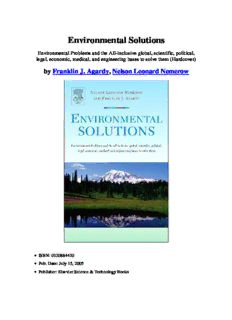
Table Of ContentEnvironmental Solutions
Environmental Problems and the All-inclusive global, scientific, political,
legal, economic, medical, and engineering bases to solve them (Hardcover)
by Franklin J. Agardy, Nelson Leonard Nemerow
• ISBN: 0120884410
• Pub. Date: July 15, 2005
• Publisher: Elsevier Science & Technology Books
Introduction
During the 20 th Century, we wrote and published countless books on the
environment--beginning with "Theories and Practices of Industrial Waste
Treatment" in 1963. Most, if not all, of these books centered on the theo-
retical aspects of environmental components. By the end of the century
environmentalists worldwide possessed all the basic ingredients to enable
them to ameliorate a rapidly deteriorating resource quality condition. Some
real progress was made in improving environmental quality, but primarily
theories were expounded and scientific papers were generated. And envi-
ronmental quality did not improve sufficiently enough to overcome criti-
cal and dangerous situations. Toxic and hazardous wastes were identified
and then discharged indiscriminately and rather secretly into the environ-
ment.
The time has arrived for us to write and propose to practicing profes-
sional environmental engineers potential solutions to vexing problems,
instead of theories of their origin, characteristics, and potential treatment.
You, as the reader, can select a particular area of interest and peruse the
chapters' potential solutions; then select the appropriate one(s)which apply
most directly to your situation. Economic comparisons of solutions make
your selection even simpler.
For example, let us presume that you have a complex organic chemi-
cal waste that is potentially damaging to the environment. And, further,
that you want to examine chapter 8 to pinpoint chemical solutions. Suppose
you find in this chapter that you can safely discharge this waste after either
chemically oxidizing it with chlorine or substituting a non-polluting chem-
ical with the same production qualities. Then you may also compare these
two solutions to ascertain the least costly one. You may also wish to
compare potential solutions in other chapters which would also alleviate
the problem such as the use of political solutions (Chapter )1 or forensic
solutions (Chapter .)2 You may then be in a better position to decide which
solutions would serve you best on an overall basis. You may even continue
to compare your selected solution with the idea of utilizing an environ-
ix
x Introduction
mentally-balanced industrial complex as described in chapter ,11 or send
the waste to a nearby industrial plant as described in chapter .21 These
latter two solutions may be feasible and even less costly than your other
selected solution.
In any event, you are encouraged to consider all solutions proposed in
chapters which may contain potential answers to your problem. The
authors of each chapter were aware of the possibility of your need to make
such decisions when they wrote their chapters.
In Chapter ,1 Bob Perciasepe recognizes from his many years of dealing
with governmental agencies that politics enter into most environmental
solutions. For example, when environmental contamination crosses estab-
lished governmental boundaries, political pressures and influences will be
brought to bear on any solution selected by the professional person. Also
when money has to be spent to abate a pollution situation, the particular
political party in control must weigh the expenditure against its political
future. The challenge for the professional is to understand the political sit-
uation and to work with it to affect a suitable environmental solution. Polit-
ical solutions to environmental problems are usually the result of the
actions of thoughtful people in "contriving" a means of abating the degra-
dation of any area of our environment. Political solutions are often consid-
ered "contrived" not for the benefit of humankind's environment, but for
the good of a segment of the people and usually at the expense of most of
the people. And behind it all lurks the ugly head of the money gained by
this segment of the people. However, it is our intent to present political
solutions in its favorable lightwone of benefiting the majority of mankind.
And it may not necessarily result in a net cost to this society to attain a
"political solution in a favorable light."
In Chapter 2, Franklin Agardy gives the reader an opportunity to use
forensic solutions to solve environmental dilemmas. The threat and use of
legal remedies often effect more abatements than physical, chemical, or bio-
logical treatments. Unfortunately forensic solutions have been used mainly
'after the fact' of environmental contamination rather than for prevention.
However, if threats of legal action can be brought to bear "a prioi" to avoid
contamination, practical and economical solutions will result. In any event,
the environmentalist should consider the use of this method for preventing
environmental deterioration. When you compare other conventional solu-
tions to forensic ones, the environmentalist can make decisions based upon
economics.
Dr. James Mihelcic, a Professor of Civil and Environmental Engineer-
ing at Michigan Technological University, describes his graduate school and
engineering service program with the United States Peace Corps as an excel-
lent example of solving environmental problems. He also describes the
education of pre-college teachers to develop the State of Michigan's middle
school curriculum related to energy and pollution prevention. His chapter
Introduction xi
(Chapter )3 gives guidance to using education to aid in the solution to envi-
ronmental problems of all kinds.
In Part 2 we have segregated the scientific and technical solutions from
the politics and policies. In Chapter 4, Ernest Lowe describes the combined
crisis in resource supply and environmental pollution as a major economic
development opportunity for both developing and developed countries. One
objective of this chapter is to provide the reader with economically feasi-
ble strategies of reducing the depletion of resources and abating contami-
nation of the environment. This author considers economic frameworks for
encouraging cleaner, more efficient production, such as the Recycling
Economy laws in Japan and Germany and the Circular Economy initiative
in China. The Chinese initiative, for instance, integrates cleaner produc-
tion and industrial ecology approaches with the goal of gaining a 7 to 10
factor improvement in resource utilization.
Even a Recycling or Circular Economy is only a partial economic solu-
tion. The deterioration of ecological systems--locally, nationally, and glob-
ally~demands economic solutions that will enable their restoration. When
looking at these systems in terms of human welfare, ecological economists
use the term "natural capital." Natural capital is the source of all natural
resources and the sinks that absorb the by-products of human activities.
The accounts of natural capital must be recharged through major invest-
ments in restoration of forests, grasslands, deserts, farms, watersheds,
oceans, and atmospheric balance. The balance between human system unre-
covered outputs and the sinks of natural capital must also be restored. The
"restoration economy" must also recover the sunk investment in human
habitat and infrastructure so as to extend its life. Here too the investments
will create massive opportunity for venture development and job creation.
Dr. Tewari, in Chapter 5, offers you physical, or engineering, solutions.
These are specific "concrete" types of systems designed to remove some or
all of contaminants from the environment. He tries to point out which
processes are most suited to eliminate certain of the multi-varied pollu-
tants. Without being armed with these methods the reader will not be able
to compare physical solutions to alternate techniques presented in the other
chapters.
On the other hand, Dr. Oerther uses microorganisms of all types to
solve existing as well as potential contaminant problems. Since most
organic matter can serve as food sources for specific bacteria, the use of this
technique to prevent environmental contamination is prevalent today. Even
inorganic contaminants such as phospates and carbonates can be utilized
by some flora~such as algae~to remove them from the environment. In
Chapter 6 you will discover many of these biological processes which you
may find as useful solutions to your situations.
In Chapter ,7 Drs. Veziroglu, Sherif, and Barbir offer hydrogen as an
alternate fuel source for moving vehicles and power plants. Products of the
xii Introduction
combustion of hydrogen not only give off energy, but also are completely
non-polluting to the environment into which they are released. They
present production cost comparisons of hydrogen with other forms of fuels.
Also, the authors give the reader several methods of producing hydrogen
fuel along with their relative utility. It is only a question of time when this
fuel will replace conventional limited resources of oil and gas.
Dr. Patrick Sullivan describes in Chapter 8 the various chemical
processes currently in use to ameliorate existing contaminants. In addition,
he offers the use of chemical substitutions in certain situations as alterna-
tives to toxic or hazardous chemical contaminants. An important contri-
bution to this chapter is the use of chemical methods of detoxifying wastes
prevalent and persistent in landfills and underground soils.
Dr. John Wilcox tackles solutions to contaminants by electrical and
thermal means in Chapter 9. Of special interest are high temperature treat-
ments such as closed system organic matter destruction at 600+degrees
centigrade. Electrical systems are also offered as treatments for microor-
ganism reduction/removal. Although relatively expensive capital and oper-
ating costs are usually involved, systems proposed in this chapter are often
economically feasible for smaller volume, highly concentrated wastes.
Alternative energy sources such as wind, solar, geothermal, and ocean wave
are also offered by your editor, Dr. Nemerow as potential solutions in proper
situations.
In Chapter ,01 Drs. Kilbourne and Falk cover the various medical solu-
tions available to avoid environmental diseases. Not only are the preven-
tion of conventional and historic environmental diseases such as dysentery,
typhoid and poliomyelitis discussed, but also solutions and systems are
offered for the more recent and dangerous ones. Needless to say the pre-
vention of and solution for biological methods of mass destruction are
vitally important in today's world living. Illustrative of these is the trans-
mission of arsenic powders through the postal systems, and prevention,
detection, and medical solutions for the diseases resulting from them.
Your editor becomes an author in Chapter 11 and presents for indus-
trial collaboration the manufacturing of products in environmentally-
balanced industrial complexes. In these complexes, a group of industries
located together reuses wastes from ancillary plants and produces useful
products without any adverse environmental impacts. I illustrate, for the
first time, with a real case scenario how the benefits of such a complex will
result in lower production costs for the industries and, at the same time,
environmental preservation.
Many potential planned and designed industrial complexes are sug-
gested to stimulate the reader to plan for environmental solutions. In the
following chapter complexes which are created from initially unplanned
groupings of industries are described.
In Chapter ,21 Erkman and Ramaswamy show how industrial ecology
utilization can lead to solutions to the environmental contamination
Introduction xiii
dilemma. Many industries have already been built and operate in so-called
"industrial parks" or "industrial estates," or at least nearby one another.
With proper cooperation these industries might avail themselves of the
residual wastes from the other plant(s) to aid in manufacturing their prod-
ucts. Thus, a savings in money for raw materials results as well as a sub-
stitute for waste treatment.
These authors have already published several books related to indus-
trial ecology and qualify as leaders in this area of environmental solutions.
In Chapter 31 we enter the international area of the book. Dr. Salah
1E Haggar proposes specific solutions especially applicable to rural, devel-
oping country environmental problems. These problems are unique to low-
population areas of nations which are in the process of developing their
regulatory systems. Problems of economics and lack of scientific and tech-
nical know-how are of uppermost importance in these country situations.
Dr. Balkau, having a "world" of experience with the United Nations,
examines the possibilities open to the world's countries for solving envi-
ronmental problems. Economic aid and technical assistance--so needed as
mentioned in Chapter 13mare available through various international agen-
cies listed in Chapter 14. Often the political support of an agency such as
the World Health Organization is all that is needed to provide the neces-
sary impetus for a country environmental pollution problem. The United
Nations Industrial Development Organization (UNIDO) may also promote
industrial collaboration such as proposed in Chapter 11.
The entire book of 14 chapters is summarized by our author and editor
Dr. Agardy, in Chapter 15, so that you, the reader, are afforded a consoli-
dated view of what you have read. You should obtain the feeling of how the
many facets of environmental solutions are related and fit together to strive
toward a state of zero pollution.
Nelson L. Nemerow
seihpargoiB
Franklin J. Agardy, Ph.D. is President of Forensic Management Associates,
a company focused on environmental litigation support and expert witness
services. Dr. Agardy received a B.S. in civil engineering from the City
College of New York in 1955, an M.S. in sanitary engineering from the Uni-
versity of California at Berkeley in 1958, and a Ph.D. degree in sanitary engi-
neering from the University of California at Berkeley in 1963. He taught
civil and sanitary engineering at San Jose State University and left the
faculty as a tenured full professor in 1971. He spent 91 years with URS Cor-
poration, retiring in 1988 as President of the corporation. After retirement
he took the position of President/CEO/Chairman of In-Process Technology,
Inc. in Sunnyvale, California, and at the same time formed Forensic
Management Associates. Dr. Agardy is a Director of Komex Corporation,
a Director of EGG Corporation, and holds an advisory seat on the Board
of The Environmental Company. Dr. Agardy is a former member of the
Dean's Advisory Council, School of Engineering, University of California,
Berkeley, and currently is a guest lecturer at the university. Dr. Agardy has
published over 50 articles and reports, has authored or co-authored, and co-
edited four textbooks, and is a life member of a number of professional soci-
eties. During his career he has consulted to numerous federal, state, and
local agencies on subjects ranging from environmental matters, nuclear
weapons countermeasures, and international business development.
Fritz Balkau, Ph.D. is Head of the United Nations Environmental Pro-
gramme's Production and Consumption Branch in the Division of Tech-
nology, Industry and Economics.
Dr. Balkau graduated as a research chemist from Monash University
in Australia in 1973. After some years teaching at Victoria University, he
worked for the Environment Protection Authority in various functions con-
cerned with environmental planning, waste and pollution management,
chemicals, and environmental policy. He spent one year with the Chemi-
XV
xvi seihpargoiB
cals Division of the Organisation for Economic Co-operation and Develop-
ment before joining UNEP's Industry and Environment Office in Paris in
1987.
The Production and Consumption Branch of UNEP promotes and
facilitates the worldwide implementation of cleaner and safer production
approaches and more systematic industrial pollution management in key
industry sectors, including resource industries such as mining, oil and gas.
It also leads activities in UNEP to promote more sustainable patterns of
consumption in civil society and industry. The unit has an active program
of information exchange, environmental education, and training support on
environmental control systems and tools to help governments and indus-
try to adopt more systematic approaches to environmental management
(see http://www.uneptie.org/pc/home.htm).
Frano Barbir, Ph.D. is currently a Professor-in-Residence at the Connecti-
cut Global Fuel Cell Center at the University of Connecticut. Prior to
joining UConn in 2003, Dr. Barbir served as Director of Fuel Cell Technol-
ogy and Chief Scientist at Proton Energy Systems in Wallingford, CT, and
Vice President of Technology and Chief Scientist at Energy Partners, West
Palm Beach. In these positions, he assembled and led research teams cov-
ering all areas of Proton Exchange Membrane fuel cell technology includ-
ing electrochemistry, materials, heat transfer and fluid mechanics. He led
teams that developed novel fuel cell stacks (from 1 to 5 kW)with emphasis
on low cost manufacturing, and applied them in a variety of working fuel
cell systems, including five fuel cell powered vehicles. He is co-inventor on
several fuel cell-related patents, and has authored or co-authored more than
100 publications, mostly on fuel cells and hydrogen energy, that appear in
scientific journals, books, encyclopedias, and conference proceedings. He is
currently an Associate Editor of the International Journal of Hydrogen
Energy, serving as Editor-in-Charge of that publication's special issues on
fuel cells. He is also a member of the editorial boards of the Journal of New
Materials for Electrochemical Systems, EGE (Croatian Journal of ,ygrenE
Environment and Economics), and the Fuel Cell Virtual .lanruoJ
Salah M. El Haggar, Ph.D., P.E. is the Professor of Energy and Environment
at the American University in Cairo, Mechanical Engineering Department,
Cairo, Egypt. Dr. 1E Haggar received a B.Sc. (1972) and an M.Sc. (1976) from
Ain Shams University, Cairo, and a Ph.D. in Mechanical Engineering from
Washington State University in 1983.
Dr. 1E Haggar has more than 30 years experience in energy and envi-
ronmental consulting and university teaching. He has been a visiting pro-
fessor at Washington State University and at University of Idaho. Dr. 1E
Haggar has more than 81 academic honors, grants, and awards. He received
the Outstanding Undergraduate Teacher Award at The American Univer-
sity in Cairo in 1995, as well as a number of outstanding AUC trustees
seihpargoiB xvii
awards. In addition, Dr. 1E Haggar has 501 scientific publications in envi-
ronmental and energy fields, 29 invited presentations, 42 technical reports,
and 01 books.
Dr. E1-Haggar's environmental consulting experience includes more
than 40 environmental/industrial audits for major industrial identities, 20
compliance action plans, and nine environmental impact assessments. In
addition, he has extensive consulting experience in environmental engi-
neering, environmental auditing, environmental impact assessment, envi-
ronmental management systems, cleaner production, industrial ecology,
energy management, hazardous and non-hazardous waste management,
recycling, pollution prevention and waste minimization, zero pollution,
biogas/solar/wind technology, community/desert development, solid and
industrial waste, and environmental assessment for the local government
and private industries. Dr. E1-Haggar is a member/board member of 41
national and international societies in the area of mechanical engineering,
environmental engineering, and community development.
Suren Erkman, Ph.D. has an academic background in philosophy and
biology, and holds a Ph.D. in Environmental Sciences from the University
of Technology of Troyes (France}. In 1994, after working for a number of
years as a science and business journalist for various media, he created an
organization headquartered in Geneva (Switzerland), the Institute for Com-
munication and Analysis of Science and Technology (ICAST). ICAST's
mission is to provide independent information in a readily accessible form
on scientific, technological and environmental issues, to companies, gov-
ernments, international organizations, academic institutions and NGOs. In
1995, he launched an international network, Industrial Ecology Praxis,
devoted to the dissemination and implementation of ideas relating to indus-
trial ecology. He also teaches industrial ecology in various universities in
Switzerland and abroad. Suren Erkman is a member of the Managing Board
of the Journal of Industrial Ecology (MIT Press) and an elected member of
the Council of the International Society for Industrial Ecology (ISIE).
Henry Falk, M.D., M.P.H. currently heads two organizations at the center
of the Department of Health and Human Services' work in environmental
health. He serves as Director for both the National Center for Environ-
mental Health (NCEH) and the Agency for Toxic Substances and Disease
Registry (ATSDR). In 2003, these two entities consolidated to form
NCEH/ATSDR.
Dr. Falk arrived at the Centers for Disease Control and Prevention
(CDC) in 1972. He is also a 30-year veteran of the U.S. Public Health Service
Commissioned Corps. This service culminated with his being named rear
admiral and an appointment as assistant U.S. Surgeon General.
At NCEH, Dr. Falk heads the Center's national effort to prevent or
control environment-related diseases, illness, and deaths. He served NCEH
xviii Biographies
for 41 years as Director of the Division of Environmental Hazards and
Health Effects. At ATSDR, which was created by the 1980 Superfund leg-
islation, Dr. Falk leads the federal agency whose mission is to protect public
health from hazardous releases of toxic substances.
Dr. Falk earned his medical degree from the Albert Einstein College
of Medicine in 1968. He received a master's degree from the Harvard School
of Public Health in 1976, and he is board-certified in pediatrics and in public
health and general preventive medicine. Throughout his career at the CDC,
Dr. Falk has lent knowledge and leadership to myriad public health proj-
ects around the United States and the world. His work includes contribu-
tions to the federal responses to Three-Mile Island, Mount .tS Helens,
Hurricanes Hugo and Andrew, and the September 1 lth attacks.
Dr. Falk has also authored or coauthored more than 100 publications
in a variety of subjects, including vinyl chloride-induced liver cancer,
prevention of lead poisoning, and the health effects of environmental
hazards.
During his career, Dr. Falk and his distinguished work have been rec-
ognized many times. His honors include the Vernon Houk Award for Lead-
ership in Preventing Childhood Lead Poisoning and the Homer C. Calver
Award from the American Public Health Association. He has also received
the CDC's William C. Watson .rJ Medal of Excellence, as well as the Dis-
tinguished Service Award from the U.S. Public Health Service.
David R. Hokanson, Ph.D. is the Operations Manager of the Sustainable
Futures Institute at Michigan Technological University. Dr. Hokanson is
also an Adjunct Assistant Professor at Michigan Technological University,
Department of Civil and Environmental Engineering. He worked for several
years as a Research Engineer affiliated with the National Center for Clean
Industrial and Treatment Technologies (CenCITT)at Michigan Technolog-
ical University, a U.S. Environmental Protection Agency Center of Excel-
lence and a partnership between Michigan Technological University (lead
institution), the University of Minnesota-Twin Cities, and the University
of Wisconsin-Madison. Through CenCITT and the Sustainable Futures
Institute, Dr. Hokanson has experience working on several federally funded
projects in the area of pollution prevention, water treatment, and sustain-
ability, including educational and outreach applications at many levels. Dr.
Hokanson was also instrumental in the development of the textbook Water
Treatment: Principles and Design, 2nd ed. (2005).
Edwin M. Kilbourne, MD is Chief Medical Officer Division fo Environ-
mental Hazards & Health Effects, National Center for Environmental
Health (NCEH), Centers for Disease Control & Prevention (CDC)in
Atlanta, Georgia. In this capacity he deals with emerging issues in medical
toxicology, including prevention and management of biological/chemical