Table Of ContentBegin Reading
Table of Contents
About the Author
Copyright Page
Thank you for buying this St. Martin’s Press ebook.
To receive special offers, bonus content, and info on new releases and other
great reads, sign up for our newsletters.
Or visit us online at us.macmillan.com/newslettersignup
For email updates on the author, click here.
The author and publisher have provided this e-book to you for your personal use
only. You may not make this e-book publicly available in any way. Copyright
infringement is against the law. If you believe the copy of this e-book you
are reading infringes on the author’s copyright, please notify the publisher
at: us.macmillanusa.com/piracy.
For Jane
1
LOST FOR WORDS
Don’t Retreat, Instead—RELOAD!
—SARAH L. PALIN
Public language matters. Words are free, and every politician and journalist and
citizen can draw on an unlimited supply of them. But there are days when the
right words are all that count, and it is the speaker who can find them who
determines what happens next. Over time, leaders and commentators and
activists with empathy and eloquence can use words not just to exploit the public
mood but to shape it. And the result? Peace, prosperity, progress, inequality,
prejudice, persecution, war. Public language matters.
This is hardly a new discovery. It’s why public language and public speaking
have been studied and taught and fought over for thousands of years. But never
before has public language been as widely and readily distributed as it is today.
Words hurtle through virtual space with infinitesimal delay. A politician can
plant an idea in ten million other minds before she leaves the podium. An image
with an author and a deliberately composed meaning—a plane hitting a
skyscraper, say—can reach the eyes of viewers around the world with an
instantaneity unconstrained by distance or mechanical limit. Once, and not long
ago in human history, we would have heard a rumor, or read a report of it, days
or even weeks later. Today we are all witnesses, all members of a crowd that is
watching and listening in real time.
Now. It’s happening now. He’s saying that now. You’re posting this now. I’m
replying now. Listen to me. Look at me. Now.
We think of ours as the age of digital information, and so it is. But we
sometimes forget how much of that information is conveyed in human language
that is doing what it has always done in human societies: alerting, frightening,
explaining, deceiving, infuriating, inspiring, above all persuading.
So this is also the age of public language. More than that, we are living
through an unparalleled, still unfolding and uncertain transformation of public
language. But when we consider and debate the state of modern politics and
media—how policies and values get discussed and decisions get made—we tend
to think of it only in passing, as if it is of interest only insofar as it can help us
understand something else, something more foundational. It is the argument of
this book that public language—the language we use when we discuss politics
and policy, or make our case in court, or try to persuade anyone of anything in a
public context—is itself worthy of close attention. Rhetoric, the study of the
theory and practice of public language, was once considered the queen of the
humanities. Now she lives out her days in genteel obscurity. I’m going to make
the case for putting her back on the throne.
We enjoy one advantage over earlier generations of students of rhetoric.
Thanks to the searchability and indelibility of modern media, it has never been
easier to trace the evolution of the specific words and statements of which a
particular oratory is constituted. Like epidemiologists on the trail of a new virus,
we can reverse time and track an influential piece of public language from its
pandemic phase, when it was on every lip and every screen, back through its late
and then its early development, until we arrive at last at the singularity: the
precise time and place it first entered the world.
*
On July 16, 2009, Betsy McCaughey, the former lieutenant governor of New
York, appeared on Fred Thompson’s radio show to add her two cents to the
hottest political topic of that summer—President Barack Obama’s controversial
plans to reform America’s health-care system and extend coverage to tens of
millions of uninsured citizens.
Fred Thompson was a colorful conservative whose furrowed and jowly
gravitas had taken him from a successful law career to the US Senate, not to
mention several successful stints as a Hollywood character actor. After the
Senate, he embraced talk radio, and in 2009 his show was one of countless
conservative outlets on which Obamacare was dissected and condemned.
There wasn’t a better person than Betsy McCaughey to do that. A historian
with a PhD from Columbia (thus entitling her to that medical-sounding “Dr.”),
McCaughey had risen through sheer brainpower from humble origins in
Pittsburgh to become a significant public figure on the American Right. And she
was considered a specialist in health-care policy. She had been a forensic as well
as ferocious critic of Clintoncare, the Democrats’ failed attempt to reform the
system in the 1990s. Obamacare, of course, was a rather different proposition—
indeed, some of its founding principles had been developed by Republicans, or
even implemented by them. The policy bore a particularly inconvenient
resemblance to Mitt Romney’s health-care reforms while he was governor of
Massachusetts. Mr. Romney was already being touted as a possible challenger to
Barack Obama in the 2012 presidential election.
But Betsy McCaughey was too forthright and ideologically committed to be
discomforted by the intellectual genealogy of Obamacare. Nor was she likely to
face a particularly testing cross-examination from her lawyer-turned-radio-host.
American politics was polarizing even before Barack Obama arrived in the
White House, and the media discussion of that politics had polarized along with
it. The paradoxical result was that the more bitter the divisions became, the more
likely it was that everyone in any given studio or on any political Web site
would agree with one another. The people with whom they all disagreed were
absent—indeed were probably all gathered in a different studio, making the
opposite case in an equally cozy ideological cocoon where they faced the same
low risk of contradiction.
On the face of it, then, nothing about this encounter—the political
circumstance, the characters, the likely flavor and flow of the argument—was
out of the ordinary. But on July 16, Betsy McCaughey had something new to
say. Deep within one of the drafts of the Obamacare legislation that was then
making its way through Congress, she had stumbled on an unnoticed but
alarming proposal:
One of the most shocking things I found in this bill, and there were many,
is on page 425, where the Congress would make it mandatory … that
every five years, people in Medicare have a required counseling session
that will tell them how to end their life sooner, how to decline nutrition,
how to decline being hydrated, how to go into hospice care … These are
such sacred issues of life and death. Government should have nothing to
do with this.1
There are two things to note about this claim. The first is simply that it’s
untrue. The section of the bill that McCaughey was referring to—Section 1233
—did not in fact call for compulsory “end-of-life” counseling sessions. Such
sessions would have remained at the patient’s discretion. The intent of the draft
section was to make these voluntary sessions eligible for coverage under
Medicare, the federal program that pays many of older Americans’ medical
costs.
But the fact that it was untrue—and indeed was promptly and definitively
refuted by defenders of the bill—did nothing to stop it from rapidly gaining
currency. This is the second, and more intriguing, point to note. Provision of
end-of-life counseling had previously enjoyed tentative bipartisan support, but in
the days following McCaughey’s appearance, many of America’s most
influential conservative commentators and a number of prominent Republican
politicians, including the House minority leader, John Boehner, took up her
charges. And the claim began to be rounded out. The radio host Laura Ingraham
cited her eighty-three-year-old father, proclaiming, “I do not want any
government bureaucrat telling him what kind of treatment he should consider to
be a good citizen. That’s frightening.”2 While a few commentators associated
with the Right ridiculed the “myth” or “hoax” of Section 1233—on MSNBC’s
Morning Joe, Joe Scarborough joked about the “Grim Reaper” clause3—most of
the discussion on the conservative side of the political divide was predicated on
the assumption that McCaughey’s claim about the bill was a straightforward
statement of fact.
Then, on August 7, Sarah Palin entered the fray with a posting on Facebook
that included the following passage:
The America I know and love is not one in which my parents or my baby
with Down Syndrome will have to stand in front of Obama’s “death panel”
so his bureaucrats can decide, based on a subjective judgment of their
“level of productivity in society,” whether they are worthy of health care.
Such a system is downright evil.4
What followed is well known. Within a few days the freshly baked term
death panel was everywhere—radio, TV, the newspapers, the Web, Twitter—
spread not only by its author and her supporters but, unintentionally yet also
unavoidably, by those who were frantically trying to debunk it. By the middle of
August, an opinion poll by the Pew Research Center suggested that 86 percent of
Americans had heard the term (that is twice as many as those able to name the
vice president). Of these, 30 percent believed it was a real proposal—the
proportion among Republicans was 47 percent—while another 20 percent said
they weren’t sure whether it was true or false.5
Despite all denials, a belief that Obamacare meant compulsory death panels
remained stubbornly widespread, and a few months later the Democrats dropped
the underlying proposal. When in 2012 the Obama administration again raised
the possibility of covering end-of-life counseling under Medicare, the tagline
threatened to take flight once more and the proposal was quickly dropped. In the
summer of 2015, after extensive further research and consultation, Medicare
announced that it did indeed intend to pay for end-of-life counseling.
Predictably, Betsy McCaughey immediately took to the New York Post to
announce: “Death panels are back.”6
A term that exaggerated and distorted a claim that was itself false, and that in
any event had virtually nothing to do with the central thrust of Obamacare, had
changed the course of politics. In fact, it is probably the only thing that many
Americans can recall about the whole health-care debate. As the veteran
conservative firebrand Pat Buchanan remarked about Sarah Palin: “The lady
knows how to frame an issue.”7
*
Let’s set aside whatever views we have about the protagonists in this political
drama, or indeed about health care and politics as a whole, and consider the
phrase death panel purely as a piece of rhetoric. What makes it tick? Why was it
so successful in shaping the debate? And what, if anything, does it tell us about
what is happening to our public language?
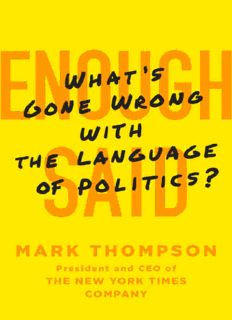
Description:There’s a crisis of trust in politics across the western world. Public anger is rising and faith in conventional political leaders and parties is falling. Anti-politics, and the anti-politicians, have arrived. In Enough Said, President and CEO of The New York Times Company Mark Thompson argues tha