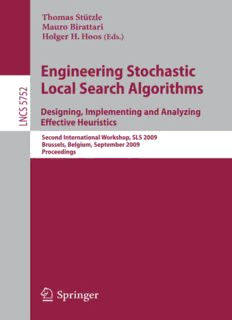
Table Of ContentLecture Notes in Computer Science 5752
CommencedPublicationin1973
FoundingandFormerSeriesEditors:
GerhardGoos,JurisHartmanis,andJanvanLeeuwen
EditorialBoard
DavidHutchison
LancasterUniversity,UK
TakeoKanade
CarnegieMellonUniversity,Pittsburgh,PA,USA
JosefKittler
UniversityofSurrey,Guildford,UK
JonM.Kleinberg
CornellUniversity,Ithaca,NY,USA
AlfredKobsa
UniversityofCalifornia,Irvine,CA,USA
FriedemannMattern
ETHZurich,Switzerland
JohnC.Mitchell
StanfordUniversity,CA,USA
MoniNaor
WeizmannInstituteofScience,Rehovot,Israel
OscarNierstrasz
UniversityofBern,Switzerland
C.PanduRangan
IndianInstituteofTechnology,Madras,India
BernhardSteffen
UniversityofDortmund,Germany
MadhuSudan
MicrosoftResearch,Cambridge,MA,USA
DemetriTerzopoulos
UniversityofCalifornia,LosAngeles,CA,USA
DougTygar
UniversityofCalifornia,Berkeley,CA,USA
GerhardWeikum
Max-PlanckInstituteofComputerScience,Saarbruecken,Germany
Thomas Stützle Mauro Birattari
Holger H. Hoos (Eds.)
Engineering Stochastic
Local Search Algorithms
Designing, Implementing and Analyzing
Effective Heuristics
Second International Workshop, SLS 2009
Brussels, Belgium, September 3-4, 2009
Proceedings
1 3
VolumeEditors
ThomasStützle
MauroBirattari
UniversitéLibredeBruxelles
IRIDIA,CoDE
AvenueF.Roosevelt50,CP194/6,1050Brussels,Belgium
E-mail:{stuetzle,mbiro}@ulb.ac.be
HolgerH.Hoos
UniversityofBritishColumbia
ComputerScienceDepartment
2366MainMall,Vancouver,BC,V6T1Z4,Canada
E-mail:[email protected]
LibraryofCongressControlNumber:2009932137
CRSubjectClassification(1998):E.5,E.2,F.2,I.1.2,I.2.8,F.2.2,H.3.3
LNCSSublibrary:SL1–TheoreticalComputerScienceandGeneralIssues
ISSN 0302-9743
ISBN-10 3-642-03750-XSpringerBerlinHeidelbergNewYork
ISBN-13 978-3-642-03750-4SpringerBerlinHeidelbergNewYork
Thisworkissubjecttocopyright.Allrightsarereserved,whetherthewholeorpartofthematerialis
concerned,specificallytherightsoftranslation,reprinting,re-useofillustrations,recitation,broadcasting,
reproductiononmicrofilmsorinanyotherway,andstorageindatabanks.Duplicationofthispublication
orpartsthereofispermittedonlyundertheprovisionsoftheGermanCopyrightLawofSeptember9,1965,
initscurrentversion,andpermissionforusemustalwaysbeobtainedfromSpringer.Violationsareliable
toprosecutionundertheGermanCopyrightLaw.
springer.com
©Springer-VerlagBerlinHeidelberg2009
PrintedinGermany
Typesetting:Camera-readybyauthor,dataconversionbyScientificPublishingServices,Chennai,India
Printedonacid-freepaper SPIN:12741809 06/3180 543210
Preface
Stochastic local search (SLS) algorithms are established tools for the solution
of computationally hard problems arising in computer science, business admin-
istration, engineering, biology, and various other disciplines. To a large extent,
their success is due to their conceptual simplicity, broad applicability and high
performance for many important problems studied in academia and encoun-
tered in real-world applications. SLS methods include a wide spectrum of tech-
niques, ranging from constructive search procedures and iterative improvement
algorithms to more complex SLS methods, such as ant colony optimization,
evolutionary computation, iterated local search, memetic algorithms, simulated
annealing, tabu search, and variable neighborhood search.
Historically, the development of effective SLS algorithms has been guided to
a large extent by experience and intuition. In recent years, it has become in-
creasingly evident that success with SLS algorithms depends not merely on the
adoption and efficient implementation of the most appropriate SLS technique
for a given problem, but also on the mastery of a more complex algorithm en-
gineering process. Challenges in SLS algorithm development arise partly from
the complexity of the problems being tackled and in part from the many de-
grees of freedom researchers and practitioners encounter when developing SLS
algorithms. Crucial aspects in the SLS algorithm development comprise algo-
rithm design, empirical analysis techniques, problem-specific background, and
background knowledge in several key disciplines and areas, including computer
science, operations research, artificial intelligence, and statistics. Ideally, the
SLS algorithm development process is assisted by a sound methodology that
addressestheissuesarisinginthevariousphasesofalgorithmdesign,implemen-
tation, tuning, and experimental evaluation.
In 2007, we organized a first workshop intended to provide a forum for re-
searchersinterested in the integration of relevant aspects of SLS researchinto a
morecoherentmethodologyforengineeringSLSalgorithms.Thiseventattracted
more than 50 participants and was widely considered a resounding success. It
wasthereforeaneasydecisiontoorganizeasecondevent,SLS2009, Engineering
Stochastic Local Search Algorithms — Designing, Implementing and Analyzing
Effective Heuristics. Like the inaugural SLS 2007, SLS 2009 brought together
researchers working on various aspects of SLS algorithms, ranging from more
theoretical contributions on aspects relevant for SLS algorithms to the devel-
opment of specific SLS algorithms for specific application problems. We believe
that this second event further promoted the awareness and use of principled
approaches and advanced methodology for the development of SLS algorithms
and other complex heuristic procedures.
Ofthe27manuscriptssubmitted,sevenwereacceptedasfullpapersforthese
workshop proceedings, which corresponds to an acceptance rate of about 25%.
VI Preface
Duringtheworkshop,eachofthesepaperswaspresentedina30-minuteplenary
talk. In addition, ten articles with promising, ongoing research efforts were se-
lectedforpublicationasshortpapers.Theselectedpaperswerechosenbasedon
the results of a rigorous peer-reviewing process, in which each manuscript was
evaluatedby atleastthree experts.SLS 2009alsoincluded the Doctoral Sympo-
sium on Engineering Stochastic Local Search Algorithms (SLS-DS), which was
organized by Frank Hutter and Marco Montes de Oca. All short papers and
the contributions of SLS-DS were presented in poster sessions. This format was
choseninorderto provideopportunities forextended discussionandinteraction
among the participants. The workshop programwas completed by three tutori-
als on important topics in SLS engineering given by well-known researchers in
the field.
Wegratefullyacknowledgethecontributionsofeveryonewhohelpedtomake
SLS 2009 a successful and lively workshop. We thank Frank Hutter and Marco
Montes de Oca for the organizationof the doctoralsymposium, SLS-DS; every-
oneatIRIDIAwhohelpedinorganizingtheevent;theresearcherswhosubmitted
their work; the Program Committee members and additional referees who pro-
videdvaluable feedback during the paper selectionprocess;the Universit´eLibre
de Bruxelles (ULB) for providing the rooms for the event. Finally, we would
liketothank the BelgianNationalFunds forScientific Research,andthe French
community of Belgium for supporting this workshop.
June 2009 Thomas Stu¨tzle
Mauro Birattari
Holger H. Hoos
Organization
SLS 2009 was organized by IRIDIA, CoDE, Universit´e Libre de Bruxelles,
Belgium.
Workshop Chairs
Thomas Stu¨tzle Universit´e Libre de Bruxelles, Belgium
Mauro Birattari Universit´e Libre de Bruxelles, Belgium
Holger H. Hoos University of British Columbia, Canada
Program Committee
Thomas Bartz-Beielstein Cologne University of Applied Sciences,
Germany
Roberto Battiti Universita` di Trento, Italy
Christian Blum Universitat Polit`ecnica de Catalunya, Spain
Marco Chiarandini University of Southern Denmark, Denmark
Carlos Cotta University of Ma´laga, Spain
Patrick de Causmaecker Katholieke Universiteit Leuven, Kortrijk,
Belgium
Camil Demetrescu Universit`a La Sapienza, Italy
Yves Deville Universit´e Catholique de Louvain, Belgium
Luca Di Gaspero Universita` degli Studi di Udine, Italy
Karl Doerner Universita¨t Wien, Austria
Marco Dorigo Universit´e Libre de Bruxelles, Belgium
Carlos M. Fonseca University of Algarve, Portugal
Michel Gendreau Universit´e de Montr´eal, Canada
Bruce Golden University of Maryland, USA
Walter J. Gutjahr Universita¨t Wien, Austria
Jin-Kao Hao University of Angers, France
Richard F. Hartl Universita¨t Wien, Austria
Geir Hasle SINTEF Applied Mathematics, Norway
Adele Howe Colorado State University, USA
David Johnson AT&T Labs Research, USA
Joshua Knowles University of Manchester, UK
Chu Min Li Universit´e de Picardie Jules Verne, France
Arne Løkketangen Molde University College, Norway
Vittorio Maniezzo Universit`a di Bologna, Italy
Catherine C. McGeoch Amherst College, USA
Daniel Merkle University of Southern Denmark, Denmark
VIII Organization
Frank Neumann Max-Planck-Institut fu¨r Informatik, Germany
Luis Paquete University of Coimbra, Portugal
Paola Pellegrini Universita` degli Studi di Trieste, Italy
Steven Prestwich University College Cork, Ireland
Gu¨nther Raidl Vienna University of Technology, Austria
Celso Ribeiro Universidade Federal Fluminense, Brazil
Andrea Roli Universita` di Bologna, Italy
Ruben Ruiz Valencia University of Technology, Spain
Michael Sampels Universit´e Libre de Bruxelles, Belgium
Andrea Schaerf Universita` degli Studi di Udine, Italy
Marc Schoenauer Universit´e Paris Sud, France
El-Ghazali Talbi University of Lille, France
Dirk Thierens Universiteit Utrecht, The Netherlands
Jean-PaulWatson Sandia National Labs, USA
David Woodruff University of California, Davis, USA
Mutsunori Yagiura Nagoya University, Japan
Local Arrangements
Saifullah bin Hussin, Renaud Lenne
Manuel L´opez-Iba´n˜ez Sabrina Oliveira
Zhi Yuan
Additional Referees
Marco A. Montes de Oca Lin Xu
Sponsoring Institutions
National Funds for Scientific Research, Belgium
http://www.fnrs.be
French Community of Belgium (through the research project META-X)
http://www.cfwb.be
Table of Contents
High-Performance Local Search for Task Scheduling with Human
Resource Allocation .............................................. 1
Bertrand Estellon, Fr´ed´eric Gardi, and Karim Nouioua
On the Use of Run Time Distributions to Evaluate and Compare
Stochastic Local Search Algorithms ................................ 16
Celso C. Ribeiro, Isabel Rosseti, and Reinaldo Vallejos
Estimating Bounds on Expected Plateau Size in MAXSAT Problems ... 31
Andrew M. Sutton, Adele E. Howe, and L. Darrell Whitley
A Theoretical Analysis of the k-Satisfiability Search Space ............ 46
Andrew M. Sutton, Adele E. Howe, and L. Darrell Whitley
Loopy Substructural Local Search for the Bayesian Optimization
Algorithm....................................................... 61
Claudio F. Lima, Martin Pelikan, Fernando G. Lobo, and
David E. Goldberg
Running Time Analysis of ACO Systems for Shortest Path Problems ... 76
Christian Horoba and Dirk Sudholt
Techniques and Tools for Local Search Landscape Visualization and
Analysis ........................................................ 92
Franco Mascia and Mauro Brunato
Short Papers
High-PerformanceLocalSearchforSolvingReal-LifeInventoryRouting
Problems ....................................................... 105
Thierry Benoist, Bertrand Estellon, Fr´ed´eric Gardi, and
Antoine Jeanjean
A Detailed Analysis of Two Metaheuristics for the Team Orienteering
Problem ........................................................ 110
Pieter Vansteenwegen, Wouter Souffriau, and Dirk Van Oudheusden
On the Explorative Behavior of MAX–MIN Ant System .............. 115
Daniela Favaretto, Elena Moretti, and Paola Pellegrini
A Study on Dominance-Based Local Search Approaches for
Multiobjective Combinatorial Optimization ......................... 120
Arnaud Liefooghe, Salma Mesmoudi, J´er´emie Humeau,
Laetitia Jourdan, and El-Ghazali Talbi
X Table of Contents
A Memetic Algorithm for the Multidimensional Assignment Problem ... 125
Gregory Gutin and Daniel Karapetyan
Autonomous Control Approach for Local Search ..................... 130
Julien Robet, Fr´ed´eric Lardeux, and Fr´ed´eric Saubion
EasyGenetic: A Template Metaprogramming Framework for Genetic
Master-Slave Algorithms.......................................... 135
Stefano Benedettini, Andrea Roli, and Luca Di Gaspero
Adaptive Operator Selection for Iterated Local Search ................ 140
Dirk Thierens
Improved Robustness through Population Variance in Ant Colony
Optimization .................................................... 145
David C. Matthews, Andrew M. Sutton, Doug Hains, and
L. Darrell Whitley
Mixed-Effects Modeling of Optimisation Algorithm Performance ....... 150
Matteo Gagliolo, Catherine Legrand, and Mauro Birattari
Author Index.................................................. 155
Description:Stochastic local search (SLS) algorithms are established tools for the solution of computationally hard problems arising in computer science, business adm- istration, engineering, biology, and various other disciplines. To a large extent, their success is due to their conceptual simplicity, broad ap