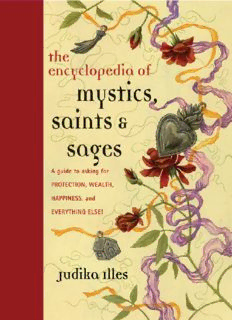
Table Of ContentThe Encyclopedia of Mystics, Saints &
Sages
A Guide to Asking for Protection, Wealth, Happiness, and Everything
Else!
Judika Illes
Dedication
To Rachel and Jordan, without whose love, patience,
and support this book could not have been written.
Epigraph
The dead don’t die. They look on and help.
D. H. LAWRENCE
Contents
Cover
Title Page
Dedication
Epigraph
Introduction
Your Friends, Allies, and Guardians from Beyond the Grave
Ghosts and Vampires
Ancestors, Spirit Guides, and Saints
Stars and Martyrs
Working with the Saints
Finding Your Saints
Using This Book
Glossary
Mystics, Saints, and Sages: A–Z
A
B
C
D
E
F
G
H
I
J
K
L
M
N
O
P
Q
R
S
T
U
V
W
X
Y
Z
Appendix I: Calendar Systems
Appendix II: Saints and Their Patronages
Bibliography
Acknowledgments
About the Author
Credits
Copyright
About the Publisher
Introduction
Your Friends, Allies, and Guardians from Beyond the Grave
I
f you randomly ask people to identify their favorite saints, they may say Saint
Anthony, Joan of Arc, or Saint Christopher, but they are also likely to name
the head of their local animal shelter, a selfless physician, or even their long-
suffering grandmother. Although all these people may be saintly, if they are still
alive then, by definition, they are not saints—or at least, not yet.
A saint is someone who, having died, does not entirely depart this mortal coil
but remains accessible in order to provide assistance and produce miracles for
the living. That is the simplest and most technically accurate definition of a
saint. Over the years, the word “saint” has acquired additional connotations and
so the dictionary may list other definitions as well. However, from a spiritual
perspective, a true saint must conform to two criteria:
• A saint is no longer alive.
• A saint has a history of producing or facilitating miracles from beyond
the grave.
Once those two criteria are met, however, all bets are off. Saints come from all
walks of life and all spiritual traditions. They derive from every ethnicity,
gender, nation, and era. There are child saints and saints who achieved venerable
ages. By any definition, many saints were “good” people while they were alive;
they gave to the poor, healed the sick, fed the hungry, and sublimated their own
personal desires to the needs of others. However, not all “saintly” people become
saints after they die. Conversely, others who now fulfill all the requirements of
sainthood may not have been particularly nice when they were breathing—some
robbed, raped, pillaged, persecuted others, and even murdered.
The notion that not all saints were saintly or that saints may derive from
The notion that not all saints were saintly or that saints may derive from
spiritual traditions other than Christianity often surprises and even shocks
people. Part of the confusion regarding saints derives from linguistic limitations.
In the 21st century, the word “saint” is used to express multiple concepts, many
having little to do with the original notion of sainthood.
Saint is used as a synonym for “extremely good,” “selfless,” or “long-
suffering.” Thus Mother Teresa was frequently described as a saint while she
was alive and operating orphanages in Calcutta. However, now that she is dead,
in order for her to become an officially recognized Roman Catholic saint, there
must be evidence and testimony indicating that she has produced at least two
miracles from beyond the grave. Being considered “exceptionally good” is not
sufficient for being regarded as a true saint. “Saintly” and “saint” are not
synonyms.
Another reason for the confusion that exists regarding saints is our general
cultural reluctance to discuss spiritual matters, especially those with a
supernatural tinge. This general disinclination to contemplate or discuss the
mystical emerged with a vengeance in the 18th century with the birth of what is
now called the Age of Reason.
During the Age of Reason, how people thought—the way they thought—was
dramatically transformed, as were the topics they thought about. Things and
concepts once accepted blindly and without question were now closely
considered and analyzed. It was the beginning of a new age in which rational
thought was revered as opposed to the faith valued by earlier generations. Myth
busters and debunkers emerged, questioning previously deeply held beliefs,
demanding evidence and proof. Among the topics reexamined and reassessed
were the after-life, the soul, miracles, communication between the living and the
dead, and paranormal powers—all subjects inextricably intertwined with
sainthood.
Scientific method was formalized during this era. Scientific method is a
system involving a series of clearly defined and mandatory steps, intended as a
way of proving things to be true or false, fact or fiction. First a hypothesis is
made—an assumption or statement to be proved or disproved. In attempts to
prove or disprove this hypothesis, evidence is gathered and experiments
conducted. In order for the hypothesis to be proven, results must be reproducible
by other researchers. By definition, scientific method thus acknowledges and
validates events, beings, experiences, and things that are standardized and
predictable, while discounting others.
Saints produce miracles, and miracles, by definition, are unique events that
Saints produce miracles, and miracles, by definition, are unique events that
defy reason and logic. To fully discuss saints—especially the extraordinary
powers many of them demonstrated in life and the miracles attributed to them
after their death—thus defies scientific method and social convention. By this
reasoning, to demonstrate familiarity with this topic demonstrates familiarity
with superstition. Thus, it is not surprising that many prefer to consider saints as
role models rather than as miracle workers—at least during public discussion.
From the late 18th century through the 20th century, discussion relating to the
supernatural or miraculous was generally avoided in polite, educated society.
However, the beginning of the 21st century marked a new revolution—an
explosion of interest in the paranormal, as well as a willingness to speak openly
about topics previously only whispered. Many are no longer afraid to describe
experiences they may have had that cannot be proved with conventional logic
and reason. Television programming on many channels is dominated by ghost
hunters. And so, it may be time for an honest and frank discussion of saints, our
friends and allies on the Other Side.
Ironically, life’s biggest mystery may be what happens after it ends.
Philosophers, mystics, theologians, and religious leaders have debated this
conundrum for millennia. Their responses can be boiled down to three options,
although obviously many fine variations exist.
• Immortality: A person possesses an immortal soul that leaves the body at
death and travels to an after-life realm like Heaven, Hell, Valhalla,
Avalon, the Western Paradise, and innumerable others.
• Reincarnation: A person possesses an immortal soul that, through the
process of reincarnation or transmigration, passes from one corporeal
body to another, lifetime after lifetime, incarnation after incarnation.
After you die, you will eventually and literally be born again, albeit in
another form or as another person.
• Finality: Death is final. Individual existence terminates at death. Our
bodies deteriorate and our lives fade from memory, although the names
of exceptional or famous people, as well as the basic facts of their lives,
may be recalled. Human life is as ephemeral as grains of sand dissolving
in the sea.
Each of these theories has its proponents—billions of them. It is possible that
each is correct—that different fates await different individuals. Some may pass
into another realm, some may pass into a new form, and some may pass into
into another realm, some may pass into a new form, and some may pass into
oblivion. This corresponds with the universal folk belief that souls of the dead
differ in how they interact with the living. In other words, not all souls of dead
people behave the same way.
Most dead people, whatever their after-life fate, are never heard from again.
Most pass from this existence completely, living only in the memories of those
left behind. These dead souls neither help nor harm the living. They are literally
the silent majority of the dead, but there are exceptions. Saints are among those
exceptions.
Certain souls of the dead do not depart—or at least not entirely. They linger
among the living for varying purposes, sometimes beneficial, but sometimes not.
The souls of the dead who remain concerned with the living for one reason or
another have traditionally and in folklore been divided into categories:
• Ghosts
• Vampires
• Ancestors
• Spirit guides
• Saints
Ghosts and Vampires
Ghosts are defined as souls of the dead who remain on the earthly plane,
haunting the living because they have unfinished personal business. Something
or someone keeps them tied to the realm of the living. There are also ghosts who
reputedly linger because they are unaware that they are dead. Something in their
transition process from life to death was botched. However, beyond their
presence, which may be inadvertently frightening, these ghosts do not
intentionally impact the living.
Some ghosts seek justice or vengeance, but not all ghosts are innately harmful.
They may also remain in order to protect loved ones or just to linger in their
presence. Other ghosts feel protective or attached to a specific location or object.
Once a ghost’s unfinished business is complete, it usually leaves and may never
be heard from again, although some are very persistent.
Although many consider serious discussion of ghosts and vampires
Description:World-class spell collector, fortune teller, psychicpractitioner, spirit worker as well as independent scholar, writer, and teacher,Judika Illes offers acomprehensive encyclopedia of the sacred, helpful mystics, saints, andsages from a large variety of religious traditions who can, whenvenerated, pr