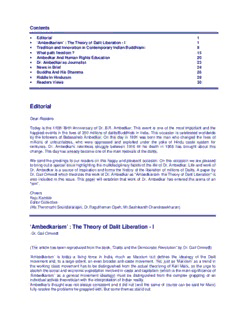
Table Of ContentContents
• Editorial 1
• ‘Ambedkarism’ : The Theory of Dalit Liberation - I 1
• Tradition and Innovation in Contemporary Indian Buddhism: 9
• What path freedom ? 15
• Ambedkar And Human Rights Education 20
• Dr. Ambedkar as Journalist 23
• News in Brief 24
• Buddha And His Dhamma 26
• Riddle In Hinduism 28
• Readers Views 30
Editorial
Dear Readers.
Today is the 110th Birth Anniversary of Dr. B.R. Ambedkar. This event is one of the most important and the
happiest events in the lives of 250 millions of dalits/Buddhists in India. This occasion is celebrated worldwide
by the followers of Babasaheb Ambedkar. On this day in 1891 was born the man who changed the lives of
millions of untouchables, who were oppressed and exploited under the yoke of Hindu caste system for
centuries. Dr. Ambedkar's relentless struggle between 1916 till his death in 1956 has brought about this
change. This day has already become one of the main festivals of the dalits.
We send the greetings to our readers on this happy and pleasant occasion. On this occasion we are pleased
to bring out a special issue highlighting the multidisciplinary facets of the life of Dr. Ambedkar. Life and work of
Dr. Ambedkar is a source of inspiration and forms the history of the liberation of millions of Dalits. A paper by
Dr. Gail Omvedt which theorizes the work of Dr. Ambedkar as "Ambedkarism- the Theory of Dalit Liberation" is
also included in this issue. This paper will establish that work of Dr. Ambedkar has entered the arena of an
"ism".
Cheers
Raju Kamble
Editor Collective
(Ms.Thenmozhi Soundararajan, Dr.Raguthaman Opeh, Mr.Sashikanth Chandrasekharan)
‘Ambedkarism’ : The Theory of Dalit Liberation - I
-Dr. Gail Omvedt
(The article has been reproduced from the book, “Dalits and the Democratic Revolution” by Dr. Gail Omvedt)
‘Ambedkarism’ is today a living force in India, much as Marxism is:it defines the idealogy of the Dalit
movement and, to a large extent, an even broader anti-caste movement. Yet, just as ‘Marxism’ as a trend in
the working class movement has to be distinguished from the actual theorizing of Karl Marx, so the urge to
abolish the social and economic exploitation involved in caste and capitalism (which is the main significance of
‘Ambedkarism’ as a general movement idealogy) must be distinguished from the complex grappling of an
individual activist-theoretician with the interpretation of Indian reality.
Ambedkar’s thought was not always consistent and it did not (and the same of course can be said for Marx)
fully resolve the problems he grappled with. But some themes stand out:
First, an uncompromising dedication to the needs of his people, the Dalits (as he said once in response to a
legislative council claim that he should think as ‘part of a whole’- ‘I am not a part of a whole; I am a part apart)
which required the total annihilation of the caste system and the Brahmanic superiority it embodied:
Second an almost equally strong dedication to the reality of India-- but an India whose historical--cultural
interpretation he sought to wrest from the imposition of a ‘Hindu’ identity to understand it in its massive,
popular reality;
Third a conviction that the eradication of caste required a repudiation of ‘Hinduism’ as a religion, and adoption
of an alternative religion, which he found in Buddhism, a choice which he saw as not only necessary for the
masses of Dalits who followed him but for the masses in India generally;
Fourth, a broad economic radicalism interpreted as ‘socialism’ (state socialism’ in some versions; ‘democratic
socialism’ in others) mixed with and growing out of his democratic liberalism and liberal dedication to individual
rights;
Fifth, a fierce rationalism which burned through his attacks on Hindu superstitions to interpret even the
Buddhism he came to in rationalistic, ‘liberation theology’ forms;
And finally, a political orientation which linked a firmly autonomous Dalit movement with a constantly attempted
alliance of the socially and economically exploited (Dalits and Shudras, ‘workers’ and ‘peasants’ in class
terms) projected as an alternative political front to the congress party he saw as the unique platform of
‘Brahminism’ and ‘Capitalism’.
However, Ambedkar, like Marx, did not spend the major part of his active life in research and writing, with
political activism as a sideline; rather, the demands of leadership absorbed the major part of his time. The
1930s being a period of intense turmoil there was little space for writing. Though many of his crucial ideas
were formed during the 1930s, almost all of his writings came in the 1940s and 1950s, when he was spending
most of his time in Delhi, as Labour Minister and the general spokesman for the untouchables. During the
1930s he not only adopted but also sought to give a political embodiment to a general left ideology combined
with the theme of caste annihilation. Yet the decade came to an end with the failure of a left alternative to the
bourgeois- Brahmin Congress, and the 1940s were very different, an era of Congress hegemony was firmly
established in the national movement at the same time as the traumatic transition to independence in a period
of global upheavals overshadowed everything else. The particular characteristics of this latter epoch have to
be understood as a background to Ambedkar’s strategy and analysis.
THE CONTEXT OF STRATEGY AND THEORY
The 1940s were a period of brutal confrontation with the most reactionary social power known in the world up
to that time, fascism; and they ended with the unleashing of atomic energies in the burning of two Japanese
cities, forecasting the technological furies that would overshadow human development for decades. For many
throughout the world, the peace that followed was a period of hope, with the emergence of newly liberated
nations throughout Asia and Africa, and the achievement of socialism by many peoples of the world. That
Stalin represented not only ‘socialist’ development but a brutal tyranny; that socialism came to vast areas not
by working class revolt but with the march of the Red Army; that traditional (and sometimes new) elites
remained firmly in control of independent Third World nations, all were debatable points that bothered very few
in countries like India at the time. The final phases of the independence struggle represented for many as
upsurge of hope and a direction towards a popular, socialistic independence.
Yet within India itself the period held a great deal of internal malaise. Several major characteristics defined it,
and represented the context in which Ambedkar sought to win some share in liberation for the untouchable
masses of India.
1. The hegemony of Marxism on the left: in India as in most of the world the liberation of exploited and
oppressed groups was to be seen as being realized through socialism, defined in terms of collective
ownership of the means of production and working class share in power as exercised through a party
acting in its name. Yet this hegemony contrasted with an extreme immaturity and weakness of the
communist movement in India, which could not exert any decisive influence on events. As in most other
Third World countries, therefore, the hegemony of ‘Marxism’ evoked a situation in which ‘collective
ownership’ was defined in terms of state ownership; the dominant nationalist party replaced the working
2
class party with claims to represent the oppressed masses; and ‘socialism’ came to mean public control
and planning of an industrialization conceived on the model of western capitalism.
2. Hindu- Muslim communalism was the overriding political reality by the 1940s. The constitution of the
‘Muslim community’ and the ‘Hindu community’ as dominant social realities was correlated with the explicit
or implicit acceptance of ‘Hinduism’ as the central religious-cultural identity of ‘India’. The ideological
approach of the Congress progressives was either to argue, with Gandhi, for a reformed Hinduism in
which the two communities lived in harmony (i.e. interpreting the ‘nation’ as a federation of religious
communities) or, with Nehru, for a secularism that exalted modernity and defined the ‘nation’, along with
‘class’, as transcending what were really feudal and backward religious and cultural identities. The
communists essentially followed the Nehru line, with an even stronger emphasis on class. Both accepted
the realities of ‘Hindu’ and ‘Muslim’ identities, of course-thereby eclipsing issues of caste and
linguistic/tribal nationalities. Both gave scope for Hindu nationalism because they did not confront the very
basis of the ‘Hindu’ identity attributed to Indian tradition.
3. The event of independence and partition brought a near-complete marginalisation of Gandhi and
Gandhism. With all the rhetoric of ‘Panchayat raj’ and khadi, it was ‘Nehruism’ that gained hegemony
ideologically. This approach advocated a broad ‘Third World alliance and made socialism and a heavy-
industry oriented development-- dominated by planning and controlled by the public sector-- the theme of
power. But with all its reasonableness and ‘secular’ focus in contrast to Gandhi’s ‘peasant backwardness’,
Nehruism, whose main tendency was to override, or at best to ignore, issues of caste and local identities,
allowed even more for Brahman dominance. To a very large degree, even while representation in the
political sphere broadened, the ‘public sector’ was to be a high-caste preserve.
In this context, the Dalit movement under Ambedkar’s leadership could only be a passive observer of most
major events, at best exerting its minor influence to achieve some gains and concessions. The failure of
Marxism in India to open itself to fertilization of theory and practice by the anti-caste movements, and the
failure of Gandhism to go beyond a spiritualistic and Hinduistic interpretation of a decentralized and
village-based development left the anti-caste movement in a vacuum. By the 1940s, it could effectively
operate only as a pressure group.
CASTE, CLASS AND MECHANICAL MARXISM
Ambedkar had said, in his 1938 speech to the peasants marching to Bombay, that he felt the communist
philosophy’ to be ‘closer than any other’ (though significantly qualified this ‘in regard to the class struggle
of toilers’). It is undeniable that his class-caste’ paradigm was basically formed during the 1930s in the
course of his confrontation with Marxism, as it was presented to him in India, thus exerted as important
and continuing influence not only over his economic theory but also over his interpretation of caste in
society.
We have noted that during the 1920s Ambedkar had dismissed communism by saying that he agreed with
the ‘ends’ of socialism but disagreed with the ‘means’ of violence. This theme was resurrected towards the
end of his life as a major point of defense of Buddhism against Marxism. During the radical years of the
1930s, however, there was no such rejection of Marxism on the grounds of violence. The thrust of
Ambedkar’s attack was against the religious-inspired ‘non-violence’ of Gandhism. In fact the main point of
his critique of violence was always that communist-led strikes and actions were often ‘adventurous’, that
they needlessly harmed the weakest sections of the working class (Dalits) and sacrificed people’s lives in
campaigns that tried to be militant for the sake of militancy. In other words, it upheld non-violence more as
a strategy than as a principle, and it specifically rejected Gandhian non-violence-as-religious-principle. The
critique as such, then, is not a major point separating Ambedkar from ‘the communist philosophy’, though
when it was linked to the denial of the leading role of the proletariat it did become so.
In fact, aside from adding ‘caste’ to ‘class’ and ‘Brahminism’ to ‘capitalism’ there were surprising
similarities between the basic assumptions of Ambedkar and the leftists. In a situation in which
communists and socialists alike took no official note of caste in the pre-independence period and simply
assumed that radicalism required an explanation of all social problems in terms of their ‘class’ content,
Ambedkar of course strongly insisted on the addition of ‘caste’ and ‘Brahminism’ as crucial social realities.
Yet in doing so, he like most of his later followers accepted some crucial assumptions of the ‘class’
framework.
A serious critical article on Marxism appeared in a 1936 issue of Janata and was reprinted in 1938 as
a front page article entitled ‘The Illusion of the Communists and the Duty of the Untouchable Class’. In
taking the relations of production as the basis of the ‘economic interpretation of history’, the article made a
clever twist of reversal in the often-used architectural analogy of ‘base and superstructure’:
3
But the base is not the building. On the basis of the economic relations a building is erected of
religious, social and political institutions. This building has just as much truth (reality) as the
base. If we want to change the base, then first the building that has been constructed on it has
to be knocked down. In the same way, if we want to change the economic relations of society,
then first the existing social, political and other institutions will have to be destroyed.
The article went on to make other important reversals. To build the strength of the working class, the
mental hold of religious slavery would have to be destroyed; the pre-condition of a united working class
struggle was the eradication of caste and untouchability. Similarly, destruction of casteism could be taken as
the main task of the ‘democratic’ stage of a two-stage revolution: it would not be fully anti-capitalist because
capitalism would not be opposed to the eradication of caste as such (freeing potential workers from caste
restrictions would increase the reserve army of labour) and, at the same time. Socialists should welcome the
effort at uniting the working class. (Thus there was some unity of interests between the workers and the
‘radical bourgeoisie’ in the ‘democratic’ stage). The removal of untouchability and caste discrimination is thus
the first stage in the struggle for the Indian revolution, and it is impossible for socialists to bypass it.
However, expressing great disillusionment with the Congress socialists and Nehru, the article concluded that
untouchables would have to pool all their strength into the fight against untouchability, without expecting
much socialist help.
The positions taking here represented a reaction to and a sharing of the assumptions of a mechanical,
economistic form of Marxism. Only ‘class’ exploitation was seen as having a material base and as being part
of the relations or production; caste and all other ‘non-class’ types of oppression (women’s oppression,
national oppression, etc.) were seen as primarily socio-religious, in the realm of consciousness and not
material life. Ambedkar accepted this frame-work and simply reversed it to assert the causal importance of
social-religious-political factors; he took a mechanical architectural analogy and turned it around to give
primacy to the ‘superstructure’. The logic of the process exemplifies the way in which a mechanical
materialism fosters idealism. If caste oppression/exploitation was central (and Ambedkar and all Dalits and
low caste activists could not but help understanding it as central) then the basic logic led them to argue that
this could only mean that socio-religious factors, factors of ‘consciousness’, were important and even
primary. In other words, there was no theoretical trend that sought to analyze a material base for caste as
Phule had done at a primary level half a century before.
Just as clearly we can see in the argument the results of the often heard cliché that an anti-caste struggle is
a part of the democratic revolution, not of socialist revolution. For communists this could not but mean (at
some basic emotional level) that the issue was of secondary importance. Ambedkar of course saw it
differently. In effect he was motivated to say: all right, if this is ‘only’ the democratic revolution this is what we
have to be concerned about here and now; you far-sighted revolutionary leaders go ahead and worry about
the socialist revolution, we have to get on with the immediate task (which you are not helping with in any
case); it’s all the more urgent to concentrate on this since no one else is around to do it. We will fight for the
democratic revolution. This logic was what undoubtedly moved Ambedkar, after the ‘years of radicalism’ won
no decisive gains, to put his efforts during the 1940s into the scheduled Caste Federation as a strong
pressure group within a democratic framework, with an indefinite postponement of a broad revolutionary
struggle.
Ambedkar’s acceptance of many of the basic assumptions of a mechanical Marxism remained throughout
his life and can be seen in his final writings on Buddha and Marx. Its most importance aspect is the
identification of economic exploitation with private property. Ambedkar’s note took it as established that a
great many errors in Marx’s original analysis (including the concept of the inevitability of socialism, the
vanguardship of the working class) made it invalid, but concluded,
What remains of Karl Marx is a residue of fire, small but very important…
(i) the function of philosophy is to reconstruct the world and not to waste its time in explaining the
origins of the world,
(ii) there is a conflict of interest between class and class,
(iii) private ownership of property brings power to one class and sorrow to another through
exploitation,
(iv) it is necessary for the good of society that the sorrow be removed by the abolition of private
property.
4
Ambedkar went in this article to argue that Buddhism, in the Sangha abolished private property more
thoroughly and without bloodshed and was therefore superior to Marxism, but that is beside the point. The
point is that here he accepted the definition of class and exploitation as being a result of private property.
This was the common theme of the Marxism of his time. It led to defining ‘socialism’ in terms of ‘nationalism’
in which collective ownership of the means of production (or the abolition of private property) could be
achieved through state control; and it continued to accept the idea that modern factory production i.e,
industrialization, constituted the economic basis of socialism. Thus, Ambedkar could term his own version of
socialism as ‘state socialism’ and call for ‘nationalization of land’, or public control of the ‘commanding
heights’ of the economy much as the Nehru socialists did without much concern for the structures of
domination and exploitation embodied in state-owned properties.
Tasking standard left economic assumptions for granted had two consequences for Ambedkar and the Dalit
movement: First, it led to attempts to formulate a historical theory of caste and social struggle in India that
functioned primarily at the ‘superstructural’ level, stressing factors of political conflict and ideology apart from
those of economic development. Second, it effectively suppressed any dialogue with alternative economic
models and ignored the degree to which a state-controlled heavy industry would be effectively a Brahmin
and high caste-controlled economy.
But was there any real alternative before Ambedkar at the time? His ‘State socialism’ was , after all, part of a
very broad consensus that saw development in terms of industrialization and nationhood in terms of a
centralized, strong, unitary state; Liberal capitalists shared this as much as socialists, and though they
disagreed about whether private or state control would be most effective, all ‘developmental economists’ by
the late 1940s and early 1950s accepted some major role for the state. Today this developmental movement
with its rejection of Nehru’s big dams as ‘modern temples’ to the farmers movement and women’s
movement, all putting forward calls for some kind of ‘alternative development’. But in Ambedkar’s time
decentralized socialism did not appear as a political viable alternative. In India, a decentralized, village-
based form of development was connected with the Gandhian tradition; to Ambedkar and militant Dalits or
non-Brahmins this did not simply promote a village society and development along the lines of Indian
tradition, it prompted Ram-raj; it was not simply critical of modern science and technology; it was soaked in
Hindu religious themes, including the belief in chaturvarnya, the moralistic acceptance of brahmachari and a
claimed principled belief in non-violence. These were not acceptable to Ambedkar nor could they meet the
needs of low castes aspiring to liberation. The fact that no other tradition of an alternative decentralized
socialism existed in India helped to push Ambedkar towards a bureaucratized state socialism, with all the
dilemmas of Brahmanic statism that this involved.
THE ECONOMICS OF A FELXIBLE SOCIALISM
Ambedkar’s two major writings on economic issues appeared in the early 1920s, and while they bear the
mark of a generally neo-classic economic theory, they also show both his general identification with the
working classes and a harsh critique of imperialism.
‘The Problem of the Rupee’ though dealing with the general history of the state and currency in British India,
was published in 1923 in the very specific context of a struggle between nationalist and the British
government over the exchange rate. Following the war, the government had maintained a high official
exchange rate of 2 shillings (2s) to the rupee, which was opposed fiercely by Indian businessmen with the
backing of the Congress. They attacked it as overvalued, an ‘enormous wrong and legalized plunder of
Indian resources’ which aided the British bureaucracy (whose salaries and pensions became more valuable
in terms of the sterling) and British exporters to India at the expense of Indian producers and exporters. They
agitated for a low exchange rate 1s.4d. The government appointed a royal commission ; Ambedkar testified
before it, broadly supporting devaluation but at a compromise ratio (1s.4d) which he argued would maintain
the interests of the ‘business classes’ as well as the ‘earning classes’ who would suffer from the price rise
brought about by devaluation.
The book itself was a scathing critical analysis of British currency policy over the years. Read in the context
of current debates on economic policy, it shows Ambedkar as a modern supporter of devaluation and an
economic who assumed that within an open economy India could well compete at the global level (he notes
that Indian exports and manufactures gained at the expense of the British during the period of the low
rupee). Yet there are qualifications: the concern for balancing capitalist and labour interests, the argument
that Indian growth and exports were actually at the cost of falling real wages of the working class, and a tone
5
of hostility both to businessmen and commodity-producing peasants. His conclusion perhaps gives his
perspective: with a high ratio, ‘the burden… imposed upon the active and working element of a society
would be intolerable’ but a too-low ratio would put the burden on wage earners.
I myself would choose 1s.6d. as the ratio at which we should stabilize… (1) it will conserve the position of
the investing and earning classes; (2) it does not jeopardize our trade and prosperity by putting any extra
burden on the business class; and (3) being the most recent in point of time it is likely to give greater justice
to the greater number of monetary contracts most of which must be recent in time.
And in fact it was the 1s.6d ratio which the British government accepted.
The Evolution of Provincial Finance in British India, published in 1925, also condemns British imperialism in
its description of the way in which British fiscal politics had impoverished India. Ambedkar attacked the
irrationality of British taxation methods, charging that ‘While the land tax prevented the prosperity of
agricultural industry the customs taxes hampered the manufactures of the country. There were internal
customs and external customs and both were equally injurious to trade and industry and that basic taxes like
the salt tax and the form of the land tax itself lay most heavily on the poor. It was clear, he noted, that the
British government was running India in the interest of British manufacturers.
Both the critique and the discussion in The problem of the Rupee were well within the framework of standard
economics: that is, Ambedkar did not see the ‘development’ of a backward ex-colony as a problem, once the
artificial barriers imposed by the colonial state were removed; many aspects of colonial rule were described
as progressive (primarily those having to do with establishing the infrastructure for growth) and the primary
barriers to progress seen as more social than economic. The British government, Ambedkar noted, not only
exploited economically but it could not act against social evils:
It could not sympathize with the living forces operating in the Indian society, was not charged with its wants,
its pains, its cravings and its desires, was inimical to its aspirations, did not advance Education, disfavoured
Swadeshi and snapped at anything that smacked of nationalism…the Government of India dared not abolish
the caste system, prescribe monogamy, alter the laws of succession, legalize intermarriage or venture to
tax the tea planters. Progress involves interference with the existing code of social life and interference is
likely to cause resistance…”
Ambedkar went on to argue that it would be social more than economic causes that led to nationalist revolt:
It is foolish to suppose that a people will indefinitely favour a bureaucracy because it has improved
their roads, constructed canals on more scientific principles, effected their transportation by rail,
carried their letters by penny post, flashed their messages by lighting, improved their currency,
regulated their weights and measures, corrected their notions of geography, astronomy and
medicines and stopped their internal quarrels. Any people, however patient, will sooner or later
demand a government that will be more than a mere engine of efficiency.
This period, in other words, see Ambedkar as a general supporter of a capitalist organisation of the
economy, assuming its inevitability and capability of providing growth and being amenable to a balancing of
interests. In this model, the role of the state was to provide infrastructure and generally handle currency and
exchange so as not to discriminate against any of the major business or agricultural classes of the country.
Though he referred to Keynes, the period, is clearly as much pre-keynes and pre-‘development’ as pre-
Marx. That capitalist economies could come into major crisis; that specific state-guided development and
even state enterprises was necessary to lift Third World countries out of their poverty was not part of
economic discourse at this time.
Then came the late 1920s and the 1930s, the depression, the new momentous force for change represented
by the Russian revolution, the upsurge of the working class in India itself and Ambedkar’s own theoretical
and practical confrontation with Marxism. Not only did socialism, defined in terms of state ownership of the
means of production, begin to appear as a viable reality for working class emancipation; it also began to
seem to be the best route to development for an economically backward ex-colony. Even standard
‘development economics’ by the post-war period began to assume the necessity of a major role of the state.
In the context of all of these developments, Ambedkar became a socialist, but not a socialist who had time to
work out his economic theory. There were, in fact, no economic writings after the 1920s.
By the middle of the 1930s, he swung into an economic radicalism that included the main themes of his time:
the exploitation of capitalists and landlords, the need for state control. His economic thrust underwent a
major change. This could be seen especially in regards to agriculture. His early writings had expressed
6
support for small peasant property as the alternative to landlordism (in fact arguing that in terms of available
capital equipment, farms were if anything too large); by the time of the Scheduled Caste Federation election
manifestos he was arguing that for enhanced production agriculture had to be mechanised. This meant that
large farms would replace small ones, and this could be most effectively done through cooperative or
collective farms. The notion of state-guided development, oriented to industrialization, was taking
precedence.
The climatic statement of this economic radicalism came in States and Minorites, written as a submission
to the Constituent Assembly in 1948, and expressed in the form of proposed constitutional clauses. As a
statement of a general economic and social programme, this is a somewhat eccentric form. In fact, only two
years before Ambedkar had rejected the idea of a constituent assembly, in language that made it clear he
did not see the constitution as a means for either establishing socialism or liberating the scheduled castes.
He had said,
I must state that I am wholly opposed to the proposals of a Constituent Assembly. It is absolutely
superfluous…. There are hardly any big and purely constitutional questions about which there can be said to
be much dispute among Indians. It is agreed that the future Indian constitution should be federal. It is also
more or less settled what subjects should go to the Centre and what to the Provinces. There is no quarrel
over the division of Revenues between the Centre and the Provinces, none on Franchise, and none on the
relation of the Judiciary to the Legislative and the Executive…. The only function, which could be left to a
Constituent Assembly is to find a solution of the Communal Problem.
Yet, two years later he was submitting a memorandum that sought to make the constitution a means for the
establishment of socialism! The economic section of States and Minorities calls for ‘State socialism’,
including for the nationalization not only of basic industries but also of land and its working in collective
farms, with peasants treated as tenants of the states. Arguing in terms of both developmental needs and
protection of working class rights, Ambedkar wrote, “State Socialism is essential for the rapid
industrialization of India. Private enterprise cannot do it, and if it did it, it would produce those inequalities of
wealth which private capitalism has produced in Europe. He described pithily the effects of poverty as
making ‘Fundamental Rights’ meaningless, and talks of capitalist tyranny:
Constitutional Lawyers… argue that where the state refrains from intervention in private affairs- economic
and social- the residue is liberty. What is necessary is to make the residue as large as possible and State
intervention as small as possible…. (But) to whom and for whom is the liberty? Obviously this liberty is
liberty to the landlords to increase rents, for capitalists to increase hours of work and reduce rates of wages.
It must be so. It cannot be otherwise. For in an economic system employing armies of workers, producing
goods en masse at regular intervals some one must make rules so that workers will work and the wheels of
industry run on. If the state does not do so the private employers will…. In other words, what is called liberty
from the control of the state is another name for the dictatorship of the private employer.
Clearly Ambedkar, like all socialists and nationalists of his time, was conceiving ‘socialism’ as a regimented
industrialized economy. Thus the basic proposals of ‘state socialism’ called for state ownership and
management of ‘key’ industries and state ownership of ‘basic’ industries; a monopoly of insurance; and
agriculture declared as a state industry, with the state to acquire (with compensation) rights to land, divide
the land into farms of ‘standard size’ and let them out for cultivation to the residents of the village ‘as tenants’
to cultivate as a collective farm, in accordance with rules and directives issued by Government, with the
produce to be distributed in shares among the tenants. It was added,
(ii) The land shall be let out to villagers without distinction of caste or creed and in such manner that there
will be no landlord, no tenant, and no landless labourer;
(iii) It shall be the obligation of the state to finance the cultivation of the collective farm by the supply of
water, draft animals, implements, manure, seeds, etc.
The state would then levy charges for the land revenue, to pay the compensation charges, and pay for the
capital goods supplied.
Clause (iii) could be interpreted to argue that the state would provide the necessary inputs according to the
wishes of the farming community, or simply provide financing for inputs that may be procured locally; but still
there seems to be an assumption (as with private ‘industrial-chemical agriculture’) that inputs for state
agriculture would come primarily from outside the village. Here is an assumption, not only that the state is
benign but that agricultural production (like industrial production) can very well be managed and directed
7
from above. The fervour to abolish the inequalities of social relations of ownership is clear ( though even
here, in allowing compensation, Ambedkar is not going as far as the left radicals), but neither the problems
of economic exploitation involved in state management nor those of the process of production in agriculture
have been given any thought.
Following this, a completely separate section on the protection of scheduled castes as minorities describes
their oppression by caste Hindus and argues strongly not only for a series of safeguards but also for
separate electorates and separate village settlements, which the state is to set up by giving Dalits forest
lands or wastelands. In regard to this, Ambedkar argues that the roots of discrimination lie in the village
system itself:
So long as the present arrangement continues it is impossible for the Untouchables either to free
themselves from the yoke of the Hindus or to get rid of their Untouchability. It is the close knit association
of the Untouchables with the Hindus living in the same village which mark them out as Untouchables…. It
is the system of the village plus the Ghetto which perpetuates Untouchability and the Untouchables
therefore demand that the nexus should be broken and the Untouchables who are as a matter of fact
socially separate should be made separate geographically and territorially also and be settled into
separate villages exclusively of Untouchables.
While this passage is followed by a description of the dependence of Dalit labourers on caste Hindu
peasants for wages, it makes no reference to a solution in terms of giving Dalits a share in the land in the
same village (in fact the first paragraph rules this out by describing untouchability as a reality even beyond
economic oppression) while the section on the ‘nationalization of land’ makes no mention of whether the
nationalized villages of untouchables are to be separate. It is as if these are two parallel solutions to the
problems of Dalits, one economic, one social, lines which never meet.
States and Minorities is in many ways a puzzling book though remarkable book. At one level it shows the
heights of radicalism Ambedkar reached in terms of both economic and caste issues, with his calls for ‘state
socialism’ on one hand and the path of protective measures, separate electorates and separate villages for
Dalits on the other. Yet it also shows the disjuncture between these-- as if the programme for liberation was
itself paralleling phenomena operating on different levels of social reality.
Not only is there no linkage between economic section and the scheduled caste-as-minority section of the
book, there is also no linkage to strategy. Ambedkar discussed the fallacies of leaving the construction of
socialism to 'the whims of a parliamentary majority’, giving this as the justification for the necessity of writing
the clauses into the constitution itself. But both in regard to state socialism and to the strong concessions to
scheduled castes, was there any possible basis for thinking that the tremendous influence of landlords,
capitalists and upper caste Hindus would admit such a constitution?
Ambedkar was after all a political realist. States and Minorities was, it must be concluded not intended as a
serious political document outlining a programme but as a manifesto designed to be extreme and
provocative, not so much to achieve the implementation of the points it set forth as to draw attention to it’s
author. Its focus was social equality, not a plan for organizing the economic production of a society. Whether
or not he thought it was ‘superfluous’, a constituent assembly was being called; Ambedkar had not been
included though he wanted to be, if only to ensure the continued provision of safeguards for the Dalits.
States and minorities was designed to achieve this goal mainly, and secondarily to throw some ideas for the
future of India before the public. It was a radical, idealistic manifesto aimed at some very partial but highly
political goals.
In the end, what is striking about Ambedkar’s economic radicalism is the extent to which it was interpreted in
terms of the rationalistic 'modernism' of his time: it included a belief in the necessity of industrialization, and
the guiding role of the state as inherently progressive if it could be shielded from the vagaries of often
manipulated political majorities. By the time States and Minorities was written, Ambedkar was intensely
pessimistic about these ‘political majorities’; there was no organizing on general economic issues, and the
non-Brahmin or Shudra worker-peasant masses seemed ready to identify as ‘Hindus’ in opposition to the
Muslims and sometimes to the Dalits. State protection for Dalits had always been seen essential, even in his
periods of greater faith in the majority; and now in an atmosphere in which India under Nehru appeared set
to adopt planning and a ‘socialist pattern of society’ Ambedkar’s main thrust was to look to this state-guided
development as a solution.
8
On the whole, his socialism had grown out of his interpretation of democracy rather than, as with Marxism a
belief in the revolutionary destiny and world-creating powers of the proletariat. Thus, while he shared the
belief of both liberals and Marxists of his time in the progressive forces of industrialization, science and
modernity, he distinguished his views from communism both in terms of the means necessary to achieve
them and in terms of stressing democracy over the ‘dictatorship of the proletariat’. In a sense, ‘state
socialism’ was aptly named in contrast to ‘proletarian socialism’; it retained the belief in the state as a
necessary phenomena in even a socialist society and sought a share in power of workers and Dalits without
seeing this as creating any unique kind of state. From an orthodox Marxist point of view, this could justify a
rejection of Ambedkar as essentially ‘petty bourgeois’, identifying the idealism (return to religion) and
reformism presumed to be implicit in his theory with a kind of backward ‘peasantist’ consciousness; this has
invariably been the response of even the most favourable left assessments. But this is not a very helpful
classification and implies assumptions about the meaning of ‘proletarian’, ‘peasant’ etc., which do not stand
the test of time very well.
In fact, the development of ‘Ambedkarism’ in India can be seen as the particular expression of a world-wide
‘democratic revolution’ indeed perhaps one possible in Indian conditions (certainly the most consistent than
a ‘proletarian socialism’ which ignored cultural-caste issues and accepted identities such as ‘Harijan’ and
‘Hindu’) one which had grown out of the experiences and situations of the most oppressed sections of the
people. ‘Democratic revolution’ in this sense almost invariably leads towards some kind of socialism, and
this in fact was how Ambedkar saw it. As he wrote towards the end of States and Minorities,
The soul of Democracy is the doctrine of one man, one value. Unfortunately, Democracy has attempted to
give effect to this doctrine only so far as the political structure is concerned by adopting the rule of one
man, one vote….It has left the economic structure to take the shape given by those who are in a position
to mould it. This has happened because Constitutional Lawyers…. never realized that it was equally
essential to prescribe the shape and form of the economic structure of society, if Democracy is to live up to
its principle of one man, one value. Time has come to take a bold step and define both the economic
structure as well as the political structure of society by the Law of the Constitution….
Ambedkar’s specific recommendations for ‘prescribing the economic structure of society’ was state ownership
of basic industries and collective farms; this would be questioned by many today along with his faith in a
centralized, industrial factory-based economy. But that the market by itself cannot guarantee equality, that the
state must play a defining and guiding role--or rather that the members of society must act collectively through
the state to regulate, limit and at points supercede the market-is a thesis that few (at least in the Third World)
would question. This flexible ‘socialism’, coupled with political democracy and non-violent mass struggle,
makes Ambedkar’s economics still relevant today.
... to be continued in next months issue
Tradition and Innovation in Contemporary Indian Buddhism:
Activities and Observances
-Dr. Eleanor Zelliott
(This paper has been taken from Dr.Eleanor Zelliott’s book, “From Untouchable to Dalit. Dr.Zelliott holds a
Ph.D from the University of Pennsylvania, which is one of the early Ph.Ds on Dr.Ambedkar’s movement. Her
findings of this paper are based on her field work in India till 1976. Though the movement with regard to
Dr.Ambedkar’s conversion to Buddhism has spread steadily to other states in the last 25 years, this paper
gives an insight into the growth of Buddhism in the 20 years after Dr.Ambedkar’s Mahaparinirvana-- Editor )
The contemporary Buddhist conversion movement in India arose neither from a missionary enterprise which
carried its own organizational structure and leadership nor from the Buddha-ization of a highly developed
existent religious structure. Unlike any other mass conversion in history, this new religious movement was
almost completely on its own. The massive conversion which began in 1956 largely affected low castes,
particularly Mahars of Maharashtra, who had been involved for decades in battle for political, social and
religious rights. Buddhism was chosen as the religion of conversion because of its qualities of rationality,
equality and intellectual creativity—because it offered a way out of the psychological imprisonment of the
Hindu caste system. Buddhism as an organized religion, however, was almost non-existent in India at that
9
time, and the ex-untouchables who chose to convert had to create leadership, structure, religious observances
and activities from very indirect models and what they created had to be a religion that would fit their own
needs.
The leader of this conversion movement, Dr.B.R.Ambedkar, had been interested in Buddhism most of his adult
life. He had read books on Buddhism which had become a minor part of India’s discovery of her own past in
the twentieth century; he had met some of the men who had, as individuals, become interested in Buddhism;
he had traveled to Ceylon and Burma to see living Buddhist countries; and he had written The Buddha and His
Dhamma, a rationalized life of the Buddha and a selection of texts, chiefly from Pali sources. Moreover, he had
prepared his followers psychologically for a conversion from Hinduism from 1935 on, beginning with his own
statement that he ‘would not die a Hindu’. But the conversion was held suddenly, dramatically and without
much organizational preparation on 14 October 1956, and within two months of it Ambedkar was dead. He had
died a Buddhist, and he had set in motion a movement that soon involved over three million people. But
although the inspiration of Ambedkar’s own example and his invitation to others to follow him were powerful
directives, the organization of the new religion was at a bare minimum.
The structural and leadership elements developed during the long struggle for social and political rights and for
educational opportunities were pressed into service to provide the thrust and direction of the religious
movement. Without the living example of a Buddhist society before them, the ‘new Buddhists’ had to create a
meaningful religious life from the sources available to them: Dr.Ambedkar’s precepts, traditional Buddhism
with whom they came in contact. Most importantly, they had to build that Buddhist society in the light of the
needs of the Buddhist converts, most of them from formerly Untouchable castes, in the context of a dominant
society.
Now twenty years after the conversion, the movement has slowed in garnering numbers. There were 180,823
Buddhists in India in 1951, before the conversion; 3,250,227 Buddhists in 1961, and 3,812,325 Buddhist in
1971, according to the Indian Census. The great bulk of the Buddhists are in Maharashtra, 3,264,000
Buddhists, but there are sizable numbers in urban centres outside that state: 10,000 in Andhra Pradesh,
81,800 in Madhya Pradesh, 14,100 in Karnataka, 87,000 in the city of Delhi, 8,400 in Orissa, 1,300 in the
Punjab, 3,500 in Rajasthan, 1,100 in Tamilnadu, 42,200 in Uttar Pradesh and 39,600 in West Bengal. There is
no single leader, there is no overall organization, but there is flourishing, creative, controversial Buddhist
society which has evolved patterns of Buddhism both innovative and traditional.
My purpose in this paper is to look at some of the visible elements of contemporary Buddhist society in India,
i.e. the place of Dr.Ambedkar in their activities and observances; the buildings that house Buddhist activities;
the leadership which teaches, preaches and conducts ritual; the sorts of public holidays and festivals which
are observed. The Buddhist tradition, the Mahar tradition and the surrounding Indian tradition all have marked
the practices of the Buddhist converts. Much that seems innovative to the Buddhist tradition will be found to be
a necessary carry-over from the convert’s past or an almost unconscious response to the prevailing Indian
(largely Hindu) present. My observations were made in three separate year-long visits to India, 1964-5,
1971and 1975-6. My perspective is limited to Maharashtra, although much of what I observed would also be
found among Buddhist groups in number of cities outside that state.
The Role of Babasaheb Ambedkar
The presence of a picture of Dr.Ambedkar in all Buddhist viharas and at all Buddhist functions seems to set
the Indian Buddhists apart from the main Buddhist tradition. The inclusion of ‘Babasaheb’ Ambedkar as an
object of reverence is the most visible innovation in the practice of contemporary Buddhists in India. The
Buddha and Babasaheb in plaster, stone, poster-art and painting, in song and drama and story, seemingly of
near-equal importance, rarely one without the other, are continual evidence that contemporary Indian
Buddhism proudly combines its own tradition with that of the main Buddhist tradition. Ambedkar is neither
worshipped nor prayed to nor, of course, is the Buddha. No puja is performed, no navas (vows) are made to
either figure, so their functions are not those of a Hindu god. But at every occasion, both figures are garlanded,
the Buddha first; incense is lit; and Bhagwan Gautam Buddha and Parampujya Dr.Babasaheb Ambedkar are
addressed before the speaker acknowledges the Chairman of the function and ‘Brothers and Sisters’.
Efforts have been made to place Dr.Ambedkar in the traditional Buddhist framework. Some Buddhists
acknowledge Dr.Ambedkar as Boddhisatva in recognition of his role in bringing modern Indian converts into
Buddhism, i.e. as a saviour. This use has been justified by, at least, one traditionally trained Thervada
10
Description:happiest events in the lives of 250 millions of dalits/Buddhists in India. The
fervour to abolish the inequalities of social relations of ownership is clear (
though even .. radical and a poet of the new Dalit school of literature, which is
briefly