Table Of ContentNEW
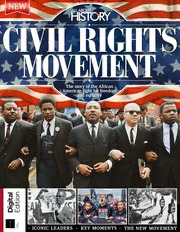
CI V IL RIGHTS
MOVEMENT
The story of the African
American fight for freedom
and equality
ln
a
o
t
i
it
g
i
d
i
D
E
N
HIRD DITIO I CONIC LEADERS K EY MOMENTS THE NEW MOVEMENT
TE
Welcome to
CI V IL RIGHTS
MOVEMENT
Marking 55 years since the landmark Civil Rights
Act was signed into law, this book takes you on a
fascinating journey through the deining moments
of America’s Civil Rights Movement during the
1950s and 1960s. You’ll ind everything from Rosa
Parks and the Montgomery Bus Boycott to Martin
Luther King’s legendary ‘I Have a Dream’ speech and
the March on Washington. Filled with fascinating
features, emotive stories and iconic imagery, the
book explores the origins of the African American
ight for freedom and equality, its achievements
in the face of intense opposition, the movement’s
iconic leaders and their roles, and how it inspired
the new wave of protest and activism currently
sweeping the United States.
CIVIL RIGHTS
MOVEMENT
Future PLC Richmond House, 33 Richmond Hill,
Bournemouth, Dorset, BH2 6EZ
Editorial
Editor Dan Peel
Designer Madelene King
Compiled by Katharine Marsh & Emma Wood
Editorial Director Jon White
Senior Art Editor Andy Downes
Cover images
Donzaleigh Abernathy, Getty Images, Library of Congress, NARA
Photography
All copyrights and trademarks are recognised and respected
Advertising
Media packs are available on request
Commercial Director Clare Dove
[email protected]
International
Head of Print Licensing Rachel Shaw
[email protected]
Circulation
Head of Newstrade Tim Mathers
Production
Head of Production Mark Constance
Production Project Manager Clare Scott
Advertising Production Manager Joanne Crosby
Digital Editions Controller Jason Hudson
Production Managers Keely Miller, Nola Cokely,
Vivienne Calvert, Fran Twentyman
Management
Chief Content Oficer Aaron Asadi
Commercial Finance Director Dan Jotcham
Head of Art & Design Greg Whitaker
Printed by William Gibbons, 26 Planetary Road,
Willenhall, West Midlands, WV13 3XT
Distributed by Marketforce, 5 Churchill Place, Canary Wharf, London, E14 5HU
www.marketforce.co.uk Tel: 0203 787 9001
All About History Book of the Civil Rights Movement Third Edition
(AHB2932)
© 2020 Future Publishing Limited
We are committed to only using magazine paper which is derived from responsibly managed,
certiied forestry and chlorine-free manufacture. The paper in this magazine was sourced
and produced from sustainable managed forests, conforming to strict environmental and
socioeconomic standards. The manufacturing paper mill and printer hold full FSC and PEFC
certiication and accreditation.
All contents © 2020 Future Publishing Limited or published under licence. All rights reserved.
No part of this magazine may be used, stored, transmitted or reproduced in any way without
the prior written permission of the publisher. Future Publishing Limited (company number
2008885) is registered in England and Wales. Registered ofice: Quay House, The Ambury,
Bath BA1 1UA. All information contained in this publication is for information only and is, as far
as we are aware, correct at the time of going to press. Future cannot accept any responsibility
for errors or inaccuracies in such information. You are advised to contact manufacturers and
retailers directly with regard to the price of products/services referred to in this publication. Apps
and websites mentioned in this publication are not under our control. We are not responsible for
their contents or any other changes or updates to them. This magazine is fully independent and
not afiliated in any way with the companies mentioned herein.
Future plc is a public Chief executive Zillah Byng-Thorne
company quoted on the Non-executive chairman Richard Huntingford
London Stock Exchange Chief inancial oficer Penny Ladkin-Brand
(symbol: FUTR)
www.futureplc.com Tel +44 (0)1225 442 244
Part of the
bookazine series
CONTENTS
We Shall Overcome
10 Defining Moments:
1619-1950s
12 A merica’s centuries
of slavery
18 KKK: The invisible army
24 F rom emancipation
to expectation
28 The founding fathers
of civil rights
32 The South under
Jim Crow
70
A Change Is Gonna Come
36 Defining Moments: 40
1954-1963
38 The murder that
shocked America
40 Rosa Parks: Tired
of giving In
46 The Little Rock Nine
48 B uilding a dream:
The rise of MLK
52 The power of
nonviolent protest
60 The campaign that
changed America
6
I Have A Dream
68 D efining Moments:
1963-1968
70 “I have a dream”
136
78 Four little girls gone
80 JFK and MLK
46
88 R acism and murder
in Mississippi
90 The long march to vote
96 Death of a King
Say It Loud…
134
108 Defining Moments:
1965-1968
28 114 110 A changing mood:
Riots & rebellion
114 The making of Malcolm X
118 Black Power,
Black Panthers
Legacy
128 Civil rights:
Achievement & anguish
118
134 Barack Obama:
The watershed president
136 Birth of the new Civil
Rights Movement
7
WWee SShhaallll
OOvveerrccoommee
10 D efining Moments: 28 The founding fathers
1600s-1950s of civil rights
12 America’s centuries 32 The South under
of slavery
Jim Crow
18 KKK: The invisible
army
24 F rom emancipation
to expectation
8
9
Defining
Moments
1600s-1950s
1 January 1863
The Emancipation
Proclamation
S
ince 1619, slavery had cemented itself firmly measure. And while a great many Republicans
into the culture and society of the New were opposed to any form of amendment to
World and the United States of America slavery law, it became clear that the vast
it would become. It drove both trade and majority of slaveholders were based
The
industry and had, quite literally, shaped the in the South and that the war on
nation. It became embedded in normality so deeply them had become a de facto war Emancipation
that for many, enforced labour was as pedestrian on slavery itself. Proclamation freed
as attending church on Sunday. But not everyone The Proclamation itself wasn’t
3.1 million of the
accepted its presence, including Abraham Lincoln, the death of slavery – in fact, it
nation’s four million
the 16th president of the United States and the man was both a tactical manipulation
at the helm of government while the Civil War of the law designed to undermine slaves when it came
raged across the nation. the South, and the first step into effect
Lincoln had long been disgusted by slavery, but towards systematically dismantling
he knew that its deep integration in both the North slavery in the United States. The new
and the South would make it an unwise avenue to law granted freedom to all slaves rebelling
pursue during wartime. However, that all changed against their masters in the South, but did not
by mid-1862, when thousands of slaves rebelled affect those owned in the North. It granted them
against their Southern masters and fled to join the the right to fight with the Union in the war, but
invading armies of the Union. With this massive did not grant them rights as citizens. It was a half- President Abraham Lincoln’s first reading of the
influx of humanity, Lincoln was now in a position step for civil rights, but it was progress in the right Emancipation Proclamation, 22 July 1862, as shown in
an engraving by Alexander Hay Ritchie dated 1866
to use the abolition of slavery as an acceptable war direction nonetheless.
The 14th and 15th NAACP founded The Great Migration 1916
Amendments 9 July 1868 12 February 1909 Between 1916 and 1970, over six million African
The 14th and 15th Amendments were, much like the 13th Formed over a century ago, the National Association Americans moved from their rural setting in the South
Amendment that preceded them, designed to bolster for the Advancement of Colored People was created to areas in the West, Midwest and Northeast of the
the basic principles of the Emancipation Proclamation. to fight, to rewrite, and to protect the civil rights of United States. This incredible exodus was in reaction to
The 14th – brought into effect on 9 July 1868 – created African Americans. The group was the successor to multiple factors, including the rise of Jim Crow laws and
protection for the civil rights of former slaves, while the the Niagara Movement, which convened in Canada violence against people of colour, as well as the impact
15th removed lawful limitations that stopped African to discuss the growth of Jim Crow laws and the of the Great Depression on rural-based communities.
American men from voting. continued disenfranchisement of citizens of colour.
1100