Table Of ContentOCCAS,IONALPAPE'R NO. 149
Records of the
Zoological Survey of India
Icolo,lcd8tudlel dhu. r.uo• • (MeahalIY.)
OD
with partic1llar refereDce to loll fl.Da
P. K. VATSAULIYA
Department of Zoology, North Eastern Hill Shillong
University~
&
J.R.B. ALFRED
Eastern Regional Station. Zoological Survey of India. . Shillong
Zoological Survey of India
RECORDS
OF
THE ZOOLOGICAL SURVEY OF INDIA
Occasional Paper No. 149
Ecological Studies on Jhum Fallows (Meghalaya) with
particular reference to soil fauna
P. K. VATSAULIYA
Department of Zoology, North Eastern Hill University, Shillong
&
J.R.B. ALFRED
Eastern Regional Station, Zoological Survey of India, Shillong
Edited by the Director
Zoological Survey of India, Calcutta
ZOOLOGICAL SURVEY OF INDIA
1993
©
Copyright, 1992 Government of India
Published: December, 1993
Price
Indian Rs. 130.00
Foreign: S 10.00 £ 6.00
Published by
The Director, Zoological Survey of India, Calcutta
Laser set by Ncatpoint Photocomposers, 6A Suddcr Street. Calcutta 700 016
and printed by Independent Printers, Calcutta 700 026
RECORDS
OF
THE ZOOLOGICAL SURVEY OF INDIA
OCCASIONAL PAPER
No. 149 1993 Pages 1-120
CONTENTS
General Introduction 1
Study Area 2
Review of Literature 5
Materials and Methods 9
Results 10
Seasonal Fluctuations 50
Discussion 77
References 101
Summary
The peseDt iDvestigation was undertaken to study the effects of excessive land use on soil faunal
dymunics. Particularly aspects of recycling, succession and stablisation of soil fauna in lands left
fallow after intensive agriculture for a number of years were considered. The uniqueness of the
situation was that these fallow lands were the results of shifting cultivation and in these regions is
refcned to as 'Jb~mjDg" where farmers move their homes and sealements as well as their fields they
cultivate at frequem intervals. The present investigation was taken up in such abandoned fallows of
diffrzent periods ranging from one year to twenty years. The study was aimed at understanding the
general populatioo dynamics of various groups of soil fauna in relation to the age of these fallows and
to identify their colonisation and successional trend in relation to the general physical factors of the
environment and chemical nature of the soil. The study though was aimed at the academic
understanding of mcb disturbed ecosystems. it was also to formulate recommendations of land use
practice 10 the regimal government.
Some of the major aspects observed from the present study was that with the immediate
abandonment of land after agriculture there was an increase in the soU animal PQpulation levels and in
panicular the mesofaunal levels as seen in the youngest abandoned fallow. There was a drop in the
subsequent aged sites while again in the oldest abandoned fallow it reached to the levels of the
youngest fallow. A definite successional pattern was seen in the case of ma cro faunal levels where the
maximum was recorded in the oldest fallow indicating thereby that the colonisation of macrofauna is
the deciding factor for relating to soil fertility in such abandoned fallows. It was seen that though
some soil fauna gel destroyed after shifting cultivation, the species density decreases within 4-5 years
and stabilises after only 20 years. From the present study it appeared that the right environment for
vertical migration of soil fauna is the moisture gradient of the soil, while temperature was only
secondary, thereby permiting the annual cycle to be panitioned by different faunal groups. It was seen
that in particular Collembola and Acarina increased in numbers and then stabilized. The density
increases of mesofaunal groups could be attributed to active migration, wind dispersal and the life
cycle being relatively short and therefore adapted for colonisation and their production being more than
one genezation per year. All this revealed that land within a year of reclamation does support a larger
and varied soil fauua while it may, take several years for bigger groups like macrofauna to become
established. This supports the view that co-active patterns as resulting from competitive interaction
where the stochaistic influences of the soil acting on its microenvironments is always balanced.
Moreovez, for any ODe species liable to interact'with a mosaic of others at differing densities and in a
number of pennutations and combinations, fugitive species could co-exist with superior competitors
by migrating to tempOrarily unexploited patches in the habitat In the formation of soil it is certain
groups of soil invertebrates like micro, meso-, and macro fauna which are responsible by way of their
metabolic activities for accumulation of organic matter in and on the soil. Therefore, several dominant
species capable of reproducing and surviving for long periods at below optimum levels of
environmental factors like pH, salinity and temperature would likely to be encountered in the early
stages of soil recovery. However. though some soil fauna are capable of living under extreme
conditions there is a threshold level beyond the damage of the soil where population dynamics
becomes irreversible. It is, therefore, the whole community which is a good indicator of the impact of
1humming and the outcome of colonisation in such lands left fallow after agriculture.
GENERAL INfRODUCTION
Soil fauna and its studies are a relatively recent field in biology, not only in the temperate latitudes
but more so in tropics. Other than the initial general studies today the interaction and
interrelationships of soil fauna and its habitats is seen· from the Anthropogenic gradient. This relates
to the study. taking "natural" as baseline ecosystems, the m~surements of dynamic aspects of soil
faunal variables, in systems which are subjected to either agricultural activities or to degrees of
manipulation and perturbation by the impact of man. This is what was referred to as "rule of the zonal
change of .strata" (Ghilyarov, 1964). Studies on the ecology of the soil invertebrates, though have
been undertaken in the humid tropics (Dammennan, 1945; Williams, 1947; Beak, 1962; Maldague
and Hilger, 1963; Toye, 1967; Madge, 1969; Fittkau and Klinge, 1973), yet only that of Lasebikan
(1975) is directly concerned with the impact of agricultural practices on on the soil faunCL Other than
the above studies on the immediate effects on land usage, interest in the restoration of severely
damaged landscape is of very recent time, primarily due to increasing human populations.
With this background in mind the present study was undertaken to see the effects of excessive land
use on soil faunal dynamics in tropical environments of this part of the world, particularly for aspects
of recycling, succession and stabiliZ!ltion of soil fauna in lands left fallow after intensive agriCUlture
for a number of years. The uniqueness of the situation was that these fallow lands were the results of
shifting cultivation, as practiced in many regions of the world. Shifting cultivation~ though is
regarded as the primitive agricultural systems of the tropics, it is not only confined to tropics, but
elsewhere also in the world. In these regions of North-Eastern India, shifting cultivation is referred to
as "Jh~mming" where farmers move their homes and settlements as well as the fields they cultivate,
at frequent intervals (UNESCO, 1952). Jhumming, as for general shifting cultivation involves' a
similar clearing of the forest by felling, logging and finally burning the undergrowth, then ploughed
for agriCUlture. Henc~ it is frequently called as "Slash and burn" agriculture referred to as Swidden
fanning (Ekwall, 1955). Many studies have existed on the immediate effects of disturbing the
ecosystem by either burning, logging or agricultnring (Nye and Greenland, 1960). However very little
if at all exist on the land after such usage and the agricultural yield falls well below the inputs when it
is left abandoned or fallow for a number of years. It is with this reason, that we were interested in
such fallows left abandoned for a considerable time, to investigate the ·influences of soil fauna and soil
each other on an ecological approach. This was primarily due to the fact that land after cultivation,
when abandoned, the life forms pass through several secondary successional stages with acute
competition of elimination of undesirable species all directly correlated to--the length of the fallow
period.
The present investigation was taken up therefore on abandoned fallows of different ages Crom a
period of one year to twenty years. It was to see in these fallows the general population dynamics of
various groups of soil fauna in relation to the age of these fallows and to identify the colonization and
successional trend if existing in relation to the general physical factors of the environment and
chemical nature of the soil.
2 Rec. Surv.lndia, Oce. Paper No. 149
%001.
The study though was aimed at the academic understanding of such disturbed ecosystems, yet it
was thought to bring a recommendation of land use practice based on such studies to the regional
government
STUDY AREA
Location
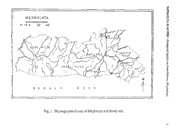
Bymihat (Meghalaya State) at 100 m asl; (Latitude 26°02' and 30"; Longitude 91 °52'), situated
approximately 90 kms from Shillong and 14 kms from Gauhati on the main Gauhati-Shillong trun~
road (Fig. 1) was chosen as the main study area. Four different study sites from this region were taken
up. These were fallows left after Jhumming cultivation was over for a specific period of time. In this
respect the study sites in the general study area was chosen on the basis of one year fallow till 20
year fallows (1 yr,5 yr, 10 yr and 20 yr).
Origin
Physiogeographically the Assam divisions are the narrow Brahmaputra valley behind the
Arunachal-Himalayan area in the North and North-eastern region, PaLkai-Naga Hills in the East and
the Lushai Hills and Shillong plateau in the South. The Surma river is led by the numerous small
tributaries from Shillong plateau and North Cachar Hills. The Surma valley occupies a triangular area
between Meghalaya on the West, North Cachar and Manipuri Hills to the East and Tripura Hills on
the South. The valley is peculiarly low lying with swamps and perfected level of aluvial flats
stretching upto the base of the steep rocky cnscapmcnl of the Shillong Plateau. The river and
tributaries only for a short distance have a steep fall in shallow and variable beds over the coarse debris
brought down by them. they lose all perceptible falls and became tortuous anastomosing water
channels. The drainage pattern over the Mikir Hills is similar to that over the Shillong Plateau.
The present changes of the Brahmaputra valley is the result of uplift and subsidence of different
blocks of the precambian crystalline. the remnant of which is now represented by the Mikir Hills
(Assam) and Shillong Plateau (Meghalaya).
The Soil Environment
Soil is lateritic brown or orange brown in colour. It is generally acidic. The characteristic of soil
in the different sites are shown in Table-I for all the four sites.
Vegetation
At all the experimental sites mostly Dendrocalantus hamillonii was found. Table-II presents the
vegetation in the different sites \vith a comparison of dominance of each species.
Climate
The region experiences a sub-tropical monsoon climate, the summer temperatures reaching 35°C
and mean winter temperatures falling to 15°C. The frost was observed sometimes in ,vinler early in
the morning. The maximum precipitation was observed from May to August ranging from 70.0 to
355.0 cm, sho\ving an average of 125 cms monthly.
MEGHALAYA
, , ..
I. ,
Kr 10 0 20
~o
BANG.LA DES H
f-------______________. . ________________- -__
.--J
Fig. 1. Physiographical nlap of Meghalaya and Study site.
4 Rec. zool. Sun. India, Oec. Paper No. 149
TABLE I
The soli types and texture in the four different study sites
Morphology Site A Site B Site C Site D
Type Lateritic Lateritic Lateritic Lateritic
Colour Yellowish brown Brown Reddish brown Dark brown
Texture Sandy loam Sandy loam Coarse sandy loam Fine sandy loam
Structure Nutty Blocky Granular Granular
Gravity Higher Lower Lower Lo\\Oer
Porosity More More Less Less
pH lvlostly acidic Acidic Acidic Acidic
occassionally
alkaline
TABLE II
The vegetation at the four different study sites and their dominance
Species Site A Site B Site C Site D
Ageratum conyzoides Linn. +++
Arundinella bengalensis (Spreng.) Druce ++ +++
Bauhinia variegala Linn. ++++
Borreria hispida (Linn) K. Schum + ++ ++++
Cyperus globosus Allioni ++ +++ ++++ ++++
Carex cruciata Nees ++++ ++++
Careya arborea Rox. ++ ++++ ++++
Callicarpa loona Roxb. + +++ ++++
Combrelurn decandrium Roxb. + + ++ ++
Desmodium triguelrum DC. ++ ++++ ++++ ++++
Dendrocalamus hamiltonii Nees & Am. ++ +t++ ++++ ++++
Dillenia indica Linn.
+ +++ ++++
Eupatorium odoralum Linn.
++++ ++++ ++ ++
Eugenia tetragona Wight + ++
Ficus hispida Linn. ++ ++++
Gregia elastica Royle ++
VATSAUUYA & ALFRED: Ecological Studies on Jhum Fallows (Megha/aya) 5
Species Site A Site B Site C Site D
Litsala assmica H.R.F. + ++
MiJcania micrantha H.B. & SK. + ++
Imperata cylindrica (L.) Beaure ++++ -H-++
Macaranga denliculala Muell. ++ +f+ ++++
Melia azadirachta Linn. + +
M achillus khasyana Meissn. + ++
M aesa indica Wall. + ++ ++
Osbeckia crinita Benth. ++
Panicum maximum Jacq. ++ +++- ++++ ++++
P. khasianum Munro ++ ++t-
•
Setaria tesseiIala WiUd. ++ ++++ ++++
Schima wallichii Chois ++ ++++ ++++
Sapium buccatum Roxb. + ++ +++
ThysallOlaena maxima Kuntze ++ +++-
Vila peduncular-is Wall ++ -H+ ++++
V. glabrata Br. ++ +++ ++++ ++++
+:+-++ = highly dominant; +++ = dominant; ++ = poorly dominant; + = present; - = absent
REVIEW OF LITERAT ORE
The purpose of the prescnt work was primarily directed towards the understanding of the nature and
biology of soil-fauna in these regions where land pressure and usage is very high. At the outset it is
advisable to indicate that soil fauna as implied by us, are those soil animals which pass one or more
active stages wholly or largely either in soil or litter (Drift, 1951). Though our studies have been
confined to the soil layers, it is understood that the faunal elements are those which more either
between the litter and the soil layers or within the soil layers themselves.
For the sake of convenience, though several methods exist, for the classification of soil fauna,
other than their systematic arrangements (Haarlov, 1960; Kevan~ 1962), we have followed the body
size as the main criteria after Wallwork (1970). Hence those soil fauna which range between 20 J.1 and
200 J..1 as microfauna, those between 200 Jl and 1 em as mesofauna and finally those greater than 1 em
as macrofauna. Microfauna included Protozoa and prostigrnatid mites, mesofauna comprised of
mesostigmata, cryptostigmata, astigmata, collembola, araneida, chelonethi and isopoda, while
macrofauna included all the soil insects (Dermaptera, Coleoptera, Hymenopte~ Hemiptera,
Lepidoptera, Diptera, Orthoptera and Thysanoptera), Myriapods (Symphyla, Chilopoda and
Diplopoda), Mollusca and Annelida.
Soil fauna and their scientific studies was developed as a discipline very recently though general
observations on them have been in existence since White (1789) who did throw some light on