Table Of ContentUnitedStates Marine Corps
ConunandandStaffCollege
Marine Corps University ,p-
2076South Street
Marine Corps CombatDevelopment Command
Quantico, Virginia 22134-5068
MASTER OFMILITARY STUDIES
TITLE: TheFalklands War April-June 1982: Operation CORPORATE - An Example of
OperationalManoeuvrefrom the Sea, or a FaitAccomplifor OperationalPlanning?
SUBMITTED INPARTIALFULFILLMENT
OFTEEREQURIEMENTS FORTEEDEGREE OF
MASTER OFMILITARYSTUDIES
MAJORSIMEONL. WARD
AUSTRALIANREGULAR ARMY
AY2007-08
Mentor and Or31-Btifense ~~~~ber: _'~-!-B!:.:l..li,)"-,,l-""--'~"-""""(..!.L\)=~=l"--''''----
_
(j;;) Ut/IY~~
Approved:
Date: -5 A:p;ut- 'ZeJflJg'
DefenC~mmjltetjMemb~~Co/ ~_L_.--",O'--'-c".L..-.:.Ne~W:.-...o:::J::.......<,?,--
O.ral _
~Lb ~ 1{. ~Z\
Approved:
i1cf./,.c( iD.?a
Date: .)
Report Documentation Page Form Approved
OMB No. 0704-0188
Public reporting burden for the collection of information is estimated to average 1 hour per response, including the time for reviewing instructions, searching existing data sources, gathering and
maintaining the data needed, and completing and reviewing the collection of information. Send comments regarding this burden estimate or any other aspect of this collection of information,
including suggestions for reducing this burden, to Washington Headquarters Services, Directorate for Information Operations and Reports, 1215 Jefferson Davis Highway, Suite 1204, Arlington
VA 22202-4302. Respondents should be aware that notwithstanding any other provision of law, no person shall be subject to a penalty for failing to comply with a collection of information if it
does not display a currently valid OMB control number.
1. REPORT DATE 3. DATES COVERED
2007 2. REPORT TYPE 00-00-2007 to 00-00-2007
4. TITLE AND SUBTITLE 5a. CONTRACT NUMBER
The Falklands War April-June 1982: Operation CORPORATE - An
5b. GRANT NUMBER
Example of Operational Manoeuvre from the Sea, or a Fait Accompli for
Operational Planning? 5c. PROGRAM ELEMENT NUMBER
6. AUTHOR(S) 5d. PROJECT NUMBER
5e. TASK NUMBER
5f. WORK UNIT NUMBER
7. PERFORMING ORGANIZATION NAME(S) AND ADDRESS(ES) 8. PERFORMING ORGANIZATION
United States Marine Corps Command and Staff College,Marine Corps REPORT NUMBER
University,2076 South Street, Marine Corps Control Development
Command,Quantico,VA,22134-5068
9. SPONSORING/MONITORING AGENCY NAME(S) AND ADDRESS(ES) 10. SPONSOR/MONITOR’S ACRONYM(S)
11. SPONSOR/MONITOR’S REPORT
NUMBER(S)
12. DISTRIBUTION/AVAILABILITY STATEMENT
Approved for public release; distribution unlimited
13. SUPPLEMENTARY NOTES
14. ABSTRACT
15. SUBJECT TERMS
16. SECURITY CLASSIFICATION OF: 17. LIMITATION OF 18. NUMBER 19a. NAME OF
ABSTRACT OF PAGES RESPONSIBLE PERSON
a. REPORT b. ABSTRACT c. THIS PAGE Same as 39
unclassified unclassified unclassified Report (SAR)
Standard Form 298 (Rev. 8-98)
Prescribed by ANSI Std Z39-18
Ward ii
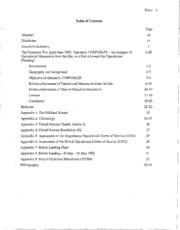
Table ofContents
Page
Glossary iii
Disclaimer iv
Executive Summary v
TheFalklands WarApril-June 1982: Operation CORPORATE- An example of 1-20
Operational Manoeuvrefrom the Sea, or aFaitAccomplifor Operational
Planning?
Introduction 1-2
Geography andbackground 2-3
Objective ofOperation CORPORATE 3-6
British achievement ofOperational Manoeuvre from the Sea 6-16
British achievement ofShip to Objective Manoeuvre 16-17
Lessons 17-19
Conclusion 19-20 .
Endnotes 21-22
Appendix 1: TheFalklandIslands 23
Appendix 2: Chronology 24-25
Appendix 3: UnitedNations CharterArticle 51 26
Appendix 4: United Nations Resolution 502 27
Appendix 5: Assessmentofthe Argentinean Operational Centre ofGravity (COG) 28
Appendix 6: AssessmentoftheBritish Operational Centre ofGravity (COG) 29
Appendix 7: BritishLandingPlans 30
Appendix 8: BritishLanding- D-Day- 21 May 1982 31
Appendix 9: Ship to ObjectiveManoeuvre (STOM) 32
Bibliography 33-35
Ward iii
Glossary
AO area ofoperations
ASW anti-submarine warfare
CAS close air support
CDO Commando
COG centre ofgravity
C2 command and control
HMS HerMajesty's Ship
LSL landing ship logistic
MV merchant vessel
OMFTS operational manoeuvrefrom the sea
RAP Royal AirForce
RM Royal Marine
RN Royal Navy
RW rotary wing aircraft (helicopters)
SAS Special AirService
SBS Royal Marine Special BoatService
SIGINT signals intelligence
SSN nuclearpoweredsubmarine
STOM ship to objectivemanoeuvre
STUFT ships take up from trade
UN UnitedNations
Ward iv
Disclaimer
The opinions andconclusions expressedherein are those oftheindividual student author anddo
not necessarilyrepresent the views ofthe Marine Corps Command andStaffCollege, the
AustralianDefenceForce orany otherUnited States orAustralian governmental agency.
References to this study shouldincludethe foregoing statement.
Quotationfrom, abstractionfrom, orreproduction ofall or anypart ofthis document
is permittedprovidedproper acknowledgementis made.
. __ __ _
~. ~, ~ ~ ._~ ._.~ ~_--c-
Ward v
ExecutiveSummary
..
Title: TheFalklands WarApril-June 1982- Operation CORPORATE- AnExample of
!
i
Operational Manoeuvrefrom the SeaoraFaitAccomplifor OperationalPlanning?
Author: MajorSimeonL. WARD, AustralianRegular Army
Thesis:
Operation CORPORATEcanbe seen as a classic example ofthe conductofoperational
manoeuvre from the sea thatindicates the advantages ofsuch an operational designfor the
conduct ofexpeditionary operations.
Discussion:
Operation CORPORATE, analysed within the context ofthe United States Marine Corps doctrine
ofOperationalManoeuvre from the Sea, clearlyindicates the advantages gainedfor the conduct
ofamphibious entry operations through adherence to the six principles ofOperational
Manoeuvre from the Sea: focusing on the operational objective; using the sea as manoeuvre
space; generating overwhelmingtempo andmomentum; pittingfriendly strengths againstenemy
weaknesses; emphasizingintelligence, deception andflexibility; and integrating organic, joint
andmultinational assets.
Byhaving clearoperational objectives assignedfrom thestart ofthe campaign,·seeking to, both
directly andindirectly, target and exploitArgentinean weaknesses, as well as protecttheirown
weaknesses, the Britishforces deployed to the South Atlantic were able to enablethe amphibious
landings at San Carlos andconductthe ground operations necessary to force the Argentinean
surrender andrepossess the FalklandIslands.
Conclusion:
Operation CORPORATE and the wayit was conductedwas not afaitaccompli. Numerous
options were developedandconsideredfor the military repossession ofBritain's sovereign
territories, the FalklandIslands andSouth Georgia. Only afterAdmiralFieldhouseprovided
clearoperational objectives, however, were Britishplanners able to develop asound operational
plan. This operationalplan withits achievement ofall six principles ofOperational Manoeuvre
from the Sea, as developedby the UnitedStates Marine Corps and articulated as theirmain
warfighting principal, illustrates for amphibious forces andoperational planners the value of
OperationalManoeuvrefrom the Sea andthebenefits for conducting military operations within
this framework.
Ward 1
"I don'tmind about you, butI'm going down there to win the war."
Rear Admiral John Woodward, RN1
Introduction
In response to Argentina's invasion ofthe British territories ofSouth Georgia and the
FalklandIslands On 2 April 1982, GreatBritain dispatched, at shortnotice, an amphibious task
group to the SouthAtlantic to reinforce the British sovereignty over andregain possession of
theseislands. Designated Operation CORPORATE, therepossession ofthe islands was to be
achievedby either demonstration ofintent, oractual combat. To executethis operation, Great
Britain deployed anaval task group, commandedbyRear Admiral John Woodward, RN,
approximately 8000miles. The force was required to operate overlonglines ofcommunication
against an enemy that was able to use shortlines ofcorrvnunication to reinforce its landforces
from its continental mainland. the success ofOperation CORPORATEcan be seen as the classic
example ofthe conductofoperationalmanoeuvre from the seathat andclearlyindicates the
advantages ofsuch an operational design for the conduct ofexpeditionary operations.
Drawingupon atradition ofmaritime supremacy and strongpolitical will, andin
recognition ofthe likelihood ofalanding, the Britishforces commencedplanning earlyto
conductan amphibious lodgment. The problemwas not so much how to conduct alanding, but
where andhow to achieve the necessaryoperational environmentto enable such an activity
against aheavilyfortified andnumerically superior opponent. Britishplanners sought detailed
information about the Argentinean forces arrayed against them, aboutpossible landing sites, and
about what andhow the Argentineans soughtto defend the Islands. Throughthe identification of
the keyArgentinean strengths, oras Clausewitz described as the centre ofgravity,2 theBritish
forces developed aplanforjointmilitary action thattargeted andreduced the Argentinean
-------------~---_._------ -----~ ' ---_._. --~--_._-,,---~----
Ward 2
strengths in orderto enable the conduct ofthe lodgment and, ultimately, the defeat of
Argentinean forces on South Georgiaand the FalklandIslands.
Itwas this analysis thatenabledthe British commanders to translate the British
government's strategic objectives into an operationalplanthat wouldre-establish British
sovereignty overtheFalkland and South GeorgiaIslands. The British operational plan soughtto
take full advantage ofthe benefits ofoperational manoeuvre to reduce the Argentinean centre of
gravity. Given thelargelymaritime nature ofthis operation, andthe restrictive landtertain ofthe
FalklandIslands and South Georgia (seeAppendix 1), this operational manoeuvre neededto
occurfrom the sea, which causedBritish operational planners to develop a plan thatfollowed the
UnitedStates Marine Corps' (USMC) concept ofoperational manoeuvrefrom the sea (OMFTS).
This paperwill apply the OMFTS principles to Operation CORPORATEin orderto
determine to what extentthe Britishforces conductedthe OMFTS by examiningits six
principles. It will also assess the extentto which Operation CORPORATE saw the conduct of
ship to objectivemanoeuvre (STOM) as conceptualizedbythe USMC.
OperationalManoeuvre from the Sea
The USMC has identifiedOMFTS as the key enablerfor the conduct ofmodern
amphibious entry operations, which the USMC expects to conduct as apart ofits Expeditionary
ManoeuvreWarfare operational concept as outlinedinits cornerstone doctrinal publication,
Marine Corps Operations.3To define the termOMFTS, itis important to understandwhat the
termmanoeuvre warfare denotes. TheUSMC has definedmanoeuvre warfare as a:
warfightingphilosophythat seeks to shattertheenemy's cohesionthrough a variety of
rapid, focused andunexpected actions whichcreate aturbulent andrapidly deteriorating
situation with which the enemycannotcope.4
In turn, the USMC has definedOMFTS as:
Ward 3
applyingmanoeuvre warfare to expeditionarypowerprojectioninnaval operations as
s
part ofajoint ormultinational campaign.
OMFTS therefore is the use ofthe maritime environmentto achieve manoeuvre and
deliverashatteringblow to the enemy's cohesion through rapid andunexpected action. OMFTS'
six principles enable the achievementofthis rapid andunexpected action. The six principles are:
focusing on the operational objective; using the sea as manoeuvre space; generating
overwhelmingtempo and momentum; pitting friendly strengths against enemy weaknesses;
emphasizingintelligence, deception, andflexibility; andintegrating organic,joint, and
multinational assets.6
The ObjectiveofOperationCORPORATE
Thehistory ofoccupation inthe FalklandIslands and claims for sovereignty datebackto
1540, with Spain, Britain, andfinally Argentina all claiming sovereignty ofthe islands (see
Appendix 2). Theoverarchingrationale forBritain to repossess the FalklandIslands andSouth
Georgia was that Britain maintainedlegitimate sovereignty overthe islands and that Argentina
had violatedthatsovereigntywith an act ofunprovokedaggression, which was a clearviolation
ofintemationallaw.7 The invasion ofthe Falklands byArgentinaforced Britain, underPrime
MinisterMargaretThatcher's leadership, to act against Argentina, to defend the sovereigntyof
British territory, andto repossess theislands by declaringBritain'srightfor self-defenceunder
Article 51 ofthe UN Charter (seeAppendix 3) and immediately dispatchedforces, which
included submarines, to the South Atlantic inthe days immediatelypriorto the 2 April 1982
invasion.8Britainsoughtimmediate action in the UN as well, and scored adiplomatic victory on
3April 1982, when the UN passed Security CouncilResolution 502 (seeAppendix 4) thatcalled
for theimmediatecessation ofhostilities and the withdrawal ofArgentinean forces from the
Falklands andSouth Georgia. Argentina's promptrefusal to abide bytheresolution fortified
Ward 4
Britain's claims oflegitimacyfor action.9Inactionbythe British military would havebeen seen
as afailure ofThatcher's increasinglyunpopulargovernmentIO and would have had significant
strategic implications for Britain as a worldpower.
In 1982, the ArgentineanmilitaryjuntaofPresidentLeopoldo Galtieri seekingto create
political stabilityfor his government saw the issue ofthe Falklands sovereignty as apolitical
solution. Galtieri andhis seniorofficers, Navy Admiral Jorge Anaya andAirForce Brigadier-
General Basilio LamiDozo, plannedthe military occupation ofthe FalklandIslands ifthe
negotiations with Britain regarding the sovereignty ofthe Falklands failed to resolve the issue.11
"-
However, what Martin Middlebrookcalledthe Argentinean "gamble" was the misguided belief
thatBritain wouldnotconduct amilitary operation to re-capture theFalklandIslands, and that
the UN and the US would not actin support ofthe Britishclaimofsovereignty.12
Throughoutthe crisis Britainmaintainedthe primacy ofa diplomatic solution and sought
to use diplomatic, informational, andeconomic means to achieve diplomatic solution.13 The
United States, through the efforts ofSecretaryofStateAlexanderHaig, made considerable
efforts as well to resolve the crisis and seek apeaceful solution underUN auspices, but was
unsuccessful. Consequently, Britishmilitaryplanners developed theiroperational planin orderto
meet the British strategic goal ofregaining possession ofthe FalklandIslands and South
Georgia.
Admiral SirJohn Fieldhouse, the BritishCommander-in-ChiefFleet, who was the overall
operational commanderofall Btitishforces deployed to the SouthAtlantic (i.e.,TaskForce 317
(TF317)), developedhis basic operationalplan andcommunicateditto his subordinate
commanders on 17 April 1982. The admiral's subordinate commanders included:
RearAdmiralWoodward, CommanderTaskUnit 318.1-the "Carrier" group