Table Of ContentAD-A236 091
(U)
SECURiTh' CLASSIFICATION OF THIS PAGE 11f 1111111111111111 111 1111 111 1111 1 ve7d
REPORT DOCUMENTATION P
04-0188
la R(EPUORT) S ECURITY CLASSIFICATION 1b RESTRICTIVE MARKINGS
___
2a SECURITY CLASSIFICATION AUTHORITY 3 DISTRIBUTION/AVAILABILITY OF REPORT
NA
2b. DECLASSIFICATION / DOWNGRADING SCHEDULE
NA Distribution Unlimited
4. PERFORMING ORGANIZATION REPORT NUMBER(S) 5 MONITORING ORGANIZATION REPORT NUMBFR(S
University of South Alabama NA N
6a NAME OF PERFORMING ORGANIZATION 6b OFFICE SYMBOL 7a NAME OF MONITORING ORGANIZATION
University of South Alabama NA Office of Naval Research 4V !
6c. ADDRESS (City, State, and ZlPCode) 7b ADDRESS(Ciry. State. and ZIP Code)
Department of Pediatrics; USA Medical Centc 800 N. Quincy Street
2451 Fillingim Street, Mobile, AL 36617 Arlington, VA 22217-5000
Ba. NAME OF FUNDING fSPONSORING Bb OFFICE SYMBOL 9 PROCUREMENT INSTRUMENT IDENTIFICATION NUN'
ORGANIZATION (If applicable)
Office of Naval Research ONR N000-14-88-K-0429
8c. ADDRESS (City, State, and ZIP Code) 10 SOURCE OF FUNDING NUMBERS
800 N. Quincy Street
PROGRAM PROJECT TASK WORK UNIT
Arlington, VA 22217-5000 ELEMENT NO NO NO ACCESSION NO
61153N PR04108 441q801
11" TITLE (Include Security Classification) ' '
(U) Effects o4. Hemorrhagic Shock and Retransfusion on -MyocardialB eta-Adrenergic
Receptors and Adenylate Cyclase Activity
12. PERSONAL AUTHOR(S)
Artinan, Michael
13a TYPE OF REPORT I 13b TIME COVERED 114. DATE OF REPORT (Year, Month, Day) 15 PAGE COUNT
FINAL FROM 6/90 TO. 12/90I 1991, January 15 15
16 SUPPLEMENTARY NOTATION
17 COSATI CODES 18 SUBJECT TERMS (Continue on reverse if necessary and identify by block number)
FIELD GROUP SUB-GROUP Hemorrhagic Shock; Reperfusion Injury; Adenylate
OR !Cyclase; -8 Beta-Adrenergic Receptors
19 ABSTRACT (Continue on reverse it necessary and identify by block number)
Mechanisms for the myocardial dysfunction observed following hemorrhagic shock remain unclear. A well
characterized rabbit model was utilized to determine the effects of shock and retransfusion on myocardial f-adrenergic
receptors and adenylate cyclase activity. Hemorrhagic shock was produced by rapid blood withdrawal to reduce mean
arterial pressure to 35 mmHg in anesthetized rabbits instrumented for comprehensive hemodynamic monitoring. The
shock state was maintained -for 60 minutes and then the animals were transfused with the autologous warmed shed
blood. Ventricular myocardium was analyzed for [1H] dihydroalprenolol binding and adenylate cyclase activity.
There was no effect of shock or retransfusion on basal or stimulated adenylate cyclase activity. However, compared
to control (67+11 fmol/mg), fl-adrenergic receptor density increased in the shock (136+22 fmol/mg) and
retransfusion (152 +-5fm ol/mg) groups, with no change in apparent ligand affinity. These results suggest that changes
in 1-adrenergic receptor number and/or adenylate cyclase activity are unlikely to account for the myocardial
dysfunction observed following hemorrhagic shock.
20 DISTRIBUTION /AVAILABILITY OF ABSTRACT 21 ABSTRACT SECUR:TY CLASSIFICATION
91 UNCLASSIFIEDIUNLIMITED 0 SAME AS RPT C1 DTIC USERS (U)
22a. NAME OF RE5PONSIBLE INDI IDUA-L 2:-E P9- Area C) 21c OIIC
Dr. Jeanrin- A. Majde oae I O SYBO.
DD Form 1473. JUN 86 Previous editions are obsolete S[CLIRITV€ CASSiE-CATION OF ' I 9-iGE
S/N 0102-LF-014-6603
V I
EFFECTS OF HEMORRHAGIC SHOCK AND RETRANSFUSION ON MYOCARDIAL BETA-
ADRENERGIC RECEPTORS AND ADENYLATE CYCLASE ACTIVITY
FINAL REPORT: JULY 1, 1990 TO DECEMBER 31, 1990
Prepared for the Office of Naval Research
ONR Contract NOOO14-88-K-0429; R&T Code 441q801
Ao0ession For
NTIS GRA&I
DTIC TAB
p bUnannounced 0
Prepared by Justificatio
Michael Artman, M.D.
LDistributlon/
Availability Codes
Avail and/or
Department of Pediatrics Dist Special
University of South Alabama
College of Medicine
2451 Fillingim Street
Mobile, Alabama 36617
91-00665
91 529 0-22
£ t
INTRODUCTION
Following massive blood loss, cardiac output falls and
diastolic filling of the coronary arteries becomes insufficient,
resulting in global myocardial ischemia and contractile
dysfunction. The internalization of fl-adrenergic receptors that
normally occurs in response to increased levels of circulating
catecholamines in the non-ischemic heart is abolished in the
acutely ischemic heart. Consequently, the balance of
internalization and externalization of fl-adrenergic receptors is
shifted during ischemia toward an increase in the number of
available receptors at the cell surface. At present, it is unclear
whether or not these receptors are effectively coupled to adenylate
cyclase, and hence are available for the signal transduction
mechanisms which presumably would be necessary to maintain
physiological responsiveness and normal contractile function.
Alterations in the f-receptor expression and coupling to adenylate
cyclase activity, which have been noted in other models of
ischemia, have not been previously examined during hemorrhagic
shock and retransfusion. Therefore, the present study was
undertaken evaluate the effects of hemorrhagic shock and
retransfusion on myocardial fl-adrenergic binding and adenylate
cyclase activity. We employed a well-characterized rabbit model of
severe hemorrhagic shock and retransfusion developed in our
laboratory.
2
METHODS
Animal Model
Mature male New Zealand white rabbits were anesthetized with
pentobarbital sodium (50 mg/kg i.v.) and then supplemented as
necessary throughout the experiment. A tracheostomy was performed
and mechanical ventilation instituted with room air. The animals
were kept on a warming blanket and under heating lamps to maintain
a physiologic rectal temperature (recorded continuously).
Continuous ECG monitoring was performed throughout the experiment.
A femoral cutdown was performed for introduction of catheters into
the descending aorta and inferior vena cava via the femoral artery
and vein. The chest was opened in the midline and catheters were
placed directly into the right atrium, left ventricle, and main
pulmonary artery. An ultrasonic flow probe was fitted onto the
ascending aorta. These surgical procedures required no more than
35 minutes to complete. This preparation allowed for continuous
monitoring of heart rate and pressures in the descending aorta,
right atrium, main pulmonary artery, and left ventricle. Ascending
aortic flow was monitored continuously and was used to determine
stroke volume and cardiac output. The maximum rate of left
ventricular pressure development (LV dP/dt) was derived from the
left ventricular pressure curve. Systemic vascular resistance was
calculated from the pressure and flow data. Arterial blood gas
measurements were obtained every 30 minutes.
Following surgery, the animals were allowed to stabilize for
30 minutes. Control ht.c-ryhm!z p~rameters and blood gases were
3
recorded at the end of this 30 minute period. The animals had
blood withdrawn (into a warmed reservoir that contained 100 U/kg of
heparin) to reduce mean arterial pressure to 35 mmHg initially.
Additional blood was not withdrawn during the following 60 minute
shock period, and the intrinsic physiologic compensatory mechanisms
were allowed to compensate for this acute loss. Following the 60
minute shock period, the animals were then randomly assigned to
either SHOCK or RETRANSFUSION groups. The SHOCK group was not
retransfused and animals were killed by pentobarbital overdose at
the end of the 60 minute shock period. Animals in the
RETRANSFUSION group received a warmed autologous transfusion (over
10 minutes) of heparinized shed blood beginning 60 minutes after
the initiation of shock. CONTROL animals were instrumented and
monitored for 3 hours but were not bled or transfused. Hemodynamic
parameters and blood gases were recorded every 30 minutes
throughout the monitoring period. Surviving animals were
sacrificed by an overdose of pentobarbital. At the end of each
acute experiment, the heart was rapidly harvested and processed to
prepare crude sarcolemmal membranes for subsequent receptor ligand
binding studies or adenylate cyclase assays. Membranes were stored
at -700C until analyzed.
Preparation of Sarcolemmal Membranes
Methods for preparation of sarcolemmal membrane fractions from
rabbit myuLardium have been adapted from previously published
tFca ±ques described for canine myocardium (1). Ventricular
4
myocardium was minced on ice and homogenized using a Polytron
tissue homogenizer (3 bursts for 20 seconds each). The
homogenization buffer contained 5 mM Tris-HCl, 0.25 M sucrose, and
1 mM MgCl2. Following homogenization, suspensions were diluted with
an equal volume of 1 M KC1 and stirred on ice for 10 minutes (this
precipitates contractile proteins and reduces non-specific
binding). Homogenates were filtered through gauze and centrifuged
at low speed for 15 minutes (700 x g). The resulting supernatant
was centrifuged at 40,000 x g for 30 minutes and the pellet
containing crude sarcolemmal membranes was resuspended in 50 mM
Tris-HC1, 10 mM MgCI2 and 1 mM ascorbic acid. The final protein
concentration was approximately 10 mg/ml. Protein was determined
by the Bradford assay using bovine serum albumin as the standard
(2).
Determination of P-Adrenergic Receptor Binding.
Sarcolemmal membranes from control, shock, and retransfused
rabbits were utilized for determining f-adrenergic receptor binding
characteristics. Assays were performed using an incubation buffer
containing 50 mM Tris-HCl, 5 mM MgCI , 1 mM ascorbate and 0.01% BSA
2
(total volume 0.20 ml). Equilibrium binding was performed by
incubation at room temperature for 30 minutes with varying
concentrations of [3H)-dihydroalprenolol (DHA; specific activity=40-
60 Ci/mmol). The concentration of [3H]-DHA ranged from 0.3 to 20
nm. Approximately 250 Ag protein was used for each sample.
Binding was terminated by addition of ice cold buffer and rapid
5
vacuum filtration over Whatman GF/C filters using an automated
Brandel cell harvester. Specific binding was determined by
subtracting binding in the presence of 10 pM dl-propranolol from
total binding. The binding isotherms were analyzed using LUNDON
software using both linear and non-linear methods.
Measurement of Adenylate Cyclase Activity
Sarcolemmal fractions were used to measure basal and
stimulated adenylate cyclase activity in each group (control,
shock, and retransfusion). Adenylate cyclase activity was assayed
according to the method of Salomon (3). Membranes were incubated
for 10 minutes at 30'C using approximately 50 jg protein for each
assay. The incubation buffer contained 0.5 mM ATP, 2 M MgCI , 1
2
mM EGTA, 5 mM phosphoenolpyruvate, 0.5 mg/ml pyruvate kinase, 0.1
mg/ml BSA, 0.1 mM isobutylmethylxanthine, and trace [32P]ATP in 80
mM HEPES. The total reaction volume was 0.10 ml. The reactions
were initiated by addition of sarcolemmal protein and terminated
with a stop solution containing 10 mM cAMP (with trace [3H] cAMP),
40 mM ATP, 1% SDS and with heating to 850C. The double column
method (4,5) is used to separate and quantitate the amount of cAMP
formed and recovered. This involves sequential chromatography over
Dowex and then alumina oxide. Recovery of authentic cAMP averages
80-90%. The amount of cAMP generated was determined by liquid
scintillation spectrometry. Results were corrected for recovery
for each individual sample. Assays were performed in the presence
and absence of various agonists in order to determine basal and
6
stimulated adenylate cyclase activities.
Statistical Analyses
Comparisons among groups for the hemodynamic data, -
adrenergic receptor binding data, and results for adenylate cyclase
activity were compared by analyses of variance. Fisher's LSD test
was utilized when the F value from the analysis of variance
indicated a significant difference was present. Statistical
significance was defined as p<0.05.
RESULTS
Figure 1 illustrates results for mean aortic pressure in the
3 groups. Blood pressure in the control group diminished slightly
in the first 30 minutes, but then remained stable throughout the 3
hour monitoring. In contrast, following blood withdrawal, blood
pressure fell significantly in the shock and retransfusion groups.
Following retransfusion, blood pressure returned to control values
by the end of the monitoring period. However, arterial pH remained
low (Figure 2) in the retransfusion group.
Specific binding of [3H]-DHA is illustrated in Figure 3.
Binding isotherms (specific binding only) are presented for each of
the 3 groups. Maximal number of binding sites (B.) was 67±11
fmol/mg in the control group. The number of binding sites
identified by DHA increased in the shock group (136±22 fmol/mg) and
in the retransfusion (152±5) groups. These were significantly
different from control (p<0.05). However, as evident in Figure 4,
7
the apparent ligand affinity did not change appreciably, in that
the slopes of the Scatchard-Rosenthal plots are similar for each
group. The apparent ligand affinity (Kd) was 7.6±2.4 mM in the
control group, 6.9±1.7 nM in the shock group, and 7.8±0.2 nM in the
retransfusion group.
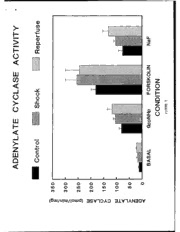
Results for basal and stimulated adenylate cyclase activity
are illustrated in Figure 5. Basal activities do not differ among
the 3 groups. In addition, the responses to the non-hydrolyzable
analogue of GTP (GppNHp), forskolin, and sodium fluoride were not
statistically different. The degree of stimulation at maximal
concentrations of GppNHp, forskolin, and sodium fluoride were
similar among the 3 groups. As shown in Figures 6 and 7, the
sensitivity to stimulation of adenylate cyclase activity by
forskolin and GppNHp were not different among the 3 groups.
DISCUSSION
In the early stages of hemorrhagic shock, global cardiac
output is decreased because of severe volume loss, but myocardial
function is preserved primarily from distributive changes mediated
by an intact neurohumoral response (6,7). In prolonged hemorrhagic
shock, as diastolic coronary artery flow decreases, substantial
primary myocardial dysfunction occurs (8-10). The mechanisms
responsible for cardiac failure in severe hemorrhagic shock are
unknown, but experimental observations support the concept of a
deterioration in sympathetic influences despite increases in local
and systemic release of catecholamines (11). The cardiac
8
stimulatory actions of catecholamines are mediated primarily by fi-
adrenergic receptors located within the myocardial cell membrane.
The 6-adrenergic receptor is linked to adenylate cyclase via a
1
stimulatory guanine-nucleotide binding protein (Gs). Adenylate
cyclase generates the second messenger 3',5'-cyclic adenosine
monophosphate (cAMP), which mediates myocardial inotropic and
lusitropic responses by activating a specific family of protein
kinases that phosphorylate selective proteins in the myocytes.
This results in increases in the rate and extent of delivery of Ca 2
to the contractile proteins during systole (inotropic benefit) and
acceleration of the cytosolic removal of Ca 2 during diastole
(lusitropic benefit).
In experimental systems the response of "normal" myocardium to
elevated catecholamine levels is a reduction in the number of cell
surface f-adrenergic receptors, a term often referred to as
receptor "down regulation"(12). However, previous studies of
myocardial ischemia have conclusively demonstrated an acute
increase in the number of cell surface P-receptors (13-22). The
increase in the population of f-adrenergic receptors is probably
due to a redistribution of receptors from intracellular
compartments (so-called internalized receptors) to the sarcolemmal
membrane (23,24), and not from rapid synthesis of new receptors.
Whether or not this increase in p-receptor density results in
increased physiological responsiveness to catecholamines would,
however, depend upon the ability to effectively couple the other
components of the P-adrenergic transduction system. Data
9