Table Of ContentCombating Terrorism Center at West Point
Objective • Relevant • Rigorous | January 2017 • Volume 10, Issue 1
FEATURE ARTICLE
A VIEW FROM THE CT FOXHOLE
Mental Health and
Peter Edge and
Terrorism Wil van Gemert
U.S. Immigration and Customs
Is there a link between Islamic State terror and mental illness? Enforcement Acting Deputy Director
and Europol Deputy Director
Emily Corner and Paul Gill
FEATURE ARTICLE
1 Is There a Nexus Between Terrorist Involvement and Mental Health in the Editor in Chief
Age of the Islamic State?
Paul Cruickshank
Emily Corner and Paul Gill
Managing Editor
INTERVIEW
Kristina Hummel
11 A View from the CT Foxhole: Peter Edge, ICE Acting Deputy Director, and
Wil van Gemert, Europol Deputy Director
EDITORIAL BOARD
Paul Cruickshank
Colonel Suzanne Nielsen, Ph.D.
Department Head
ANALYSIS
Dept. of Social Sciences (West Point)
17 Fighting the Long War: The Evolution of al-Qa`ida in the Arabian Peninsula
Michael Horton Lieutenant Colonel Bryan Price, Ph.D.
Director, CTC
23 Drone, Counter Drone: Observations on the Contest Between the United
States and Jihadis
Brian Dodwell
Don Rassler
Deputy Director, CTC
28 Sub-Saharan Africa’s Three “New” Islamic State Affiliates
Jason Warner
CONTACT
Combating Terrorism Center
U.S. Military Academy
The deadly attack at Fort Lauderdale airport earlier this month by an indi-
607 Cullum Road, Lincoln Hall
vidual claiming to have been influenced by voices he heard and to have
acted on behalf of the Islamic State has renewed attention on the nexus West Point, NY 10996
between terrorism and mental health. In our cover article, Emily Corner and Paul Gill explore what
Phone: (845) 938-8495
they argue are complex and often misunderstood links. Their preliminary findings show that the
proportion of attackers in the West possibly influenced by the Islamic State with a history of psycho- Email: [email protected]
logical instability is about the same as the rate of such instability in the general population, though Web: www.ctc.usma.edu/sentinel/
the rate is higher than in the general population if Islamic State-directed attacks are excluded. This is
in line with their previous findings that group-based terrorists are much less likely to have mental
disorders than lone-actor terrorists. They also question the degree to which lone-actor terrorists with SUBSMISSIONS
mental disorders are symptomatic at the time of attacks. Lone-actor terrorists with mental disorders,
The CTC Sentinel welcomes submissions.
they have found, are just as likely to engage in rational planning prior to attacks as those without.
Their research has also found a significantly higher rate of schizophrenia among lone-actor terrorists Please contact us at [email protected].
than in the general population. There is a long-running debate about whether this condition could
make individuals of all ideological persuasions less inhibited in moving from radical thought to rad-
The views expressed in this report are
ical action.
In a joint interview, Peter Edge, Acting Deputy Director of U.S. Immigration and Customs En- those of the authors and not of the U.S.
forcement, and Wil van Gemert, Deputy Director of Europol, focus on the challenges of identifying, Military Academy, the Department of the
tracking, and interdicting foreign terrorist fighters and steps being taken to deepen transatlantic
Army, or any other agency of the U.S.
cooperation. Michael Horton argues that AQAP’s deepening ties to anti-Houthi forces in Yemen’s
Government.
civil war is making the terrorist group even more resilient and difficult to combat. Don Rassler exam-
ines the contest between the United States and jihadis on drones and drone countermeasures. Jason
Warner looks at the three newly self-declared affiliates of the Islamic State in sub-Saharan Africa.
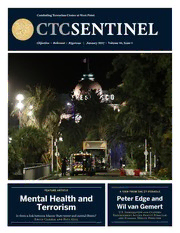
Cover: Police officers stand near the truck
Paul Cruickshank, Editor in Chief Mohamed Lahouaiej-Bouhlel used to kill
pedestrians in Nice, France, on July 14, 2016.
(Valery Hache/AFP/Getty Images)
JANUARY 2017 CTC SENTINEL 1
Is There a Nexus Between Terrorist
Involvement and Mental Health in the Age
of the Islamic State?
By Emily Corner and Paul Gill
rigorous evidence base for these debates. These questions include:
The wave of Islamic State-linked terrorism experienced in What is the existing evidence base regarding psychopathology and
the West over the past couple of years has rekindled debates terrorist involvement? How prevalent are mental disorders among
surrounding mental disorders and terrorist engagement. Islamic State-directed and -inspired offenders in the West? What
A very preliminary survey by the authors found that out of is the content of these diagnoses? When present, what relationship
did the disorder have with radicalization?
55 attacks in the West where the 76 individuals involved
were possibly influenced by the Islamic State, according
The Evidence Base
to media reports, 27.6% had a history of apparent
Very few scientific analyses have focused upon the relationship
psychological instability, a percentage comparable to that
between mental health and terrorist involvement. The following
found in the general population. This figure is driven largely
outlines the headline results from the sum total of these scientific
by individuals inspired by the Islamic State, as opposed endeavors.3 Some recent studies analyzed the prevalence rates of
to those directed by it, however. The percentage is likely different disorders within very different samples of terrorist offend-
overinflated for several noteworthy reasons, including ers. Based on police files, 6% of Anton Weenink’s sample of 140
poor reporting, low benchmarks, and the tendency Dutch individuals who either became foreign fighters or sought to
to overuse mental health problems as a ‘silver-bullet’ travel abroad for the purpose of terrorism had diagnosed disorders.4
explanation for terrorist involvement. The relationship An additional 20% displayed signs of undiagnosed mental health
is, in fact, far more complex than typically presented. problems. The diagnoses included ADD, AD/HD, autism spectrum,
narcissistic, schizophrenia, post-traumatic stress, and psychotic dis-
orders. The prevalence of schizophrenia (2%) in the sample was
he Islamic State-linked terrorism experienced in the higher than what would be expected in the general population,
T
West recently has reignited debates about the con- which is currently estimated at between 0.87% and 1%.5
nection between mental disorders in terrorist activ- A study of lone-actor terrorists co-authored by the authors of
ity. Indeed, the assistant commissioner for specialist this article also found higher rates of schizophrenia than in the gen-
operations in London’s Metropolitan Police Service eral population, as well as certain other disorders. Based on open
acknowledges the Islamic State is actively trying to recruit, among source information, over 40% of Emily Corner, Paul Gill, and Oliver
others, “those with mental health issues.”1 Similarly, Australia’s na- Mason’s study6 of 153 lone-actor, solo-actor, and dyad terroristsa
tional counterterrorism coordinator, Greg Moriarty, has outlined had a diagnosed disorder, much higher than in the general pop-
that many cases involve individuals “not necessarily deeply com-
mitted to and engaged with the Islamist ideology but are none-
theless, due to a range of reasons, including mental health issues,
susceptible to being motivated and lured rapidly down a dangerous
path by the terrorist narrative.”2 The debates became particularly
salient through the summer of 2016 when lone actors inspired and
encouraged by the Islamic State killed 135 civilians in separate at-
tacks in Orlando and Nice. More recently, the fatal shooting of five
individuals at Fort Lauderdale airport added complexity to these a A lone-actor terrorist is defined by John Horgan, Paul Gill, Noemie
debates. All perpetrators had reported histories of mental disorder. Bouhana, James Silver, and Emily Corner as “an individual lacking any
This article seeks to answer several questions to provide a more ties to a terrorist/violent extremist group … These individuals typically
engage in violence in support of a group and/or ideology.” Lone actors
within the sample included those inspired by Islamist, right-wing, left-
wing, nationalist, and single issue ideologies. John Horgan, Paul Gill,
Emily Corner is a research associate at the University College Noemie Bouhana, James Silver, and Emily Corner, “Across the universe? A
London’s Department of Security and Crime Science. She is cur- comparative analysis of violent radicalization across three offender types
with implications for criminal justice training and education,” National
rently working on a European Union-funded project on lone-actor
Institute of Justice, June 2016. A “solo-actor terrorist” is defined as “an
terrorists. individual who either (a) carried out the act of terror alone, but under
instruction or (b) carries out the act through his/her own volition, but has
Paul Gill is a senior lecturer at the University College London’s had previous contact with terrorist/violent extremist groups and/or radical
environments to receive planning and support.” John Horgan et al. A dyad
Department of Security and Crime Science. He is currently work-
in this context refers to two individuals who conceive, plan, and carry out
ing on projects on decision-making and lone-actor terrorism that
an attack on their own. One or both individuals may have previously been
are funded by CREST, the European Union, and Minerva. attached to a terrorist group.
2 CTC SENTINEL JANUARY 2017 CORNER / GILL
ulation (25-27%).b The diagnoses included schizophrenia (8.5%), group-based terrorists.10 This result was in line with Christopher
depression (7.2%), unspecified personality disorder (6.5%), bipolar Hewitt’s analysis of U.S.-based terrorists who espoused a range of
disorder (3.9%), post-traumatic stress disorder (PTSD, 3.3%), au- ideologies (22% vs. 8.1%),11 and that of Jeff Gruenewald, Steven
tism spectrum disorder (3.3%), delusional disorder (2.0%), unspec- Chermak, and Joshua Freilich, who examined U.S.-based, far-right
ified anxiety disorder (1.3%), traumatic brain injury (TBI, 1.3%), offenders (40.4% vs. 7.6%).
obsessive compulsive disorder (OCD, 1.3%), unspecified sleep dis- Evidence also suggests that some terrorist roles may be more
order (0.7%), schizoaffective disorder (0.7%), psychotic disorder likely to experience particular mental disorders. Ariel Merari
(0.7%), drug dependence (0.7%), and dissociative disorder (0.7%).c and his colleagues carried out psychological tests on samples of
Three disorders held a substantially higher prevalence than found suicide bombers and various control groups (e.g. other terrorists
within general populations (schizophrenia, delusional disorder, and and non-political criminals)12 employing a range of techniques
autism spectrum disorders), whereas depression, anxiety, PTSD, including clinical interviews, personality tests, the Thematic Ap-
and sleep disorders are more commonly found within the general perception Test, and the House-Tree-Person Drawing test. Suicide
population than the lone-actor sample.7 bombers obtained significantly more diagnoses of Avoidant-De-
Michael and Simon Gottschalk8 also tested rates of various mea- pendent Personality Disorder (60% vs. 17%), depressive symptoms
sures of personality and psychopathology within terrorist samples (53% vs. 8%) and more readily displayed suicidal tendencies (40%
against the civilian population. By administering the MMPI-2,d vs. 0%). On the other hand, the control group was more likely to
they compared 90 incarcerated Palestinian and Israeli terrorists to contain members with psychopathic tendencies (25% vs. 0%) and
control groups of Palestinians and Israeli Jews matched on demo- impulsive-unstable tendencies (67% vs. 27%). Suicide bomber or-
graphic features. The former group scored higher on subscale mea- ganizers scored higher in ego-strength, impulsivity, and emotional
sures of psychopathic deviate, paranoid, depressive, schizophrenic, instability than would-be suicide bombers.
and hypomanic tendencies. Collectively, these results provide important insight into how we
It is worth remembering, however, that the Weenink study and should try to understand Islamic State-linked cases. We should ex-
the Corner, Gill, and Mason study are based on small samples of pect to see higher rates of specific mental disorders among lone-ac-
particular terrorist types and not necessarily a depiction of all ter- tors than the general population, and we should expect variance
rorist populations globally. Evidence suggests, for example, that across the roles and behaviors that these individuals engage in once
the rates of mental disorders within lone-actor terrorist popula- they have chosen to turn to violence (e.g. suicide attack vs. non-sui-
tions are significantly higher than group-based terrorists. Corner, cide attack). We may also expect to find higher rates of disorders
Gill, and Mason9 found a negative correlation between the level of among lone actors inspired and encouraged versus those who are
co-offending and the rate of mental disorder prevalence. Whereas directly trained and dispatched by the Islamic State.
40% of the study’s lone-actor terrorists had a mental disorder, the
prevalence rates were lower for solo-actor terrorists at around 20%, The Circumstantial Evidence Base
just over 5% for terrorist dyads, and less than 3% for terrorist group Whereas the above studies meticulously collected data and com-
members.e In an earlier study, Corner and Gill found that lone-actor pared the terrorist samples to wider comparison or control groups,
terrorists were 13.5 times more likely to have a mental disorder than no such studies exist on Islamic State-linked plotters in the West.
Some insight may come from a couple of studies on al-Qa`ida-in-
spired or -directed terrorism in the 1990s and 2000s to provide
b A large-scale worldwide epidemiological investigation based on the a useful framework for trying to understand the current security
International Classification of Diseases (ICD) diagnostic tool highlighted problem. Marc Sageman’s seminal study of al-Qa`ida networks
that the average prevalence for a diagnosis of any disorder is 27.43%.
downplayed the presence of mental disorder. His first study of
Ronald Kessler and Bedirhan Üstün, The WHO world mental health surveys:
172 individuals highlighted one case of “probable mild mental re-
Global perspectives on the epidemiology of mental disorders (Cambridge:
Cambridge University Press, 2008). Whereas a worldwide study utilizing tardation or borderline intellectual functioning” and two cases of
the Diagnostic and Statisticians Manual (DSM) as a diagnostic tool “psychotic disorders.” Sageman notes this is “about the incidence
identified a lifetime prevalence of 25.0%. Jordi Alonso et al., “Prevalence of these disorders in the general population.”13 In Sageman’s up-
of Mental Disorders in Europe: Results from the European Study of the
dated analysis of around 500 individuals, “there were about four
Epidemiology of Mental Disorders (ESEMeD) Project,” Acta Psychiatrica
Scandinavica 109 (2004): pp. 21-22. with hints that they experienced beliefs that were not based in re-
ality,” but there was “little evidence for any personality disorder.”14
c The cases were based on information found in open source accounts,
including court documents. Diagnoses were confirmed through extensive It should be noted, however, that these figures may be a function of
cross-checking of sources. Court decisions were deemed most reliable, but the actors being largely network-based. The current threat is more
in some cases, mental health status was not argued at trial as the individual
varied with a higher propensity for lone actors, so we may also ex-
had an established history.
pect the presence of mental disorders to differ. It may be better to
d Developed from the MMPI by James Neal Butcher, it is utilized by mental
focus on al-Qa`ida inspired lone-actors for insight. In Paul Gill,
health professionals to clinically assess personality traits and mental
John Horgan, and Paige Deckert’s study of 119 lone-actor terror-
health problems. James Neal Butcher, “Minnesota Multiphasic Personality
Inventory (MMPI), International Encyclopedia of the Social & Behavioral ists, 43% were al-Qa`ida-inspired. Of this sub-sample, 25% had
Sciences (1989): pp. 9,891-9,894. a diagnosed mental disorder, which is essentially the same as the
e An individual in a group (three or more individuals) involved in or intent on population base rate. This figure, however, was significantly lower
carrying out acts of terrorism. This database consists of 544 actors, with than those lone actors inspired by single-issue causes (52%) such as
links to 85 designated terror organizations. (Cross checked with Terrorism
anti-abortion, environmentalism, and animal rights.15
Research & Analysis Consortium, Global Terrorism Database, and the U.S.
In preparing this article, the authors looked at 55 attacks (total-
Department of State’s list of terrorist designations and state sponsors of
terrorism). ing 76 individuals) between May 1, 2014, and September 30, 2016,
JANUARY 2017 CTC SENTINEL 3
where media reports indicated they were possibly influenced in highest end, the vast majority of cases are still reliant on sources
some way by the Islamic State.f (See appendix). These cases encom- from the lower end.
pass both Islamic State-inspired attacks and Islamic State-directed When dealing solely with this lower end, researchers need to be
attacks as well as attacks enabled by communications with Islamic careful of a number of potential pitfalls. Many high-profile, Islamic
State operatives who provided guidance to attackers without them State-inspired individuals have undoubtedly either shown symp-
ever connecting to the group in person.g And they include both toms of psychological distress in earlier years or have been formally
confirmed Islamists and troubled individuals with unconfirmed diagnosed with a disorder. However, at a time when rigorous and
ideological commitment to Islamist causes who may just have been interdisciplinary insight was needed, many researchers, reporters,
influenced by the group’s calls to violence. A history of psycholog- and practitioners turned to flippant language and coinage. Such
ical instabilityh was noted in 21 (27.6%) of the individuals. This is phrases not only failed to explain the relationship (if any) between
broadly comparable to the current worldwide average (25-27%). terrorist engagement and psychopathology but also potentially
The authors were not able to find examples of psychological insta- stigmatized the infinitesimally greater number of individuals suf-
bility in the media reporting on those alleged to have taken part fering from some form of mental disorder with absolutely no hint
in Islamic State directed attacks (for example, the November 2015 of radicalization or plans to engage in violence. These include Max
Paris attacks and the March 2016 Brussels attacks). Excluding Is- Abrahms’ “loon wolf”16 phrase, a term that he applies to any lone
lamic State-directed plots, the percentage of attackers with reported terrorist suffering any form of mental disorder or psychological dis-
psychological instability was 34.4%. tress. The “loon” connotation also implies crazy or deranged and
It is worth noting that some of those with overt mental health misses the fact that rational planning often occurs in the presence
problems may not have been inspired by the Islamic State but were of a mental disorder.
simply professing Allahu akbar because it is well recognized as a Corner and Gill17 (these authors) empirically compared a sam-
phrase used in violent attacks. As these cases were dismissed as not ple of lone-actor terrorists with mental disorders with a sample of
being terrorism, there was barely any (in many cases no) further lone-actor terrorists without mental disorders. They found that
media reporting as to the individual’s intentions, and therefore, those with a mental disorder were just as (and in some cases more)
the degree to which they were truly Islamic State inspired is not likely to engage in a range of rational pre-attack behaviors as those
currently known. who were not. Offenders with mental disorders were more likely to
These are extremely preliminary results.i There are several prac- express violent desires, seek legitimization for their intended ac-
tical constraints to a full-blown study akin to Sageman’s at this mo- tions, stockpile weapons, train, carry out a successful attack, kill
ment. On a very basic level, it is difficult to put a true figure on the and injure, discriminate in their targeting, and claim responsibility.
prevalence rates simply because the vast majority of cases have yet Most of these traits are typically viewed as rational behaviors to
to be examined in a court of law. If one thinks about the reliability achieve terrorism goals.
of sources on a credibility continuum with trial evidence on the Other popular terms used on Twitter are “Islamopsychotics” and
“Mentalhadist,” terms that conflate religious devotion with mental
illness, thus simplifying and demonizing both.18 Such conceptually
f Cases were chosen following expansive searches of multiple open loose and boundary-less terms may have the impact of also inflating
source outlets, using the LexisNexis open source archive of academic
perceptions of the prevalence of mental disorders (which have a
and media articles as a starting point. Cases were determined to be
very strict set of operationalized and bounded criteria).
“possibly influenced” by the Islamic State following cross-referencing of
information. The authors did not include cases where media reporting A second obvious problem with this lower end of the credibility
indicated inspiration came from Islamist terrorist groups other than the continuum is that the sources are sometimes highly questionable.
Islamic State, such as the July 2015 Chattanooga, Tennessee, attack. See
Again, this may artificially inflate the true prevalence rate. In many
Devlin Barret and Arian Campo-Flores, “Investigators See Radicalization in
cases, anonymous sources allude to the individual’s (usually unspec-
Chattanooga Shooter,” Wall Street Journal, July 21, 2015.
ified) strange and erratic behaviors prior to their radicalization. It
g By “Islamic State-directed” attacks, the authors mean attacks involving
is often implied and assumed that this is related to mental health
Islamic State fighters recruited in person into the group and tasked by the
group to launch attacks. problems, but the reporting is unspecific. For example, on Septem-
h The threshold the authors used for determining psychological instability ber 23, 2014, Numan Haider stabbed and injured two counterter-
was individuals reported to have had a history of psychiatric or rorism officers in the parking lot of a police station in Melbourne,
psychological intervention for perceived mental problems or mental health Australia. Haider was shot dead at the scene. There is evidence that
interventions and/or diagnoses after their attacks. Cases in which family
his family previously encouraged him to seek help from a counsel-
members reported depression or erratic behavior or mental health issues
or for erratic behavior.19 However, this was most likely linked to
that did not result in such interventions were not included. For example,
Orlando nightclub shooter Omar Mateen was not classed as having their worries over his potential radicalization rather than mental
psychological instability because although his former wife told reporters he health issues.20 Other cases reporting “erratic behavior” include Mi-
was “mentally ill,” the authors were not able to find any evidence there was
chael Zehaf-Bibeau (the Parliament of Canada shooter) and Zale
any mental health intervention. Greg Toppo, “Ex-wife: Orlando shooter ‘very
Thompson (who attacked four New York City police officers with a
short-tempered,’ violent,” USA Today, June 12, 2016.
hatchet). All three examples fall short of a confirmed mental health
i These results differ from the earlier work of the authors, where more
comprehensive cases, particularly regarding mental health status, could be diagnosis of any sort. All three, however, have been held up as irre-
formed. The cases of Corner and Gill (2015), and Corner, Gill, and Mason futable evidence of the link between mental health problems and
(2016) were drawn from individuals who had either been convicted of a radicalization. The bar for confirming evidence should be higher
terrorist act or died in the commission of their offense. The large majority
within research and practitioner communities.
of Islamic State-linked cases referenced in this article have not reached
Other cases highlight instances where mental health problems
trial stage, and there is therefore less concrete information to draw from
and analyze. were alluded to by non-experts (often family, friends, neighbors) but
4 CTC SENTINEL JANUARY 2017 CORNER / GILL
latched onto by the wider media as concrete evidence of a disorder’s
presence (and presumably direct role in the violent intent/actions).
Worryingly, now that concrete empirical evidence has demonstrat-
ed the greater propensity for lone-actor terrorists to have a mental
health problem, it is often one of the first lines of investigation in
media reporting. The below examples, while interesting, show the
disturbingly low levels of evidence provided within some reporting
that depicts the individual as having a mental disorder. Such report-
ing has potentially overinflated the true rates.
On October 20, 2014, Martin Couture-Rouleau, a 25-year-old
French Canadian who converted to Islam in 2013, deliberately
rammed his car into two Canadian Armed Forces soldiers in a shop-
ping center parking lot in Saint-Jean-sur-Richelieu, Quebec, Can-
ada. One soldier was killed. Couture-Rouleau was shot following
a chase and altercation with a female police officer. No confirmed
diagnoses exist, but neighbors claim he was “depressed,” and one
additional source claimed Couture-Rouleau’s father had previously
attempted unsuccessfully to admit him to psychiatric care.21
On January 7, 2016, Edward Archer shot and wounded a police
officer in Philadelphia. When apprehended, Archer confessed that
he committed the attack in the name of Islam and pledged alle-
giance to the Islamic State. Archer’s mother claimed that he had
Orlando shooter Omar Mateen (F.B.I.)
sustained a traumatic head injury from a moped accident and that
he had “some form” of mental illness because “he’s been talking In other cases, specific diagnoses were made but are not public-
to himself … laughing and mumbling” and “hearing voices in his ly available. On March 14, 2016, Ayanle Hassan Ali, a 27-year-old
head.”22 Canadian, stabbed two soldiers at a recruitment center in Toronto,
On June 12, 2016, Omar Mateen, a 29-year-old American cit- Canada. Following the attack, Ali told officers “Allah told me to do
izen of Afghan descent, attacked the Pulse nightclub in Orlando, this, Allah told me to come here and kill people.” Ali was initially
Florida, killing 49 individuals. Mateen was shot and killed by law deemed unfit to stand trial due to “psychotic symptoms of a major
enforcement following an extended standoff. Mateen had a history mental illness,” but following mandatory treatment, Ali was found
of disruptive behavior while at school. When Mateen applied for his fit to stand trial for a range of charges.31
security guard’s license in 2007 and its renewal in 2013, no psycho- On July 14, 2016, Mohamed Lahouaiej-Bouhlel, a 31-year-old
logical issues were noted at screening. Mateen was a habitual user Tunisian with French residency, drove a 19-ton cargo truck into a
of steroids, and his first wife claimed that he was “mentally unsta- crowd of individuals celebrating Bastille Day on the Promenade des
ble and mentally ill.”23 There is no further evidence to support this Anglais, Nice. Lahouaiej-Bouhlel was shot and killed by police after
claim, however. Confusion remains over Mateen’s exact motives, as he managed to drive over one mile through the crowded streets
he pledged allegiance to the Islamic State just prior to this attack and pedestrian areas. According to reports, Lahouaiej-Bouhlel had
over the phone. Multiple witnesses have also claimed that Mateen only started attending a mosque two months prior to the attack.32
was homosexual and struggled to come to terms with his sexuality.24 Lahouaiej-Bouhlel’s father claimed that his son had undergone psy-
Other cases are complicated by continuing questions over the chiatric treatment prior to 2005 and had a nervous breakdown and
degree of psychological distress and other vulnerabilities. On July a history of substance misuse and depression.33
24, 2016, Mohammad Daleel, a 27-year-old Syrian refugee, carried On July 26, 2016, Adel Kermiche and Abdel Malik Petitjean took
out a suicide bombing in Ansbach, Germany. Only the assailant was six people captive in the church of Saint-Étienne-du-Rouvray, Nor-
killed. Investigators believe he had planned to detonate the device mandy, before killing a priest. Kermiche was born in Algeria, and he
remotely, was planning follow-on attacks, and his death was an ac- had twice attempted to travel to Syria in 2015 and was jailed.34 The
cident.25 Daleel, who had been treated by a trauma therapist who attackers were shot and killed when police stormed the church. Fol-
warned he might engage in a “spectacular” suicide attempt,26 twice lowing the attack, psychological reports carried out at Kermiche’s
was reported as attempting suicide following failed asylum applica- trial prior to the attack in October 2015 suggested that Kermiche
tions in Germany, after which his deportation was stalled.27 Eleven had a history of mental health problems.35 This also highlights an
days before the bombing, Daleel was again served a deportation additional problem: when the offenders die at the scene of the at-
order. Given the Islamic State’s claim that he was previously part of tack, psychiatrists cannot access the offenders to assess their mental
the group in Syria28 and detailed instructions he was receiving in health. If not for his previous dalliance with the law, Kermiche’s
communication with a suspected Islamic State handler overseas,29 mental health issues might have been missed entirely.
some have pointed to the possibility that he might have exaggerated The fact is that confirmed diagnoses in recent cases remain few
his mental health problems to escape deportation.30 As it is difficult and far between. In December 2014, Man Haron Monis, a 50-year-
to determine whether his earlier suicide attempts were used as a old Iranian living in Australia, took hostages at the Lindt Cafe in
function to avoid deportation or due to underlying distress, it is Sydney. The siege lasted over 12 hours and ended when security
difficult to disentangle these actions from the form of violence he officials stormed the cafe and shot Monis. Two others were killed.
ultimately chose to engage in on behalf of the Islamic State. Monis had claimed allegiance with the Islamic State, and following
JANUARY 2017 CTC SENTINEL 5
the siege, the Islamic State praised his actions in its propaganda.36 Binghamton shooter).j All three individuals reported being ‘target-
Monis had an extensive history of mental health issues. Forensic ed individuals’ and acted violently in order to get the government
psychologist Kate Barrelle, advisor to the coroner in Monis’ case, to turn off their mind-control machines.
concluded that the attacker suffered from “narcissism, paranoia, In many other cases, when confirmed diagnoses were pres-
and antisocial behaviour disorder.” 37 Forensic psychiatrist Jonathan ent, there was a tendency to try dismiss the possibility of terror-
Phillips concurred with Barrelle. He dismissed the possibility that ism altogether. For example, on December 21, 2015, an unnamed
Monis also suffered from comorbid disorders by explaining that 40-year-old ran over 11 pedestrians across the city of Dijon, France,
earlier non-psychosis-related diagnoses were no different from while shouting “Allahu akbar,” claiming he was “acting on behalf
“what everyone experiences ‘from time to time.’” Phillips explained of the children of Palestine,” and brandishing a knife. Police knew
that his diagnostic decision was based on Monis’ history of sexu- the assailant for previous minor offenses, and he had spent time
al assaults and that he “orchestrated the incident in a meticulous in psychiatric services. Due to the psychiatric history of the assail-
and callous manner.”38 Counsel assisting the coroner at the inquest, ant, authorities deemed the attack not to be an act of terrorism.48
Jeremy Gormly, SC., surmised Phillips’ conclusions: “[Monis] was A similar attack that injured 10 in December 2014 in Nantes was
suffering from some definable personality disorders, including an- similarly dismissed as non-terrorism because the individual was
ti-social, paranoid and narcissistic tendencies, but did not suffer a “unbalanced.”49 On May 10, 2016, an individual attacked commut-
mental illness and his actions cannot be attributed to mental ill- ers with a knife at Grafing train station near Munich. One victim
ness.”39 died from his wounds. The assailant reportedly shouted “Allahu
On January 7, 2015, Amedy Coulibaly, a French extremist claim- akbar” and continued to espouse similar sentiments such as “all
ing to act on behalf of the Islamic State, shot and wounded a jogger infidels must die.” This was later confirmed by police authorities
in Paris.40 A day later, he is suspected of having killed a French mu- but dismissed as terrorism because the individual was “mentally
nicipal police officer. The following day, he murdered four hostages disturbed.”50 Moussa Coulibaly’s stabbing of three anti-terrorism
at a kosher supermarket. A psychiatrist had previously assessed him police officers in Nice in February 2015 was similarly rejected by
following earlier criminal behavior and found that Coulibaly had authorities as terrorism because he was viewed as an “unbalanced
an “immature and psychopathic personality” but stopped short of individual.”51
diagnosing a specific mental disorder.41 Nowhere was this debate on whether attacks were terrorism
In December 2015, Muhaydin Mire attacked commuters at Ley- or non-politically motivated acts of mentally disturbed individ-
tonstone underground station in London with a breadknife, injur- uals more evident than in the Man Haron Monis inquest. Many
ing three. Mire reportedly claimed, “This is for Syria, my Muslim commentators reasoned it was his history of mental disorder that
brothers.”42 Mire had a history of mental illness and had spent time best explains his actions and that he should not be considered a
in psychiatric institutions for delusional and paranoid tendencies terrorist. For example, Dr. Rodger Shanahan, a research fellow
with some reports of paranoid schizophrenia.43 Mire’s family had at the Lowy Institute, argued at the inquest that Monis was “not
also sought to have him admitted one month prior to the attack.44 motivated by political, ideological or religious causes, but rather
In a recent and complicated case, Esteban Santiago-Ruiz killed was someone with mental health issues acting on his own personal
five and injured another six in a shooting at Fort Lauderdale airport grudges.”52 Shanahan also argued that “if he [Monis] was following
in January 2017. Federal officials confirmed that Santiago-Ruiz had IS [Islamic State] direction why didn’t he go in there and kill ev-
received psychological treatment. His family members claim that eryone?”53 Shanahan instead believed that Monis chose the Lindt
his problems stemmed from witnessing two fellow servicemen die Cafe for personal rather than political reasons, highlighting Monis’
in combat in Iraq.45 Two months prior to the attack, Santiago-Ruiz historical grievance with Seven Network’s Sunrise television pro-
visited an F.B.I. field office and reported the U.S. government con- gram, whose studios were across the road from the cafe. Shanahan
trolled his mind and made him watch Islamic State-related videos. also drew on Monis’ lack of direct connection to the Islamic State
The C.I.A. was also forcing him to join the group, according to San- and his wearing of a headband, which has an association with the
tiago-Ruiz. After the attack, Santiago-Ruiz initially made similar Shi`a sect of Islam and is considered heretical by the Islamic State.54
claims. However, after Santiago-Ruiz was transferred to an F.B.I. Clarke Jones of Australian National University agreed with Shana-
office following the attack, he claimed he carried out the attack on han, explaining that due to his mental health problems, Monis was
behalf of the Islamic State and had not again mentioned mind con- desperate to attach himself to a cause, further explaining that his
trol, an F.B.I. agent testified on January 17. Despite Santiago-Ruiz’ actions were extremely hard to predict.55 Terrorism scholar Bruce
later claims, the Islamic State are yet to claim responsibility for the Hoffman held an opposing view. Monis’ history of mental disorder,
attack.46 Investigators are continuing to disentangle Santiago-Ruiz’ in Hoffman’s opinion, was “immaterial” as to whether he carried
motivation, and whether the attack was motivated by voices in his out a terrorist attack.56
head telling him to commit acts of violence.47 Here, the link between The debate rests on the question about whether the presence of
mental state and the violence appears to be much clearer than in a mental health diagnosis is enough to state that it was a driver of
many other cases. However, the depth of his ideological orientation the radicalization-linked behavior or whether it was just one ingre-
toward the Islamic State is highly questionable at the time of writ-
ing. For the authors, he looks far more like other mass murderers
such as Myron May (the Florida State University shooter), Aaron j Myron May recorded an extensive explanation (1 hr. 47 min. video) of his
Alexis (the Washington Navy Yard shooter and Jiverly Wong (the opinion regarding being a targeted individual shortly before carrying out
the shooting at Florida State University. Within the recording, he refers to
“other targeted individuals, Aaron Alexis, and Jiverly Wong.” This video was
uploaded following his attack and death. “The Apprentice of Honor “Myron
May mind control victim,” YouTube, March 27, 2015.
6 CTC SENTINEL JANUARY 2017 CORNER / GILL
dient in the individual’s vulnerability profile and grievance struc- Conclusion
ture. Some tentative answers are available in the wider research It is simply too early to come to a definitive answer regarding the
literature. role of mental health problems and various forms of Islamic State
Corner and Gill57 utilized a sample of 119 lone-actor terrorists terrorism. Mental disorders appear more prevalent among those
and investigated whether certain behaviors within the chain of inspired by Islamic State than those directed by it. Beyond that,
events that led to a terrorist attack were more likely to co-occur however, it is difficult to make clear conclusions. The available
with certain diagnoses than others. Those diagnosed with schizo- open-source information is clouded by poor reporting practices,
phrenia and associated disorders were the only diagnostic group the tendency to treat all mental health disorders equally, and the
to be significantly associated with previous violent behavior and fetishized way mental health is reported. The answer is likely to
this supports previous research in the general violence literature.58 differ wildly from case to case depending upon the individual’s di-
This could be linked to the lowering of inhibitions against violence agnosis, prior life experiences, co-existence of other stressors and
or potentially the increased chances the individual had previously vulnerabilities, and lack of protective factors. Researchers need to
engaged in (non-terrorist) violence.k Those with personality disor- have a mature enough response in practice, research, and public
ders and autism were less likely to have a spouse/partner involved discussion that is comfortable with this complexity; understand
in a terrorist movement, which may be indicative of not having a that where it is present, it is usually one of several drivers; and do
spouse due to the detrimental nature of these disorders. Because so by not stigmatizing the vast majority that suffer from mental
mental disorders often share symptoms (and because diagnoses health problems while remaining non-violent, non-radicalized, and
are often not available), further research may also focus on ana- in need of care.
lyzing symptoms of mental illness rather than purely the diagno- What we see from the existing research is that lone-actor terror-
ses themselves.59 The results of this investigation offer insight into ism is usually the culmination of a complex mix of personal, polit-
links between specific disorder types, and specific behaviors, that ical, and social drivers that crystalize at the same time to drive the
in isolation can be linked to a wide range of activities, not just those individual down the path of violent action. This should be no dif-
found in a terrorist attack. Researchers are yet to study temporal ferent for those inspired by the Islamic State. Whether the violence
trajectory of behaviors, and how these interact with each other and comes to fruition is usually a combination of the availability and
the wider environment in space and time. We just know some be- vulnerability of suitable targets and the individual’s capability to en-
haviors co-occurred at some point in the individual’s life-course. gage in an attack from both a psychological and technical capability
John Horgan correctly notes that although studies of lone actors standpoint. Many individual cases share a mixture of personal life
often find high preponderance of mental health issues within the circumstances coupled with an intensification of beliefs that later
sample, “detailed research would be needed to further clarify the developed into the idea to engage in violence. What differs is how
precise nature and role (if any) of mental health problems in the these influences were sequenced. Sometimes personal problems led
development of their violent activity.”60 to a susceptibility to ideological influences. Sometimes long-held
This debate is on-going within the wider study of crime as ideological influences became intensified after the experience of
well. On the one hand, a strand of research assumes a consistent personal problems. This is why we should be wary of mono-causal
causal link between psychiatric symptoms (where they are found ‘master narratives’ about how this process unfolds. Mental health
to be present) and criminal behavior.61 On the other hand, a more problems are undoubtedly important in some cases. Intuitively, we
nuanced strand of research argues there are “a (small) group of might see how in some cases it can make carrying out violence eas-
offenders whose symptoms relate directly to crime and a (larger) ier. In other cases, it may make the adoption of the ideology easier
group whose symptoms and crimes are not directly related.”62 For because of delusional thinking or fixated behaviors. However, it will
example, various studies illustrate that the offender (across a range only ever be one of many drivers in an individual’s pathway to vio-
of crimes) experienced his/her psychiatric symptoms at the time of lence. In many cases, it may be present but completely unrelated.
the (often violent) crime between 4% and 18% of the time.63 There The development of radicalization and attack planning behaviors
is no reason to suggest this should be any different for a terrorist is usually far more labyrinthine and dynamic than one single fac-
subset of offenders. If anything, one might presume the figures to tor can explain, be it mental disorders (today’s go-to silver-bullet
be lower given the wider ideology and ideologues underpinning it explanation), online radicalization (another popular silver-bullet
provide a grievance and set of instructions on who to target and explanation), or root causes that encompass socio-demographic
how. A complex mixture of personality, situational, and personal characteristics.
drivers (among others) likely drives most general crime. Terrorism We must also bear in mind that the relationship between men-
is no different but for the addition of an overarching ideology. The tal health problems and terrorist engagement is just one part of
presence of this ideology in the motivational mix therefore likely the story. Given the scale and types of violence being conducted by
lessens the relative cognitive response to mental health problems. the Islamic State, many perpetrators will develop mental health
problems as a byproduct of involvement as opposed to it being a
driver of involvement. There will also be a generation of children
who were born within the Islamic State and/or trained as fighters,
many of whom will return to their parents’ country of origin in the
k For over 40 years, argument has ensued in the schizophrenia and violence coming years. The interface of mental health practitioners and the
literature as to whether schizophrenia is definitively linked to an increased Islamic State will, therefore, not just be limited to assessing the risk
risk of engaging in violence. There are multiple extraneous risk factors
of whether someone will become a terrorist but will be extended to
that individuals with schizophrenia may be exposed to (e.g. drug use,
safeguarding and treatment.
homelessness) that are now recognized as increasing the risk of violence
across populations, not just among those with schizophrenia. In conclusion, after many years in the dark, the link between
JANUARY 2017 CTC SENTINEL 7
mental health problems and terrorist engagement is now often within these studies was lost, however. Just because a factor (such
the “go-to” explanation. This is partially due to the studies, cited as mental disorder) was present, does not make it causal. Nor does
above, that showed the relatively high rates within specific terror- it necessarily make it facilitative. It may be completely irrelevant
ist sub-samples. These studies coalesced in time with an uptick in altogether. Contemporary media reporting may have led to a poten-
Islamic State lone-actor plots and attacks and were latched onto by tially overinflated sense of how prevalent the link truly is and how
media, the public and policymaker communities hungry for intui- closely tied it is to the individual’s pathway into terrorism. CTC
tively appealing and straightforward answers. Much of the nuance
Appendix: Attacks Possibly Influenced by the Islamic State and Psychological Instability
Month/Year Attacks Possibly Influenced by the Islamic State Media Reporting on Psychological or
(according to media reports) Psychiatric Intervention
May 2014 Brussels Jewish Museum shooting No
September 2014 Endeavor Hills, Melbourne stabbing No, but evidence of counselor intervention
for radical behavior
September 2014 Moore, Oklahoma beheading attack Yes
October 2014 Saint-Jean-sur-Richelieu, Quebec vehicular Yes
ramming
October 2014 Ottawa Parliament shooting Yes
October 2014 New York hatchet attack No, but family reporting of depression
October 2014 Kvissel, Denmark murder No
December 2014 Sydney Lindt Cafe siege Yes
December 2014 Joué-lès-Tours, France police station stabbing No
December 2014 Dijon vehicular ramming Yes
January 2015 Metz police assault Yes
January 2015 Paris kosher market attack and murder No; received psychological assessment
without specific diagnosis or treatment
February 2015 Nice police stabbing Yes
February 2015 Copenhagen shootings No
April 2015 Zvornik, Bosnia police station shooting No
May 2015 Garland, Texas shooting No
June 2015 Saint-Quentin-Fallavier, France factory attack No, but attacker committed suicide in prison
August 2015 Thalys train attack No
September 2015 Sandholm asylum center police stabbing No
October 2015 Parramatta, Sydney police shooting Yes
November 2015 University of California stabbing No
November 2015 Marseille anti-semitic stabbing No
November 2015 Paris attacks No
December 2015 San Bernardino attack No
December 2015 Leytonstone, London Tube attack Yes
January 2016 Valence, France soldier vehicular ramming No
January 2016 Goutte d’Or, Paris police station attack No
January 2016 Philadelphia police shooting Yes
January 2016 Marseille Jewish school machete attack No
8 CTC SENTINEL JANUARY 2017 CORNER / GILL
February 2016 Rochdale Imam murder No
February 2016 Hanover police stabbing No
March 2016 Toronto army recruitment center stabbing Yes
March 2016 Brussels attacks No
April 2016 Kempsey, Australia prison assault No
April 2016 Essen Sikh temple bombing No
May 2016 Saint Julien du Puy, France soldier stabbing No
May 2016 Grafing, Germany train station stabbing Yes
June 2016 Etterbeek, Brussels stabbing No
June 2016 Florida Pulse night club shooting No
June 2016 Magnanville, France stabbings No
July 2016 Nice truck attack Yes
July 2016 Würzburg, Bavaria train stabbing No
July 2016 Ansbach, Bavaria suicide bombing Yes
July 2016 Saint-Étienne-du-Rouvray church attack Yes (for one assailant)
August 2016 Charleroi police stabbing No
August 2016 Strasbourg stabbing Yes
August 2016 Queensland hostel stabbing Yes
August 2016 Oberhausen music festival stabbing Yes
August 2016 Toulouse police stabbing Yes
August 2016 Copenhagen shooting No
September 2016 Vincennes, Paris stabbing Yes
September 2016 Osny, France prison attack No
September 2016 Taranto, Italy prison attack No
September 2016 Minto, Sydney stabbing Yes
September 2016 Rimini police attack No
Islamic State-directed attacks by individuals recruited in person into the group and tasked with launching attacks are shaded in gray. The
Brussels Jewish museum shooting by a French Islamic State recruit was not categorized as Islamic State-directed because it is not yet clear
whether he was tasked by the group to launch an attack.
All the attacks involved one attacker except the Paris attacks (nine attackers), the Brussels attacks (five attackers), the stabbing attack on a
Jewish teacher in Marseille (three attackers), the Sikh temple bombing in Essen (three attackers), the San Bernardino attack (two attackers),
the Kvissel murder (two attackers), the Saint-Étienne-du-Rouvray church attack (two attackers), the Rochdale murder (two attackers), and
the Saint Julien du Puy attack (two attackers). In total, there were 55 cases involving 76 attackers. There was media reporting indicating
psychological instability for 21 of the attackers (27.6%). Excluding Islamic State-directed attacks, the percentage of attackers with reported
psychological instability was 34.4%.