Table Of ContentPraise for Yan Lianke
“ Yan is one of those rare geniuses who fnds in the peculiar absurdities
of his own culture the absurdities that infect all cultures.”
—Washington Post
“ Yan’s subject is China, but he has condensed the human forces driving
today’s global upheavals into a bracing, universal vision.”
—New York Times
“ China’s most controversial novelist . . . [A] preternatural gift for meta
phor spills out of him unbidden.”—N ew Yorker
“ One of China’s eminent and most controversial novelists and satirists.”
—C hicago Tribune
“ China’s foremost literary satirist. . . . [Yan] deploys ofbeat humour,
anarchic set pieces and surreal imagery to shed new light on dark epi
sodes from modern Chinese history.”— Financial Times
“ One of China’s most impor tant— and certainly most fearless— living
writers.”— Kirkus Reviews
“ A master of imaginative satire.”— Guardian
This page intentionally left blank
DISCOVERING FICTION
SINOTHEORY
A series edited by Carlos Rojas and Eileen Cheng yin Chow
Yan Lianke
DISCOVERING
FICTION
TRANSLATED AND WITH AN INTRODUCTION BY
CARLOS ROJAS
duke university press
Durham and London 2 022
© 2011 Yan Lianke
发现小说
© 2022 Introduction and En glish Translation,
Duke University Press
All rights reserved
Printed in the United States of Amer i ca on
acid- free paper ∞
Designed by A. Mattson Gallagher
Typeset in Adobe Jenson Pro and Futura Std
by Westchester Publishing Services
Library of Congress Cataloging-in-Publication Data
Names: Yan Lianke, [date] author. | Rojas, Carlos, [date]
translator.
Title: Discovering fction / Yan Lianke ; translated by
Carlos Rojas.
Other titles: Fa xian xiao shuo. English | Sinotheory.
Description: Durham : Duke University Press, 2022. |
Series: Sinotheory | Includes bibliographical references
and index.
Identifers: LCCN 2021041141 (print) | LCCN 2021041142
(ebook)
ISBN 9781478015673 (hardcover)
ISBN 9781478018308 (paperback)
ISBN 9781478022916 (ebook)
Subjects: LCSH: Fiction—Technique. | Fiction—History
and criticism. | Realism in literature. | BISAC: LITERARY CRITI
CISM / General | FICTION / Literary
Classifcation: LCC PL2925.L54 F3613 2022 (print) |
LCC PL2925.L54 (ebook) | DDC 895.13/52—dc23/
eng/20220111
LC record available at https://lccn.loc.gov/2021041141
LC ebook record available at https://lccn.loc.gov/2021041142
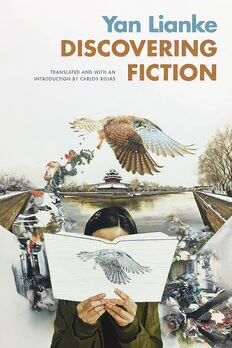
Cover art: Zhong Biao, Take Of, 2015. Oil on
canvas, 59 × 47¼ inches (150 × 120 cm). Courtesy
of Eli Klein Gallery and the artist; © Zhong Biao.
Contents
translator’s introduction
Creating Real ity and Surpassing Realism ix
Carlos Rojas
1 Realism’s Four Levels of Truth 1
2 Zero Causality 35
3 Full Causality 51
4 Partial Causality 59
5 Inner Causality 83
6 Mythorealism 99
Appendix: Chinese Authors and Works 125
Notes 129
Bibliography 133
Index 137
Translator’s Introduction
Creating Real ity and Surpassing Realism
carlos rojas
Completed in 2010 (and published in 2011), Discovering Fiction opens
with a reference to “A Traitor to Writing,” Yan Lianke’s afterword to his
2010 novel Te Four Books. Set in a re education camp for accused Right
ists in the late 1950s, the novel explores not only the po liti cal persecu
tion associated with the AntiR ightist Campaign (1957–1959) but also
the devastating famine that took the lives of tens of millions of Chinese
during this same period. Known euphemistically as the “three years of
natu ral disaster,” the Great Famine (1959–1962) was actually a direct
result of a set of misguided po liti cal and economic policies implemented
under the Great Leap Forward Campaign (1958–1962).
Although the AntiR ightist Campaign and the Great Famine im
pacted wide swaths of China’s population, they have received relatively
little direct attention by Chinese fction authors. During the Maoist
period, up through the end of the Cultural Revolution (1966–1976), the
government exercised strict control over literary production, and even
after these controls were loosened during the Reform and Opening Up
Campaign that Mao’s successor Deng Xiaoping launched in 1978, cer
tain po liti cally sensitive topics remained efectively of limits— due to a
combination of ofcial censorship (whereby all published fction must
be reviewed and approved by governmenta ppointed agents) and soft
censorship (whereby authors and publishers are encouraged to volun
tarily avoid sensitive topics).
When Yan Lianke mentions at the beginning of Discovering Fiction
that Te Four Books “has almost no chance of being published in China,”
accordingly, this is a reference to his decision to devote the novel to the
overlapping po liti cal and humanitarian crises that aficted China in
the late 1950s. Yan Lianke had previously had several works that were
either banned or recalled (such as Serve the P eople!), or that had been
signifcantly shaped by his own practice of selfc ensorship (such as Dream
of Ding Village, which was l ater recalled anyway). With Te Four Books,
however, Yan Lianke de cided to write the novel without consideration
of whether it would be acceptable to Chinese publishers and censors.
Like many of this works, it was published in Chinese in Taiwan and
Hong Kong and was subsequently translated into many foreign lan
guages, but it was never ofcially published in Mainland China.
Like all of Yan Lianke’s fction, Te Four Books is closely engaged with
the historical realities of modern China, though it frequently approaches
these topics in an unusual, fantastic manner. For instance, during the
height of the famine, the work’s protagonist, who is known simply as
“the Author,” begins cultivating a secret plot of grain and comes up with
the idea of irrigating the soil with his own blood:
When I lowered my head, I saw that the wheat leaves were covered
with a combination of beads of blood and drops of water, and the
felds were fowing with a mixture of blood and rain that alternated
between light and dark red, as though it were a dyeing mill. I saw the
uppermost grain of wheat sucking the blood rain like an infant suck-
ing milk, and the wheat leaves sprinkling drops of blood-w ater in all
directions. After the thick smell of blood dissipated and mixed with the
scent of wheat, I became surrounded by a fresh new aroma.
I resolved to slice my own fesh.
I also de cided to allow my blood to fully bleed out, to the point that
I could no longer remain upright. I collapsed limply to the ground and
closed my eyes for a while. When I opened them again, light from the
setting sun was shining in through the lower part of the win dow, like
red rain fowing into the room. (293)
Te result is a crop of oversized, bloodf lled ears of wheat, which are
pursued intently by other residents of the re education camp. Although
clearly fantastic, this “blood grain” plotline evocatively captures the sorts
x TRANSLATOR’S INTRODUCTION