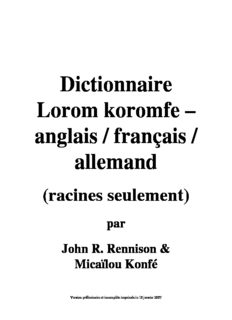
Table Of ContentDictionnaire
Lorom koromfe –
anglais / français /
allemand
(racines seulement)
par
John R. Rennison &
Micaïlou Konfé
Version préliminaire et incomplète imprimée le 10 janvier 2007
Ce dictionnaire a été agréé par
le Chef du Lorom
a jɔ Sigri
(Pobé-Mengao)
L’alphabet utilisé dans cette publication est en accord avec l’alphabet
international phonétique (IPA), sauf que [j] est remplacé par [y].
a ar(ɪ)-
a
a article. a, an; fr: un, une; dt: ein, eine. albasl- noun. onion; garlic; fr: oignon; ail; dt: Zwiebel;
a article. [Note: The article precedes the noun or Knoblauch. [Note: The singular refers to a single
noun-phrase which it qualifies. It is obligatory for onion/garlic (plant). Generically (e.g. as an
all common nouns (including nominal derivations ingredient in cooking) the plural is used.]
from verbs) and some proper nouns, but not for a albaslrɛ common noun sg./singulative.
place names. Adverbs and finite verbs are never a aləbasəla common noun pl./collective.
preceded by the article. The article a is omitted if alkʌmisʌ noun. Thursday; fr: jeudi; dt: Donnerstag.
the noun or noun-phrase is qualified by a personal a alkʌmisʌ common noun sg.
pronominal adjective (my, your, etc.), whether in a alkʌmisʌu common noun pl.
the weak or strong form. It is also omitted if the a alkʌmisʌfi common noun pl.
noun or noun-phrase is qualified a numeral or by a alkʌmisʌmʌ common noun pl.
certain (final) deictic or demonstrative adjectives, all- noun. enemy; fr: ennemi; dt: Feind.
such as nandɪ. Such cases are noted individually in a allɔ common noun sg.
the entry of each such adjective. The article a has a yallɔ common noun sg.
no special meaning, but since there is no indefinite a alləba common noun pl.
article in Koromfe, it conveniently translates as a yalləba common noun pl.
'a/an'.] almɛt- noun. match; fr: allumette; dt: Streichholz, Zünder.
aa negative particle. not; fr: ne...pas; dt: nicht. [Note: [Note: This is a loan, originally from Fr.
This negative particle occurs between the subject "allumette".]
NP and the verb (in the same position as ba). It is a aləmɛtəfɛ common noun singulative.
extremely rare in occurrence; ba is far more a aləmɛtɪ common noun pl./collective.
common.] a aləmɛtʊ common noun pl./collective.
aa negative particle. a aləmɛtəfɪ common noun pl.
kãŋ kãã aa harɛ dɪ conditional clause. If nothing has amĩĩnʌ exclamation. amen; fr: amen; dt: amen.
touched him...; fr: Si rien ne l'a touché...; dt: Wenn amĩĩnʌ sentential exclamation.
ihn nichts berührt hat... arba noun. Wednesday; fr: mercredi; dt: Mittwoch.
ala relative pronoun. who, whoever, he/she who; fr: a arəba common noun sg.
qui, celui / celle qui; dt: wer, wer auch immer. a arəbaʊ common noun pl.
ala relative pronoun sg. a arəbafɪ common noun pl.
bɛ̃nəmãŋ relative pronoun pl. [Note: The final velar a arəbama common noun pl.
nasal assimilates to the place of articulation of the ar(ɪ)- noun. blacksmith, jeweller; fr: forgeron, bijoutier;
following consonant, as in the following examples.] dt: Schmied, Juwelier.
bɛ̃nəmãm bɛ noun phrase. those who have come; fr: a arɪɔ [Note: Unusual extra ɪ in the singular, as also in
ceux qui sont venus; dt: diejenigen, die gekommen a balɪɔ 'stranger' and a bɛrɪɔ 'Nyonyosi'.] common
sind. noun sg.
bɛ̃nəmãn da noun phrase. those who have won; fr: ceux a yarɪɔ common noun sg.
qui ont gagné; dt: diejenigen, die gewonnen haben. a arəba common noun pl.
bɛ̃nəmãŋ kʊ noun phrase. those who have killed; fr: a yarəba common noun pl.
ceux qui ont tué; dt: diejenigen, die getötet haben. a arəfɛ common noun singulative. blacksmith's trade;
ala interrogative pronoun. who, whom, whose; fr: qui, blacksmith's tools and equipment; fr: forgeronnerie;
à qui; dt: wer, wen, wem, wessen. outils et appareils du forgeron; dt: Schmiederei;
ala interrogative pronoun sg. Werkzeug und Ausrüstung des Schmieds.
alama interrogative pronoun pl. a yarəfɛ common noun singulative.
alama la bɛ interrogative sentence. Who (pl.) has a arə kɛ̃ɔ compound noun sg. blacksmith's wife (=
arrived?; fr: Qui (pl.) est venu?; dt: Wer (pl.) ist potter); fr: femme du forgeron (= potière); dt: Frau
angekommen? des Schmieds (= Töpferin).
alama la na nã interrogative sentence. Who (pl.) did a yarə kɛ̃ɔ compound noun sg.
you (pl.) see?; fr: Qui (pl.) avez-vous vu?; dt: Wen a arə kɛ̃na compound noun pl.
(pl.) habt ihr gesehen? a yarə kɛ̃na compound noun pl.
ala dãŋ la koŋ interrogative sentence. Whose house is
that?; fr: C'est la maison de qui?; dt: Wessen Haus
ist das?
10/01/2007 Koromfe Dictionary 1
arkɪl- ayo
arkɪl- noun. strip of woven cotton (ca. 4-5" wide); fr: arzumʌ noun. Friday; fr: vendredi; dt: Freitag.
bande de coton tissé (ca. 8-12 cm. de largeur); dt: a arzumʌ common noun sg.
gewebter Baumwollstreifen (ca. 8-12 cm breit). a arzumʌfi common noun pl.
[Note: These long strips of cloth are the basis of all a arzumʌmʌ common noun pl.
traditional garments etc. made of cotton. They are ayawoodi exclamation. okay, good heavens; fr: d'accord,
cut to length and sewn together.] ça alors; dt: okay, ach.
a arkɪllɛ common noun sg. ayawoodi sentential exclamation.
a arkɪla common noun pl. ayɛy exclamation. no; fr: non; dt: nein. [Note:
a arkɪlaʊ common noun pl. Synonymous with ajo.]
arzɛg- noun. riches, treasure; fr: richesse, trésor; dt: ayɛy sentential exclamation.
Reichtum, Schatz. ayo exclamation. no; fr: non; dt: nein. [Note:
a arzɛkɛ common noun sg./mass. Synonymous with ajɛj.]
a arzɛka common noun sg./mass. ayo sentential exclamation.
a arzɛgsʊʊ common noun pl.
2 Koromfe Dictionary 10/01/2007
ba babt-
b
ba pronoun / possessive adjective. they; their; them; fr: of all others) seems to be an old negation particle
ils, elles; leur(s); les, leur; dt: sie (3. pl.); ihr(,-er,- aa, which occurs once in an oral text recorded in
e,-es) (3. pl.); ihnen. 1967 by Wilhelm Staude and published in Rennison
ba proclitic personal pronoun (subject), postclitic (1985b). This particle in turn might possibly have
personal pronoun (direct or indirect object) & come from the commonly used áʔà 'no'. As with the
possessive adjective 3rd person pl. human. [Note: negative particle ba, negative pronouns cause
This form is either prefixed to a verb or a noun shortening of the final vowel of the future.]
phrase, or suffixed to a verb; it cannot stand alone baa bɛ̃nɛ sentence. They didn't come.; fr: Ils ne sont
(e.g. as the elliptical answer to a question). As the pas venus.; dt: Sie sind nicht gekommen.
prefix of a verb, it is the subject pronoun, on a noun ba negative particle. not; fr: ne...pas; dt: nicht. [Note:
phrase it is the "possessor", and as a suffix on a Can be used to negate a verb, or participial
verb it is the (direct or indirect) object. The 3rd adjective. It precedes the constituent which it
person plural pronoun can be used when referring to negates.]
a single person as a sign of respect (e.g. when ba negative particle.
speaking about the chief). The vowel of this a yɔ ba bɛ̃nɛ sentence. The chief hasn't arrived.; fr: Le
pronoun is lexical and is therefore (in contrast with chef n'est pas arrivé.; dt: Der Chef ist noch nicht
some other pronouns) never omitted.] angekommen.
ba bo ke ba bɛllaa sentence. They said that they will a pɛrəgʊ ba bĩnəmʌ̃ NP+Neg+Participle compound
come.; fr: Ils ont dit qu'ils viendront.; dt: Sie haben noun sg. a shirt that is not black; fr: une chemise
gesagt, daß sie kommen werden. qui n'est pas noir; dt: ein Hemd, das nicht schwarz
maa hamanda ba wɔgɔ sentence. I don't believe their ist.
words.; fr: Je ne crois pas leurs paroles.; dt: Ich a pɛ̃nɛ ba bĩnĩʌ̃ NP+Neg+Adjectival noun pl. shirts
glaube nicht an ihren Worten. that are not black; fr: chemises qui ne sont pas noir;
maa hamanda ba sentence. I don't believe them.; fr: Je dt: Hemden, die nicht schwarz sind.
ne leur crois pas.; dt: Ich glaube ihnen nicht. ba tag- noun. bachelor; fr: célibataire; dt: Junggeselle.
bakɔ disjunctive personal pronoun (subject, direct or a ba tagrɛ Neg+N compound noun sg.
indirect object) & possessive adjective 3rd person a ba tagəba Neg+N compound noun pl. [Note: The
pl. human. they; their(s); fr: ils, elles; leur(s), le/la element tag may be distantly related to a tɔɔm
leur(e)(s); dt: sie (3. pl.); ihr(,-er,-e,-es) (3. pl.). 'marry a woman'. It seems to have no connection
[Note: This form of the pronoun indicates some with the word a tagrɛ 'pond, lake'.]
kind of "emphasis", but this can be so minimal that ba zɛ̃n- noun. lazy; fr: paresseux; dt: faul.
in practice the disjunctive form can always be used a ba zɛ̃nəŋa Neg+N compound noun diminutive sg.
in place of a clitic pronoun. It never undergoes any a ba zɛ̃nəba Neg+N compound noun pl.
phonological reduction or expansion. It can stand in a ba zɛ̃nəya Neg+N compound noun pl. [Note:
the normal (preverbal) subject or (postverbal) object Possibly related to a zɛŋdɛ 'upper arm']
positions, and can also be used as the elliptical bããd- noun. ill, sick (person); fr: malade; dt: krank,
answer to a question. As with all disjunctive Kranke(r). [Note: = Mòoré]
pronouns, it is formed with the proclitic prefix a bããda common noun sg.
version of the pronoun and the invariant stem-like a bããdama common noun pl.
element kɔ.] a bããdɛɪ common noun sg. illness, sickness; fr:
bakɔ bo ke ba bɛllaa sentence. They said that they will maladie; dt: Krankheit.
come.; fr: Ils ont dit qu'ils viendront.; dt: Sie haben a bããdɛɪfɪ common noun pl.
gesagt, daß sie kommen werden. babt- verb. crouch, hide; fr: s'accroupir, se cacher; dt:
maa hamanda la bakɔ wɔgɔ sentence. I don't believe sich zusammenkauern, sich verstecken.
their words.; fr: Je ne crois pas leurs paroles.; dt: bafaa future.
Ich glaube nicht an ihren Worten. babtraa future.
baa negative proclitic (subject) personal pronoun 3rd babtɛ past.
person pl. they...not; fr: ils/elles ne...pas; dt: sie (3. babt(ʊ) perfective.
pl.)...nicht. [Note: This pronoun is equivalent to the baf(ʊ) imperfective.
proclitic subject pronoun ba combined with the babtr(ʊ) imperfective.
(homophonous, but otherwise unrelated) negative a babtam action noun sg./mass.
particle ba. The origin of this negative pronoun (and
10/01/2007 Koromfe Dictionary 3
bãg- bal(ɪ)-
a bafɔ deverbal agent noun sg. s.o. who is crouching / ase la - mə bãɪ̃ interrogative sentence & answer.
hiding; fr: qu.un qui s'accroupit / se cache; dt: jd. What's up? - I don't know.; fr: Qu'est-ce qu'il-y-a? -
der sich zusammenkauert / versteckt. Je ne sais pas.; dt: Was ist los? - Ich weiß (es) nicht.
a babtrɔ deverbal agent noun sg. ala la dəkɔ - mə bãɪ̃ interrogative sentence & answer.
a bafəba deverbal agent noun pl. Who's that? - I don't know (him).; fr: Qui est celui-
a babtrəba deverbal agent noun pl. là? - Je ne (le) connais pas.; dt: Wer ist das? - Ich
a bafəgʊ deverbal instrument noun sg. object for kenne (ihn) nicht.
hiding oneself; fr: objet pour se cacher; dt: baɪlɔ noun. Jew's harp; fr: arc musical; dt: Maultrommel.
Gegenstand, um sich zu verstecken. a baɪlɔ common noun sg.
a babtrəgʊ deverbal instrument noun sg. a baɪlɔfɪ common noun pl.
a bafəhɛ̃ deverbal instrument noun pl. a baɪlɔma common noun pl.
a babtrəhɛ̃ deverbal instrument noun pl. bak- verb. make, do; fr: faire; dt: machen, tun.
a bafəga deverbal instrument noun diminutive sg. bakraa future.
a babtrəga deverbal instrument noun diminutive sg. bakɛ past.
a bafəfa deverbal local noun. bak(ɪ) perfective.
a babtrəfa deverbal local noun. place to hide; fr: bakr(ɪ) imperfective.
endroit pour se cacher; dt: Versteckplatz. a bakam deverbal action noun sg./mass.
a bafmãʊ̃ deverbal nomen acti pl. places to hide; fr: a bakrɔ deverbal agent noun sg. s.o. who makes /
endroits pour se cacher; dt: Versteckplätze. does; fr: qu.un qui fait; dt: jd. der macht / tut.
bãg- verb. thin out (shoots of a crop), weed; fr: sarcler; a bakrəba deverbal agent noun pl.
dt: jäten. [Note: = Mòoré] a bakrəgʊ deverbal instrument noun sg. object for
bãgəraa future. making (sth.); fr: objet pour faire (q.chose); dt:
bãgɛ past. Gegenstand um (etwas) zu machen.
bãg(ɪ) perfective. a bakrəhɛ̃ deverbal instrument noun pl.
bãkʊ perfective + object gʊ. a bakrəga deverbal instrument noun diminutive sg.
bãgər(ɪ) imperfective. a bakrəsɪ deverbal instrument noun diminutive sg.
a bãgam deverbal action noun sg./mass. a bakrəfa deverbal local noun. place for making (sth.);
a bãka deverbal action noun sg. diminutive. second fr: endroit pour faire (q.chose); dt: Platz um (etwas)
stage of cultivation (in August): thinning and zu machen.
weeding; fr: deuxième étape de cultivation (en a bakmãʊ̃ deverbal nomen acti pl. what remains after
août): sarclage; dt: zweite Etappe des Feldbaus (im one has made something; fr: ce qui reste lorsqu'on a
August): jäten. [Note: < bãg + ga. a bãka This is fait q.chose; dt: das, was bleibt, wenn man etwas
also the name of a traditional lunar month - see a gemacht hat.
pɪlaŋ] bal- noun. ball, balloon; fr: balle, ballon; dt: Ball,
a bãgəsʊʊ deverbal action noun pl. Luftballon. [Note: < French "balle" (probably via
a bãgərɔ deverbal agent noun sg. s.o. who thins out / Mòoré)]
weeds; fr: qu.un qui sarcle; dt: jd. der jätet. a ballɪ common noun sg.
a bãgərəba deverbal agent noun pl. a bala common noun pl.
a bãgərəgʊ deverbal instrument noun sg. object for a balləfɪ common noun pl.
thinning out / weeding; fr: objet pour sarcler; dt: a balləma common noun pl.
Gegenstand zum Jäten. bala conjunction. because; fr: parce que; dt: weil. [Note:
a bãgərəhɛ̃ deverbal instrument noun pl. = Mòoré. Cf. Koromfe ke.]
a bãgərəga deverbal instrument noun diminutive sg. bala conjunction.
a bãgərəfa deverbal local noun. place for thinning out balafɔ̃ noun. balaphone (xylophone-like mus. instrument);
/ weeding; fr: endroit pour sarcler; dt: Platz zum fr: balaphon (instr. musical ressemblant à une
Jäten. xylophone); dt: Balaphon (Xylophon-ähnliches
a bãgəmãʊ̃ deverbal nomen acti pl. plants already mus. Instrument). [Note: Origin unknown; not
weeded; fr: plantes déjà sarclées; dt: bereits gejätete Koromfe.]
Pflanzen. a balafɔ̃ common noun sg.
bãɪ-̃ defective verb. not know; fr: ne pas savoir, ne pas a balafɔ̃fɪ common noun pl.
connaître; dt: nicht wissen, nicht kennen. a balafɔ̃ma common noun pl.
bãɪ̃ perfective. [Note: This form may have originated bal(ɪ)- noun. stranger; fr: étranger; dt: Fremder.
from a perfective form of the verb a jɛ̃ɛ̃lɛ̃ɪ̃ preceded a balɪɔ common noun sg.
by the negative particle ba, i.e. baj̃ɛ̃.] a baləba common noun pl.
a bãɪ̃lɛɪ deverbal action noun sg./mass. not knowing,
ignorance; fr: ignorance; dt: Nichtwissen,
Unwissenheit.
4 Koromfe Dictionary 10/01/2007
ban- bʌ̃ndʌku
ban- noun. mother's brother; any male member of the a barəma common noun pl.
mother's family; fr: frère de la mère ; chaque a barə kɛ̃ɛ̃nɛ̃ɪ̃ jealousy; fr: jalousie; dt: Eifersucht.
membre mâle de la famille de la mère; dt: Bruder [Note: The lengthening of ɛ̃ is unexpected.]
der Mutter; jedes männliche Mitglied der Familie bark- verb. bless; fr: bénir; dt: segnen.
der Mutter. barəkraa future.
a bana common noun sg. barəkɛ past.
a banama common noun pl. barək(ɪ) perfective.
bãŋ- verb. hammer in (e.g. nail, stake); fr: clouer (p.e. barəkr(ɪ) imperfective.
une pointe, un piquet); dt: hineinhämmern (z.B. a barəkam deverbal action noun sg./mass.
Nagel, Pflock). a dɔfrɛ barəkɛ hɔ̃ sentence. God has blessed us.; fr:
bãŋnaa future. Dieu nous a béni.; dt: Gott hat uns gesegnet.
bãŋɛ past. a barəkrɔ deverbal agent noun sg. s.o. who blesses; fr:
bãŋ perfective. qu.un qui bénit; dt: jd. der segnet.
bãŋn(ɛ) imperfective. a barəkrəba deverbal agent noun pl.
a bãŋam deverbal action noun sg./mass. a barəkrəgʊ deverbal instrument noun sg. object for
a bãŋnɔ̃ deverbal agent noun sg. s.o. who hammers; fr: blessing; fr: objet pour bénir; dt: Gegenstand um zu
qu.un qui cloue; dt: jd. der hämmert. segnen.
a bãŋnəba deverbal agent noun pl. a barəkrəhɛ̃ deverbal instrument noun pl.
a bãŋnəgʊ deverbal instrument noun sg. object for a barəkrəga deverbal instrument noun diminutive sg.
hammering (e.g. hammer); fr: objet pour clouer a barəkrəfa deverbal local noun. place for blessing; fr:
(p.e. un marteau); dt: Gegenstand zum Hämmern endroit pour bénir; dt: Platz zum Segnen.
(z.B. ein Hammer). a barəkəmãʊ̃ deverbal nomen acti pl. things which are
a bãŋnəhɛ̃ deverbal instrument noun pl. blessed; fr: choses qui sont bénies; dt: Dinge, die
a bãŋnəga deverbal instrument noun diminutive sg. gesegnet sind.
a bãŋnəfa deverbal local noun. place for hammering; barka exclamation. thank you; fr: merci; dt: Danke.
fr: endroit pour clouer; dt: Platz zum Hämmern. [Note: Clearly related to a barkam 'bless'; possibly
a bãŋmãʊ̃ deverbal nomen acti pl. things that have the plural of a - dɛ nomen acti.]
been hammered in; fr: choses qui sont clouées; dt: barka sentential exclamation.
Dinge, die hineingehämmert worden sind. barkɪ bi noun. Burkinabe; fr: burkinabé; dt: Burkinabe.
bãŋ- noun. bare; fr: nu; dt: nackt. a barəkɪ bi common noun sg.
a bãŋde common noun sg. a barəkɪ bu common noun pl.
a bãŋa common noun pl. bat- noun. meeting (generic, incl. celebration); fr:
a fɪrɛ bãŋdɛ NP+N compound noun sg. full sunlight; réunion (générique, y inclu une fête); dt:
midday (ca. 12:00-15:00); fr: plein soleil; midi (ca. Versammlung (generisch, einschl. Fest).
12:00-15:00); dt: volles Sonnenlicht; Mittag (ca. a batʊ common noun sg.
12:00-15:00). a batəfɪ common noun pl.
a pɪlaŋ bãŋdɛ NP+N compound noun sg. full moon; fr: a batʊʊ common noun pl.
lune pleine; dt: Vollmond. bʌ̃ʌ̃ni noun. health; fr: santé; dt: Gesundheit. [Note: Often
a ỹʊ̃ bãŋdɛ NP+N compound noun sg. hairless head; used in greetings. See a kɪbarʊ. An older Koromfe
fr: tête sans cheveux; dt: haarloser Kopf. term for 'health' is a kʊlɔ jagaɪ 'freshness/coolness
a ỹʊ̃fɪ bãŋa NP+N compound noun pl. of the body'.]
bãŋgʊ noun. circumcised (= initiated) male (who must a bʌ̃ʌ̃ni common noun sg.
then leave his mother's house); fr: homme circoncis bʌhʌpʌ noun.
(= initié) (qui doit quitter la maison de sa mère); dt: a bʌhʌpʌ common noun sg.
Beschnittener (= Initiierter) (der darauf das Haus a bʌhʌpʌmʌ common noun pl. glutton; fr: gourmand;
seiner Mutter verlassen muß). [Note: = Mòoré] dt: Vielfraß.
a bãŋgʊ common noun sg. bʌluu- noun. kind of flute (made by children from millet
a bãŋgʊfɪ common noun pl. stalks); fr: espèce de flûte (de tiges de mil fabriquée
a bãŋgʊma common noun pl. par les enfants); dt: Art Flöte (von Kindern aus
a bãŋgʊ bi NP+N compound noun sg. circumcised Hirsestengeln gemacht). [Note: Probably not of
male; fr: homme circoncis; dt: Beschnittener. Koromfe origin.]
a bãŋgʊ bu NP+N compound noun pl. a bʌluuri common noun sg.
baŋs- noun. spear; fr: lance; dt: Speer. a bʌluuyʌ common noun pl.
a baŋsʊ common noun sg. a bʌluuyo common noun pl.
a baŋsɪɪ common noun pl. bʌ̃ndʌku noun. manioc; fr: manioc; dt: Manio. [Note: =
bar- noun. husband; fr: mari; dt: Ehemann. Mòoré]
a bara common noun sg. a bʌ̃ndʌkufe common noun singulative.
10/01/2007 Koromfe Dictionary 5
bʌndəbi bɛll-
a bʌ̃ndʌkufre common noun singulative. because the first element of this compound is an
a bʌ̃ndʌku common noun pl./collective. adverb.]
a bʌ̃ndʌkufi common noun pl. bɛllɛ nɛ sãmmã adverb+N compound noun pl.
bʌndəbi noun. mother's brother who is still a child; child bɛ(l)- verb. come, (auxiliary) happen; fr: venir,
of the mother's family; fr: frère de la mère qui est (auxiliaire) arriver; dt: kommen, (Auxiliar)
un enfant; enfant de la famille de la mère; dt: geschehen, dazukommen.
Bruder der Mutter, der noch ein Kind ist; Kind der bɛllaa future.
Familie der Mutter. [Note: Probably < a bana bi] bɛnɛ past.
a bʌndə bi N+N compound noun sg. bɛ perfective.
a bʌndə bu N+N compound noun pl. bɛll(ɪ) imperfective.
bɛb- verb. travel; get dressed, put on; fr: voyager ; a bɛ̃nam action noun sg./mass.
s'habiller, mettre; dt: reisen; sich anziehen, a bɛ̃ʊ̃ action noun sg./mass. also: arrival; fr: aussi:
anziehen. arrivée; dt: auch: Ankunft.
bɛbraa future. a bɛllɔ deverbal agent noun sg. s.o. who is coming; fr:
bɛbfaa future. qu.un qui vient; dt: jd. der kommt.
bɛbɛ past. a bɛlləba deverbal agent noun pl.
bɛb(ʊ) perfective. a bɛlləgʊ deverbal instrument noun sg. thing / animal
bɛbr(ʊ) imperfective. that is coming; fr: objet / animal qui est en train de
bɛbf(ʊ) imperfective. venir; dt: Ding / Tier, das kommt.
a bɛbam deverbal action noun sg./mass. a bɛlləhɛ̃ deverbal instrument noun pl.
a bɛbrɔ deverbal agent noun sg. traveller; dresser; fr: a bɛlləga deverbal instrument noun diminutive sg.
voyageur; habilleur; dt: Reisender; Anzieher. a bɛlləfa deverbal local noun. place for arriving; fr:
a bɛbrəba deverbal agent noun pl. endroit pour arriver; dt: Platz zum Ankommen.
a bɛbrəgʊ deverbal instrument noun sg. garment (of a biisi bɛlləfa NP+N compound noun sg. bus stop, bus
any kind); fr: vêtement, habit (de toute sorte); dt: station; fr: arrêt d'autobus, station d'autobus; dt:
Kleidungsstück (jeder Art). Bushaltestelle, Busbahnhof.
a bɛbrəhɛ̃ deverbal instrument noun pl. bɛll- verb. pan (generic), separate grain from grist (by
a bɛbrəga deverbal instrument noun sg. panning with a straw fan or calabash), clean (after
a bɛbrəfa deverbal local noun. place to which one pounding); fr: vanner (générique), nettoyer (après
travels; place for dressing; fr: endroit où on voyage; avoir pilé); dt: trennen, waschen (generisch),
endroit pour s'habiller; dt: Ort, wo man hinreist; Getreide von Spreu trennen (mit einem Strohfächer
Platz zum anziehen. oder einer Kalebasse), reinigen (nach dem
a bɛbmãʊ̃ deverbal nomen acti pl. places to which one Stampfen). [Note: This is the penultimate process in
has travelled; dressed; fr: endroits où on a voyagé; preparing grain for cooking. First comes a sɔgtam,
habillé; dt: Orte, wohin man gereist ist; angezogen. followed by a sellʌm, then a bɛllam. Afterwards the
bɛl- noun. back; fr: dos, arrière; dt: Rücken, Rückseite. grains are panned in water to remove stones (a
[Note: This word actually refers to the whole rear jislʌm). Cf. also a forʌm 'separate grain from grist
surface of the body, from the shoulders to the feet, by pounding'.]
though it is commonly used to refer to the back bɛllraa future.
only. The less commonly used word a kundoŋ bɛllɛ past.
refers to the back only (from the shoulders to the bɛll(ɪ) perfective.
waist).] bɛllr(ɪ) imperfective.
a bɛllɛ common noun sg. a bɛllam deverbal action noun sg./mass.
a bɛla common noun pl. a bɛllrɔ deverbal agent noun sg. s.o. who pans; fr:
bɛllɛ (nɛ) postposition. behind; fr: derrière; dt: hinter. qu.un qui vanne; dt: jd. der trennt / wäscht.
[Note: Can be used with or without nɛ.] a bɛllrəba deverbal agent noun pl.
a dãŋ koŋ bɛllɛ prepositional phrase. behind the house; a bɛllrəgʊ deverbal instrument noun sg. tool for
fr: derrière la maison; dt: hinter dem Haus. panning; grain that is being panned; fr: outil pour
a dãŋ koŋ bɛllɛ nɛ prepositional phrase. behind the vanner; grains qui sont en train d'être vannés; dt:
house; fr: derrière la maison; dt: hinter dem Haus. Werkzeug zum trennen / waschen; Körner, die
bɛllɛ nɛ adverb. at the back; fr: en arrière; dt: hinten. gerade getrennt/gewaschen werden.
[Note: Can be used with or without nɛ.] a bɛllrəhɛ̃ deverbal instrument noun pl.
də tuko bɛllɛ nɛ sentence. He sat at the back.; fr: Il a bɛllrəga deverbal instrument noun diminutive sg.
était assis en arrière.; dt: Er saß hinten. a bɛllrəfa deverbal local noun. place for panning; fr:
bɛllɛ nɛ saa adverb+N compound noun sg. last; fr: endroit pour vanner; dt: Platz zum trennen /
dernier; dt: letzt(-er,-e,-es). [Note: No article a waschen.
6 Koromfe Dictionary 10/01/2007
bɛ̃n- bɛrd-
a bɛlləmãʊ̃ deverbal nomen acti pl. panned grain; fr: jene vier Männer. [Note: * a bɛnna nãã beŋ is
grains vannés; dt: getrenntes / gewaschenes impossible because a numeral precludes the article
Getreide. a.]
bɛ̃n- noun. faeces, shit; fr: merde, crotte; dt: Defäkalien, bɛŋgɛ ba zɔmma mɛ sentence. Those guys don't like
Scheiße, Kot. [Note: This word has no singular me.; fr: Ceux-la ne m'aiment pas.; dt: Die dort
form.] mögen mich nicht.
a bɛ̃na common noun pl. bɛr- noun. small piece (of sth.); fr: petite pièce, petit
a bɛ̃n gɛllɛ N+N compound noun sg. piece of shit; fr: morceau (de q.ch.); dt: kleiner Teil (von etwas).
morceau de merde; dt: Stück Scheiße. [Note: (= Mòoré)]
a bɛ̃n gɛla N+N compound noun pl. a bɛrəga common noun sg.
bɛnn- noun. backside, arse; fr: derrière, cul; dt: Hintern, a bersi common noun pl.
Arsch. bɛr- noun. male (animal); (in compounds, also) penis-
a bɛnnəŋa diminutive sg. shaped; fr: (animal) mâle; (dans les mots composés,
a bɛnnənɛ diminutive pl. aussi) à forme de pénis; dt: männliches (Tier); (in
a bɛnnəŋa yɪbrɛ NP+N compound noun sg. Zusammensetzungen, auch) penisförmig.
a bɛnnənɛ yɪba NP+N compound noun pl. anus, a bɛtɛ common noun sg.
arsehole; fr: anus; dt: After, Arschloch. a bɛra common noun pl. [Note: For 'penis-shaped', see
bɛ̃nta noun. traditional shorts (single piece of material); the compounds a hʊrə-bɛtɛ, a wɔ̃nə-bɛtɛ, a da-bɛtɛ.]
fr: culotte traditionnelle (une seule pièce d'étoffe); a sũndu bɛtɛ NP+N compound noun sg. male horse,
dt: traditionelle kurze Hose (ein einziges Stück stallion; fr: cheval mâle, étalon; dt: männliches
Stoff). Pferd, Hengst.
a bɛ̃nta common noun sg. a sũndii bɛra NP+N compound noun pl.
a bɛ̃ntafɪ common noun pl. a wɔ̃nə bɛtɛ N+N compound noun sg.
bɛŋ demonstrative adjective / pronoun. a wɔ̃nə bɛra N+N compound noun pl. male chicken,
bɛŋ demonstrative adjective human pl. these, those, cock; fr: poulet mâle, coq; dt: männliches Huhn,
the; these / those people; fr: ces, les; ceux-ci/là, Hahn.
celles-ci/là; dt: diese, jene, die. [Note: a bɛrəga common noun diminutive sg.
Demonstrative adjectives are also used as definite a bɛrɪɪ common noun diminutive pl. young male
articles. Their similarity to the corresponding noun- (animal); fr: (animal) jeune mâle; dt: junges
class suffixes is unmistakable. They always follow männliches (Tier). [Note: The regular diminutive
the NP and do not affect the presence or absence of plural would be a bɛrənɛ, but no such form exists.]
the article a before the NP. When used pronouns a pesə bɛrəga N+N compound noun diminutive sg.
they stand alone in the position of an NP. Cf. the young male sheep, young ram; fr: petit mouton
full set of demonstratives: hoŋ, koŋ, bɛŋ, hɛ̃ŋ, kɛ̃ŋ.] mâle; dt: kleines männliches Schaf, kleiner
a bɛnna bɛŋ noun phrase. the / these / those man; fr: les Schafbock.
/ ces hommes; dt: die / diese / jene Männer. a pesə bɛrɪɪ N+N compound noun diminutive pl.
bɛnna nãã bɛŋ noun phrase. the / these / those four bɛrd- verb. lie down / lay next to (obj.) turned at an angle,
men; fr: les / ces quatre hommes; dt: die / diese / prop against one another; fr: se coucher / poser à
jene vier Männer. [Note: * a bɛnna nãã bɛŋ is coté de (obj.) tourné, caler; dt: (sich) hinlegen
impossible because a numeral precludes the article neben (Obj.) gedreht, gegeneinander stützen.
a.] bɛrɛdaa future.
bɛŋ ba zɔmma mɛ sentence. Those guys don't like bɛrədɛ past.
me.; fr: Ceux-la ne m'aiment pas.; dt: Die dort bɛrɛ perfective.
mögen mich nicht. bɛrɛd(ɪ) imperfective.
bɛŋgɛ strong demonstrative adjective / pronoun. a bɛrədam deverbal action noun sg./mass.
[Note: The strong demonstratives are said to be mə bɛrədɛ (a) fʊba sentence. I lay down next to the
more emphatic than the corresponding normal people.; fr: Je me suis couché près des gens.; dt: Ich
demonstrative, but in practice can be found habe mich neben den Leuten hingelegt. [Note: This
everywhere where the latter occur. All strong example assumes that a group of people are lying
demonstratives are formed by adding -gV to the on the ground next to one another. I lay down either
normal demonstrative, where V is a (non-nasal) alongside their heads or alongside their feet.]
copy of the (one and only) vowel of the normal mə bɛrədɛ (a) dãɪ̃ã dombʌ sentence. I propped one
demonstrative.] stick against the other.; fr: J'ai calé un bois contre
a bɛnna bɛŋgɛ noun phrase. the / these / those man; l'autre.; dt: Ich habe die Stöcke gegeneinander
fr: les / ces hommes; dt: die / diese / jene Männer. gestützt.
bɛnna nãã beŋgɛ noun phrase. the / this / that one a bɛrɛdɔ deverbal agent noun sg. s.o. who lies down
woman; fr: les / ces quatre hommes; dt: die / diese / turned by 90º; fr: qu.un qui se couche à côté tourné
10/01/2007 Koromfe Dictionary 7
bɛrɛms- beld-
à 90º; dt: jd. der sich daneben hinlegt um 90º bɛrʊ numeral. (a) hundred (100); 500 francs C.F.A.; fr:
gedreht. centaine, cent (100); 500 francs C.F.A.; dt:
a bɛrɛdəba deverbal agent noun pl. Hundert, hundert (100); 500 Francs C.F.A. [Note:
a bɛrɛdəgʊ deverbal instrument noun sg. prop; fr: No article a is used before this word, except
objet pour caler; dt: Gegenstand zum aufstützen. (optionally) when it is used non-attributively
a bɛrɛdəhɛ̃ deverbal instrument noun pl. (disjunctively). Mengao speakers say that this is an
a bɛrɛdəga deverbal instrument noun diminutive sg. Aribinda form. The normal Mengao form is kɔbəga
a bɛrɛdəfa deverbal local noun. place for propping (=Mòoré)or (older) zãŋfɔ. The plural form is used
things; fr: endroit pour caler; dt: Platz zum stützen. when this word qualifies another numeral (e.g.
a bɛrɛmãʊ̃ deverbal nomen acti pl. that which is bɛrʊma hĩĩ 'two hundred; 1000 francs C.F.A.').]
propped; enclosure in the bush (made of sticks bɛrʊ attributive & non-attributive (disjunctive)
propped against one another); fr: ce qui est calé; cardinal numeral sg.
clôture en brousse (fabrique de bois qui sont calés bɛrʊma attributive & non-attributive (disjunctive)
l'un contre l'autre); dt: das, was gestützt ist; cardinal numeral pl.
Umzäunung im Busch (aus Stöcken, die fʊba bɛrʊ NP+N compound noun sg. a hundred
aufeinander gestützt sind). people; fr: cent gens, cent personnes; dt: hundert
bɛrɛms- verb. overtake, cross; fr: dépasser, traverser; dt: Menschen.
überholen, überqueren, kreuzen. dãɪ̃ bɛrʊ NP+N compound noun sg. a hundred houses;
bɛrɛmsraa future. fr: cent maisons; dt: hundert Häuser.
bɛrɛmsɛ past. a bɛrɛndɔ ordinal numeral human sg. second; fr:
bɛrɛms(ʊ) perfective. deuxième; dt: zweit(-er,-e,-es).
bɛrɛmsər(ʊ) imperfective. a bɛrɛndəba ordinal numeral human pl.
a bɛrɛmsam deverbal action noun sg./mass. a bɛrɛndəgʊ ordinal numeral non-human. [Note: Non-
a bɛrɛmsərɔ deverbal agent noun sg. s.o. who overtakes human ordinal numerals have no plural form;
/ crosses, passer-by; fr: qu.un qui dépasse / traverse, instead the singular is used.]
passant; dt: jd. der überholt / überquert / kreuzt, bel- noun. child, person younger than ego; fr: enfant,
Passant. personne moins agé que ego; dt: Kind, Mensch
a bɛrɛmsərba deverbal agent noun pl. jünger als ego.
a bɛrɛmsərəgʊ deverbal instrument noun sg. place a beləŋʌ common noun diminutive sg.
where many people pass by (e.g. busy street); a beliʌ common noun pl. [Note: This plural suffix is
bridge; fr: endroit où beaucoup de gens passent otherwise found mainly on nominal adjectives with
(p.e. une rue fréquentée); pont; dt: Ort, wo viele the sg. suffix -V ŋ (where V is a copy of the
Menschen vorbeigehen (z.B. belebte Straße); preceding vowel). Such adjectives also often have a
Brücke. diminutive with - əŋa (cf. e.g. a feleŋ). However,
a bɛrɛmsərəhɛ̃ deverbal instrument noun pl. there is no form like * a beleŋ.]
a bɛrɛmsərəga deverbal instrument noun diminutive mə sa beləŋʌ NP+N compound noun sg.
sg. mə sa beliʌ NP+N compound noun pl. my sibling; fr:
a bɛrɛmsərəfa deverbal local noun. place where many mon frère / ma soeur; dt: mein Geschwister.
people pass by (e.g. busy street). crossing place; fr: beld- verb. sell, barter; fr: vendre, échanger, faire le
endroit où beaucoup de gens passent (p.e. une rue marché; dt: verkaufen, tauschen. [Note: The
fréquentée), endroit à traverser; dt: Ort, wo viele meaning of this verb does not include the actual
Menschen vorbeigehen (z.B. belebte Straße), exchange of money, for which a dolʌm must be
Überquerungsstelle. used.]
bɛr(ɪ)- noun. specific clan, Nyonyosi; fr: clan spécifique, beledʌʌ future.
Nyonyosi; dt: spezifische Großfamilie (Clan), beləde past.
Nyonyosi. [Note: The ɪ of the singular form is bele perfective.
unusual (cf. also a balɪo). See also the Mòore word beled(i) imperfective.
a j̃ɔ̃j̃ɔ̃ɔ̃ga] a belədʌm deverbal action noun sg./mass.
a bɛrɪɔ common noun sg. a beledo deverbal agent noun sg. seller, salesperson;
a bɛrəba common noun pl. buyer, customer; fr: vendeur; acheteur, client; dt:
VerkäuferIn; KäuferIn, KundIn.
a beledəbʌ deverbal agent noun pl.
a beledəgu deverbal instrument noun sg. article that is
for sale; fr: article à vendre; dt: Verkaufsartikel.
a beledəhẽ deverbal instrument noun pl.
a beledəgʌ deverbal instrument noun sg.
8 Koromfe Dictionary 10/01/2007
Description:a arəfɛ common noun singulative. blacksmith's trade; blacksmith's tools and .. a bɛllrəgʊ deverbal instrument noun sg. tool for panning; grain that is