Table Of ContentAmalia E. Gnanadesikan
Dhivehi
Mouton-CASL Grammar Series
Editors
Anne Boyle David
Claudia M. Brugman
Thomas J. Conners
Amalia E. Gnanadesikan
Volume 3
Amalia E. Gnanadesikan
Dhivehi
|
The Language of the Maldives
Edited by
Anne Boyle David
This material is based upon work supported, in whole or in part, with funding from the United
States Government. Any opinions, findings and conclusions or recommendations expressed in this
material are those of the author(s) and do not necessarily reflect the views of the University of
Maryland, College Park and/or any agency or entity of the United States Government.
ISBN 978-1-61451-304-9
e-ISBN (PDF) 978-1-61451-234-9
e-ISBN (EPUB) 978-1-5015-0076-3
Library of Congress Cataloging-in-Publication Data
A CIP catalogue record for this book has been applied for at the Library of Congress.
Bibliographic information published by the Deutsche Nationalbibliothek
The Deutsche Nationalbibliothek lists this publication in the Deutsche Nationalbibliografie;
detailed bibliographic data are available on the Internet at http://dnb.dnb.
© 2017 University of Maryland. All rights reserved.
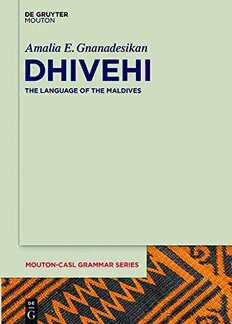
Cover photo: A thun’du kunaa, a traditional Maldivian mat. Photo by Gitanjali Gnanadesikan
Printing and binding: CPI books GmbH, Leck
♾ Printing on acid free paper
Printed in Germany
www.degruyter.com
Foreword
Itisremarkablethat,inthisageofunprecedentedglobalcommunicationandinterac-
tion,themajorityoftheworld’slanguagesareasyetnotadequatelydescribed.With-
outbasicgrammarsanddictionaries,theselanguagesandtheircommunitiesofspeak-
ersareinarealsenseinaccessibletotherestoftheworld.Thisstateofaffairsisanti-
theticaltotoday’sinterconnectedglobalmindset.
Thisseries,undertakenasacriticalpartofthemissionoftheUniversityofMary-
land Center for Advanced Study of Language (CASL), is directed at remedying this
problem. One goal of CASL’s research is to provide detailed, coherent descriptions
oflanguagesthatarelittlestudiedorforwhichdescriptionsarenotavailableinEn-
glish.Evenwheregrammarsfortheselanguagesdoexist,inmanyinstancestheyare
decadesoutofdateorlimitedinscopeordetail.
Whilethecriticalityoflinguisticdescriptionsisindisputable,thepainstakingwork
ofproducinggrammarsforneglectedandunder-resourcedlanguagesisofteninsuffi-
cientlyappreciatedbyscholarsandgraduatestudentsmoreenamoredofthelatestthe-
oreticaladvancesanddebates.Yet,withoutthefoundationofaccuratedescriptionsof
reallanguages,theoreticalworkwouldhavenomeaning.Moreover,withoutprofes-
sionallyproducedlinguisticdescriptions,technologicallysophisticatedtoolssuchas
thoseforautomatedtranslationandspeech-to-textconversionareimpossible.Such
researchrequirestime-consuminglabor,meticulousdescription,andrigorousanaly-
sis.
Itishopedthatthisserieswillcontribute,howevermodestly,totheultimategoal
ofmakingeverylanguageoftheworldavailabletoscholars,students,andlanguage
loversofallkinds.IwouldliketotakethisopportunitytosalutethelinguistsatCASL
andaroundtheworldwhosubscribetothisvisionastheirlife’swork.Itistrulyanoble
endeavor.
RichardD.Brecht
FoundingExecutiveDirector
UniversityofMarylandCenterforAdvancedStudyofLanguage
Series Editors’ Preface
Thisseriesaroseoutofresearchconductedonseveralunder-describedlanguagesat
theUniversityofMarylandCenterforAdvancedStudyofLanguage.Incommencing
our work, we were surprised at how many of the world’s major languages lack ac-
cessibledescriptiveresourcessuchasreferencegrammarsandbilingualdictionaries.
Among the ongoing projects at the Center is the development of such resources for
variousunder-describedlanguages.Thisseriesofgrammarspresentssomeofthelin-
guisticdescriptionwehaveundertakentofillsuchgaps.
Thelanguagescoveredbytheseriesrepresentabroadrangeoflanguagefamilies
andtypologicalphenomena.Theyarespokeninareasofinternationalsignificance,
someinregionsassociatedwithpolitical,social,orenvironmentalinstability.Provid-
ingresourcesfortheselanguagesisthereforeofparticularimportance.
However,thesecircumstancesoftenmakeitdifficulttoconductintensive,in-coun-
tryfieldwork.Incaseswheresuchfieldworkwasimpractical,theauthorsofthatgram-
marhavereliedoncloseworkingrelationshipswithnativespeakers,and,wherepos-
sible,corporaofnaturalisticspeechandtext.Theconditionsfordata-gathering—and
henceourapproachtoit—varywiththeparticularsituation.
Wefoundthedescriptivestateofeachlanguageintheseriestobedifferentfrom
thatoftheothers:insomecases,muchworkhadbeendone,buthadneverbeencol-
lectedintoasingleoverview;inothercases,virtuallynomaterialsinEnglishexisted.
Similarly,theavailabilityofsourcematerialinthetargetlanguagevarieswidely:in
somecases,literacyandmediaareverysparse,whileforothercommunitiesplentiful
writtentextsexist.Theauthorshaveworkedwiththeavailableresourcestoprovide
descriptionsascomprehensiveasthesematerials,thenativespeakerconsultants,and
theirowncorporaallow.
Oneofourgoalsisforthesegrammarstoreachabroadaudience.Forthatreason
theauthorshaveworkedtomakethevolumesaccessiblebyprovidingextensiveex-
emplificationandtheoreticallyneutraldescriptionsorientedtolanguagelearnersas
wellastolinguists.Allgrammarsintheseries,furthermore,includethenativeorthog-
raphy,accompaniedwhererelevantbyRomanization.Whiletheyarenotintendedas
pedagogicalgrammars,werealizethatinmanycasestheywillsupplythatroleaswell.
Each of the grammars is presented as a springboard to further research, which
foreverylanguagecontinuestobewarranted.Wehopethatourempiricalworkwill
provideabasefortheoretical,comparative,computational,andpedagogicaldevelop-
mentsinthefuture.Welookforwardtothepublicationofmanysuchworks.
ClaudiaM.Brugman
ThomasJ.Conners
AnneBoyleDavid
AmaliaE.Gnanadesikan
Preface
When I first came to the University of Maryland Center for Advanced Study of Lan-
guage(CASL),ItoldmynewcolleaguesthatIwantedtoconcentrateonaSouthAsian
language.IhaddabbledinvariousSouthAsianlanguagesbefore,butIwantedtodo
betterthanthat—Iwantedtoreallylearnonethistime.DavidCoxsuggestedIwork
onDhivehiandmadeitpossibleformetodoso—thankyou!Theresulthasbeena
fascinatingride.IcannotsaythatIhavemasteredtheDhivehilanguage,butIhave
learnedanewanduniquescript,cudgeledmybrainintoprocessinganewsetofsyn-
tacticstructures,studiedtheMaldiviannewspapers,andeatenrihaakuru(fishpaste)
andgarudhiya(fishsoup).Ihaveevenmadesomeprogressonidentifyingthemany
stagesofcoconutdevelopmentandcometoseeatulipasakindofatree(ސ ް ގަ gas).
AlongthewayIhavehadtheprivilegeofgettingtoknowsomeMaldiviansandofben-
efitingfromtheirkindness.IamespeciallygratefultoDr.MaryamMariya,whohas
servedasaconsultant,answeringcountlessquestionsaswellasfacilitatingmymeet-
ingswithotherDhivehispeakersbothinNewZealandandinMalé.Mythanksalsoto
DeanAbdulRasheed(Absy)Ali,whoprovidedmewithworkingspaceattheFaculty
ofArtsatMaldivesNationalUniversity.TheotherDhivehispeakerswhogenerously
sharedtheirlanguagewithmemustremainanonymousduetoIRB(InstitutionalRe-
viewBoard)ethicsrulesontheuseofhumansubjects,butIalwaysrememberthem
andthefriendshiptheyextendedtomewithgratitude.
ThisgrammarhasalsobenefitedfromtheinputofmanypeopleattheUniversity
ofMaryland.AnneDavidhasservedastheeditorforthisvolume,catchingtypos,bad
prose,poorformatting,andfuzzythinkingalike.MikeMaxwellandTomConnershave
alsomadeeditorialcontributions.AricBills,MikeMaxwell,SeanSimpson,Stephanie
Kramer,andNateClairhaverenderedtechnicalassistance.SpecialthankstoAricBills
formakingthemapandtheotherfigures.Earlierversionsofthisworkbenefitedfrom
theproofreadingskillsofRebeccaMcGowan,theformattingskillsofMelissaFox,and
theindexingskillsofEvelynBrowne,allofwhichweresadlymissedinlaterversions.
Mythankstoallofthem.
AtdeGruyter-MoutonmythanksareduetoLaraWysongandherteamforshep-
herdingthebookthroughthepublicationprocess.ThanksalsotoJonathonLumand
ananonymousreviewerwhosecarefulcommentshelpedtoimprovethefinaltext.None
oftheaforementionedpeoplebearanyresponsibilityfortheerrorsthatmustsurelyre-
maininthiswork.AdefinitivegrammarofDhivehiremainstobewritten,butIhope
thatthecurrentbookrepresentsastepinthatdirection.
AmaliaE.Gnanadesikan