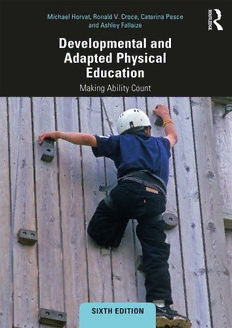
Table Of ContentDEVELOPMENTAL AND ADAPTED
PHYSICAL EDUCATION
Now in a fully revised and updated 6th edition, reflecting changes in legislation and cutting-edge
research, this is a complete introduction to adapted physical education, from the underpinning
science to practical teaching strategies and program design.
The book covers a broader range of disabilities, developmental disorders, and health
conditions than any other textbook and includes brand new material on developmental
coordination disorders and cognitive development. Full of teaching and coaching strategies and
techniques, it introduces scientific fundamentals, key legislation, and best practice in designing
effective programs. It encourages the reader to consider the individual before the disability and
to focus on what learners can do rather than what they can’t.
This is an essential reference for teachers, coaches, or exercise professionals working with
children with disabilities. It is also an invaluable resource for undergraduate or postgraduate
students of adapted physical education, kinesiology, physical education, physical therapy,
exercise science, athletic training, or sports coaching.
The new edition features updated online resources, including PowerPoint slides, web links,
an example syllabus, and quizzes.
Michael Horvat is Professor Emeritus of Adapted Physical Education and Motor Behavior at
the University of Georgia, USA, where he was Director of the Movement Studies Laboratory
and the Pediatric Exercise and Motor Development Clinic. His research focus is on cognition
and motor behavior of individuals with disabilities.
Ronald V. Croce is Professor in the Department of Kinesiology at the University of New
Hampshire, USA. His main teaching focus is in Adapted Physical Education, Applied Anatomy/
Kinesiology, and Medical Neuroscience. His main research focus is on cognition-motor learning
and motor control processes in typical and atypical populations.
Caterina Pesce is Associate Professor in the Department of Movement, Human and Health
Sciences at the University “Foro Italico” of Rome, Italy. Her main teaching focus is physical
activity for children, and her main research focus is exercise, cognition, and motor coordination
across the lifespan, and enhancing physical education in schools.
Ashley Fallaize is Training and Education Manager at BlazeSports, USA. In this role she
oversees the BlazeSports Institute for Adaptive Sports and Recreation. She is a Certified
Adaptive Recreation and Sports Specialist II, Certified Adapted Aquatics Instructor, and
Certified Inclusive Fitness Trainer.
DEVELOPMENTAL AND
ADAPTED PHYSICAL
EDUCATION
Making Ability Count
Sixth Edition
MICHAEL HORVAT, RONALD V. CROCE,
CATERINA PESCE AND ASHLEY FALLAIZE
Sixth edition published 2019
by Routledge
2 Park Square, Milton Park, Abingdon, Oxon, OX14 4RN
and by Routledge
52 Vanderbilt Avenue, New York, NY 10017
Routledge is an imprint of the Taylor & Francis Group, an informa business
© 2019 Michael Horvat, Ronald V. Croce, Caterina Pesce and Ashley Fallaize
The right of Michael Horvat, Ronald V. Croce, Caterina Pesce and Ashley Fallaize
to be identified as authors of this work has been asserted by them in accordance
with sections 77 and 78 of the Copyright, Designs and Patents Act 1988.
All rights reserved. No part of this book may be reprinted or reproduced or utilised
in any form or by any electronic, mechanical, or other means, now known or
hereafter invented, including photocopying and recording, or in any information
storage or retrieval system, without permission in writing from the publishers.
Trademark notice: Product or corporate names may be trademarks or registered
trademarks, and are used only for identification and explanation without intent to
infringe.
[First edition published by Human Kinetics 2007]
[Fifth edition published by Pearson Education, Inc. 2011]
British Library Cataloguing-in-Publication Data
A catalogue record for this book is available from the British Library
Library of Congress Cataloging-in-Publication Data
A catalog record has been requested for this book
ISBN: 978-1-138-56986-7 (hbk)
ISBN: 978-1-138-56987-4 (pbk)
ISBN: 978-0-203-70403-5 (ebk)
Typeset in Sabon
by Apex CoVantage, LLC
Visit the eResources: www.routledge.com/9781138569874
Michael Horvat
I would like to dedicate this book to the memory of my parents, who taught
me the values of hard work and doing the right thing. It’s also dedicated to
my wife, Glada, and children Ian, Kala, and Michael, who make life worth
living.
Ronald V. Croce
To those who have instilled in me a dedication to academic excellence: my
parents; my brother, Michael; my mentor, Dr. Frank Papcsy; and the many
wonderful colleagues and students with whom I have had the pleasure to
work.
Ashley Fallaize
To my husband Michael, my family, and my son Tripp. Thank you for your
unwavering support, encouragement, and love.
Caterina Pesce
To my parents Elio and Elena, whose names indicate the ‘sun’ and ‘sunshine’
they gave me, and to my children Sofia, Luca, and Matthias, who carry on
the flow of light in my life.
CONTENTS
SECTION I
Introduction: physical education for children with disabilities 1
1 But first I have some questions, professor 3
2 Legal mandates 7
3 Continuum of placements and program planning 21
4 Parents and the motor performance team 45
5 Motor development and postural control 61
6 Perceptual-cognitive development and cognition
of movement 87
7 Physical fitness development and its relationship to cognition 109
SECTION II
Teaching individuals with learning and behavior disabilities 135
8 Intellectual disabilities 137
9 Learning, attention, and developmental coordination disorders 151
10 Autistic spectrum disorders 181
SECTION III
Teaching individuals with sensory impairments 197
11 Visual impairments 199
12 Deafness and hearing loss 217
SECTION IV
VIII
Teaching individuals with congenital and acquired impairments 235
nts
e
nt 13 Posture and orthopedic impairments 237
o
C
14 Neurological disorders 262
15 Muscular dystrophy and arthritis 307
SECTION V
Teaching individuals with health impairments 329
16 Respiratory disorders 331
17 Diabetes 349
18 Nutritional disorders 363
19 Cardiovascular disorders and hypertension 381
SECTION VI
Developing and implementing the physical activity program 399
20 Behavior management 401
21 Teaching physical fitness 411
22 Teaching motor skills 425
23 Teaching adapted aquatics 460
24 Coaching and sport for persons with disabilities 476
Index 492
SECTION I
Introduction
Physical education for children with
disabilities
The chapters in this section provide information concerning legal mandates and the placement
of children with disabilities into physical education. The initial steps in meeting the needs for
children with disabilities requires the input of physical education teachers, special education
teachers, athletic trainers, and physical and occupational therapists who make up the motor
performance team (MPT). This information should facilitate:
■ the availability of physical education services at the federal, state, and local levels;
■ an understanding of individualized education plans (IEP) that are developed to place chil-
dren with disabilities in the least restrictive learning environment based on the needs of the
child;
■ an understanding of the roles of parents and various administrative professionals in the
educational process and input on the MPT;
■ a determination of how the child’s need are met through evaluation and assessment in
program planning and implementation; and
■ the application of the developmental concepts of physical fitness, movement development,
motor skill acquisition, and cognitive and perceptual development when teaching children
with disabilities.