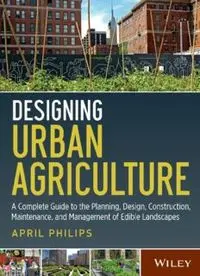
Table Of ContentDesigning
Urban Agriculture
Designing
Urban Agriculture
A Complete Guide to the Planning, Design, Construction,
Maintenance, and Management of Edible Landscapes
April Philips
Cover Design: Michael Rutkowski
Cover Photography: Front top: Courtesy of Riverpark Farm, photo by Ari Nuzzo; Front botom (L to R):
Photo courtesy of Atlanta Botanical Garden; Courtesy of Riverpark Farm, photo by Ari Nuzzo; Beth
Hagenbuch; Back (L to R) © Beth Hagenbuch; Photo courtesy of Atlanta Botanical Garden; Courtesy of
Riverpark Farm, photo by Ari Nuzzo; © Beth Hagenbuch; Courtesy of Riverpark Farm, photo by Ari Nuzzo
This book is printed on acid-free paper.
Copyright © 2013 April Philips. All rights reserved.
Published by John Wiley & Sons, Inc., Hoboken, New Jersey.
Published simultaneously in Canada.
No part of this publication may be reproduced, stored in a retrieval system, or transmited in any form or by
any means, electronic, mechanical, photocopying, recording, scanning, or otherwise, except as permited un-
der Section 107 or 108 of the 1976 United States Copyright Act, without either the prior writen permission
of the Publisher, or authorization through payment of the appropriate per-copy fee to the Copyright Clear-
ance Center, Inc., 222 Rosewood Drive, Danvers, MA 01923, 978-750-8400, fax 978-646-8600, or on the
web at www.copyright.com. Requests to the Publisher for permission should be addressed to the Permissions
Department, John Wiley & Sons, Inc., 111 River Street, Hoboken, NJ 07030, 201-748-6011, fax 201-748-
6008, or online at htp://www.wiley.com/go/permissions.
Limit of Liability/Disclaimer of Warranty: While the publisher and author have used their best eforts in
preparing this book, they make no representations or warranties with the respect to the accuracy or complete-
ness of the contents of this book and speciically disclaim any implied warranties of merchantability or itness
for a particular purpose. No warranty may be created or extended by sales representatives or writen sales ma-
terials. he advice and strategies contained herein may not be suitable for your situation. You should consult
with a professional where appropriate. Neither the publisher nor the author shall be liable for damages arising
herefrom.
For general information on our other products and services, or technical support, please contact our Cus-
tomer Care Department within the United States at 800-762-2974, outside the United States at 317-572-
3993 or fax 317-572-4002.
Wiley publishes in a variety of print and electronic formats and by print-on-demand. Some material included
with standard print versions of this book may not be included in e-books or in print-on-demand. If this book
refers to media such as a CD or DVD that is not included in the version you purchased, you may download
this material at htp://booksupport.wiley.com.
For more information about Wiley products, visit our Web site at htp://www.wiley.com.
Library of Congress Cataloging-in-Publication Data:
Philips, April.
Designing urban agriculture : a complete guide to the planning, design, construction, maintenance and
management of edible landscapes / April Philips.
pages cm
Includes index.
ISBN 978-1-118-07383-4 (hardback); 978-1-118-33023-4 (ebk.); 978-1-118-33092-0 (ebk.);
978-1-118-33307-5 (ebk.)
1. Urban agriculture. 2. Edible landscaping. I. Title.
S494.5.U72P44 2013
630.9173'2—dc23
2012045251
Printed in the United States of America
10 9 8 7 6 5 4 3 2 1
Contents
Preface vii
Acknowledgments ix
Chapter 1
Food Cities: Ecology + Urban Agriculture 1
Lafayette Greens, Detroit 1
Bar Agricole, San Francisco 10
City Slicker Farms, Oakland 13
Viet Village, New Orleans 29
Big City Farms, Baltimore 38
Chapter 2
Planning Strategies for Urban Food Systems 41
Prairie Crossing, Grayslake 41
River Falls Eco Village, River Falls 51
Verge Sidewalk Garden, Charlottesville 75
Scent of Orange, Chongqing 80
Chapter 3
Vision, Synthesis, and Form 87
Villa Augustus, Dordrecht 87
Miller Creek Edible Garden and Outdoor Kitchen,
San Rafael 104
2001 Market Street, San Francisco 109
Gary Comer Youth Center, Chicago 117
v
Chapter 4
Systems Integration and Connections 133
Medlock Ames Wine Tasting Room, Healdsburg 133
Our School at Blair Grocery, New Orleans 144
Incredible Edible House, prototype 156
Science Barge, Yonkers, New York 167
Banyan Street Manor, Honolulu 177
Chapter 5
Lifecycle Operations 181
Die Plantage, Munich 181
MUSC Urban Fram, Charleston 191
Riverpark Farm, Manhattan 202
VF Outdoors Campus, Alameda 209
Sacred Heart Organic Garden, Atherton 218
Slow Food Nation Victory Garden, San Francisco 224
Chapter 6
Outreach and Community 227
Atlanta Botanical Garden, Atlanta 227
Urban Food Jungle, prototype 235
Expo 2015, Milan 239
Alemany Farms, San Francisco 250
P-Patch Gardens, Seattle 253
Glide Church, San Francisco 259
Gotham Greens, Brooklyn 261
Bibliography 267
Image credits 271
Index 273
Preface
DESIGNING URBAN AGRICULTURE is about the intersection of ecology, design
and community. It is a dialogue on the ways to invite food back into the city and forge a
path towards creating healthier communities and a healthier environment.
When the recession began I planted an edible garden. I started with potatoes and
herbs such as parsley, sage, rosemary, mint, and thyme. Within a few weeks I began to
notice that even though I only spent 15 minutes a day each morning in the garden my
work day stress levels went down and life’s hiccups seemed to more easily be put into per-
spective. My family and I also noticed that our food tasted so much beter when I added
the home grown edible ingredients to our meals. he potatoes we harvested that irst year
were the most exquisite and sweetest potatoes I have ever tasted in my life. We all began
to eat a bit healthier. If someone was stressing out I’d send them out to the garden to har-
vest something from our backyard crops and they would come back with a smile on their
face and a strawberry or two to share. You could say that we had discovered a litle slice of
bliss in our daily lives.
What happened next became my adventure into the world of urban agriculture be-
cause I wanted to learn more about this incredibly interesting landscape typology and
its efects on human health and design. With media headlines such as people around the
country being put in jail for planting vegetables in their front yard, or the huge amount of
farms failing across the country for various reasons like water and climate, as I dove into
the research I began to discover the dark side of our industrial food system and industri-
alized agriculture. And because the food system in America is broken, the health of our
cities and communities are at risk.
As a landscape architect and urban designer I had questions I wanted answers to
such as 1. How could these agrarian landscapes be designed at the urban scale to become
an integral part of the food system of a city and also be connected to a regional food
system, and 2. How could designers collaborate and partner with urban farmers, food
entrepreneurs, community organizations, urban ecologists, visionary developers, and city
planners in a meaningful way to facilitate the creation of these landscapes while simulta-
neously addressing issues of human and environmental health, food justice, food security,
climate change, cultural aesthetics, and sustainable development. he end result of my
quest to answer these questions is this book.
My journey to ind answers took many turns along the way. Researching and reading
consumed a vast portion of my time tracking down news, articles, books, and web sites
that covered the subject mater not readily available in one place. I found seminars, forums
and conferences to atend and amazing ilm documentaries to watch and learn from. One
of the most fascinating components of this quest were the conversations I had with col-
leagues and urban farm enthusiasts from all walks of life about the links between food,
design, ecology, and building community.
vii
viii Preface
In particular, my conversations with Jake Voit, who was the Sustainability Manager
for Cagwin & Dorward , a top 25 Landscape Contracting irm in the United States lo-
cated in California turned extremely fruitful. Jake and I had an ongoing conversation
thread for over a year’s time frame sometimes emailing web sites, articles, ted talks, and
sharing video links since we are both passionate about deining the role that designers and
citizens can play with urban agriculture in creating positive environments for change. We
eventually had enough content on the subject for a provocative dialogue that I invited
Jake to present with me at a number of national conferences. By this time Jake was lead-
ing the grand vision of the InCommons Initiative for the Archibald Bush Foundation in
Minnesota that creates community powered problem solovers. (His work there created
highly efective listeners and facilitators of deep relationships based on empathy and
a realization of interconnectedness, which inluences creating conditions for current
and emerging leaders to hold the space for a paradigm shit from individualistic trans-
action-based communities to shared relationship-based communities.) He began to
focus our discussions on the integration of collaborative conversations and ecological
parameters into a systems thinking process. I am indebted to the continuing collaborative
dialogue we share and the material he has contributed in this book on sustainable agricul-
ture construction practices and how to build resilient communities through collaborative
conversations. his includes his description of Cuba’s transformation into a sustainable
agriculture economy ater the trade embargo crisis and his irsthand knowledge of perma-
culture principles from being raised on an organic farm. His explanations on the intrica-
cies of the soil food web and how to monitor and design for soil health provide clarity and
tools for soil management that is a critical component of urban agriculture landscapes.
With Jake’s background in Environmental Studies, Philosophy, and Permaculture Design,
I found his perspective was always unique.
My personal focus then turned towards advocacy and in particular why designers
need to play a key role in the integration of urban agriculture landscapes into the urban
realm. hese explorations and conversations were extended further into physical solu-
tions with my most visionary clients who allowed me to champion urban agriculture
within their development projects. I am indebted to them for their trust in leting me de-
sign these landscapes for them.
his book showcases projects and designers around the world who are forging new
paths to the sustainable city through these urban agriculture landscapes. he case stud-
ies demonstrate the environmental, economic and social value of these landscapes and
illustrate ways to forge a new paradigm for a greener and healthier lifestyle. he book
begins with a foundation on ecological principles and the idea that the food shed is part
of a city’s urban systems network. It outlines a design process that is based on systems
thinking and the design process spheres I developed for a lifecycle or regenerative based
approach. It includes strategies, tools and guides to help readers make informed decisions
on planning, designing, budgeting, constructing, maintaining, marketing, and increasing
the sustainability aspects of this re-invented design typology.
Michael Pollan has said that the garden suggests that there might be a place where we
can meet nature half way. Wendell Barry in his What are People for essays said that “eat-
ing is an agricultural act.” My own personal experience with urban agriculture leads me
to believe that our dilemma with explaining food as an integral system within the city is
because we do not as a culture think of food in this way. People are so disconnected from