Table Of ContentDesigning tall BuilDings
structure as architecture
The firsT of iTs kind, Designing Tall Buildings is an accessible reference
that guides the reader through the fundamental principles of designing
high-rises. Each chapter focuses on a theme central to tall-building design,
giving a comprehensive overview of the related architecture and structural
engineering concepts. Author Mark Sarkisian, PE, SE, LEED® AP, provides
clear definitions of technical terms and introduces important equations,
gradually developing the reader’s knowledge. Later chapters explore more
complex applications, such as biomimicry. Projects drawn from SOM’s vast
portfolio of built high-rises, many of which Sarkisian engineered, demonstrate
these concepts.
This book considers the influence of a particular site’s geology,
wind conditions, and seismicity. Using this contextual knowledge and
analysis helps determine what types of structural solutions are best suited
for a tower on a specific site, and allows the reader to conceptualize
efficient structural systems that are not only safe, but also constructible
and economical. Sarkisian also addresses the influence of nature in design,
urging the integration of structure and architecture for buildings of superior
performance, sustainability, and aesthetic excellence.
Designing tall
BuilDings
structure as architecture
Mark sarkisian
To the architects and engineers of skidmore, owings & Merrill LLP
First published 2012
by Routledge
711 Third Avenue, New York, NY 10017
Simultaneously published in the UK
by Routledge
2 Park Square, Milton Park, Abingdon, Oxon OX14 4RN
Routledge is an imprint of the Taylor & Francis Group, an informa business
© 2012 Mark P. Sarkisian and Skidmore, Owings & Merrill LLP
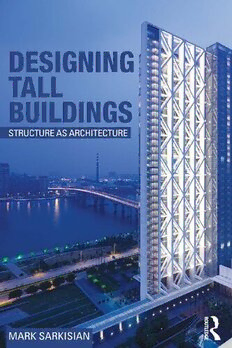
Cover image courtesy of SOM © Tim Griffith
Project: Poly International Plaza, Guangzhou, China
The right of Mark P. Sarkisian to be identified as author of this work has been
asserted by him in accordance with sections 77 and 78 of the Copyright, Designs
and Patents Act 1988.
All rights reserved. No part of this book may be reprinted or reproduced or utilised
in any form or by any electronic, mechanical, or other means, now known or
hereafter invented, including photocopying and recording, or in any information
storage or retrieval system, without permission in writing from the publishers.
Trademark Notice: Product or corporate names may be trademarks or registered
trademarks, and are used only for identification and explanation without intent
to infringe.
Library of Congress Cataloging in Publication Data
Sarkisian, Mark P.
Designing tall buildings : structure as architecture / Mark P. Sarkisian.
p. cm.
Includes bibliographical references and index.
1. Tall buildings--Design and construction. I. Title.
NA6230.S27 2011
720’.483—dc22
2011004868
Consulting editor: Laurie Manfra
Acquisition editor: Wendy Fuller
Project manager: Laura Williamson
Production editor: Alfred Symons
Designer and typesetter: Alex Lazarou
Printed and bound on acid-free paper by TJ International Ltd, Padstow, Cornwall
ISBN13: 978-0-415-89479-1 (hbk)
ISBN13: 978-0-415-89480-7 (pbk)
ISBN13: 978-0-203-80659-3 (ebk)
contents
FOReWORD xi
INTRODUCTION xii
chaPTer 1 PersPecTive 1
chaPTer 2 siTe 11
2.1 WIND 11
2.1.1 General effects 11
2.1.2 Code Requirements 14
2.1.3 Rational Wind Considerations 16
2.2 SeISMICITY 17
2.2.1 Intensity 17
2.2.2 Magnitude 19
2.2.3 energy 21
2.2.4 Peak Ground Acceleration 21
2.2.5 Correlation of Intensity, Magnitude, and Peak Ground Acceleration 22
2.2.6 earthquake, Site, and Building Period 23
2.2.7 Probability of exceedance and Return Period 24
2.2.8 Spectral Acceleration 24
2.2.9 Design and Maximum Considered earthquakes 26
2.2.10 Levels of Seismic Performance 26
2.3 SOILS 27
2.3.1 Spread or Continuous Wall Footings 28
2.3.2 Mat Foundations 28
2.3.3 Pile Foundations 29
2.3.4 Caisson Foundations 30
2.3.5 Basement/Foundation/Retaining Walls 31
2.3.6 Deep Foundation Considerations 32
chaPTer 3 forces 35
3.1 CODe-DeFINeD GRAvITY LOADS 35
3.2 CODe-DeFINeD veRTICAL FORCe DISTRIBUTION FOR WIND 35
3.3 CODe-DeFINeD veRTICAL FORCe DISTRIBUTION FOR SeISMIC 36
3.3.1 earthquake Force 36
3.3.1.1 Earthquake Force (E)—IBC 2006 36
3.3.1.2 Earthquake Force (E)—UBC 1997 37
3.3.2 Static Force Procedure 38
3.3.2.1 Seismic Base Shear (V)—IBC 2006 38
3.3.2.2 Seismic Dead Load (W)—IBC 2006 41
v
CONTeNTS
3.3.2.3 Seismic Base Shear (V)—UBC 1997 41
3.3.2.4 Seismic Dead Load (W)—UBC 1997 41
3.3.2.5 Fundamental Period (Approximate Methods)—UBC 1997 42
3.3.3 Distribution of Lateral Forces 43
3.3.3.1 Vertical Force Distribution 43
3.3.3.2 Horizontal Force Distribution 43
3.3.4 Bending Moment Distribution (Overturning) 44
3.3.5 Story Drift Limitations 45
3.4 GRAvITY LOAD DISTRIBUTION AND TAKeDOWNS 45
3.4.1 Floor Systems 45
3.4.2 exterior Walls 47
3.4.3 Loads to vertical elements 48
3.5 LOAD COMBINATIONS 49
3.5.1 Basic Load Combinations—Strength or Load and Resistance Factor Design 49
3.5.2 Basic Load Combinations—Allowable (Working) Stress Design 49
3.6 DeSIGN AXIAL, SheAR, AND BeNDING MOMeNTS 51
chaPTer 4 Language 53
4.1 FORCe FLOW 53
4.2 STRUCTURAL FRAMING PLANS 54
4.2.1 Lateral vs. Gravity Systems 54
4.2.2 Steel 56
4.2.3 Concrete 58
4.2.4 Composite 60
4.3 STRUCTURAL SYSTeM eLevATIONS 62
4.3.1 Steel 62
4.3.2 Concrete 64
4.3.3 Composite 66
chaPTer 5 aTTribuTes 69
5.1 STReNGTh 69
5.2 SeRvICeABILITY 70
5.2.1 Drift 70
5.2.2 Damping 73
5.2.3 Accelerations 74
5.2.4 Creep, Shrinkage, and elastic Shortening 77
chaPTer 6 characTerisTics 83
6.1 DYNAMIC PROPeRTIeS 83
6.2 AeRODYNAMICS 85
vi
CONTeNTS
6.3 PLACeMeNT OF STRUCTURAL MATeRIALS 86
6.4 FLOOR-TO-FLOOR heIGhTS 86
6.5 ASPeCT RATIOS 87
chaPTer 7 sysTeMs 89
7.1 MATeRIAL QUANTITIeS 91
7.2 PRACTICAL LIMITS OF STRUCTURAL SYSTeMS 92
7.2.1 Structural Steel 94
7.2.1.1 Steel Semi-Rigid Frame 95
7.2.1.2 Steel Rigid Frame 96
7.2.1.3 Steel Frame with Shear Truss 96
7.2.1.4 Steel Frame with Shear, Belt, and Outrigger Trusses 97
7.2.1.5 Steel Exterior Framed Tube 98
7.2.1.6 Steel Bundled Frame Tube 99
7.2.1.7 Steel Exterior Diagonal Tube 100
7.2.1.8 Steel Superframe 101
7.2.1.9 Steel Diagonal Mesh Tube Frame 102
7.2.2 Reinforced Concrete 103
7.2.2.1 Concrete Frame 103
7.2.2.2 Concrete Shear Wall 104
7.2.2.3 Concrete Frame - Shear Wall 105
7.2.2.4 Concrete Framed Tube 106
7.2.2.5 Concrete Tube-in-Tube 107
7.2.2.6 Concrete Modular Tube 108
7.2.2.7 Concrete Diagonal Braced Tube 109
7.2.2.8 Concrete Belt Shear Wall-Stayed Mast 110
7.2.2.9 Concrete Diagonal Mesh Tube Frame 111
7.2.3 Composite (Combination of Steel and Concrete) 112
7.2.3.1 Composite Frame 112
7.2.3.2 Concrete Shear Wall - Steel Gravity Columns 113
7.2.3.3 Concrete Shear Wall - Composite Frame 114
7.2.3.4 Composite Tubular Frame 115
7.2.3.5 Composite Tube-in-Tube 116
7.2.3.6 Composite Modular Tube 117
7.2.3.7 Composite Diagonal Braced Tube 118
7.2.3.8 Composite Belt Outrigger-Stayed Mast 119
7.2.3.9 Composite Diagonal Mesh Tube Frame 120
7.3 MAJOR SYSTeM DeTAILS 121
7.3.1 The Arch—Broadgate Phase II 121
7.3.2 The Rocker—Beijing Poly 122
7.3.3 Pipe Collector—Jinao Tower 123
7.3.4 Pinned Trusses—Jin Mao Tower 124
7.3.5 Pin-Fuse Devices 126
vii
CONTeNTS
chaPTer 8 naTure 129
8.1 SCReeN FRAMeS 130
8.2 COReS AND PReSTReSSeD FRAMeS 132
8.3 The INFINITY COLUMN 133
8.4 GROWTh PATTeRNS 135
8.5 The STAYeD MAST 139
8.6 The PeRFeCT TUBe 141
8.7 The LOGARIThMIC SPIRAL 142
chaPTer 9 MechanisMs 147
9.1 UNNATURAL BehAvIOR 147
9.2 CONveNTIONAL BeAM-TO-COLUMN TeSTS 148
9.3 WOOD DOWeLS AND STeeL PINS 150
9.4 PINNeD JOINTS 153
9.5 The PIN-FUSe JOINT® 155
9.6 MANAGING LARGe SeISMIC MOveMeNTS 157
9.7 COMBINING NATURAL FORMS AND MeChANISMS 159
chaPTer 10 environMenT 165
10.1 AUTOMOBILe ANALOGY 166
10.2 CONveNTIONAL veRSUS eNhANCeD SeISMIC SYSTeMS 166
10.3 ReDUCTION OF SeISMIC MASS 168
10.4 The eNvIRONMeNTAL ANALYSIS TOOL™ 170
10.4.1 The Basis of evaluation 170
10.4.2 Carbon Mapping early in Design 170
10.4.3 Carbon Mapping in Advanced Stages of Design 172
10.4.4 environmental Analysis Tool™ Program Details 172
10.4.5 Cost-Benefit and PML 172
10.5 ReDUCING eNvIRONMeNTAL IMPACT ThROUGh
ADvANCeD ORGANIC TheORIeS 174
10.5.1 emergence Theory 174
10.5.2 Fibonacci Sequence 176
10.5.3 Genetic Algorithms 180
10.5.3.1 Cable Profile Influenced by Genetics 181
10.5.3.2 Cable Profile Optimization Using Genetic Algorithms 182
GLOSSARY 189
ReFeReNCeS 200
ACKNOWLeDGeMeNTS 201
The AUThOR 202
INDeX 203
viii
foreword
one of The central challenges of the 21st century is designing intelligent
forms of human settlement. In the last 200 years, the global population grew
from 1 billion to 6.9 billion. In less than four decades, the global popula-
tion will reach 9 billion. Our highly consumptive pattern of development that
relies upon an inexhaustible supply of arable land, water, and energy cannot
be sustained. Buildings and transportation today create two-thirds of the
carbon in our atmosphere. Where we place our buildings, the way we build
them, and the way in which we move between them are the major causes of
climate change. The future of our planet is contingent upon our ability at the
beginning of this new millennium to create cities of delight—urban environ-
ments that are dense, compact, and highly livable.
A key to achieving this is an American invention: the tall building.
The experiment in vertical building begun by Jennings, Burnham, Sullivan,
and others in Chicago after the Great Fire of 1871 is central to the long-
term sustainability of our planet. The earliest examples of this building form,
begun in earnest in the 20th century, must now be reconsidered with the
understanding that the tall building is not simply an expression of corporate
power or civic pride—it must become the very basis of human settlement.
To physically realize compact, dense, and humanistic vertical cities in
a future of limited material resources, radical innovations in architecture and
structural engineering are necessary. Mark Sarkisian and his colleagues at
SOM have embraced this challenge. Their process begins not with columns
and beams, but rather with an intuitive understanding of the interrelation-
ship between forces at play. They go beyond the rote, normative process of
structural optimization to consider new ways of achieving holistic building
efficiencies in which the essence of architectural form becomes part of the
solution.
Mark advocates an intuitive and organic understanding of structure
and form in SOM’s design studios. To support this nuanced approach, he
and his colleagues have assembled extraordinary new tools to achieve inno-
vation. These systems combine computational analysis with visualization
models similar to those used by scientists to quickly visualize organic form
and behavior at the molecular level. This work is undertaken in a collabora-
tive, multidisciplinary environment, much like the “group intelligence” model
of today’s collaborative sciences.
Mark and his colleagues have extended this collaborative model
beyond SOM’s professional studios to the academic studio. SOM’s engage-
ment with leading universities in many disciplines over the years has yielded
constant reciprocal benefits—inspiration and research—for the firm and the
academy. This book, Designing Tall Buildings, is a direct result of the engi-
neering and architecture class at Stanford University that Mark began with
ix
FOReWORD
architect Brian Lee in October 2007. It is a book that will no doubt provide
inspiration as well as practical guidance to students, professors, practicing
architecture and engineering professionals, and design devotees.
craig W. hartman, faia
January, 2011
x