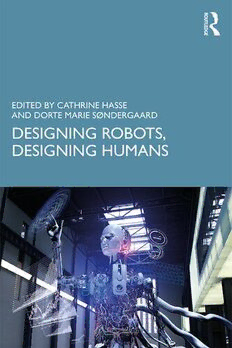
Table Of ContentDESIGNING ROBOTS, DESIGNING
HUMANS
Whilst most research concentrates on the imagined future of robotics, this book
brings together a group of international researchers to explore the different ways
that robots and humans engage with one another at this point in history.
Robotic design is advancing at an incredible pace, and consequently the role
of robots has expanded beyond mechanical work in the industrial sector to the
social and domestic environment. From kitchen table pets in the shape of dino-
saurs or baby seals, to robot arms that assist with eating, to self-driving cars, this
book explores the psychological impact of robotic engagement, especially in
domestic settings. Each chapter explores a different aspect of humanoid robotics,
for example, the relationship between robotics and gender, citizenship, moral
agency, ethics, inequality, and psychological development, as well as exploring
the growing role of robots in education, care work, and intimate relationships.
Drawing on research from across the fields of psychology, anthropology, and
philosophy, this ground-breaking volume discusses the emerging social side of
robotics. By examining our relationship with robots now, this book offers a new
and innovative opportunity for understanding our future with robots and robotic
culture. Designing Robots, Designing Humans will be of interest to researchers of
artificial intelligence and humanoid robotics, as well as researchers from cogni-
tive and social psychology, philosophy, computer science, anthropology, linguis-
tics, and engineering backgrounds.
CathrineHasse,ProfessorinAnthropologyandLearning,AarhusUniversity,Denmark.
DorteMarieSøndergaard,ProfessorinSocialPsychology,AarhusUniversity,Denmark.
DESIGNING ROBOTS,
DESIGNING HUMANS
Edited by Cathrine Hasse and Dorte Marie
Søndergaard
Firstpublished2020
byRoutledge
2ParkSquare,MiltonPark,Abingdon,OxonOX144RN
andbyRoutledge
52VanderbiltAvenue,NewYork,NY10017
RoutledgeisanimprintoftheTaylor&FrancisGroup,aninformabusiness
©2020selectionandeditorialmatter,CathrineHasseandDorteMarie
Søndergaard;individualchapters,thecontributors
TherightofCathrineHasseandDorteMarieSøndergaardtobe
identifiedastheauthorsoftheeditorialmaterial,andoftheauthorsfor
theirindividualchapters,hasbeenassertedinaccordancewithsections
77and78oftheCopyright,DesignsandPatentsAct1988.
Allrightsreserved.Nopartofthisbookmaybereprintedorreproduced
orutilisedinanyformorbyanyelectronic,mechanical,orothermeans,
nowknownorhereafterinvented,includingphotocopyingand
recording,orinanyinformationstorageorretrievalsystem,without
permissioninwritingfromthepublishers.
Trademarknotice:Productorcorporatenamesmaybetrademarksor
registeredtrademarks,andareusedonlyforidentificationand
explanationwithoutintenttoinfringe.
BritishLibraryCataloguing-in-PublicationData
AcataloguerecordforthisbookisavailablefromtheBritishLibrary
LibraryofCongressCataloging-in-PublicationData
Acatalogrecordhasbeenrequestedforthisbook
ISBN:978-0-415-78656-0(hbk)
ISBN:978-0-415-78657-7(pbk)
ISBN:978-1-315-22720-7(ebk)
TypesetinBembo
bySwales&Willis,Exeter,Devon,UK
CONTENTS
Contributors vii
Introduction 1
CathrineHasseandDorteMarieSøndergaard
1 Gotai:corporealaestheticsandroboticexoskeletonsinJapan 5
JenniferRobertson
2 Onhumanoids,avatarsandtherestofus:genderanddesigning
ournewOthers 21
DorteMarieSøndergaard
3 Performingthekitchen:becomingaqueeringwitnesstothe
enactmentsofsubject–objectrelationsinarobotickitchenlab 40
PatTreusch
4 Theautomationofethics:thecaseofself-drivingcars 55
RaffaeleRodognoandMarcoNørskov
5 ‘Activecitizenship’andfeedingassistiverobotics:acrumbling
story? 73
NielsChristianMossfeldtNickelsen
vi Contents
6 Materialconceptformation:inequalityinchildren’sconceptual
robotimaginaries 88
CathrineHasse
7 Unpackingtheculturalbaggageoftravellingrobots:howsocially
assistiverobotsareintegratedinpractice 111
LasseBlondandFinnOlesen
8 Robotcompanionsforchildrenandolderpeople:ethicalissues
andevidence 132
AmandaSharkey,NatalieWoodandRaihahAminuddin
Index 147
CONTRIBUTORS
Raihah Aminuddin is a PhD student at the Department of Computer Science,
University of Sheffield, UK. She is a member of the Machine Learning research
group. Her research areas include the study of stress responses in care environ-
ments when mediated by robot companion technologies.
LasseBlond is a PhD Fellow at Information Studies, University of Aarhus, Den-
mark, and a researcher at the IT University of Copenhagen, Denmark. He is
associated with the research program Future Technology, Culture and Learning
at the Department of Education and the AU Datalab at Aarhus University. His
research is focused on transfer and implementation of Asian robot in Nordic
health care and elderly care practices from a science and technology (STS)
perspective.
Cathrine Hasse is a Professor of Anthropology and Learning at the Danish
School of Education at Aarhus University, Denmark. She heads the research
program Future Technology, Culture and Learning and currently coordinates
a large international, interdisciplinary project on robot ethics. She has written on
posthuman learning, postphenomenology, technological literacy, cultural learn-
ing, robot ethics, and organizational culture. Her recent research interests
include educational technology, physics sciences, robotics, machine learning, and
AI.
NielsChristianMossfeldtNickelsen is a trained clinical psychologist and Associ-
ateProfessoratAarhusUniversity,SchoolofEducation,Denmark,Hisresearchis
centred in practice theory and science and technology studies (STS), working
with ethnographic methods. His research interests are in technological arrange-
ments, citizen involvement in technological innovations in their own health
viii Contributors
activities such as tele-rehabilitation, medication and feeding, self-monitoring,
homecare,andpatienteducation.Hecurrentlyheadsaprojectontelecare.
MarcoNørskov is an Associate Professor at the Research Unit for Robophiloso-
phy at Aarhus University, Denmark, and collaborate researcher at the Hiroshi
Ishiguro Laboratories, ATR, Japan. He is a member of the steering committee
of the AU Social Robotics Lab, administrative coordinator of the TRANSOR
network (Transdisciplinary Studies of Social Robotics), and co-organizer of the
biannual Robophilosophy conference. His research is focused on android phil-
osophy, Japanese thought, phenomenology, and the philosophy of technology.
Finn Olesen is Associate Professor at Information Studies at University of
Aarhus, Denmark, where he teaches philosophy of science and the arts, and
STS. His research is grounded in philosophical and sociological studies of sci-
ence, technology and society, and in ethnographic studies of sociotechnical
development of health care practices. He has published articles and papers in
Danish and international books and journals on everyday practices in health
care, on posthumanity, and on philosophy and technology.
Jennifer Robertson is Professor of Anthropology and the History of Art at the
University of Michigan, US, specializing in Japan. She is an affiliate faculty in
the Michigan Robotics Institute, and the Japan Editor of Critical Asian Studies.
Her most recent book is Robo Sapiens Japanicus: Robots, Gender, Family, and the
Japanese Nation (University of California Press 2018, available November 2017).
Raffaele Rodogno is Associate Professor of Philosophy at Aarhus University,
Denmark. He is part of the Cognition and Culture project at MINDLab and
co-ordinator of the autism@aarhus network, and collaborates with members of
the Swiss Center for the Affective Sciences and the Oxford Centre for Neu-
roethics. His research focuses on topics in ethics, legal, and social philosophy,
and the emotions. He has written about well-being, metaethical sentimentalism,
rights, the environment, punishment, restorative justice, social robotics, and
shame and guilt.
Amanda Sharkey is a Senior Lecturer (Associate Professor) in the Department
of Computer Science at University of Sheffield, UK. She is a member of Shef-
field Robotics and is on the executive board of the Foundation for Responsible
Robotics. Her current research interests are in robot ethics, particularly the
ethics of robot care. Amanda was a founding member of the scientific commit-
tee for an international series of workshops on Multiple Classifier Systems, was
the editor of the journal Connection Science (now associate editor), and is
a member of IET.
Contributors ix
Dorte Marie Søndergaard is a Professor of Social Psychology in the Depart-
ment of Educational Psychology at the Danish School of Education, Aarhus
University, Denmark. She heads the research program Engage – (Dis)Engaging
Children and Young People. Her main research areas include sex/gender and
feminist theory, technology and human-robot-interaction (HRI), and human-
technology relations such as bullying and violent computer gaming among
school children and sexualized digital abuse among young people.
Pat Treusch is a Postdoctoral Fellow at the Berlin Cooperative Graduate Pro-
gram DiGiTal — Digitalization: Design and Transformation. She leads a project
that involves teaching robot arms how to knit, funded by the Volkswagen
Foundation, and is working on a project about transformations of learning at the
age of the IoT, at the Center for Interdisciplinary Women’s and Gender Studies
(ZIFG) and the Department of General and Historical educational Science, TU
Berlin, Germany. Her research areas are human-machine relations, HRI, femin-
ist STS, and cyborgfeminism.
Natalie Wood is a PhD student at the Department of Psychology at University
of Sheffield, UK. Her research areas include the study of the therapeutic effects
of robot companions in health care.