Table Of ContentPaul A. Tres
Designing
Plastic Parts
for Assembly
8th Edition
Paul A. Tres
Designing Plastic Parts for Assembly
Paul A. Tres
Designing Plastic
Parts for Assembly
8th Edition updated
Hanser Publishers, Munich Hanser Publications, Cincinnati
The Author:
Paul A. Tres, ETS Inc.
www.ets-corp.com
P.O. Box 7747
Bloomfield Hills MI 48302-7747
Distributed in North and South America by:
Hanser Publications
6915 Valley Avenue, Cincinnati, Ohio 45244-3029, USA
Fax: (513) 527-8801
Phone: (513) 527-8977
www.hanserpublications.com
Distributed in all other countries by
Carl Hanser Verlag
Postfach 86 04 20, 81631 München, Germany
Fax: +49 (89) 98 48 09
www.hanser-fachbuch.de
The use of general descriptive names, trademarks, etc., in this publication, even if the former are not especially identi-
fied, is not to be taken as a sign that such names, as understood by the Trade Marks and Merchandise Marks Act, may
accordingly be used freely by anyone. While the advice and information in this book are believed to be true and
accurate at the date of going to press, neither the authors nor the editors nor the publisher can accept any legal
responsibility for any errors or omissions that may be made. The publisher makes no warranty, express or implied,
with respect to the material contained herein.
Author’s Disclaimer:
The data and information presented in this book have been collected by the authors and publisher from many sources
that are believed to be reliable. However, the authors and publisher make no warranty, expressed or implied, to this
book’s accuracy or completeness. No responsibility or liability is assumed by the authors and publisher for any loss or
damage suffered through reliance on any information presented in this book.
The authors do not purport to give any toxicity or safety information.
The final determination of the suitability of any information for the use contemplated for a given application remains
the sole responsibility of the user.
Cataloging-in-Publication Data is on file with the Library of Congress
Bibliografische Information Der Deutschen Bibliothek
Die Deutsche Bibliothek verzeichnet diese Publikation in der Deutschen Nationalbibliografie;
detaillierte bibliografische Daten sind im Internet über <http://dnb.d-nb.de> abrufbar.
ISBN 978-1-56990-668-2
E-Book ISBN 978-1-56990-669-9
All rights reserved. No part of this book may be reproduced or transmitted in any form or by any means, electronic or
mechanical, including photocopying or by any information storage and retrieval system, without permission in writing
from the publisher.
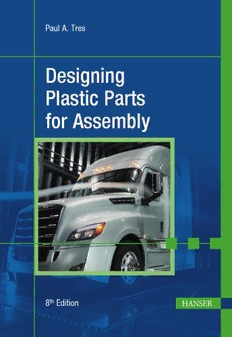
The illustration for the cover is provided by Daimler Trucks North America (DTNA) of Portland, Oregon, United States
of America. It shows the new Freightliner Cascadia Truck undergoing aerodynamic testing in DTNA’s proprietary full-
scale wind tunnel.
© Carl Hanser Verlag, Munich 2017
Editor: Mark Smith
Production Management: Jörg Strohbach
Coverconcept: Marc Müller-Bremer, www.rebranding.de, München, Germany
Coverdesign: Stephan Rönigk
Typesetting: Kösel Media GmbH, Krugzell, Germany
Printed and bound by Hubert & Co GmbH, Göttingen, Germany
Printed in Germany
Foreword to the
Eighth Edition
In this 8th edition of Designing Plastic Parts for Assembly, the addition of the “Fasten-
ers” chapter provides a great update to an already indispensable resource for design
engineers. Paul Tres starts with an introduction to plastics, covering many topics
from the basics of resin to what makes up a plastic, to a variety of plastic properties.
This is fundamental for anyone working with plastics and Paul presents the informa-
tion in a concise, organized manner. By providing the basis of plastic materials, he
is able to lay the foundation for solid design. Of particular interest to DENSO as a
global automotive supplier, Paul covers both the principle and detail of safety fac-
tors, essential in today’s automotive environment as well as within other industries.
Additionally, an overview of plastic material strength is provided, which serves as
both a refresher for some, and a detailed calculation guide for all.
The main focus of the book, of course, is assembly techniques and the needed design
considerations for plastic parts. Clear explanations for numerous types of joining
techniques and the desired design features to ensure appropriate product quality
can be easily found by the reader, while the design engineer is also provided with a
general understanding of the manufacturing process. Paul covers in detail the de-
sign of press fits, snap fits, and living hinges. In particular, Paul’s approach to the
case studies based on a “right way” and a “wrong way” allows for ease of understand-
ing from the novice engineer through to management. The book does a great job in
illustrating real-life examples and case studies to make the key points clear for
nearly every topic that Paul presents. The easy-to-follow text provides a standardized
approach and step-by-step calculation methods and examples for a wide variety of
assembly techniques.
As a global manufacturer of numerous automotive parts, DENSO utilizes many of the
topics presented in this book, which has been a go-to resource, along with Paul’s lo-
cal training class. In addition to the book, Paul’s supplemental training course has
been of benefit to numerous DENSO engineers. While Paul’s enthusiasm during the
VI Foreword to the Eighth Edition
Automotive Plastic Part Design class is difficult to put to paper, the book Designing
Plastic Parts for Assembly incorporates the essence of Paul’s enthusiasm for this
subject. In all, Paul’s explanation and expertise in this area is highly recommended
for those involved in plastic product development.
Southfield, Michigan Douglas E. Patton
2017 President—Society of Automotive Engineers (SAE)
Executive Vice President/Chief Technical Officer DENSO International America, Inc.
Preface to the
Eighth Edition
The world of plastic products has been growing at an average rate of over five per-
cent per year in the last decades, which makes plastics by far the fastest growing
material class on the globe. This growth is related to the versatile properties of poly-
mers and plastics. Perhaps some of the most important aspects contributing to this
spectacular growth are design and assembly. Making sure that plastic parts are de-
signed optimally for assembly has become an intrinsic and fundamental part of
engineering of new products. Paul Tres has done a tremendous job in bringing to-
gether in one concise book all the technical aspects of this process.
The book is a “must” for all those engineers, developers, and designers who are
working on tomorrow’s products. The detailed presentations provide many exam-
ples, clearly illustrated with succinct yet very effective drawings. This makes the
book the ultimate outline of the perfect syllabus for all engineering classes in plas-
tics and product development programs at any university.
At SPE, we know that we have to educate the OEMs and their product developers on
the great potential and opportunities there are in designing and combining plastic
parts with each other or with other materials. Paul Tres’ Designing Plastic Parts for
Assembly should be mandatory literature for all of them.
I truly believe that this book can open more doors and add opportunities in our plas-
tics industry. The book is very well conceived and therefore experienced plastics
engineers, as well as product developers (who might have only limited knowledge of
the properties and behavior of plastics), can use it as a perfect, extremely helpful
synopsis.
Ronse, East Flanders, Belgium Wim De Vos
Chief Executive Officer
Society of Plastics Engineers (SPE)
Foreword to the
First Edition
Knowing well the work and many special talents of Paul A. Tres, I take delight in the
opportunity to introduce his new book, Designing Plastic Parts for Assembly, and
recommend it to a broad range of readers. Material engineers, design and manu-
facturing engineers, graduate and under-graduate students, and all others with an
interest in design for assembly or plastic components development now have a
clearly written, method-oriented resource.
This practical book is an outgrowth of the like-named University of Wisconsin–
Madison course which is being offered nationally and internationally. Just as his
lectures in the course provide a detailed yet simplified discussion of material selec-
tion, manufacturing techniques, and assembly procedures, this book will make his
unique expertise and effective teaching method available to a much larger audience.
Mr. Tres’ highly successful instructional approach is evident throughout the book.
Combining fundamental facts with practical techniques and a down-to-earth phi-
losophy, he discusses in detail joint design and joint purpose, the geometry and na-
ture of the component parts, the type of loads involved, and other vital information
crucial to success in this dynamic field. Treatment of this material is at all times
practice-oriented and focuses on everyday problems and situations.
In addition to plastics, Mr. Tres has expert knowledge in computer software, having
directed the development of DuPont’s design software. The course at the University
of Wisconsin–Madison is indirectly an outgrowth of the software he designed for
living hinges and snap fits at DuPont.
Mr. Tres holds numerous patents in the plastics field. He is known worldwide for his
expertise in computer programming, manufacturing processes, material selection
and project management on both a national and international scale.
Most recently, Mr. Tres’ accomplishments have earned him the DuPont Automotive
Marketing Excellence Award as well as recognition in the 1994–1995 edition of
Who’s Who Worldwide.