Table Of ContentAnnika Wiklund-Engblom
Designing New
Learning Experiences?
Exploring Corporate E-Learners’ Self-
Regulated Learning A
n
n Annika Wiklund-Engblom
How can we design digital learning contexts to sup- ik
a
port self-regulated learning (SRL)? A self-regulated W
ik
e-learner is able to exercise agency and cope with lu
Designing New Learning Experiences?
n
new digital learning contexts, despite the fact that d
-
E
these often lack the feedback processes inherent in n
g
Exploring Corporate E-Learners’ Self-Regulated Learning
b
traditional face-to-face interactions. This study has lo
m
explored how the design of an e-learning course in-
fluenced actions and intentions of corporate e-lear- | D
e
s
ners with regard to their self-regulation of behaviour, ig
n
cognition, and affect. Results show that feedback in
g
facilitated self-regulation and targeted exploration. N
e
Important needs of the corporate e-learners were w
L
real life relevance of content, flexible assessment, e
a
r
n
and options for social meaning negotiation. SRL was
in
g
found to be dynamically interconnected with an E
x
affect-cognition continuum of both positive and ne- p
e
r
gative experiences (Learning experience dimension). ie
n
Awareness of self-regulation in relation to learning c
e
s
in a digital context was identified as design-based ? | 2
epistemic metareflection (SRL agency dimension). 0
1
5
Results suggest that learning designs can empo-
wer e-learners by supporting their design-based
epistemic metareflection in relation to affordances ISBN 978-951-765-792-1
and constraints of the learning technology design
(Content and context dimension) .
9 789517 657921
ISBN 978-951-765-792-1
Annika Wiklund-Engblom
Diploma in business and public administration, Vasa svenska handelsläroverk, 1991
MA, Developmental Psychology, Åbo Akademi University, 1997
IT-pedagogue, Kalmar University College, Sweden, 2003
Research coordinator at MediaCity, Faculty of Education and Welfare Studies,
Åbo Akademi University 2008 –
Annika Wiklund-Engblom has worked as an educational consultant for e-learning develop-
ment projects in the industry and been involved in numerous research and development
projects in her work at MediaCity, conducting user experience and design research using
cross media and transmedia design approaches – both for learning and entertainment.
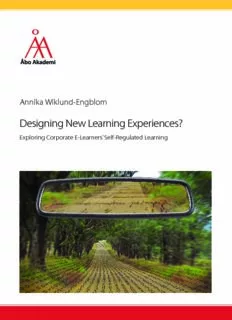
The cover image collage by Hasse Eriksson is illustrating Marshall McLuhan’s citation on
page 1. The collage includes an old text about distance education written by my late
grandfather Erik Viljam Fågelbärj (1901–1961).
Åbo Akademi University Press
Tavastgatan 13, FI-20500 Åbo, Finland
Phone number: +358 (0)2 215 3478
E-mail: [email protected]
DESIGNING NEW LEARNING EXPERIENCES?
Designing New Learning Experiences?
Exploring Corporate E-Learners’ Self-Regulated Learning
Annika Wiklund-Engblom
Åbo Akademis förlag | Åbo Akademi University Press
Åbo, Finland, 2015
CIP Cataloguing in Publication
Wiklund-Engblom, Annika.
Designing new learning experiences? :
exploring corporate E-learners’ self-
regulated learning / Annika Wiklund-
Engblom. - Åbo : Åbo Akademi
University Press, 2015.
Diss.: Åbo Akademi University.
ISBN 978-951-765-792-1
ISBN 978-951-765-792-1
ISBN 978-951-765-793-8 (digital)
Oy Arkmedia Ab
Vasa 2015
Abstract
The context of this study is corporate e-learning, with an explicit focus on how digital
learning design can facilitate self-regulated learning (SRL). The field of e-learning is
growing rapidly. An increasing number of corporations use digital technology and e-
learning for training their work force and customers. E-learning may offer economic
benefits, as well as opportunities for interaction and communication that traditional
teaching cannot provide. However, the evolving variety of digital learning contexts
makes new demands on learners, requiring them to develop strategies to adapt and cope
with novel learning tools. This study derives from the need to learn more about learning
experiences in digital contexts in order to be able to design these properly for learning.
The research question targets how the design of an e-learning course influences
participants’ self-regulated learning actions and intentions. SRL involves learners’ ability
to exercise agency in their learning. Micro-level SRL processes were targeted by
exploring behaviour, cognition, and affect/motivation in relation to the design of the
digital context. Two iterations of an e-learning course were tested on two groups of
participants (N=17). However, the exploration of SRL extends beyond the educational
design research perspective of comparing the effects of the changes to the course designs.
The study was conducted in a laboratory with each participant individually. Multiple
types of data were collected. However, the results presented in this thesis are based on
screen observations (including eye tracking) and video-stimulated recall interviews.
These data were integrated in order to achieve a broad perspective on SRL.
The most essential change evident in the second course iteration was the addition of
feedback during practice and the final test. Without feedback on actions there was an
observable difference between those who were instruction-directed and those who were
self-directed in manipulating the context and, thus, persisted whenever faced with
problems. In the second course iteration, including the feedback, this kind of difference
was not found. Feedback provided the tipping point for participants to regulate their
learning by identifying their knowledge gaps and to explore the learning context in a
targeted manner.
Furthermore, the course content was consistently seen from a pragmatic perspective,
which influenced the participants’ choice of actions, showing that real life relevance is
an important need of corporate learners. This also relates to assessment and the
consideration of its purpose in relation to participants’ work situation. The rigidity of
the multiple choice questions, focusing on the memorisation of details, influenced the
participants to adapt to an approach for surface learning. It also caused frustration in
cases where the participants’ epistemic beliefs were incompatible with this kind of
assessment style. Triggers of positive and negative emotions could be categorized into
four levels: personal factors, instructional design of content, interface design of context,
and technical solution. In summary, the key design choices for creating a positive
learning experience involve feedback, flexibility, functionality, fun, and freedom.
The design of the context impacts regulation of behaviour, cognition, as well as affect
and motivation. The learners’ awareness of these areas of regulation in relation to
learning in a specific context is their ability for design-based epistemic metareflection. I
describe this metareflection as knowing how to manipulate the context behaviourally
for maximum learning, being metacognitively aware of one’s learning process, and being
aware of how emotions can be regulated to maintain volitional control of the learning
situation. Attention needs to be paid to how the design of a digital learning context
supports learners’ metareflective development as digital learners. Every digital context
has its own affordances and constraints, which influence the possibilities for micro-level
SRL processes. Empowering learners in developing their ability for design-based
epistemic metareflection is, therefore, essential for building their digital literacy in
relation to these affordances and constraints.
It was evident that the implementation of e-learning in the workplace is not
unproblematic and needs new ways of thinking about learning and how we create
learning spaces. Digital contexts bring a new culture of learning that demands attitude
change in how we value knowledge, measure it, define who owns it, and who creates it.
Based on the results, I argue that digital solutions for corporate learning ought to be
built as an integrated system that facilitates socio-cultural connectivism within the
corporation. The focus needs to shift from designing static e-learning material to
managing networks of social meaning negotiation as part of a holistic corporate learning
ecology.
Keywords: self-regulated learning, learning technology design, e-learning, corporate
learning, educational design research
Preface
In 1998, my boyfriend, Kenneth Engblom, came home from work one day and told me
that he had been offered a job in India. He said that he would agree to go only if I came
with him. I hesitated a few seconds before stating my claims. I told him that I would
accompany him if we got married first and if I would get my own computer and Internet
connection wherever we were staying. Little did I know then that my second claim would
forever change the way I viewed reality and the possibilities for communication and
learning. And, of course, the first claim did change my life a great deal as well. While
living in India, I changed direction from the field of developmental psychology to e-
learning research. I started from zero – once again. However, I did not expect this
research journey to span four continents and so much joy and sorrow, sickness and
health. In many ways, I am a true distance student myself, having experienced all the
challenges and also the privileges this entails. I strongly believe that we create our lives
through the people we meet. These meetings give us opportunities to mirror our
thoughts and learn about the perspectives of others, which shapes our understanding of
the world, as well as our own identity in relation to it. There are several professors and
researchers I have had the honour of meeting. Being invited into their discourse has
impacted my research journey. I want to thank Sven-Erik Hansén, who has tirelessly
helped me to see this work through and diligently guided me in my writing process,
Göran Djupsund, who gave me a much appreciated place in his research school on
media at a time when I was quite lost and lonely, Marc Hassenzahl, who gave me insights
into design thinking and user experience research, as well as Rainer Nyberg, who
inspired me to start this e-learning research. I also want to express my appreciation to
Tom Wikman for reading my manuscript and giving me encouraging feedback, Mike
Horsley for always boosting my self-esteem and giving me the opportunity take part in
building the user experience laboratory at Central Queensland University, Peter
Goodyear for allowing me to join in the CoCo seminars at the University of Sydney,
Roger Azevedo for coming to our research methods symposium, Pat Bazeley for opening
up her home at the research farm and teaching me about NVivo. I am also grateful for
the valuable feedback I received from my reviewers Sanna Järvelä and Staffan Selander.
My dear colleagues at MediaCity have always believed in my ability and my effort,
despite all the obstacles in my way. It has been a great joy and privilege to be part of this
inspiring team. Thank you Kimmo Rautanen, Yvonne Backholm-Nyberg, Michaela
Esch, Helena Johansson, Sören Andersson, Susanne Hägglund, Anette Bengs, Simon
Staffans, Hasse Eriksson, Joachim Högväg, Joachim Majors, Anders Wik, Lasse
Norrgård, Jonas Mastosalo, Mentor Dreshaj, and also Tommy Strandvall, who was my
first tutor in MediaCity’s lab. My collaborators of the Talking Tools research group have
been a great inspiration to me, such as Juha Hartvik, Mia Porko-Hudd, Kasper Hiltunen,
and Marléne Johansson. I am convinced that we will do great things together. Thank
you Heidi Höglund and Charlotta Hilli for always being eager to network and
collaborate in our transmedia learning design seminars and other educational media
workshops that I have organised. Thanks to the team behind the DiDiDi project for
arranging interesting seminars – also outside of Academill. My fellow researchers and
doctoral students at Tritonia represented a safe haven and a stimulating discussion
group for several years. Thanks to all of you for your friendship. Likewise, to all dear
friends of mine. What would life be without having people like you around? I want to
thank Jari Ullakonoja and Taifun Pisirici at Wärtsilä for allowing me to be part of the e-
learning development, as well as all the participants giving their time for this study. Your
voices have been with me from Finland to Houston to Sydney, from times of nursing
my children to times of academic debate. Furthermore, the library staff has been
invaluable for their assistance, such as Christina Flemming and Inger Appel. I am also
indebted to the administrative staff at Åbo Akademi University, such as Nina Bäckman
and Anna Buss for helping me out with practical matters, as well as to Ream Barclay,
John Shepherd, and Annemarie Södergård for their valuable language reviews.
The financial grants I have received throughout the years have been much appreciated.
These have made my work possible and also given me opportunities to attend
international conferences and seminars, which have been an important part of my
research process. One example is the week long seminar in Kos, organised by Göran
Djupsund, which became an important milestone for me. Many thanks go to Stiftelsens
för Åbo Akademi Forskningsinstitut, Svenska kulturfonden, Svensk-österbottniska
samfundet, Högskolestiftelsen i Österbotten, ledningsgruppen för forskarutbildningen
vid Pedagogiska fakulteten vid Åbo Akademi, and Branderska fonden.
My husband, Kenneth Engblom, an open-minded, humorous realist, exposed himself to
the risk of being my first pilot study in the lab. You have been my support and discussion
partner – at high and low tide. Thank you dearly! Our children, Frida and Elias, our
pride and joy, are continuously teaching us about the world. I remember when Frida
laughed at the epiphany of seeing the irony in the fact that ‘some of us’ have to learn
how to use a computer – it is not a given, as it seemed to her. Elias expressed the innate
attitude of the generation born into a digital society when he once asked me: “Mom,
what’s really the use of computers … except that they help you learn better?” Then again,
I don’t possess his innocence of a natural believer in the indisputable benefits of
computers – unless there is an integrated theoretically grounded learning design. Hence,
I argue for the importance of a study like this one. My deepest gratitude to my family,
especially my mother, Stina Mellberg, who introduced me to the concepts of psychology
and pedagogics already in my early childhood. She has an undeniable fearlessness of
diving into new adventures with boundless optimism – not least when it comes to
technology.
Gutta cavat lapidem, non vi seds aepe cadendo.
Sundom, April 11th, 2015
TÇÇ|~t j|~ÄâÇw@XÇzuÄÉÅ
Description:built as an integrated system that facilitates socio-cultural connectivism within the corporation. Horsley for always boosting my self-esteem and giving me the opportunity take part in building the user Esch, Helena Johansson, Sören Andersson, Susanne Hägglund, Anette Bengs, Simon. Staffans