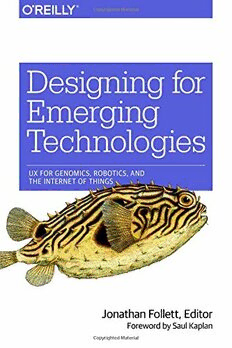
Table Of ContentDesigning for Emerging Technologies
The recent digital and mobile revolutions are a minor Contributors include: ED
blip compared to the next wave of technological
Stephen Anderson me
change, as everything from robot swarms to skin-
Martin Charlier s
top embeddable computers and bio printable organs e
i Designing for
start appearing in coming years. In this collection of Lisa deBettencourt rg
inspiring essays, designers, engineers, and researchers Jeff Faneuff gn
discuss their approaches to experience design for Andy Goodman ini
groundbreaking technologies. n
Camille Goudeseune
g Emerging
g
Design not only provides the framework for how Bill Hartman
technology works and how it’s used, but also T
Erin Rae Hoffer f
places it in a broader context that includes the total eo
Steven Keating
ecosystem with which it interacts and the possibility cr
Brook Kennedy Technologies
of unintended consequences. If you’re a UX designer h
or engineer open to complexity and dissonant ideas, Dirk Knemeyer
n
this book is a revelation. Barry Kudrowitz
o
Gershom Kutliroff
l
“ If you’re looking for insights into how to Michal Levin o
g
design the future today, look no further.” Matt Nish-Lapidus UX FOR GENOMICS, ROBOTICS, AND
i
—Dan Saffer Marco Righetto e THE INTERNET OF THINGS
Author of Microinteractions Juhan Sonin s
“ This book is a must-read for anyone Scott Stropkay
S cott Sullivan
involved in innovative product design, new
Hunter Whitney
business creation, or technology research
Yaron Yanai
for near future applications. The wide
collection of essays offers a wild ride across About the editor:
Jonathan Follett is a principal at
multiple disciplines.”
Involution Studios where he is a
—Carla Diana designer and an internationally pub-
Creative Technologist and author lished author on the topics of user
experience and information design.
F
o
ll
e
t
t
USER EXPERIENCE/DESIGN Twitter: @oreillymedia
facebook.com/oreilly
US $49.99 CAN $52.99
Jonathan Follett, Editor
ISBN: 978-1-449-37051-0
Foreword by Saul Kaplan
Designing for Emerging Technologies
The recent digital and mobile revolutions are a minor Contributors include: ED
blip compared to the next wave of technological
Stephen Anderson me
change, as everything from robot swarms to skin-
Martin Charlier s
top embeddable computers and bio printable organs e
i Designing for
start appearing in coming years. In this collection of Lisa deBettencourt rg
inspiring essays, designers, engineers, and researchers Jeff Faneuff gn
discuss their approaches to experience design for Andy Goodman ini
groundbreaking technologies. n
Camille Goudeseune
g Emerging
g
Design not only provides the framework for how Bill Hartman
technology works and how it’s used, but also T
Erin Rae Hoffer f
places it in a broader context that includes the total eo
Steven Keating
ecosystem with which it interacts and the possibility cr
Brook Kennedy Technologies
of unintended consequences. If you’re a UX designer h
or engineer open to complexity and dissonant ideas, Dirk Knemeyer
n
this book is a revelation. Barry Kudrowitz
o
Gershom Kutliroff
l
“ If you’re looking for insights into how to Michal Levin o
g
design the future today, look no further.” Matt Nish-Lapidus UX FOR GENOMICS, ROBOTICS, AND
i
—Dan Saffer Marco Righetto e THE INTERNET OF THINGS
Author of Microinteractions Juhan Sonin s
“ This book is a must-read for anyone Scott Stropkay
S cott Sullivan
involved in innovative product design, new
Hunter Whitney
business creation, or technology research
Yaron Yanai
for near future applications. The wide
collection of essays offers a wild ride across About the editor:
Jonathan Follett is a principal at
multiple disciplines.”
Involution Studios where he is a
—Carla Diana designer and an internationally pub-
Creative Technologist and author lished author on the topics of user
experience and information design.
F
o
ll
e
t
t
USER EXPERIENCE/DESIGN Twitter: @oreillymedia
facebook.com/oreilly
US $49.99 CAN $52.99
Jonathan Follett, Editor
ISBN: 978-1-449-37051-0
Foreword by Saul Kaplan
Designing for Emerging
Technologies
UX for Genomics, Robotics, and the
Internet of Things
Edited by Jonathan Follett
Beijing · Cambridge · Farnham · Köln · Sebastopol · Tokyo
Designing for Emerging Technologies
Edited by Jonathan Follett
Copyright © 2015 Jonathan Follett. All rights reserved.
Printed in the United States of America.
Published by O’Reilly Media, Inc.,
1005 Gravenstein Highway North, Sebastopol, CA 95472.
O’Reilly books may be purchased for educational, business, or sales
promotional use. Online editions are also available for most titles
(safaribooksonline.com). For more information, contact our corporate/
institutional sales department: (800) 998-9938 or [email protected].
Editors: Jonathan Follett, Mary Treseler, Cover Designer: Ellie Volckhausen
and Angela Rufino Interior Designers: Ron Bilodeau and
Production Editor: Kara Ebrahim Monica Kamsvaag
Copyeditor: Dianne Russell Illustrator: Rebecca Demarest
Proofreader: Charles Roumeliotis Compositor: Kara Ebrahim
Indexer: Ginny Munroe
November 2014: First Edition.
Revision History for the First Edition:
2014-10-30 First release
2015-05-08 Second release
See http://www.oreilly.com/catalog/errata.csp?isbn=0636920030676
for release details.
The O’Reilly logo is a registered trademark of O’Reilly Media,
Inc. Designing for Emerging Technologies, the cover image, and re-
lated trade dress are trademarks of O’Reilly Media, Inc.
While the publisher and the authors have used good faith efforts to ensure
that the information and instructions contained in this work are accurate,
the publisher and the authors disclaim all responsibility for errors or omis-
sions, including without limitation responsibility for damages resulting
from the use of or reliance on this work. Use of the information and instruc-
tions contained in this work is at your own risk. If any code samples or
other technology this work contains or describes is subject to open source
licenses or the intellectual property rights of others, it is your responsibility
to ensure that your use thereof complies with such licenses and/or rights.
ISBN: 978-1-4493-7051-0
[LSI]
[ List of Contributors ]
Chapter 1: Designing for Emerging Technologies
Jonathan Follett, Principal—Involution Studios
Chapter 2: Intelligent Materials: Designing Material Behavior
Brook Kennedy, Associate Professor, Industrial Design—Virginia Tech
Chapter 3: Taking Control of Gesture Interaction
Gershom Kutliroff, Principal Engineer—Intel
Yaron Yanai, Creative Director—Omek Studio at Intel
Chapter 4: Fashion with Function: Designing for Wearables
Michal Levin, Senior User Experience Designer—Google
Chapter 5: Learning and Thinking with Things
Stephen P. Anderson, Independent Consultant—PoetPainter, LLC
Chapter 6: Designing for Collaborative Robotics
Jeff Faneuff, Director of Engineering—Carbonite
iii
Chapter 7: Design Takes on New Dimensions: Evolving Visualization
Approaches for Neuroscience and Cosmology
Hunter Whitney, UX Designer and Principal—Hunter Whitney and
Associates, Inc.
Chapter 8: Embeddables: The Next Evolution of Wearable Tech
Andy Goodman, President—Fjord US
Chapter 9: Prototyping Interactive Objects
Scott Sullivan, Experience Designer—Adaptive Path
Chapter 10: Emerging Technology and Toy Design
Barry Kudrowitz, Assistant Professor and Director of Product Design—
University of Minnesota
Chapter 11: Musical Instrument Design
Camille Goudeseune, Computer Systems Analyst—Beckman Institute,
University of Illinois at Urbana-Champaign
Chapter 12: Design for Life
Juhan Sonin, Creative Director—Involution Studios
Chapter 13: Architecture as Interface: Advocating a Hybrid Design
Approach for Interconnected Environments
Erin Rae Hoffer, Industry Strategist—Autodesk
Chapter 14: Design for the Networked World: A Practice for the Twenty-
First Century
Matt Nish-Lapidus, Partner and Design Director—Normative
iv | List of Contributors
Chapter 15: New Responsibilities of the Design Discipline: A Critical
Counterweight to the Coming Technologies?
Martin Charlier, Independent Design Consultant
Chapter 16: Designing Human-Robot Relationships
Scott Stropkay, Cofounder and Partner—Essential Design
Bill Hartman, Director of Research—Essential Design
Chapter 17: Tales from the Crick: Experiences and Services When Design
Fiction Meets Synthetic Biology
Marco Righetto, Interaction and Service Designer—SumAll
Andy Goodman, President—Fjord US
Chapter 18: Beyond 3D Printing: The New Dimensions of Additive
Fabrication
Steven Keating, Mechanical Engineering Doctoral Candidate—MIT
Media Lab, Mediated Matter Group
Chapter 19: Become an Expert at Becoming an Expert
Lisa deBettencourt, Director of Product Design—Imprivata
Chapter 20: The Changing Role of Design
Dirk Knemeyer, Founder—Involution Studios
List of Contributors | v
[ Contents ]
Foreword ..............................................xiii
Preface .................................................xv
Chapter 1 Designing for Emerging Technologies . . . . . . . . . . . . . . . . . 1
by Jonathan Follett
A Call to Arms . . . . . . . . . . . . . . . . . . . . . . . . . . . . . . . . . . . . . . . . . . 1
Design for Disruption . . . . . . . . . . . . . . . . . . . . . . . . . . . . . . . . . . 3
Eight Design Tenets for Emerging Technology . . . . . . . . . 8
Changing Design and Designing Change . . . . . . . . . . . . . 26
Chapter 2 Intelligent Materials: Designing Material Behavior . . . 27
by Brook Kennedy
Bits and Atoms . . . . . . . . . . . . . . . . . . . . . . . . . . . . . . . . . . . . . . . . 27
Emerging Frontiers in Additive Manufacturing . . . . . . . 32
Micro Manufacturing . . . . . . . . . . . . . . . . . . . . . . . . . . . . . . . . . 33
Dynamic Structures and Programmable Matter . . . . . . 34
Connecting the Dots: What Does Intelligent
Matter Mean for Designers? . . . . . . . . . . . . . . . . . . . . . . . . . . . 37
Conclusion . . . . . . . . . . . . . . . . . . . . . . . . . . . . . . . . . . . . . . . . . . . . . 41
Chapter 3 Taking Control of Gesture Interaction . . . . . . . . . . . . . . . . . 43
by Gershom Kutliroff and Yaron Yanai
Reinventing the User Experience . . . . . . . . . . . . . . . . . . . . . . 43
Analysis . . . . . . . . . . . . . . . . . . . . . . . . . . . . . . . . . . . . . . . . . . . . . . . .46
Prototyping . . . . . . . . . . . . . . . . . . . . . . . . . . . . . . . . . . . . . . . . . . . . 47
A Case Study: Gesture Control . . . . . . . . . . . . . . . . . . . . . . . . 50
Trade-offs . . . . . . . . . . . . . . . . . . . . . . . . . . . . . . . . . . . . . . . . . . . . . . 61
Looking Ahead . . . . . . . . . . . . . . . . . . . . . . . . . . . . . . . . . . . . . . . . 62
vii
Chapter 4 Fashion with Function: Designing for Wearables . . . . . .65
by Michal Levin
The Next Big Wave in Technology . . . . . . . . . . . . . . . . . . . . . 65
The Wearables Market Segments . . . . . . . . . . . . . . . . . . . . . . 66
Wearables Are Not Alone . . . . . . . . . . . . . . . . . . . . . . . . . . . . . . 71
UX (and Human) Factors to Consider . . . . . . . . . . . . . . . . . 73
Summary . . . . . . . . . . . . . . . . . . . . . . . . . . . . . . . . . . . . . . . . . . . . . 113
Chapter 5 Learning and Thinking with Things . . . . . . . . . . . . . . . . . 115
by Stephen P. Anderson
Tangible Interfaces . . . . . . . . . . . . . . . . . . . . . . . . . . . . . . . . . . . 115
(Near) Future Technology . . . . . . . . . . . . . . . . . . . . . . . . . . . . 125
Timeless Design Principles? . . . . . . . . . . . . . . . . . . . . . . . . . .130
Farther Out, a Malleable Future . . . . . . . . . . . . . . . . . . . . . . 136
Nothing New Under the Sun . . . . . . . . . . . . . . . . . . . . . . . . . 137
Closing . . . . . . . . . . . . . . . . . . . . . . . . . . . . . . . . . . . . . . . . . . . . . . . 138
Chapter 6 Designing for Collaborative Robotics . . . . . . . . . . . . . . . . . 139
by Jeff Faneuff
Introduction . . . . . . . . . . . . . . . . . . . . . . . . . . . . . . . . . . . . . . . . . . 139
Designing Safety Systems for Robots . . . . . . . . . . . . . . . . . 143
Humanlike Robots . . . . . . . . . . . . . . . . . . . . . . . . . . . . . . . . . . . 154
Human-Robot Collaboration . . . . . . . . . . . . . . . . . . . . . . . . . 158
Testing Designs by Using Robotics Platforms . . . . . . . . 165
Future Challenges for Robots Helping People . . . . . . . 172
Conclusion . . . . . . . . . . . . . . . . . . . . . . . . . . . . . . . . . . . . . . . . . . . .174
Robotics Resources . . . . . . . . . . . . . . . . . . . . . . . . . . . . . . . . . . . 175
Chapter 7 Design Takes on New Dimensions:
Evolving Visualization Approaches for
Neuroscience and Cosmology . . . . . . . . . . . . . . . . . . . . . . . . 177
by Hunter Whitney
The Brain Is Wider Than the Sky . . . . . . . . . . . . . . . . . . . . 177
Section 1: An Expanding Palette for Visualization . . . 179
Section 2: Visualizing Scientific Models (Some
Assembly Required) . . . . . . . . . . . . . . . . . . . . . . . . . . . . . . . . . . 188
viii | ContEnts