Table Of ContentJames Wentling
Designing a Place
Called Home
Reordering the Suburbs
Second Edition
Designing a Place Called Home
James Wentling
Designing a Place
Called Home
Reordering the Suburbs
Second Edition
James Wentling
Philadelphia, PA, USA
ISBN 978-3-319-47915-6 ISBN 978-3-319-47917-0 (eBook)
DOI 10.1007/978-3-319-47917-0
Library of Congress Control Number: 2016959580
© Springer International Publishing AG 1994, 2017
This work is subject to copyright. All rights are reserved by the Publisher, whether the whole or part of
the material is concerned, specifically the rights of translation, reprinting, reuse of illustrations, recitation,
broadcasting, reproduction on microfilms or in any other physical way, and transmission or information
storage and retrieval, electronic adaptation, computer software, or by similar or dissimilar methodology
now known or hereafter developed.
The use of general descriptive names, registered names, trademarks, service marks, etc. in this publication
does not imply, even in the absence of a specific statement, that such names are exempt from the relevant
protective laws and regulations and therefore free for general use.
The publisher, the authors and the editors are safe to assume that the advice and information in this book
are believed to be true and accurate at the date of publication. Neither the publisher nor the authors or the
editors give a warranty, express or implied, with respect to the material contained herein or for any errors
or omissions that may have been made.
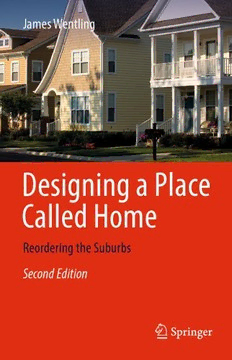
Cover Photo: New Port, a new community built on a redeveloped Navy housing site in Portsmouth, VA.
(Photograph courtesy of Lusher Productions).
Printed on acid-free paper
This Springer imprint is published by Springer Nature
The registered company is Springer International Publishing AG
The registered company address is: Gewerbestrasse 11, 6330 Cham, Switzerland
Introduction to the Second Edition
This is a book about the design of suburban housing. Following the Great Recession,
some media outlets and academics opined that suburban housing is no longer in
demand in the United States. One popular book, entitled The End of the Suburbs,
explained the reasons for the forthcoming demise of suburbia in great detail. Other
predictions were that we would become a nation of renters living in multifamily
settings—a view reinforced by a decline in the homeownership rate in recent years.
Rest assured, the suburbs are not dead, and the detached house continues to be
the most popular choice for most Americans. At the peak of the housing market,
over 80 % of all housing starts were single-family detached homes. Since that time,
the total has declined: now about two-thirds of all starts are detached houses. Less
than 10 % of the total detached houses built are custom homes or rentals, with the
balance constructed by homebuilders in suburban settings.
In terms of ownership, detached homes account for over 80 % of our total housing
stock, and the latest community survey by the Census Department indicates that that
segment is not declining, but rather growing. Attached townhouses and condomini-
ums comprise only 10 % of owned housing. Consumer surveys point to the fact that
the younger household who rents still aspires to eventually own a detached home,
though preferably in a walkable neighborhood with access to parks and services.
Given the continued preference for suburban homes, and in light of the disdain
for “sprawl,” it seems appropriate to reconsider the topics discussed in the first edi-
tion of this book. For the most part, many of the ideas put forth in the first edition
have gained traction. Thanks to advocacy from organizations such as the Congress
for New Urbanism, the Urban Land Institute, the American Planning Association,
the U.S. Green Building Council, among other groups, new suburban communities
have become much more energy efficient, sustainably built, and socially engaging.
Many local governments have embraced innovative planning tools such as form-
based zoning, conservation communities, and other policies over traditional zoning
ordinances that separate uses and encourage automobile usage. Other environmen-
tal goals such as reducing carbon emissions, better stormwater and waste
management strategies, and promoting healthy mobility options such as biking have
also been adopted as policies.
v
vi Introduction to the Second Edition
Challenges remain, however, particularly in the area of affordable and workforce
housing. And in spite of the progress that has been achieved over the past two
decades, the majority of new communities are still built as single-use, detached
houses isolated from quality open space and community amenities. More work is
still needed to continue the transition toward housing and community design stan-
dards that works for all citizens.
With this in mind, and based on an additional 20 years of experience as an archi-
tect immersed in residential design and planning, I have edited the first edition of
this book to reflect the positives that have taken place, as well as the challenges still
to be addressed. Sustainability and energy efficient design practices are among the
most important new topics, while demographics and lifestyle preferences are still
major influencers on housing and community design practices.
These trends continue to evolve, reflected by floor plans that favor open and
casual layouts over formal room definitions. New technologies for windows and
doors that allow more natural light into the home without permitting as much heat
to enter or escape are more readily available. New heating and ventilation systems
are being rolled out to reduce energy consumption and provide healthier interior
environments. Outdoor spaces adjacent to the home are becoming more of an
extension of the home’s interior for easy indoor–outdoor living. New low-mainte-
nance materials for both interior and exterior use are being made from more sus-
tainable materials, such as recycled plastics and textiles, and wood from renewable
forestry practices.
Although new technologies have been introduced to new home construction, we
find that traditional exterior design concepts for both housing styles and community
design continue to resonate with our population. Historically influenced and ver-
nacular house styles with character such as the Craftsman, Dutch Colonial, Mission,
and Monterey styles that are familiar to buyers are generally still preferred, even as
the Mid-Century Modern style, with its clean lines, is an instance of alternative
design becoming very popular.
We will continue to explore manufactured housing in this edition, since it is still
a significant portion of owned housing after single family detached. Multifamily
housing types will also be included, as they often provide the bulk of our affordable
housing stock. Attached housing, for sale or rental, is commonly the initial housing
type where younger people reside, as well as for retirees or households looking to
downsize or escape the maintenance of a detached house.
Suburban housing and community design can be an extensive topic; to be clear
in this book we will be looking at densities of 4–8 units per acre, which includes
conventional and small-lot detached homes as well as attached townhouses and
garden units up to three stories. We will not be exploring some of the higher density
multifamily designs above three stories, a category that generally includes elevator
buildings. Nor will there be discussions on specialty housing types such as live/
work, co-housing, or accessory units. This book will cover housing that is generally
privately built and with designs that could be affordable to buy or rent for households
earning the US median household income level. Households with income below
that level, including the homeless, are an entirely different topic that generally
Introduction to the Second Edition vii
needs to be addressed by government, nonprofit housing providers, or public-p rivate
partnerships—a need for which I have great concern but much less knowledge and
experience. Instead, we will focus on the “plain vanilla,” the most common and
numerous types of housing and communities underway throughout the country.
Finally, environmentally responsible design programs such as Energy Star,
LEED, Passive Houses, and others that meet green certification programs will be
discussed. These designs represent a growing segment of our new housing stock,
and certainly many of the elements of these programs will become the norm in
market-rate housing as well as mandated by building codes. We will explore all of
these trends and many others in detail in this second edition of Designing a Place
Called Home.
Acknowledgements
Since this second edition is largely based on the framework established by the first
edition, I would like to again recognize those individuals who reviewed and pro-
vided guidance on the first manuscript drafted over 20 years ago. Those would
include Susan Bradford and Mitch Rouda, then of BUILDER magazine, Todd
Zimmerman of Zimmerman/Volk Associates, and James Timberlake of
KieranTimberlake Architects. Randall Arendt, then of the Natural Lands Trust, now
Greener Prospects, Chuck Graham of Newton-Graham, author Philip Langdon, the
late Donald Prowler, professor of Architecture at the University of Pennsylvania,
Joseph Duckworth, then of Realen Homes, now Arcadia Land Company, also criti-
cally reviewed the text. Rebecca Hardin of Open Line Communications profession-
ally reviewed and copyedited the first edition.
Many of the exhibits and photographs from the first edition were replaced with
color images in this publication. Assistance with these images came from photogra-
pher Tom Voss, Stephen Fuller of Stephen Fuller Designs, Sara Davis of the Fredrick
Law Olmsted National Historic Site, Wiley Books for the National Trust for Historic
Preservation, and photographer Rick McNees, who provided the image of the
Usonian Home.
Jason Ebberts of TBL Photography provided photos of the Country Club Plaza’s
historic community and Roger Lewis, professor of Architecture at the University of
Maryland and columnist for the Washington Post, authorized the use of his cartoons to
add some humor to the text. Xavier Iglesias of Duany/Plater-Zyberk Architects, Carson
Looney and Beth Van Der Jagt of Looney Ricks Kiss Architects, Mitali Ganguly of
Calthorpe Associates, and Debra Ehnstrom and Tony Green of Pinehills, LLC also
provided images and background information on their respective communities.
Victor Mirontschuk and Trina Locklear of EDI International, Craig Morrison of
Cimarron Homes, Bob Fusari Sr. of Real Estate Service of Connecticut, Dan
Mummey of Clear Springs Development Company, Anne Hutchinson of the Natural
Lands Trust, Jonathan Braun of Ernest Braun Photography provided the Eichler
home photo, and Kristi Jue of Stantec San Francisco (formerly Anshen & Allen)
also provided assistance. Jeff Berkus and Ben Krinzman of Jeffrey Berkus Architects
provided images from the Berkus Group Architects archives.
ix
x Acknowledgements
Thanks also to Heather McCune of Bassenian/Lagoni Architects, Roxanne
Williams and J. Lee Glenn of RLD2X, Holly Stuut and Wayne Visbeen of Visbeen
Architects, Donald MacDonald of MacDonald Architects, Jerry Hoffman of RGL
Properties, Randall Arendt of Greener Prospects, Kathy West Studios of Village
Homes, and Debbie Loudon and Ross Chapin of Ross Chapin Architects also pro-
vided images for the text. Finally, Eliza MacLean assisted with images from the
Visualizing Density book, featuring aerial photography of Alex MacLean and Doug
Scott in Seattle provided photos of the High Point community for Mithun Architects.
Marissa Zhao from our practice had the talent and skills needed to add color to
the original black and white graphics. She also was responsible for formatting the
text and new material from our internal files, as well as for obtaining the photos and
graphics from other sources and coordinating the most all of permissions needed for
publication of the book.
From Springer International Publishing, Tiffany Gasbarrini was my original edi-
tor who accepted the book proposal and then located a “digital brontosaurus” to
convert the 20-year-old text from a “floppy disk” (and these were the really floppy
ones) into currently usable software. Springer staff members Rebecca Hytowitz,
Zoe Kennedy, and Faith Pilacik also provided guidance during the editing process.
As with the first edition, I would like to thank the many clients of our architec-
tural practice, who, in addition to financial support, have supported the firm’s ideas
by providing built examples of our designs. Many of the ideas in the book were
formulated as a joint effort with our clients or by observing the practices of other
progressive homebuilders.
In addition I’d like to thank the many talented people who assisted in the formu-
lation and execution of the firm’s ideas, the many dedicated employees who have
passed though our office, which after 30 years are too numerous to mention by
name. A note of gratitude is in order to everyone in this group.
Finally and most importantly, I thank my wife Anne and son Patrick for their
patience, love, and support of my professional endeavors.
How to Use This Book
This book is organized from the old to the new, from the large to the small, and from
the general to the specific. Depending on the reader’s background, some of the chap-
ters may be of more interest than others. Builders of a single house, for example, may
have less interest in how the entire community could be better planned. Community
developers, on the other hand, might not be as concerned with interior design issues.
1. Housing Yesterday is a condensed historical review of planning and design
themes found in American housing, with an eye to how some older building
practices could be applied to current housing designs.
2. Housing Today looks at the forces behind today’s housing and community
design standards—with suggestions to change them.
3. Community Planning and Design addresses land planning techniques to
improve neighborhood quality among groupings of houses and housing types.
4. Siting and Lot Patterns talks about how to configure houses on appropriate lot
sizes—and to organize plans that relate best to the lot and the greater
neighborhood.
5. Floor Plans and Building Image suggests organizing principles for floor plans
to create enjoyable interior room arrangements that will also achieve pleasing
elevations.
6. Interior Details moves the discussion inside to present more detailed ideas for
rooms and spaces that will add warmth, character, and livability with cost-
effective details.
7. Exterior Details moves back outside the house to recommend design concepts
that will enhance exterior elevations.
8. Multifamily Housing discusses how general design principles apply to attached
houses and addresses community design issues specific to attached houses.
9. Manufactured Housing is a brief overview of design concerns of particular
interest to builders of manufactured houses.
10. Toward More Sustainable Homes and Communities calls for environmen-
tally responsible design practices in new homes and communities, with a par-
ticular emphasis on reducing the consumption of natural nonrenewable resources.
xi