Table Of ContentZootaxa 4109 (1): 073–080 ISSN 1175-5326 (print edition)
Article ZOOTAXA
http://www.mapress.com/j/zt/
Copyright © 2016 Magnolia Press ISSN 1175-5334 (online edition)
http://doi.org/10.11646/zootaxa.4109.1.6
http://zoobank.org/urn:lsid:zoobank.org:pub:E2CABF95-7527-42BD-B895-CD5A2B5F7CD1
Description of a new species of crested newt, previously subsumed in Triturus
ivanbureschi (Amphibia: Caudata: Salamandridae)
B. WIELSTRA1,2,3,4 & J.W. ARNTZEN1
1Naturalis Biodiversity Center, P. O. Box 9517, 2300 RA Leiden, The Netherlands
2Department of Animal and Plant Sciences, University of Sheffield, S10 2TN Sheffield, UK
3Department of Ecology and Evolutionary Biology, University of California, Los Angeles, CA 90095, USA
4Corresponding author. E-mail: [email protected]
Abstract
Multilocus molecular data play a pivotal role in diagnosing cryptic species (i.e. genetically distinct but morphologically
similar species). A multilocus phylogeographic survey has provided compelling evidence that Triturus ivanbureschi sensu
lato comprises two distinct gene pools with restricted gene flow. We conclude that this taxon had better be treated as two
distinct (albeit morphologically cryptic) species. The name T. ivanbureschi should be restricted to the western species,
which is distributed in western Asiatic Turkey plus the south-eastern Balkan Peninsula. No name is as yet available for
the eastern species, which is distributed in northern Asiatic Turkey. We propose the name T. anatolicus sp. nov. for the
eastern species and provide a formal species description.
Key words: gene flow, introgression, phylogeny, Triturus anatolicus sp. nov., Triturus karelinii
Introduction
Diagnosing cryptic species. Speciation unaccompanied by morphological change has led to an underestimation of
biodiversity (Bickford et al., 2007; Pfenninger & Schwenk, 2007). With the advent of molecular data, many
‘cryptic species’—genetically distinct species that were previously unrecognized due to their morphological
similarity—have been revealed (Beheregaray & Caccone, 2007; Bickford et al., 2007). DNA barcoding is an
important tool in the search for cryptic diversity, but deals with mtDNA exclusively (Hebert et al., 2003). Although
a phylogeographical survey with mtDNA provides an efficient manner to identify potential cryptic species, the
biological significance of geographical populations with differentiated mtDNA should be explored before making
taxonomical decisions (Balloux, 2010; DeSalle, 2006; Moritz & Cicero, 2004).
Indeed, mtDNA divergence may fail to reflect the presence of different species: a deep divergence that arose
during historic allopatry can be accompanied by unlimited gene flow upon secondary contact (Pereira & Wake,
2009) and in species with low dispersal and/or small population sizes, phylogeographic breaks in mtDNA can
originate in the face of unimpeded nuclear gene flow (Irwin, 2002). Even if mtDNA does reflect the presence of
distinct cryptic species, its spatial distribution will regularly deviate from the actual species boundary (Toews &
Brelsford, 2012). This is because mtDNA is relatively susceptible to introgression (Petit & Excoffier, 2009), and
positive selection (Chan & Levin, 2005) or hybrid zone movement (Currat et al., 2008) can subsequently cause a
geographical asymmetry in mtDNA introgression to arise.
For candidate species identified based on differentiated mtDNA, the best evidence for evolutionary
independence would be a congruent genetic divergence of many unlinked markers, distributed across the nuclear
genome (Avise, 2000; Edwards, 2009). With the advent of next-generation sequencing, consulting a considerable
number of nuclear markers for a large number of individuals of non-model species has come within reach (Ekblom
& Galindo, 2011; Twyford & Ennos, 2012). We developed a next-generation sequencing protocol for marbled and
crested newts, genus Triturus (Wielstra et al., 2014a) that can be applied to address taxonomical questions. A
Accepted by M. Vences: 31 Mar. 2016; published: 5 May 2016 73
Licensed under a Creative Commons Attribution License http://creativecommons.org/licenses/by/3.0
recent study confirmed that one currently recognized crested newt species actually consists of two cryptic species
(Wielstra et al., submitted). We present a taxonomic revision here.
The crested newt Triturus ivanbureschi comprises two species. Triturus ivanbureschi Arntzen and Wielstra
2013 (in Wielstra et al., 2013b) comprises two candidate species and we refer to the collective as T. ivanbureschi
sensu lato . The two candidate species comprising T. ivanbureschi sensu lato were initially identified based on their
deep genetic divergence of mtDNA, on par with recognized crested newt species (Wallis & Arntzen, 1989; Wielstra
et al., 2010). There are no known morphological differences to distinguish the two (Arntzen, 2003; Ivanović et al.,
2013). A phylogeographical survey employing three nuclear introns provided support for the hypothesis of the two
candidate species representing distinct species (Wielstra et al., 2013a). Ambiguous separation based on allozyme
data (Arntzen & Wielstra, 2010) and the observation of recent mtDNA introgression (Wielstra et al., 2013a)
supported a scenario of recent genetic interaction and suggested that the alternative hypothesis of ongoing gene
flow could not be excluded (Wielstra et al., 2013b).
A study employing 52 nuclear markers and samples from across the putative hybrid zone, confirms that gene
flow between the two candidate species that make up T. ivanbureschi sensu lato is restricted (Wielstra et al.,
submitted). Here we consider the two candidate species to represent distinct, albeit morphologically cryptic
species. The first species covers the western part of the total range of T. ivanbureschi sensu lato, namely western
Asiatic Turkey and the south-eastern Balkan Peninsula, and the second covers the eastern part, namely northern
Asiatic Turkey. The two species meet at a hybrid zone in northwestern Asiatic Turkey (Wielstra et al., submitted).
An overview of the distribution of the two species is provided in Fig. 1 and a summary of the genetic data as
analyzed with Structure 2.3.3 (Pritchard et al., 2000) is provided in Fig. 2. The name T. ivanbureschi sensu stricto
applies to the western species, considering that the type locality is in Bulgaria (Wielstra et al., 2013b). As no name
is as yet available for the eastern species (Wielstra et al., 2013b) we provide one here, together with a formal
species description.
FIGURE 1. The two cryptic species comprising Triturus ivanbureschi sensu lato are distributed in Asiatic Turkey and the
south-eastern Balkan Peninsula. A rough distribution outline for T. ivanbureschi sensu stricto is shown in green and for T.
anatolicus sp. nov. in red. The two taxa meet at a hybrid zone in northwestern Asiatic Turkey. A rough distribution outline for
T. karelinii sensu stricto – with which Triturus ivanbureschi sensu lato until recently was considered to be conspecific – is in
blue. Records of Triturus newts are absent from most of NE Turkey, suggesting that the ranges of T. anatolicus sp. nov. and T.
karelinii sensu stricto do not meet. White dots represent type localities for, from left to right, T. ivanbureschi sensu stricto, T.
anatolicus sp. nov. and T. karelinii sensu stricto.
Results
Description of a new crested newt species
Triturus anatolicus sp. nov.
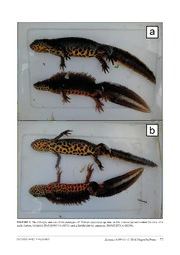
Type material. Holotype. RMNH.RENA.48232, an adult male (Fig. 3) from Gölköy, near Kalecik, Turkey
74 · Zootaxa 4109 (1) © 2016 Magnolia Press WIELSTRA & ARNTZEN
(coordinates: 40.077°N, 33.341°E, elevation: 1230 meter a.s.l.; Fig. 4), collected 6 April 2014 and donated to
Naturalis Biodiversity Center by Kurtuluş Olgun from the Department of Biology at Adnan Menderes University,
Aydın, Turkey. Paratypes. Six males (RMNH.RENA.48233-48238), six females (RMNH.RENA.48239-48245),
and a juvenile (RMNH.RENA.48246), with collection details identical to the holotype. For imagery, see Fig. 3 and
online Appendix 1 and 2.
FIGURE 2. Genetic data for Triturus ivanbureschi sensu lato presented in Wielstra et al. (submitted) illustrate the sharp
geographical overturn between the genotypes representing its two constituent species. Panel (a) shows the 67 sampled
populations as dots with the colored background representing a rough distribution outline of the two species based on nuclear
DNA. Populations are colored according to the mtDNA type present; western populations of Triturus anatolicus sp. nov.
possess mtDNA of Triturus ivanbureschi sensu stricto. Those populations harboring individuals showing introgression and
genetically admixed individuals based on nuclear DNA (as defined below) are highlighted. Panel (b) shows a Structure plot
representing Q scores with which the 428 sampled individuals were allocated to two different species (k = 2 was the optimal
number of gene pools inferred in the Structure analysis). The individuals are ordered based on the Q score with which they are
allocated to T. ivanbureschi sensu stricto, from high to low values. Individuals allocated to their respective species with Q ≥
0.987 are considered genetically pure. Individuals showing introgression are defined as being allocated to a species with 0.987
> Q > 0.85 and genetically admixed individuals as being allocated to either species with Q ≤ 0.85. Those individuals that are
not genetically pure are highlighted in panel (b). Note that nuclear introgression is geographically asymmetric.
Diagnosis. The new species is assigned to the genus Triturus because it possesses the characteristics of crested
newts (the T. cristatus superspecies), in particular the combination of a denticulated crest (in males in breeding
costume), a dark brown dorsal coloration and an orange ventral side covered with black spots. Based on mtDNA
sequence data, crested newts from the type locality are firmly placed in the genus Triturus, within the distinct
‘central T. karelinii sensu lato’ mtDNA lineage (Wielstra et al., 2010). Although identification based on mtDNA is
possible across the majority of the range of the new species, mtDNA derived from T. ivanbureschi has introgressed
at the western part of the range (Wielstra et al., submitted; Fig. 2). The pattern of asymmetric introgression is
mirrored by certain individual nuclear DNA markers and we consider this to represent a genomic footprint of
hybrid zone movement (Wielstra et al., submitted; Fig. 2). As yet only multilocus nuclear DNA sequence data
distinguish T. anatolicus sp. nov. unambiguously from T. ivanbureschi – and from T. karelinii, with which both T.
anatolicus sp. nov. and T. ivanbureschi were until recently considered conspecific (Wielstra et al., submitted). No
morphological features are currently known to distinguish the three species comprising T. karelinii sensu lato. How
to separate T. anatolicus sp. nov., T. ivanbureschi and T. karelinii from the other crested newt species is discussed
in Wielstra et al. (2013b).
Description of holotype. A relatively robust crested newt, with a broad head (wider than neck) and well
developed limbs. Four fingers and five toes. Toes fringed but interdigital webbing absent. Relative length of fingers
left 1 < 4 < 2 < 3, right 4 < 1 < 3 < 2 (3 and 4 possibly regenerated). Relative length of toes on both sides 1 < 5 < 2
< 4 < 3. Skin granulated on dorsal and lateral sides, tail base and throat; tail and venter smooth. Gular fold
inconspicuous. Swollen cloaca with papillae bordering cloacal slit. Denticulated crest, indented over the position of
the legs and cloaca. Laterally compressed tail with evident dorsal fin and less conspicuous ventral fin. In life a
CRESTED NEWT TAXONOMY Zootaxa 4109 (1) © 2016 Magnolia Press · 75
brownish-blackish base color on the dorsolateral side, with scattered black flecks, most pronounced and marbled
on the head. Bluish-white streak along the lateral side of the tail along the caudal vertebrae. A deep-orange ventral
side and throat, dotted with small angular black spots; throat spots smaller and denser than belly spots. In the
preserved state colors have slightly faded (see online Appendix 1).
TABLE 1. Number of rib-bearing pre-sacral vertebrae and measurements (in millimeters) for the holotype and paratypes
of Triturus anatolicus sp. nov.
Museum number Sex Material NRBV SVL1 SVL2 TL ILD
RMNH.RENA.48232 male holotype 13 53 61 108 27
RMNH.RENA.48233 male paratype 13 63 71 126 34
RMNH.RENA.48234 male paratype 12 53 60 110 29
RMNH.RENA.48235 male paratype 13 53 61 109 26
RMNH.RENA.48236 male paratype 13 50 58 100 27
RMNH.RENA.48237 male paratype 13 56 64 115 30
RMNH.RENA.48238 male paratype 13 53 60 110 29
RMNH.RENA.48239 female paratype 13 57 62 118 31
RMNH.RENA.48240 female paratype 13 62 68 133 32
RMNH.RENA.48241 female paratype 13 58 63 122 33
RMNH.RENA.48242 female paratype 13 58 62 123 30
RMNH.RENA.48243 female paratype 13 62 67 117 ** 33
RMNH.RENA.48244 female paratype 13 65 70 131 36
RMNH.RENA.48245 female paratype 13 56 60 111 31
RMNH.RENA.48246 juvenile paratype 13 51 55 102 29
continued.
Museum number Sex Material HL HW Arm Finger3 Leg Toe4
RMNH.RENA.48232 male holotype 16.2 10.6 18.7 5.6 * 22.1 9.5
RMNH.RENA.48233 male paratype 18.4 12.0 26.9 10.4 26.6 11.6
RMNH.RENA.48234 male paratype 16.5 11.5 22.7 8.6 25.9 10.4
RMNH.RENA.48235 male paratype 16.3 11.2 22.0 7.9 22.9 8.8
RMNH.RENA.48236 male paratype 15.5 10.7 20.2 7.7 21.3 8.6
RMNH.RENA.48237 male paratype 16.7 11.9 19.1 5.5 23.7 9.3
RMNH.RENA.48238 male paratype 16.6 11.5 20.8 7.8 22.8 9.4
RMNH.RENA.48239 female paratype 16.8 11.2 21.5 6.8 21.9 8.1
RMNH.RENA.48240 female paratype 18.5 13.0 23.6 8.9 24.1 9.5
RMNH.RENA.48241 female paratype 17.2 11.5 20.8 7.9 22.2 7.8
RMNH.RENA.48242 female paratype 17.1 11.4 20.9 7.8 21.1 8.1
RMNH.RENA.48243 female paratype 18.6 13.3 23.4 9.0 22.9 7.1
RMNH.RENA.48244 female paratype 18.7 13.5 24.4 9.5 23.0 8.6
RMNH.RENA.48245 female paratype 16.1 11.0 20.7 7.2 22.6 8.0
RMNH.RENA.48246 juvenile paratype 15.2 10.3 17.6 6.6 18.6 6.7
Abbreviations used are: NRBV = Number of rib-bearing pre-sacral vertebrae; SVL1 = Snout-vent length up to and
including the insertion of the hind-legs; SVL2 = Snout-vent length up to and including the cloaca; TL = Total length;
ILD = Inter-limb distance; HL = Head length; HW = Head width; Arm = Length of the right arm including the third
finger; Finger3 = Length of the right third finger; Leg = Length of the right leg including the fourth toe; Toe4 = Length of
the right fourth toe. * Finger c3/4 regenerated; ** Deformed tail tip.
76 · Zootaxa 4109 (1) © 2016 Magnolia Press WIELSTRA & ARNTZEN
FIGURE 3. The holotype and one of the paratypes of Triturus anatolicus sp. nov. in life. Lateral (a) and ventral (b) view of a
male (below, holotype, RMNH.RENA.48232) and a female (above, paratype, RMNH.RENA.48239).
CRESTED NEWT TAXONOMY Zootaxa 4109 (1) © 2016 Magnolia Press · 77
FIGURE 4. The type locality of Triturus anatolicus sp. nov. at Gölköy, Turkey.
The number of rib-bearing pre-sacral vertebrae (NRBV) is 13, as determined from X-ray photographs (see
online Appendix 2). The following measurements are in millimeters and have been determined with plastic Vernier
calipers. Snout-vent length up to and including the hind-legs 53; Snout-vent length up to and including the cloaca
61; Total length 108; Inter-limb distance 27; Head length 16.2; Head width 10.6; Length of the right arm including
the third finger 18.7; Length of the right third finger 5.6; Length of the right leg including the fourth toe 22.1;
Length of the right fourth toe 9.5.
Description of paratypes. The morphology of the paratypes resembles that of the holotype in general, but the
pattern of black spots on the ventral side is highly variable among individuals (online Appendix 1). Compared to
males (such as the holotype), adult females have non-swollen cloacae, lack the denticulated crest and possess a less
pronounced tail fin. All paratypes have an NRBV count of 13 except one, which has an NRBV count of 12 (Table
1; online Appendix 2). In Table 1 the same measurements as taken for the holotype are provided for the paratypes.
Distribution. The distribution encompasses Asiatic Turkey south of the Black Sea, reaching up to c. 200
kilometers inland (usually less), but not into inner Anatolia. To the west the new species reaches the Bosphorus at
the northern side of the Marmara Sea. On the southern side of the Marmara Sea it meets T. ivanbureschi sensu
stricto, east of Lake Ulubat and west of the city of Bursa. The two species form a hybrid zone here (Wielstra et al.,
submitted). To the east the new species reaches the town of Yomra, just east of the city of Trabzon. The nearest
known Triturus localities further east are from the extreme NE of Turkey, over 150 km away, and probably concern
T. karelinii sensu stricto (Wielstra et al., 2013a). An outline of the distribution of the new species is provided in
Fig. 1. A database of distribution records is provided in Wielstra et al. (2014b).
Etymology. The specific epithet reflects the distribution of the new Triturus species. Triturus anatolicus sp.
nov. is endemic to Anatolia. It is the only Triturus species to which this applies. It should be noted that the range of
T. ivanbureschi sensu stricto covers western Anatolia (Wielstra et al., 2013a; Wielstra et al., submitted) and the
range of T. karelinii sensu stricto probably protrudes into northeastern Anatolia (Wielstra et al., 2010).
78 · Zootaxa 4109 (1) © 2016 Magnolia Press WIELSTRA & ARNTZEN
Proposed vernacular name. We propose to use the vernacular name Anatolian Crested Newt for T. anatolicus
sp. nov. This name highlights its status as an Anatolian endemic. We suggest to use the vernacular name Balkan
Crested Newt for T. ivanbureschi sensu stricto (rather than Balkan-Anatolian Crested Newt previously applied to T.
ivanbureschi sensu lato). Although T. ivanbureschi sensu stricto also partially occurs in Anatolia, the main part of
its range is in the Balkan Peninsula.
Conclusion
We have taken a cautious approach in revising the taxonomy of T. karelinii sensu lato. We first split the group into
T. karelinii sensu stricto and T. ivanbureschi sensu lato and preferred to await a detailed analysis of the putative
hybrid zone between the two candidate species within T. ivanbureschi sensu lato before considering whether
further taxonomic change was warranted (Wielstra et al., 2013b). By applying a next-generation sequencing
protocol for Triturus (Wielstra et al., 2014a) to a detailed sampling in and around the putative hybrid zone
(Wielstra et al., submitted) we could confirm the existence of an as yet undescribed cryptic species in T.
ivanbureschi sensu lato. This gave us the confidence to describe T. anatolicus sp. nov. in the present paper. Our
studies on Triturus illustrate how ‘shallow genomics’ (Zilversmit et al., 2002), in which a comprehensive but
tractable portion of the total genome is employed to approximate evolutionary history, can be a driving force in
taxonomy. As yet no diagnostic morphological characters are known to distinguish the three species comprising T.
karelinii sensu lato. This raises the question: are the three crested newt species truly cryptic, or have they not been
studied closely enough? Considering that previous morphological studies have mainly focused on the species
meeting in the Balkan Peninsula rather than T. karelinii sensu lato (Arntzen, 2003) we suspect the latter. A future
morphological study, using the genetic results as a guidance, should prove illuminating.
Online appendices
The following supplementary materials are available on the Zootaxa server:
Online Appendix 1—Pictures of the ventral side of the holotype and paratypes of Triturus anatolicus sp. nov.
Online Appendix 2—X-ray photographs of the holotype and paratypes of Triturus anatolicus sp. nov.
Acknowledgements
BW conducted part of this work as a Newton International Fellow and is currently supported by a Marie
Skłodowska-Curie Individual Global Fellowship (EU project 655487). Kurtuluş Olgun facilitated obtaining the
type series. Dirk van der Marel provided the X-ray photographs.
References
Arntzen, J.W. (2003) Triturus cristatus Superspecies - Kammolch-Artenkreis (Triturus cristatus (Laurenti, 1768) - Nördlicher
Kammolch, Triturus carnifex (Laurenti, 1768) - Italienischer Kammolch, Triturus dobrogicus (Kiritzescu, 1903) - Donau-
Kammolch, Triturus karelinii (Strauch, 1870) - Südlicher Kammolch). In: Grossenbacher, K. & Thiesmeier, B. (Eds.),
Handbuch der Reptilien und Amphibien Europas. Schwanzlurche IIA. Aula-Verlag, Wiebelsheim, pp. 421–514.
Arntzen, J.W. & Wielstra, B. (2010) Where to draw the line? A nuclear genetic perspective on proposed range boundaries of the
crested newts Triturus karelinii and T. arntzeni. Amphibia-Reptilia, 31, 311–322.
http://dx.doi.org/10.1163/156853810791769509
Avise, J.C. (2000) Phylogeography: The history and formation of species. Harvard University Press, Cambridge,
Massachusetts, 447pp.
Balloux, F. (2010) The worm in the fruit of the mitochondrial DNA tree. Heredity, 104, 419–420.
http://dx.doi.org/10.1038/hdy.2009.122
Beheregaray, L. & Caccone, A. (2007) Cryptic biodiversity in a changing world. Journal of Biology, 6, 9.
http://dx.doi.org/10.1186/jbiol60
Bickford, D., Lohman, D.J., Sodhi, N.S., Ng, P.K.L., Meier, R., Winker, K., Ingram K. & Das, I. (2007) Cryptic species as a
CRESTED NEWT TAXONOMY Zootaxa 4109 (1) © 2016 Magnolia Press · 79
window on diversity and conservation. Trends in Ecology & Evolution, 22, 148–155.
http://dx.doi.org/10.1016/j.tree.2006.11.004
Chan, K.M.A. & Levin, S.A. (2005) Leaky prezygotic isolation and porous genomes: rapid introgression of maternally
inherited DNA. Evolution, 59, 720–729.
http://dx.doi.org/10.1554/04-534
Currat, M., Ruedi, M., Petit, R.J. & Excoffier, L. (2008) The hidden side of invasions: massive introgression by local genes.
Evolution, 62, 1908–1920.
http://dx.doi.org/10.1111/j.1558-5646.2008.00413.x
DeSalle, R. (2006) Species discovery versus species identification in DNA barcoding efforts: response to Rubinoff.
Conservation Biology, 20, 1545–1547.
http://dx.doi.org/10.1111/j.1523-1739.2006.00543.x
Edwards, S.V. (2009) Is a new and general theory of molecular systematics emerging? Evolution, 63, 1–19.
Ekblom, R. & Galindo, J. (2011) Applications of next generation sequencing in molecular ecology of non-model organisms.
Heredity, 107, 1–15.
http://dx.doi.org/10.1038/hdy.2010.152
Hebert, P.D.N., Cywinska, A., Ball, S.L. & deWaard, J.R. (2003) Biological identifications through DNA barcodes.
Proceedings of the Royal Society of London. Series B: Biological Sciences, 270, 313–321.
http://dx.doi.org/10.1098/rspb.2002.2218
Irwin, D.E. (2002) Phylogeographic breaks without geographic barriers to gene flow. Evolution, 56, 2383–2394.
http://dx.doi.org/10.1554/0014-3820(2002)056[2383:PBWGBT]2.0.CO;2
Ivanović, A., Üzüm, N., Wielstra, B., Olgun, K., Litvinchuk, S.N., Kalezić, M.L. & Arntzen, J.W. (2013) Is mitochondrial
DNA divergence of Near Eastern crested newts (Triturus karelinii group) reflected by differentiation of skull shape?
Zoologischer Anzeiger, 252, 269–277.
http://dx.doi.org/10.1016/j.jcz.2012.08.005
Moritz, C. & Cicero, C. (2004) DNA Barcoding: Promise and Pitfalls. PLoS Biology, 2, e354.
http://dx.doi.org/10.1371/journal.pbio.0020354
Pereira, R.J. & Wake, D.B. (2009) Genetic leakage after adaptive and nonadaptive divergence in the Ensatina eschscholtzii ring
species. Evolution, 63, 2288–2301.
http://dx.doi.org/10.1111/j.1558-5646.2009.00722.x
Petit, R.J. & Excoffier, L. (2009) Gene flow and species delimitation. Trends in Ecology & Evolution, 24, 386–393.
http://dx.doi.org/10.1016/j.tree.2009.02.011
Pfenninger, M. & Schwenk, K. (2007) Cryptic animal species are homogeneously distributed among taxa and biogeographical
regions. BMC Evolutionary Biology, 7, 121.
http://dx.doi.org/10.1186/1471-2148-7-121
Pritchard, J.K., Stephens, M. & Donnelly, P. (2000) Inference of population structure using multilocus genotype data. Genetics,
155, 945–959.
Toews, D.P.L. & Brelsford, A. (2012) The biogeography of mitochondrial and nuclear discordance in animals. Molecular
Ecology, 21, 3907–3930.
http://dx.doi.org/10.1111/j.1365-294X.2012.05664.x
Twyford, A.D. & Ennos, R.A. (2012) Next-generation hybridization and introgression. Heredity, 108, 179–189.
http://dx.doi.org/10.1038/hdy.2011.68
Wallis, G.P. & Arntzen, J.W. (1989) Mitochondrial-DNA variation in the crested newt superspecies: limited cytoplasmic gene
flow among species. Evolution, 43, 88–104.
http://dx.doi.org/10.2307/2409166
Wielstra, B., Baird, A.B. & Arntzen, J.W. (2013a) A multimarker phylogeography of crested newts (Triturus cristatus
superspecies) reveals cryptic species. Molecular Phylogenetics and Evolution, 67, 167–175.
http://dx.doi.org/10.1016/j.ympev.2013.01.009
Wielstra, B., Duijm, E., Lagler, P., Lammers, Y., Meilink, W.R.M., Ziermann, J.M. & Arntzen, J.W. (2014a) Parallel tagged
amplicon sequencing of transcriptome-based genetic markers for Triturus newts with the Ion Torrent next-generation
sequencing platform. Molecular Ecology Resources, 14, 1080–1089.
Wielstra, B., Espregueira Themudo, G., Güclü, Ö., Olgun, K., Poyarkov, N.A. & Arntzen, J.W. (2010) Cryptic crested newt
diversity at the Eurasian transition: the mitochondrial DNA phylogeography of Near Eastern Triturus newts. Molecular
Phylogenetics and Evolution, 56, 888–896.
http://dx.doi.org/10.1016/j.ympev.2010.04.030
Wielstra, B., Litvinchuk, S.N., Naumov, B., Tzankov, N. & Arntzen, J.W. (2013b) A revised taxonomy of crested newts in the
Triturus karelinii group (Amphibia: Caudata: Salamandridae), with the description of a new species. Zootaxa, 3682,
441–453.
http://dx.doi.org/10.11646/zootaxa.3682.3.5
Wielstra, B., Sillero, N., Vörös, J. & Arntzen, J.W. (2014b) The distribution of the crested and marbled newt species
(Amphibia: Salamandridae: Triturus)—an addition to the New Atlas of Amphibians and Reptiles of Europe. Amphibia-
Reptilia, 35, 376–381.
http://dx.doi.org/10.1163/15685381-00002960
Zilversmit, M., O'Grady, P. & DeSalle, R. (2002) Shallow genomics, phylogenetics, and evolution in the familiy Drosophilidae.
Pacific Symposium on Biocomputing, 7, 512–523.
80 · Zootaxa 4109 (1) © 2016 Magnolia Press WIELSTRA & ARNTZEN