Table Of ContentAdditional praise for Derrida’s Bible:
“This valuable volume represents a helpful shift of focus of current discussions of
‘Derrida and religion’ to ‘Derrida and the Bible,’ to the way in which this scrupu-
lously close micro-reader of texts reads and helps us read Biblical texts, the assembled
conglomerate of which is what is meant by ‘Derrida’s Bible.’ The collection shows
superbly how ‘the Bible’ (like ‘Plato’), as a single overarching theological unity or an
enabling ecclesiastical authorization, is exploded by a close—even ‘literalist’—
reading which releases an avalanche of metaphors, puns, competing theologies, het-
erogeneities, multiple layers of cut and paste authorship, good news and bad, awash
in problems of interpretation and translation—in short, everything that Derrida
predicts a ‘text’ (a ‘scripture’) would be. Yvonne Sherwood has produced an impor-
tant collection for which everyone, readers of Derrida and readers of the Bible, will be
grateful.”
—John D. Caputo, Watson Professor of Religion, Syracuse University
“Readers who imagine they already know what ‘Derrida’s Bible’ amounts to—a
transcendental signified cast down to earth, Lucifer-like, here; gleeful greasing of the
higher rungs of a Jacob’s ladder there—will be pleasantly surprised by this collection.
The Derrida of the title is, for the most part, ‘later’ Derrida, increasingly irreducible
to deconstruction, and certainly to deconstruction-by-numbers; and the readings of
biblical texts showcased within are, at their best, correspondingly nuanced, surpris-
ing, and consequential.”
—Stephen D. Moore, author of Mark and Luke in Poststructuralist
Perspectives: Jesus Begins to Write and Poststructuralism and the
New Testament: Derrida and Foucault at the Foot of the Cross
RELIGION/CULTURE/CRITIQUE
Series editor: Elizabeth A. Castelli
How Hysterical: Identification and Resistance in the Bible and Film
Edited by Eric Runions
(2003)
Connected Places: Region, Pilgrimage, and Geographical Imagination in India
Edited by Anne Feldhaus
(2003)
Representing Religion in World Cinema: Filmmaking, Mythmaking, Culture Making
Edited by Brent S. Plate
(2003)
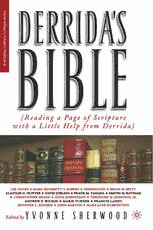
Derrida’s Bible (Reading a Page of Scripture with a Little Help from Derrida)
Edited by Yvonne Sherwood
(2004)
Derrida’s Bible
(Reading a Page of Scripture with a Little
Help from Derrida)
Edited by
YVONNE SHERWOOD
DERRIDA’SBIBLE
© Yvonne Sherwood 2004.
All rights reserved.No part of this book may be used or reproduced in any
manner whatsoever without written permission except in the case of brief
quotations embodied in critical articles or reviews.
First published in 2004 by
PALGRAVE MACMILLAN™
175 Fifth Avenue,New York,N.Y.10010 and
Houndmills,Basingstoke,Hampshire,England RG21 6XS.
Companies and representatives throughout the world.
PALGRAVE MACMILLAN is the global academic imprint of the Palgrave
Macmillan division of St.Martin’s Press,LLC and of Palgrave Macmillan Ltd.
Macmillan® is a registered trademark in the United States,United Kingdom
and other countries.Palgrave is a registered trademark in the European
Union and other countries.
ISBN 978-1-4039-6663-6 ISBN 978-1-137-09037-9 (eBook)
DOI 10.1007/978-1-137-09037-9
Library of Congress Cataloging-in-Publication Data is available from the Library of
Congress.
A catalogue record for this book is available from the British Library.
Design by Newgen Imaging Systems (P) Ltd.,Chennai,India.
First edition:November 2004
10 9 8 7 6 5 4 3 2 1
Transferred to Digital Printing in 2011
For
Jacques Derrida
Contents
Series Editor’s Preface ix
Acknowledgments xi
Contributors xiii
Introduction: Derrida’s Bible 1
Yvonne Sherwood
beginnings 21
1. Between Genealogy and Virgin Birth: Origin and
Originality in Matthew 23
Lee Danes
writing, posting, erasing 37
2. Of Secretaries, Secrets, and Scrolls: Jeremiah 36
and the Irritating Word of God 39
Mark Brummitt
3. Postcards from the (Canon’s) Edge: The Pastoral Epistles and
Derrida’s The Post Card 49
Robert Paul Seesengood
4. Erasing Amalek: Remembering to Forget with Derrida and
Biblical Tradition 61
Brian M. Britt
specters and messiahs 79
5. The Missing/Mystical Messiah: Melchizedek Among the
Specters of Genesis 14 81
Alastair G. Hunter
6. Jerusalem and Memory: On a Long Parenthesis in Derrida’s
Specters of Marx 99
David Jobling
boundaries/hyphens/identity-markers 117
7. Shibboleth and the Ma(r)king of Culture: Judges 12 and the
Monolingualism of the Other 119
Frank M. Yamada
viii Contents
8. The Book of Esther: The Making and Unmaking of Jewish Identity 135
Dmitri M. Slivniak
responsibilities, secrets, gifts 149
9. Triangulating Responsibility: How and Why Abraham, Isaac, and
Ishmael Offer and Refuse the Gift of Death, and to/from Whom 151
R. Christopher Heard
10. Preferring or not Preferring: Derrida on Bartleby as
Kierkegaard’s Abraham 167
Oona Eisenstadt
11. Justice as Gift: Thinking Grace with the Help of Derrida 181
Theodore W. Jennings, Jr.
12. Trembling in the Dark: Derrida’s Mysterium Tremendumand the
Gospel of Mark 199
Andrew P. Wilson
13. Death At the Gate: Who Let Him In?Responsibility for Death
in the Wisdom of Solomon and Derrida 215
Marie Turner
endings 229
14. The End of the World: Archive Fever, Qohelet 12:1–7, and
Lamentations Rabbah 231
Francis Landy
15. Decomposing Qohelet 247
Jennifer L. Koosed
16. And Sarah Died 261
Yvonne Sherwood
postscripts 293
17. Pardon Me... 295
Mary-Jane Rubenstein
18. Beliebigkeit 301
John Barton
Appendix: Abstracts 305
Author Index 313
Reference Index 317
Series Editor’s Preface
RELIGION/CULTURE/CRITIQUE is a series devoted to publishing work that addresses
religion’s centrality to a wide range of settings and debates, both contemporary and
historical, and that critically engages the category of “religion” itself. This series is
conceived as a place where readers will be invited to explore how “religion”—whether
embedded in texts, practices, communities, or ideologies—intersects with social and
political interests, institutions, and identities.
Derrida’s Bible (Reading a Page of Scripture with a Little Help from Derrida)brings
together the work of scholars of religion, literature, philosophy, theology, and the
Bible to explore two influential canons: the Bible and the oeuvreof Jacques Derrida.
In the midst of continental philosophy’s famous (or, to some, notorious) turn toward
religion, Derrida—as a reader of biblical texts, as the name most closely associated
with the philosophical and literary practices of deconstruction, as a figure for “theory”
as a whole—has inspired renewed attention among readers concerned with the place
of religion, theology, and scripture in the current cultural situation. The title of this
collection, Derrida’s Bible, invites us to consider both the character and nature of
Derrida’s own Bible but also the shape of scriptural reading in a post-Derridean age.
In the process of having produced their elegant readings attuned to (and sometimes
in tension with) the writings of Jacques Derrida, the contributors to this book have
both issued and answered invitations to engage in an ongoing conversation about
theBible as a ghost in the machinery of contemporary culture. Derrida’s Bibleblurs
the lines that so often separate different disciplinary enterprises, especially those
lines that have (for ambivalent reasons) grown up between biblical studies and
philosophy/theology. Thanks to Yvonne Sherwood’s deft conceptualizing and careful
editorial work, Derrida’s Bible makes a compelling contribution to the project to
which this series is dedicated.
Elizabeth A. Castelli
RELIGION/CULTURE/CRITIQUESeries Editor
New York City
May 2004
Acknowledgments
The glimmer of the idea that became Derrida’s Bibleand the conference Derrida and
Religion: Other Testaments(Toronto 2002) first occurred to me at a conference held at
the University of Luton, England in 1995. (That conference was originally called,
rather whimsically, Applied Derrida but was later changed, a little pink-facedly, to
Applying to Derrida.) As the only representative of religion, let alone Bible, I was
struck by unexpectedly enthusiastic responses to a little Bible study that Ipresented
on Derrida and Hosea. I was particularly struck by the responses of the late Anthony
Easthope (who I had never imagined as former attendee of Sunday School) and I
remember with gratitude a bar conversation about the potential of Bible Study for
Grown-Ups. Since then I have been deeply fortunate to find such a congenial set of
colleagues and friends among whom to rethink what could be meant by ‘Bible’ and
the act of inheriting Bible. To prevent the list sprawling inappropriately like some
incontinent Oscar speech, I’ll confine myself on this occasion to the current members
of the Reading, Theory and the Bible committee at the Society of Biblical Literature:
Tim Beal, Deb Krause, Tod Linafelt, Stephen Moore, Hugh Pyper, Ken Stone. I am
grateful to Elizabeth Castelli for ushering the book so painlessly into the
Religion/Culture/Critique series and to Amanda Johnson, Laura Morrison, Erin Ivy,
and Newgen for seeing it into print so efficiently. Above all, I want to express my
gratitude to Richard Davie for his very underpaid and very patient sub-editing work.
Without his assistance, Derrida’s Biblewould probably still be a pile of papers in my
office, rather than the book you’re holding in your hand.