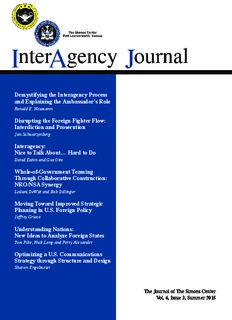
Table Of ContentDemystifying the Interagency Process
and Explaining the Ambassador’s Role
Ronald E. Neumann
Disrupting the Foreign Fighter Flow:
Interdiction and Prosecution
Jan Schwarzenberg
Interagency:
Nice to Talk About… Hard to Do
David Eaton and Gus Otto
Whole-of-Government Teaming
Through Collaborative Construction:
NRO/NSA Synergy
Leilani DeWitt and Bob Dillinger
Moving Toward Improved Strategic
Planning in U.S. Foreign Policy
Jeffrey Grieco
Understanding Nations:
New Ideas to Analyze Foreign States
Tom Pike, Nick Long and Perry Alexander
Optimizing a U.S. Communications
Strategy through Structure and Design
Sharon Engelmeier
The Journal of The Simons Center
Vol. 6, Issue 3, Summer 2015
Arthur D. Simons Center for Interagency Cooperation, Fort Leavenworth, Kansas Features | 1
InterAgency Journal
The InterAgency Journal (IAJ) is published quarterly by the Command and General Staff College Foundation
Press for the Arthur D. Simons Center for Interagency Cooperation. The InterAgency Journal is a national
security studies journal providing a forum for professional discussion and the exchange of information and
ideas on matters pertaining to operational and tactical issues of interagency cooperation, coordination, and
collaboration.
The articles published in the IAJ represent the opinions of the authors and do not reflect the official views of
the Department of the Army, the Department of Defense, the United States government, the Simons Center,
or the Command and General Staff College Foundation.
Contributions: The Simons Center encourages the submission of original articles based on research
from primary sources or which stem from lessons learned via personal experiences. For additional
information see “Simons Center Writer’s Submission Guidelines” on the Simons Center website at
www.TheSimonsCenter.org/publications.
Publications released by the Simons Center are copyrighted. Please contact the Simons Center for use of its
materials. InterAgency Journal should be acknowledged whenever material is quoted from or based on its
content.
About The Simons Center
The Arthur D. Simons Center for Interagency Cooperation is a major program of the Command and General
Staff College Foundation, Inc. The Simons Center is committed to the development of interagency leaders
and an interagency body of knowledge that facilitates broader and more effective cooperation and policy
implementation.
About the CGSC Foundation
The Command and General Staff College Foundation, Inc., was established on December 28, 2005 as a tax-
exempt, non-profit educational foundation that provides resources and support to the U.S. Army Command
and General Staff College in the development of tomorrow’s military leaders. The CGSC Foundation helps
to advance the profession of military art and science by promoting the welfare and enhancing the prestigious
educational programs of the CGSC. The CGSC Foundation supports the College’s many areas of focus
by providing financial and research support for major programs such as the Simons Center, symposia,
conferences, and lectures, as well as funding and organizing community outreach activities that help connect
the American public to their Army. All Simons Center works are published by the “CGSC Foundation
Press.”
The CGSC Foundation is an equal opportunity provider.
InterAgency Journal Features
3 Demystifying the Interagency Process and
Vol. 6, Issue 3, Summer 2015
Explaining the Ambassador’s Role
Arthur D. Simons Center Ronald E. Neumann
for Interagency Cooperation
10 Disrupting the Foreign Fighter Flow:
P.O. Box 3429 Interdiction and Prosecution
Fort Leavenworth, Kansas 66027
Jan Schwarzenberg
Ph: 913-682-7244
Fax: 913-682-7247
Email: [email protected]
23 Interagency:
Web site: www.TheSimonsCenter.org
Nice to Talk About… Hard to Do
David Eaton and Gus Otto
32 Whole-of-Government Teaming Through
Publisher/editor-in-Chief
Collaborative Construction: NRO/NSA
Raymond D. Barrett, Jr. Synergy
Leilani DeWitt and Bob Dillinger
Mananging editor 39 Moving Toward Improved Strategic Planning
Elizabeth Hill in U.S. Foreign Policy
Jeffrey Grieco
CoPy editor 47 Understanding Nations:
Valerie Tystad New Ideas to Analyze Foreign States
Tom Pike, Nick Long and Perry Alexander
design/ProduCtion 57 Optimizing a U.S. Communications
Strategy through Structure and Design
Mark H. Wiggins
Sharon Engelmeier
MHW Public Relations
and Communications
W N
orth otiNg
Printing
64 Anti-ISIL Strategy to Include Civilian and
Allen Press, Inc.
Military Agencies
Lawrence, Kansas
64 Updated National Military Strategy Released
64 Report Examines Cybersecurity Bills
Copyright 2015 65 White House Establishes Interagency Hostage
CGSC Foundation, Inc.
Recovery Fusion Cell
All rights reserved.
No part of this journal may be
reproduced, stored in a retrial 65 USAID Updates Civilian-Military Cooperation
system, or transmitted by any
means without the written Policy
permission of the
CGSC Foundation, Inc.
W N
orth otiNg (cont’d)
66 Simons Center Hosts Cybersecurity Roundtable
66 State, USAID Release 2015 QDDR
67 DoD Releases Cyber Strategy
67 CSIS Reports on DHS Unity of Effort Initiative
68 U.S. Provides Humanitarian Assistance to Nepal
B r
ook evieW
69 Partners in Prevention: Making Public-Private Security Cooperation More
Efficient, Effective and Sustainable. Recommendations of the Task Force
Demystifying
the Interagency Process and
Explaining
the Ambassador’s Role
by Ronald E. Neumann
“He’ll sit here, and he’ll say, ‘Do this! Do that!’ And nothing will
happen. Poor Ike—it won’t be a bit like the Army. He’ll find it very
frustrating.”
— President Truman after Eisenhower was elected 1
This article is designed to be an introduction to the interagency process and its application in
the field for those unfamiliar with the subject.2
Characteristics of the Process
One great obstacle to understanding the interagency process is the tendency, particularly in the
U.S. military, to refer to “the interagency.” To be a fussy linguist for a moment, when “interagency”
is used as an adjective to describe a “process,” for example, how paper is handled and decisions are
made, it suggests to the unwary or uninformed that there is a thing called the interagency that can
be identified as separate. There is no such thing. Grasping that is the beginning of understanding.
In fact, there is not one process but many—formal, informal, and personal. There are a great
number of actors in this process, too many for any sort of effectiveness. Cabinet departments,
agencies, divisions, and services will all want to play in any discussion that somehow touches on
their interests. Everyone wants a hand on the steering wheel, and most want a foot on the break,
which is to say they insist their group must concur in order for action to happen. Only a few drivers
will be trying to use the gas pedal to get things done.
Membership in the interagency process is flexible depending on the issue at hand, so it cannot
be depicted on an organizational chart. Sometimes those new to this area are surprised to discover
Ambassador (Ret.) Ronald E. Neumann is the President of the American Academy of Diplomacy.
Ambassador Neumann was Ambassador to Algeria, Bahrain, and Afghanistan as well as a Deputy
Assistant Secretary of State for the Middle East and a senior officer in Iraq. He is the author of
The Other War: Winning and Losing in Afghanistan. Ambassador Neumann holds a B.A. in History
and M.A. in Political Science from the University of California at Riverside.
Arthur D. Simons Center for Interagency Cooperation, Fort Leavenworth, Kansas Features | 3
that the interagency process also includes them. indecision unless the President personally drives
If you are in the U.S. government and your issue an action. But presidents have many issues to
is part of an interagency decision, then you or, worry about, and the number of interagency
more accurately, your parent agency is part of coordination or policy issues they can handle is
the process. very limited.
Terms and Definitions
One characteristic [of
interagency decisions] is Several terms come up in discussions about
that the process is far better the interagency process; therefore, it is useful to
at reaching consensus than define them. A meeting of the principal cabinet
at resolving disputes. officials, often with a few others included,
is called a National Security Council (NSC)
meeting if the President is chairing it. A so
Because there are so many potentially called Principal’s Committee meeting is the
involved in any interagency decision, the same group without the President. Usually a
process tends to have certain characteristics. Principal’s Committee will be chaired by the
One characteristic is that the process is far better National Security Advisor.
at reaching consensus than at resolving disputes. The next rung down is the Deputy’s
If everyone agrees, then the organizations can Committee (DC). Sometimes it is really the
act. But if there is disagreement among cabinet deputy secretaries of the cabinet departments
departments, then no one is in charge or able who attend. Often the members, depending
to resolve a dispute unless the issue goes to on the subject, will actually be at the
the President. Since cabinet secretaries dislike undersecretary level, occasionally lower. The
referring their disputes to the President, they role of the DC is to shape issues for decision
do not raise many issues and the issues simply above, but it often fails to do so. The DC can
linger. ratify a consensus but not make a decision when
Additionally, many arguments are not there is disagreement. Hence DCs, which often
among cabinet agencies but within them. State require extensive paper preparation and staff
Department organizations will argue with each time, frequently do not resolve to do more than
other. The organizations within the Department have another meeting. The problem is not new.
of Defense as well as the Joint Chiefs of Staff As the late Under Secretary of State Kantor said
(JCS) have an enormous ability to fuss with each many years ago when briefing the staff on a just
other and prevent reaching a decision on its own completed DC, “That meeting was as feckless
position even before it tries to coordinate with as it was indecisive.”
others. Many proposals have been made to reform
Often one will hear calls to “put someone the NSC, particularly after the Iran-Contra
in charge,” and sometimes a central coordinator scandal when the NSC ran illegal actions, and
or “czar” will be appointed to move some issue currently when it seems to overshadow State,
along faster. This solution almost never works Defense, and JCS. The problem with most
because such appointed czars are really only proposals for reform legislation is that they
coordinators and lack control over agency ignore the fact that every President reshapes
budgets. Since they do not control the money, the NSC to suit his preference and, to some
they cannot control the action. As a result, one extent, that of his National Security Advisor.
is left with a process that is slow and made for This is unlikely to change. However, one can be
4 | Features InterAgency Journal Vol. 6, Issue 3, Summer 2015
fairly certain that the current NSC has been so policy makers. Reporting is part of what makes
criticized that the next president will change its an embassy a player in the policy formulation
organization. Whether that will make it better or process. It is a significant and historical role for
just different is another question. diplomats.
One significant point about embassy work
The Embassy’s Central Role in
is that its mission never ends. Some individual
Interagency Coordination
tasks will be completed; however, managing
There are now more than thirty departments relations with the host country and addressing
and agencies of the U.S. government operating the many multinational issues that the host
overseas. The number of deployments, nation may be involved in are a continuing
programs, and the sheer size of the U.S.
government, plus the lack of a single decision
...the role of the embassy
maker below the President, make it essentially
becomes key for interagency
impossible to achieve real interagency
coordination abroad, and the
coordination in Washington. For that reason the
U.S. ambassador has particular
role of the embassy becomes key for interagency
authority to play a central role.
coordination abroad, and the U.S. ambassador
has particular authority to play a central role.
Embassies should be understood as operation. Embassy work has no defined
platforms hosting every civilian and many end state because relations among states are
military representatives of the U.S. government ongoing. Military deploying to a particular
in a particular country. Often the State country must understand that the embassy will
Department contingent will be a minority of the be there before they arrive in country and will
staff. Somewhat oversimplified, the embassy’s remain after they leave. That may well make
mission is to manage all aspects of policy. It is the embassy’s perspective on a given mission
often said, sometimes somewhat dismissively, different from a deployed unit’s perspective.
that State Department officers’ main role is A small matter of language may be worth
to “observe and report.” This is true, but may a note. Military briefing charts and slides
miss the point that reporting is an active, often refer to a Foreign Service officer as the
not passive role in two senses. In one sense, Department of State representative. Like their
reporting focuses not just on what is happening military counterparts, Foreign Service officers
on the ground, but also on whether policies are hold their commissions by act of Congress and
working. If something affects policy success, represent a separate service. They are properly
including military operations, it is appropriate referred to as FSOs or embassy liaison officers
for embassy reporting. This can be a point of or representatives. Although true, one would
friction with some military officers who feel never see a United States Marine Corps liaison
that it is their “lane.” The counter argument, as officer referred to as a United States Central
I once discussed with General George Casey in Command representative on a briefing chart.
Iraq, is that losing a war has policy significance.
The Ambassador
General Casey agreed. In another sense,
embassy reporting is also a base and vehicle The ambassador in his or her country of
for recommending policy change, both fine assignment has a particular importance in
tuning it and suggesting major alterations. This interagency coordination and the broadest grant
is different from just analyzing information for of authority in the federal government. Whether
Arthur D. Simons Center for Interagency Cooperation, Fort Leavenworth, Kansas Features | 5
a career FSO or a political appointee, the to some higher headquarters, in addition to the
ambassador represents the President and not the ambassador. Electronic communications make
Department of State. Since the administration such cross-cutting instructions easy to deliver
of President Eisenhower, a newly arrived and agencies still control their own budgets.
ambassador receives a letter of instruction from Nevertheless, a good ambassador has a
the President that grants him or her authority strong hand to play. Ambassadors can expel
over all U.S. government personnel, including someone from the country or deny entrance
military, not under authority of a combatant of U.S. government employees but not private
commander. U.S. citizens. The ambassador is authorized
Note that the distinction is not military versus to see all instructions and communications of
civilian, but in the chain of command. A defense every section and agency in the embassy (with
attaché reporting to the Defense Intelligence some CIA exceptions). While most ambassadors
Agency is under ambassadorial authority as is have neither the time nor the wish to read the
a temporary military mission sent by the JCS. vast flow of communications with a post, the
Only those in a combatant commander’s direct authority to do so is a hedge against hidden
chain of command are outside ambassadorial programs.
But the real tool of the ambassador is
the increased visibility over what happens in
...the real tool of the
country compared to the vast bureaucracy of the
ambassador is the increased
federal government in Washington. However
visibility over what happens
large the group of agencies and departments at
in country compared to the
post—collectively called the country team—
vast bureaucracy of the federal
they are smaller and more unified than their
government in Washington.
headquarters in Washington. Most embassies
will have a weekly “country team meeting,”
authority. And just to add further confusion, essentially a staff meeting of all agency heads
some positions may be dual-hatted and fall and section chiefs. This is a chance for the
into both. Thus the head of an office of military ambassador to catch up on what everyone is
cooperation, responsible for overseeing military doing and provide direction. Such meetings
sales and training to a foreign nation, would fall can be boring show-and-tell occasions or
under the ambassador’s authority but might be seminars on the major policies and priorities
dual-hatted by the regional commander as the the ambassador and country team are pursuing.
senior defense representative at post. A certain Whether they are boring or spirited will depend
amount of dexterity and common sense is largely on the ambassador.
required of anyone in this position of having
Relations with a Combatant
multiple commanders.
Commander: How to Wage War
It is this grant of authority and the While Keeping the Peace
ambassador’s position of being the President’s
representative that form the basis for coordinating The major exception to the ambassador’s
all aspects of U.S. government policy in his or authority over U.S. government personnel is the
her country of assignment. Not surprisingly, separate authority of a combatant commander
this is more complicated than the statement over all those in the chain of command. Thus
alone would suggest. Every agency and even wherever military personnel or units are present
many sections at an embassy must pay attention under such authority, there will be two chains of
6 | Features InterAgency Journal Vol. 6, Issue 3, Summer 2015
command. This situation is frequently lamented, to a maneuver commander, who would report to
and many ideas have been offered to improve a divisional or regional commander, who would
it, but absent legislation and for the foreseeable report to the International Joint Command
future, it is likely to remain unchanged. (IJC) at Bagram. The IJC reported to the
Because there is no single individual
in charge until one reaches the President, Because there is no single
cooperation and coordination between the individual in charge until
ambassador and the combatant commander and one reaches the President,
their staffs is absolutely essential. Ultimately, cooperation and coordination
this becomes a function of personalities. between the ambassador and the
However, understanding a number of points can combatant commander and their
help. staffs is absolutely essential.
While authorities for decision are different,
there are no separate “lanes” or areas where
the other authority does not need information commanding general of International Security
and, importantly, does not have a right to a Assistance Force (ISAF), who in turn reported
particular point of view. In Afghanistan, I to NATO. Each level of command has a staff
understood that General Karl Eikenberry (then whose many tasks rarely include increasing the
Commanding General of Combined Forces speed of passing information. By contrast, the
Command-Afghanistan) was entitled to a point FSO providing political advice in the PRT had
of view on areas such as the justice sector and a chain of command that ran only through one
economic development or governance, because intermediate office before being passed to the
if those areas were handled badly, the results ambassador or his deputy. If the ambassador
would be felt directly in military operations. reacted to some adverse development quickly,
By the same logic, I was entitled to express the commander of the ISAF could easily be
views on the security sector, operational-level surprised, and the PRT commander at the low end
military operations, and even some tactical of the chain could get “burned” as a result. This
operations because they affected what I could becomes even more the case if the ambassador
do politically. Anyone who has dealt with the passes information to Washington in a way that
friction about night raids in Afghanistan will produces fallout on the commanding general
understand that the issue is simultaneously before he is aware of the issue. The answer is
political and military. Whatever views prevail not to try to control information but to be aware
over a specific issue, the answer should never of the differences and manage how information
be that “this is a military (or civilian) matter and is used to enhance cooperation
none of your business.” Because there are so many situations and
In a situation where there are many so few established procedures for resolving
deployed forces, it is important to interagency differences, the role of personalities is critical.
cooperation to note the differences in the lengths Civilian and military officers must work to
of the chain of command. While the military understand the view point of the other side.
generally delegates more, its chain of command They must be flexible in trying to find pragmatic
is frequently much longer than that of a civilian solutions over assertions of unilateral authority.
counterpart. For example, in a provincial And when they disagree, they still need to stay
reconstruction team (PRT) in Afghanistan, the civil.
PRT’s military commander would likely report
Arthur D. Simons Center for Interagency Cooperation, Fort Leavenworth, Kansas Features | 7
Cultural Differences are many reasons for this, including Presidents
who did not ask for resources and Congresses
Getting along and reaching agreed solutions
that did not provide them. Here I want only
can be easier if each side understands a bit
to note the small size of the State Department
more about the culture of the other. A frequent
staff. Although it has expanded nearly 50
criticism from the military is that civilians are
percent since 2006, it still numbers only 13,860
too slow to get to action. The civilians respond
Americans of all ranks.3 Of these, only 8,039
that the military is determined to rush to failure.
are FSOs. They are deployed in 275 posts in
Each may be right in a given situation, but there
190 countries. Additionally, it is important to
are real reasons for the culture each brings to
understand that aside from a small number in
a discussion. In an oversimplified sense, a
training, State personnel are fully deployed.
military officer is trained to identify a problem,
There is no reserve that can be fielded in an
solve it, and move on to the next task. Defining
emergency.
the desired end state is often critical to getting
Despite several years of discussion, the idea
the solution right.
of a deployable reserve in a Bureau of Conflict
and Stabilization has led to only a small
As of this writing, if there is
increase in planning staff available for short-
again a need for a rapid civilian
term deployments. As of this writing, if there is
augmentation in a conflict
again a need for a rapid civilian augmentation
or post-conflict situation,
in a conflict or post-conflict situation, the
the probability is that the
probability is that the need will not be met.
need will not be met.
Two other cultural differences are worthy
of brief note. One is the use of planning and
mission statements and the other is the post-
The civilian background is frequently
Benghazi problem of security. Planning is a
one of dealing with issues that have no end
major part of military operations, and it is a very
state. Economic development, encouraging
strong tool. It is closely allied with delegation
democracy, or bilateral relations of the U.S.
in mission accomplishment. Neither is true
with another nation are all examples of things
of the State Department or, for that matter,
that continue indefinitely. There is no mission
most civilian organizations involved in the
completed point. This background conditions
interagency process. Embassies and domestic
civilians to see many problems as things to be
State Department organizations are tiny by
managed rather than solved, such as trying to
comparison with military staffs. There are very
prevent relations from moving into conflict and
few people available for planning and not much
looking more to incremental progress than to
takes place in a formal sense.
single solutions. Both approaches have value.
The culture is also different with respect
There are times when the civilians really do
to the use of planning. There is no civilian
need to get something decided. And there are
counterpart to the mission statement or, at least
times when forcing a decision may create more
in theory, to the delegation given to military
long-term difficulties than it is worth. Neither
organizations to carry out a mission. The speed
approach has a total monopoly on virtue.
of communications, the Washington tendency
A frequent problem, particularly in
to micromanagement, the pace of change, and
Afghanistan and Iraq, was the slow pace of
the short chains of civilian command have
getting enough civilians into the area. There
combined to create a culture in which broad
8 | Features InterAgency Journal Vol. 6, Issue 3, Summer 2015
Description:To be a fussy linguist for a moment, when “interagency” .. commanded the Counter-IED Task Force in Afghanistan in 2010 people were injured in the blasts, some severely, .. teenager, learned Arabic, traveled to Yemen.