Table Of Content1_ oZ<5.76/3:cZ//^7 ClemsonUniversity
3 1604 014 798 179
NATIONAL REGISTER
BULLETIN
Technical information on the the National Register ofHistoric Places:
survey, evaluation, registration, and preservation ofcultural resources
FEDERAL
PUBLICATION U.S. DepartmentoftheInterior
NationalParkService
CulturalResources
NationalRegister, Historyand Education
DEFINING BOUNDARIES FOR
NATIONAL REGISTER PROPERTIES
The missionofthe Department ofthe Interior is to protectand provide
access to our Nation's naturaland cultural heritageand honorour trust
responsibilities to tribes.
This material is partiallybased uponworkconducted under a cooperative
agreement with the National Conference ofState Historic PreservationOfficers
and the U.S. Department ofthe Interior.
Cover:
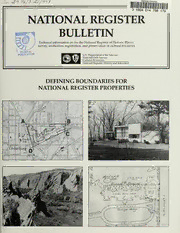
(Top Left) Detail ofUSGS map showing the National Registerboundariesofthe
Columbia Historic District in Cedarburg, Wisconsin.
(Top Right) ViewofArchitect Marcel Breuer's International Stylehome in Lincoln,
Massachusetts. (Ruth Williams)
(Bottom Left) Viewofthe Roxborough State ParkArcheological District near Waterton,
Colorado. (William Tate)
(Bottom Right) Detailofa 1987land survey mapdefining theproperty boundaries of
Gunston Hall in Buncombe County, North Carolina. (Blue Ridge Land Surveying, Inc.)
NATIONAL REGISTER
BULLETIN
DEFINING BOUNDARIES FOR
NATIONAL REGISTER PROPERTIES
BY
DONNA
SEIFERT
J.
including
Barbara J. Little, Beth L. Savage, and John H. Sprinkle,Jr.
DEPARTMENT OF THE INTERIOR
U.S.
NATIONAL PARK SERVICE
NATIONAL REGISTER OF HISTORIC PLACES
1995, REVISED 1997
TABLE OF CONTENTS
PREFACE
ii
CREDITS ANDACKNOWLEDGMENTS
iii
DEFINING BOUNDARIES FORNATIONAL REGISTERPROPERTIES
I. 1
Why Boundaries are Important 1
Getting Help 1
Deciding What to Include 2
Factors to Consider 2
Selecting Boundaries 3
Revising Boundaries 4
DOCUMENTING BOUNDARIES
II. 5
Completing Section 10, Geographical Data 5
The Verbal Boundary Description and BoundaryJustification 5
Universal Transverse Mercator (UTM) References 6
Global PositioningSystem (GPS) 6
III. CASE STUDIES 7
Boundaries for Buildings 7
Buildings in Urban Settings 7
Buildings in Rural Settings 10
Boundaries for Historic Districts 12
Contiguous Districts in Urban Settings 13
Discontiguous Districts in Urban Settings 16
Contiguous Districts in Rural Settings 17
Discontiguous Districts in Rural Settings 23
Parks as Districts 23
Boundaries for Particular Property Types 27
Traditional Cultural Properties 27
Mining Properties 27
Boundaries for Archeological Sites and Districts 30
Archeological Sites 31
Contiguous Archeological Districts 33
Discontiguous Archeological Districts 34
Shipwreck Sites 35
Boundaries for Historic Sites 36
Boundaries forObjects 40
Boundaries for Structures 41
IV. REFERENCES 45
V. NATIONAL REGISTERCRITERIA FOR EVALUATION 46
VI. NATIONAL REGISTER BULLETINS 47
APPENDIX: Definition ofNational Register Boundaries for Archeological Properties
(formerly National Register Bulletin 12: Definition ofNational Register BoundariesforArcheological Properties) 48
PREFACE
The National Register ofHistoric document, and register significant This bulletin was prepared by
Places is the official Federal list of properties. This bulletin is designed Donna Seifert, archeologist, under a
J.
districts, sites, buildings, structures, to help preparers properly select, cooperative agreement between the
and objects significant in American define, and document boundaries for National Conference ofState Historic
history, architecture, archeology, National Register listings and deter- Preservation Officers and the Na-
engineering, and culture. National minations ofeligibility. It includes tional Park Service.
Register properties have significance basic guidelines for selectingbound-
in the prehistory or history oftheir aries to assist the preparer in complet- Carol D. Shull
community, State, or the nation. The ing the National Register Registration Keeper,
National Register is maintained by the Form. Examples ofa variety of National Register ofHistoric Places
National ParkService on behalfofthe property types are presented. These National Park Service
Secretary ofthe Interior. examples illustrate several ways to U. S. Department of the Interior
National Register Bulletins provide address boundary issues.
guidance on how to identify, evaluate,
AND
CREDITS
ACKNOWLEDGMENTS
This bulletinaddresses issues Comments and contributions from Resources Division, National Park
originally presented in National the following individuals were Service; Kirk F. Mohney, Maine
Register Bulletin: Definition ofBound- particularly valuable: Paul Alley, Historic PreservationCommission;
ariesforHistoric Units oftheNational Western Regional Office, National David L. Morgan, Kentucky Heritage
Park System and National Register Park Service; David Banks, Inter- Council; BruceNoble, Interagency
Bulletin: How to Establish Boundaries agency Resources Division, National Resources Division, National Park
forNational Register Properties. Both Park Service; Robin K. Bodo, Dela- Service; William W. Schenk, Midwest
were prepared before National Register ware Historic PreservationOffice; RegionalOffice, National Park
Bulletin: How to Complete theNational Carol Burkhart, Alaska Regional Service; and Robert E. Stipe, Chapel
RegisterRegistration Form was revised. Office, National ParkService; William Hill, NorthCarolina.
This revised bulletincomplements the R. Chapman, Historic Preservation This publication hasbeenprepared
guidelines onboundaries inHow to Program, University ofHawai'i at pursuant to the National Historic
Complete theNational RegisterRegistra- Manoa; Rebecca Conard, Tallgrass Preservation Actof 1966, asamended,
tion Form and provides a variety of Historians L.C.; Dan G. Diebler, whichdirects the Secretary of the
case studies to assist nomination Pennsylvania Historical and Museum Interior todevelop and make avail-
preparers. Commission;Jim Draeger, Wisconsin able informationconcerning historic
Thisbulletin benefited from the DivisionofHistoric Preservation; properties. Defining Boundariesfor
suggestions offered by thestaff Audry L. Entorf, General Services National RegisterProperties was
members ofthe National Registerof Administration; Betsy Friedberg, developed under the general
Historic Places, who shared their Massachusetts Historical Commis- editorship ofCarol D. Shull, Keeper,
opinions and expertise. Critical sion; Bruce Fullem, New YorkState National Register ofHistoric Places.
guidance was provided by Carol D. Office ofParks, Recreation and Antoinette Lee, historian, was
J.
Shull, Antoinette Lee, andJan Historic Preservation; Elsa Gilbertson, responsible for publications coordina-
J.
Townsend; BethSavage provided an Vermont Division for Historic Preser- tion, and Tanya M. Velt provided
important case study, which was vation; Susan L. Henry, Interagency editorial and technical support.
included in thebulletin. John Byrne Resources Division, National Park Comments on this publication may be
ofthe National Register staff, pre- Service; Gerri Hobdy, Louisiana directed to Keeperof theNational
pared lists ofproperties to consider in OfficeofCultural Development; Register of Historic Places, National
the selection ofthe case studies, and Thomas F. King, SilverSpring, ParkService, 1849 C Street, NW,
Tanya M. Velt ofthe National Confer- Maryland;John Knoerl, Interagency Washington, D.C. 20240.
ence ofState Historic Preservation Resources Division, National Park
Officers provided researchassistance. Service; Paul Lusignan, Interagency
in
Digitized by the Internet Archive
in 2012 with funding from
LYRASIS Members and Sloan Foundation
http://archive.org/details/definingboundariOOseif
DEFINING BOUNDARIES
I.
FOR NATIONAL
REGISTER
PROPERTIES
The preparer ofa National Register however, these considerations apply archeological site, traditional cultural
nomination collects, evaluates, and only to governmentactions affecting property, or rural historic district.
presents the information required to the property; National Register listing Such properties may extend far
document theproperty and justify its does not limit the private owner's use beyond the area ofpotential effect or
historical significance. Among the ofthe property. Private property access may be denied in areas beyond
decisions the preparer must makeis owners can do anything they wish the undertaking. It is always best to
the selection of the property's bound- with their property, provided no consider the entire eligible property,
aries: in addition to establishing the Federal license, permit, or funding is but it maynot be possibleor practical
significanceand integrity ofa prop- involved. to define the full extentofthe prop-
,
erty, the physical location and extent Under Section 106 of the National erty. Insuch cases, reasonable,
ofthe property are defined as part of Historic Preservation Act of 1966, as predicted, estimated, or partial
the documentation. Boundary infor- amended, Federal agencies must take boundaries encompassing resources
mation is recorded in Section 10, into account the effect oftheir actions within the area ofpotential effect may
Geographical Data, on the National on historic properties (defined as be the only way to set the limits of
Register Registration Form. This properties in, or eligible for, the contributing resources when the
bulletin is designed to assist the National Register ofHistoric Places) entire property cannotbe observed or
preparer in selecting, defining, and and give the Advisory Council on evaluated from historic maps or other
documenting boundaries for National Historic Preservation the opportunity documents (as in the case ofsubsur-
Register properties. The bulletin to comment. To be in compliance face archeological resources). Con-
addresses the factors to considerand with the act, Federal agencies must sider all available information and
includes examples that illustrate identify and evaluate National select boundaries on the basis of the
properly defined boundaries for a Register eligibility ofproperties best information available. When
variety ofproperty types. within thearea ofpotential effect and defining boundaries oflarge resources
WHY evaluate the effect ofthe undertaking extending beyond the area ofpoten-
BOUNDARIES oneligible properties. The area of tial effect, it is advisable to consult the
potential effect is defined as the area State historic preservation office.
ARE IMPORTANT in which eligible properties may be
affected by the undertaking, including GETTING HELP
direct effects (such as destruction of
Carefully defined boundaries are the property) and indirect effects
important forseveral reasons. The (such as visual, audible, and atmo- In addition to the guidance in this
boundaries encompass the resources spheric changes which affect the bulletin, assistance is also available
that contribute to the property's character and setting of the property). from State Historic Preservation
significance. Boundaries may also The area ofpotential effect may Officers, Federal PreservationOffic-
have legal and management implica- include historic properties that are ers, and the staffof the National
tions. For example, only the area well beyond the limits of the under- Register ofHistoric Places. These
within the boundaries may be consid- taking. For example, a Federal professionals can help preparers with
ered part of the property for the undertaking outside of thedefined general questions and special prob-
purposes of Federal preservation tax boundaries ofa rural traditional lems. For assistance with specific
incentives and charitable contribu- cultural property oran urban historic questions or for information on how
tions. State and local laws that require district can have visual, economic, to contact the appropriate State
consideration ofhistoric resources traffic, and social effects on the Historic Preservation Officer or
may also refer to boundaries in the setting, feeling, and association of the Federal Preservation Officer, contact
application ofimplementing regula- eligible resources. the National Register ofHistoric
tions or design controls. National Large properties present special Places, National Register, History and
Register boundaries, therefore, have problems. For example, an undertak- Education, National Park Service,
legal implications that can affect the ing in a narrow corridor, such as a 1849 C Street, NW, Washington, D.C
property's future. Under Federal law, pipeline, may affect part ofa large 20240.
Several other National Register
GUIDELINES FOR SELECTING BOUNDARIES:
publications arealso available to
assistpreparers. National Register ALL PROPERTIES
Bulletin: How to Complete theNational
Register Registration Form provides the (summarized from How to Complete theNational RegisterRegistration Form,
basic instructions forboundary
p. 56)
selectionand documentation. The
following instructions, which are • Selectboundaries to encompass but not exceed theextent ofthesignifi-
consistent with those inHow to cant resources and land areas comprising the property.
Complete theNational RegisterRegistra-
tion Form, provide additional assis- • Includeall historic features of the property, but do not include buffer
tance for the preparer. The following zones or acreage not directly contributing to the significance ofthe
discussion addresses many property property.
types by considering the special • Exclude peripheral areas that no longer retain integrity due to alter-
boundary problems associated with ations in physical conditions or setting caused by human forces, such
each type and providing casestudies as development, or natural forces, such as erosion.
to assist the preparer in dealing with • Include small areas that are disturbed or lacksignificance when they
such issues. Bulletins that deal with are completely surrounded by eligible resources. "Donut holes" are
specific property types mayalsobe
notallowed.
useful (see the listofNational Regis-
ter Bulletins at the end ofthis publica- • Define a discontiguous property when large areas lacking eligible
resources separate portions ofthe eligible resource.
tion).
WHAT
DECIDING
contributing resources; simply must be preserved. Activities that
TO INCLUDE
identify the noncontributing resources often compromise integrity include
and include them within the bound- new constructionor alterations to the
aries of the property. resource or its setting. Natural
Selection ofboundaries is a judg- Districts may include noncontribut- processes that alter or destroy
mentbased on the nature ofthe ing resources, such as altered build- portions of the resource or its setting,
property's significance, integrity, and ings orbuildings constructed before suchas fire, flooding, erosion, or
physical setting. Begin to consider or after the period ofsignificance. In disintegration of the historic fabric,
boundaries during the research and situations where historically associ- may compromise integrity. For
data-collection portion of the nomina- ated resources were geographically example, an abandoned farmhouse
tion process. Byaddressingboundary separated from each other during the that has been exposed to the ele-
issues during the field and archival period ofsignificance orare separated ments throughyears ofneglect may
research, the preparer can take into by intervening development and are have lost its integrity as a building;
account all the factors that should be now separated by large areas lacking however, it may retain integrity as
considered in selecting boundaries. eligible resources, a discontiguous an archeological site.
aWthede,nresaisgsneisfsictahnecebohuasndbaereinesevtaolu- adirsitersicotfmthaeydbiescdoenftiingeudo.usThdiestbroicutnd- • Setting and Landscape Features:
ensure appropriate correspondence define two or more geographically Consider the setting and historically
between the factors that contribute to separate areas that includeassociated important landscape features.
the property's significanceand the Natural features ofthe landscape
physical extent of the property. eligible resources. may be included when they are
Select boundaries that define the located within thedistrict or were
limits of the eligible resources. Such FACTORS TO used for purposes related to the
resources usually include the immedi- historical significance of the prop-
ate surroundings and encompass the CONSIDER erty. Areas at the margins of the
appropriatesetting. However, eligible resources may be included
exclude additional, peripheral areas only when suchareas were histori-
that do not directly contribute to the Thereare several factors to con- cally an integral part of the property.
property's significance as bufferor as sider in selecting and defining the For example, a district composed of
open space to separate the property boundaries ofa National Register farmsteads along a creek may
from surrounding areas. Areas that property. Compare the historic extent include the creek if it runs through
have lost integrity becauseofchanges of the property with the existing the district, if the creek was impor-
in cultural features or setting should eligible resources and consider tant in the original siting of the
be excluded when they are at the integrity, setting and landscape farmsteads, or if the creek wasa
periphery ofthe eligible resources. features, use, and research value. source ofwater power or natural
When such areas are small and resources exploited by the farm-
surrounded by eligible resources, they • Integrity: The majority ofthe steads. Consult National Register
may notbe excluded, but are included property must retain integrity of Bulletin: Guidelinesfor Evaluatingand
as noncontributing resources ofthe location, design, setting, feeling, Documenting Rural Historic Land-
property. That is, do not select and association to be eligible. The scapes for additional guidance in
boundaries which exclude a small essential qualities that contribute to selecting boundaries for rural
noncontributing island surrounded by an eligible property's significance historic landscapes.