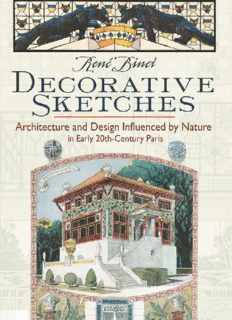
Table Of ContentDECORATIVE SKETCHES
Architecture and Design Influenced by Nature in Early
20th-Century Paris
René Binet
DOVER PUBLICATIONS, INC.
Mineola, New York
To
GUSTAVE GEFFROY
His grateful friend,
R. Binet
Bibliographical Note
This Dover edition, first published in 2017, is an unabridged republication of sixty plates from
Esquisses Décoratives, originally published by Librairie Centrale des Beaux-Arts, Paris, ca. 1902. The
original preface by Gustave Geffroy has been newly translated from the French by Diane Goullard,
www.FrenchAndEnglish.com.
Library of Congress Cataloging-in-Publication Data
Names: Binet, René, 1866–1911, creator. | Geffroy, Gustave, 1855–1926, writer of preface.
Title: Decorative sketches : architecture and design influenced by nature in early 20th-century Paris / Rene
Binet.
Description: Mineola, New York : Dover Publications, 2017. | “This Dover edition, first published in 2017,
is an unabridged republication of sixty plates from Esquisses Décoratives, originally published by
Librairie Centrale des Beaux-Arts, Paris, ca. 1902. The original preface by Gustave Geffroy has been
newly translated from the French by Diane Goullard.”
Identifiers: LCCN 2017022952| ISBN 9780486816685 (paperback) | ISBN 0486816680
Subjects: LCSH: Binet, René, 1866–1911—Themes, motives. | Decoration and ornament—France—Paris
—Art nouveau. | BISAC: ARCHITECTURE / Decoration & Ornament. | ART / European.
Classification: LCC NK1449.Z9 B562 2017 | DDC 745.092—dc23
LC record available at https://lccn.loc.gov/2017022952
Manufactured in the United States by LSC Communications
81668001 2017
www.doverpublications.com
CONTENTS
Preface
List of Illustrations
Decorative Sketches: Architecture and Design Influenced by Nature in Early
20th-Century Paris
PREFACE
But if they can’t understand that parts that are so small that they are unnoticeable can be as
divided as the firmament, then there is no better way than to have them look through
binoculars that enlarge that delicate speck to an enormous mass. There, they will easily
understand that through the medium of another piece of glass, more artistically tailored, one
can enlarge it to the point of emulating that very firmament, the vastness of which they
admire. These objects now seem to them very easily partitionable, they may remember that
nature is infinitely greater than art.
PASCAL: THOUGHTS (Reflections Upon Geometry In General)
. . . There is such an insect that by day or by night, viewed through the naked eye or
under a microscope, would present no interest. But if, with the aid of a scalpel, you took the
time, patiently, delicately, to lift from under the thick scaly wings the layers that form it, you
would often find some most unexpected designs made of sinuous curves, twig branchlets,
angular streaking figures, even hieroglyphics, reminiscent of the alphabet of certain Oriental
languages.
. . . Truly, what is there that is similar or close to, in art? How tired it seems, so languid.
How it needs to return to the living source! Habitually, instead of going directly to Nature, to
the inexhaustible fountain of beauty and invention, arts have appealed to scholarly
knowledge, to the arts of yesteryear, to the past of man.
. . . Our intelligent Paris merchants, who regrettably followed the paths that large
producers imposed upon them, may one day break away from the powerful and rich. Some
will have enough of it and, turning their backs on the scribes of old rubbish, they will inquire
of Nature itself, the great collections of insects, the greenhouses of the Garden of Plants.
MICHELET: THE INSECT (Renovation of our Arts through the Study of Insects, Ch. VII)
The architect of the main entrance door [Ed.:“La Porte Monumental Paris,”
designed by architect René Binet, who incorporated illustrations from Ernst
Haeckel’s work Art Forms in Nature] of the Paris Exposition [Ed.: The
Exposition Universelle de 1900, an international exhibition of new technology
and cultural innovations, such as Art Nouveau], René Binet, is an artist who has
an accurate sense of the general evolution of human endeavor. Therefore, he is
not publishing this collection intending, overtly or covertly, that it is going to
revolutionize the arts of furnishings, bring an expected epiphany, create a buzz,
to use a consecrated expression, however irritating and unfit. Fortunately for
him, he didn’t invent the Binet style. He knows only too well that such a
personal fantasy, one that would not pretend to be connected to what preceded it,
would run the risk of falling flat. The author’s objective is a lot simpler, and
completely legitimate. Going through the trouble of carrying on his objective,
the effort is necessarily going to be held back, categorized, and used, for the
simple reason that it encompasses a great deal of necessary work and that it
brings to its performance a spirit of unity and method.
Far from wanting to create a style, René Binet, relying on a process closely
connected to careful and unassuming data in an experimental spirit, returns, in a
way where ingenious invention and learned ingenuousness can be appreciated, to
the origin of all styles, to the unchanging principles, those that are absolute and
infinitely varied and complex, that determine the essential forms and their many
derivations.
René Binet became aware that there is a way of escaping from the obsession
with all the decorative forms we have inherited in the course of centuries, with
all the trials and all the successes that make up today’s code of tradition. This
means to resort to the large laboratory of Nature, one that is always moving,
always producing, never standing still for one instant, having not a single
moment where it stops or hesitates. Therein lies the tried-and-true secret of all
creation, of all transformation.
No doubt, others have asked its secret of nature. What am I saying? Others!
All may not have obtained it, but all have asked, even those who claim to
consider it of secondary importance and who substitute it for the genius of their
theories. But it is a different matter altogether to peer into art or to question
nature. An artist does not need theories to supplement nature, it is enough to
want to translate it: inevitably, the artist’s personality appears, his or her
perspective, the way he or she sees, experiences, or understands, seeps through.
He confesses his or her intelligence, his emotions, he creates the image residing
in his mind, from which he creates his perception of the world. But, while he is
thus manifesting a personal creation, he is conceiving a template that others, who
don’t have his sensitivity and clairvoyance, will merely imitate. They will
imitate his discovery while distorting it, and nature will be sieved through the
art, losing its native force, its freshness, its vigor, its original grace. This explains
one reason why, in the arts applied to everyday subjects—as for other arts—the
fading away, the falling from fashion in all forms and all ornamentation that
once had their youth and their blossoming. Formulas wilt, become wrinkled, are
abraded, die, over the course of a long period during which they decompose,
become more complex, and show the pointless, puerile, sad game of their slow
demise, in lieu of subtlety and refinement.
This means that every time the sap dries up, every time the sense of things
natural becomes scarcer and scarcer, one has to exert a sudden burst of the will
and return to the inexhaustible source.
It is into this exertion of a burst of the will that René Binet has dipped. He
has traveled to the invisible world, to the infinity of the forms revealed by the
microscope. He has studied with passionate focus the general characteristics of
these forms and the flow of their derivatives. He has learned the perpetual
renewal of life that is hidden in the depths of the ocean, all this universe in
constant movement, where separate forms constantly emerge from the transitory
mixture of mineral life, vegetable life, animal life. In the sixteenth lesson of his
History of the Creation of Organized Beings, does not Haeckel say the
following:
“We see perfectly that beings are divided into vegetable and animal forms, and it doesn’t come to our
mind to think that these beings might originate from one common source. Yet, it does, or, at least, it seems
to, since as you climb up the ladder of original life, you arrive, beyond ferns and mollusks, at a group,
called the protists, of which most of the representatives are of so small a volume, that they are, more or less,
invisible to the naked eye. The drama of their lives is so singularly a mixture of animal and vegetable
properties, that the existence of their groups has not been classified in any kingdom.
The conflicting information that has arisen on their existence does not result from our lack of
knowledge on the subject of protists, but rather stems from their unicellular nature.”
We see how a contemporary artist, such as René Binet, who turned toward a
scientific culture, foreseeing that an increasingly greater knowledge of the world
could reveal countless forms, was led to apply his works to natural history,
which seemed so different from his architectural work. Such a simple, legitimate
connection. To start with, why wouldn’t he have felt passionate about Nature, in
its immense labor; expanding on his experiences, attempting to succeed, by
creating an incalculable variety of drawings based on the protists, which separate
themselves into two kingdoms: one attached to the soil, growing from the
ground where it was born, a type that cannot move through its own will: the
vegetable organism; the other, whereby its organisms have the faculty of being
able to move from place to place: the animal organism. This classification
having been established, Nature reaches deep into its blueprint to sketch them in
one direction or another, but this evolution is slow, spanning centuries, from
which stems the resemblance between the melethallia, the radiolara, and certain
sponges.
Fig. 1.
This is our artist, one who follows the learned professor at the University of
Iéna, who was preceded in this study by Ehrenberg and Orbigny. He examined
the larger categories of the intermediary kingdom of the protists: first, the
Moneras; second, the Bacillus; third, the Infusoria; fourth, the Rhizopoda. He
learned that the Bacillus gave birth to the Diatoms, the Rhyzopoda gave birth to
the Thalamophora and to the Radiolaria. He looked at the Diatoms and found
most interesting these small microscopic cells, enclosed within a soft cell wall of
silica, which produces the most elegant and diversified forms.
Description:At the turn of the 20th century, artists and craftsmen throughout Europe and America were profoundly affected by a new art style that took its inspiration from nature. Generally referred to as Art Nouveau, the trend influenced all manner of creative types, from painters, illustrators, and architects