
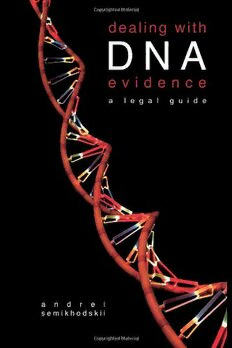
Download Dealing with DNA Evidence: A Legal Guide PDF Free - Full Version
Download Dealing with DNA Evidence: A Legal Guide by Andrei Semikhodskii in PDF format completely FREE. No registration required, no payment needed. Get instant access to this valuable resource on PDFdrive.to!
About Dealing with DNA Evidence: A Legal Guide
We do really need this book as the law of evidence is becoming one vast DNA test in many fields where the defence insists on challenging basic factual statements (on instructions from the client, of course).The questions really are - what use is this book and does it help me with my work? The answer to both questions is a resounding `yes'. DNA is now the indispensable weapon in the fight against crime because it allows both the unambiguous identification of the defendant from traces of biological material left at the scene of a crime, whilst acquitting the innocent.In plain English, `Dealing with DNA Evidence' states how DNA evidence is actually obtained - something many of us are totally unfamiliar with. Semikhodskii describes the various types of DNA test which are available and what the weaknesses of DNA testing are. For the benefit of both the judiciary and the defence, the author explains how DNA evidence can successfully be challenged in the courts so that the impact of such evidence can be minimised, or even dismissed completely.The defence advocate is given even greater assistance with strategies for refuting DNA evidence when presented and discussed during any stage of the criminal justice process. However, readers should note that the emphasis is squarely placed on DNA evidence so that it can be treated as just another piece of evidence which, of its own volition, would be insufficient to convict the defendant of a particular offence. Who should bother reading this book? Most students I remember from my Bar Vocational Course would run a mile rather than read something like this book. However, the book must be essential reading for students and practitioners of criminal law and practice, for forensic science and law, and for all practitioners within criminal justice management at whatever level because it is a unique sourcebook for twenty-first century advocacy which no professional criminal justice manager should be without today.Whilst the cases, statutes and regulations are relatively sparse for detail, I came away with the impression that `Dealing with DNA Evidence' presents a fair balance of the tasks confronting advocates in this new frontier of proof. I always remember hearing a devastating question posed by the great Norman Birkett KC when he asked a hapless witness (allegedly expert) "what is the co-efficient of the expansion of brass?" This expert didn't know - round one to Birkett, even if the question was a bit unfair, and possibly irrelevant.What Semikhodskii goes on to say is that when an advocate is faced with scientific evidence, he "has to understand it and the prosecution scientist who presents it, as well as the scientist who is working for the defence team". Counsel will know that their defence job is to highlight the drawbacks of the prosecution analysis presented to a jury and also have the ability to question experts about the subtleties of their supposed scientific expertise. It is right to say that such questioning is undoubtedly true for DNA evidence because it will be possibly the most scientifically demanding types of evidence available to the Crown.There are eleven chapters in the book covering the following detailed areas of DNA law: An introduction to Criminal DNA Analysis; Forensic DNA Testing; Interpretation and Statistical Evaluation of DNA Evidence; Criminal DNA Databases; Pitfalls of DNA Testing; DNA Testing Errors; DNA Evidence Interpretation Errors; DNA Evidence During Trial; Challenging DNA Evidence in the Courtroom; Post-Convictional DNA Testing; and Ethical Aspects of DNA Testing.The book concludes with a detailed set of references and a splendid glossary which I feel any person involved in the criminal justice process will find extremely useful. Readers will find the index detailed and content-heavy which really sums up the subject matter nicely for the subject is technical.Lawyers may wonder why this book is relatively slim at about 150 odd pages plus the referencing material. I felt that this book is actually more of a slim pocketbook on DNA for the advocate for both sides. "Always know your enemy" has been used a standard tactic for centuries so do not underestimate your opponent's DNA case. Semikhodskii writes in his preface that the understanding of how DNA evidence is obtained and evaluated allows lawyers to find pitfalls in evidence and in data interpretation, and to use their skills when dealing with other `id' evidence to highlight them to a jury, concluding that "providing lawyers with such information is the main goal of this book". Well, he has scored with that one! The author goes on to say that a match between the accused and a biological sample recovered from a crime scene `does not and should not automatically mean conviction, even if it is a complete match'. This is why the subtlety of the book strikes such success - it is the balancing act which Semikhodskii achieves for both sides of the argument so that fairness will prevail.Clearly, this is a book about detail. However, the case law is somewhat thin at present although R v Doheny and Adams [1997] 1 Cr. App.R. 369 features well on the conflicting sides to expert evidence in the courtroom. I am sure more cases will follow as they are reported. The book mainly succeeds with its well constructed writing style which is to explain complicated scientific and statistical issues in simple terms for all. However, there are additional detailed sources referred to such as "Forensic DNA Evidence Interpretation" (Buckleton, Triggs and Walsh 2005), "Forensic DNA Typing" (Butler 2005), "Weight-of-evidence for Forensic DNA Profiles" (Balding 2005), "Statistics and the Evaluation of Evidence for Forensic Scientists" (Aitken and Taroni, 2004) "Interpreting Evidence" (Robertson and Vignaum, 1995) and the invaluable "Genetic Testing and criminal Law" (Chalmers, 2005).These sources give tremendous additional gravitas to an already highly competent book which will clearly become a classic as the century's new discoveries unfold.
Detailed Information
| Author: | Andrei Semikhodskii |
|---|---|
| Publication Year: | 2007 |
| ISBN: | 9780203945032 |
| Pages: | 196 |
| Language: | English |
| File Size: | 1.342 |
| Format: | |
| Price: | FREE |
Safe & Secure Download - No registration required
Why Choose PDFdrive for Your Free Dealing with DNA Evidence: A Legal Guide Download?
- 100% Free: No hidden fees or subscriptions required for one book every day.
- No Registration: Immediate access is available without creating accounts for one book every day.
- Safe and Secure: Clean downloads without malware or viruses
- Multiple Formats: PDF, MOBI, Mpub,... optimized for all devices
- Educational Resource: Supporting knowledge sharing and learning
Frequently Asked Questions
Is it really free to download Dealing with DNA Evidence: A Legal Guide PDF?
Yes, on https://PDFdrive.to you can download Dealing with DNA Evidence: A Legal Guide by Andrei Semikhodskii completely free. We don't require any payment, subscription, or registration to access this PDF file. For 3 books every day.
How can I read Dealing with DNA Evidence: A Legal Guide on my mobile device?
After downloading Dealing with DNA Evidence: A Legal Guide PDF, you can open it with any PDF reader app on your phone or tablet. We recommend using Adobe Acrobat Reader, Apple Books, or Google Play Books for the best reading experience.
Is this the full version of Dealing with DNA Evidence: A Legal Guide?
Yes, this is the complete PDF version of Dealing with DNA Evidence: A Legal Guide by Andrei Semikhodskii. You will be able to read the entire content as in the printed version without missing any pages.
Is it legal to download Dealing with DNA Evidence: A Legal Guide PDF for free?
https://PDFdrive.to provides links to free educational resources available online. We do not store any files on our servers. Please be aware of copyright laws in your country before downloading.
The materials shared are intended for research, educational, and personal use in accordance with fair use principles.

