
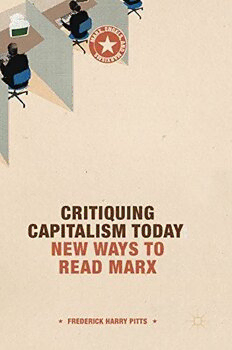
Download Critiquing Capitalism Today: New Ways to Read Marx PDF Free - Full Version
Download Critiquing Capitalism Today: New Ways to Read Marx by Frederick Harry Pitts in PDF format completely FREE. No registration required, no payment needed. Get instant access to this valuable resource on PDFdrive.to!
About Critiquing Capitalism Today: New Ways to Read Marx
This book critically introduces and compares two of the most compelling contemporary schools of Marxist thought: the German Neue Marx-Lekture, or New Reading of Marx, and Italian postoperaismo. In so doing, it radically updates our understanding of the key categories of Marx’s critique of political economy- including value, money, labour, class and crisis- in light of new and exciting theoretical developments. The New Reading of Marx reevaluates Marx’s Capital in the shadow of the first-generation Frankfurt School, finding an increasing uptake in the Anglophone world. Postoperaismo reconceptualises Marx’s work in the wake of the Grundrisse, its theories of immaterial labour and capitalist crisis finding growing favour beyond the radical fringe via recent bestsellers like Paul Mason’s Postcapitalism. Drawing on the first to engage in a pathbreaking critique of the second at a time of peak interest in its optimistic prospectus, the book brings into critical dialogue important modern thinkers such as Michael Heinrich, Werner Bonefeld, and Antonio Negri. In so doing, Critiquing Capitalism Today serves as both an introduction to each of these radical reinterpretations of Marx’s critique of political economy, and a contribution to continuing debates within and between these and other strands of contemporary Marxism. Advancing knowledge in the field by bridging recent scholarship with older material, including the works of Marx himself, Theodor Adorno and Alfred Sohn-Rethel, it relates theoretical disputes with their historical context in capitalist society itself, keeping an empirical focus that clarifies complex conceptual material for readers new to these cutting-edge currents of critical thought.
Detailed Information
| Author: | Frederick Harry Pitts |
|---|---|
| Publication Year: | 2017 |
| ISBN: | 9783319626321 |
| Language: | English |
| File Size: | 1.289 |
| Format: | |
| Price: | FREE |
Safe & Secure Download - No registration required
Why Choose PDFdrive for Your Free Critiquing Capitalism Today: New Ways to Read Marx Download?
- 100% Free: No hidden fees or subscriptions required for one book every day.
- No Registration: Immediate access is available without creating accounts for one book every day.
- Safe and Secure: Clean downloads without malware or viruses
- Multiple Formats: PDF, MOBI, Mpub,... optimized for all devices
- Educational Resource: Supporting knowledge sharing and learning
Frequently Asked Questions
Is it really free to download Critiquing Capitalism Today: New Ways to Read Marx PDF?
Yes, on https://PDFdrive.to you can download Critiquing Capitalism Today: New Ways to Read Marx by Frederick Harry Pitts completely free. We don't require any payment, subscription, or registration to access this PDF file. For 3 books every day.
How can I read Critiquing Capitalism Today: New Ways to Read Marx on my mobile device?
After downloading Critiquing Capitalism Today: New Ways to Read Marx PDF, you can open it with any PDF reader app on your phone or tablet. We recommend using Adobe Acrobat Reader, Apple Books, or Google Play Books for the best reading experience.
Is this the full version of Critiquing Capitalism Today: New Ways to Read Marx?
Yes, this is the complete PDF version of Critiquing Capitalism Today: New Ways to Read Marx by Frederick Harry Pitts. You will be able to read the entire content as in the printed version without missing any pages.
Is it legal to download Critiquing Capitalism Today: New Ways to Read Marx PDF for free?
https://PDFdrive.to provides links to free educational resources available online. We do not store any files on our servers. Please be aware of copyright laws in your country before downloading.
The materials shared are intended for research, educational, and personal use in accordance with fair use principles.

