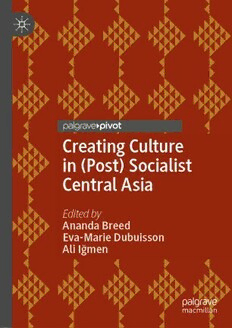
Table Of ContentCreating Culture
in (Post) Socialist
Central Asia
Edited by
Ananda Breed
Eva-Marie Dubuisson
Ali Iğmen
Creating Culture in (Post) Socialist Central Asia
· ·
Ananda Breed Eva-Marie Dubuisson
Ali Ig˘men
Editors
Creating Culture
in (Post) Socialist
Central Asia
Editors
Ananda Breed Eva-Marie Dubuisson
College of Arts Department of Languages,
University of Lincoln Linguistics, and Literature
Lincoln, UK Nazarbayev University
Nur-Sultan, Kazakhstan
Ali Ig˘men
Department of History
California State University
Long Beach, CA, USA
ISBN 978-3-030-58684-3 ISBN 978-3-030-58685-0 (eBook)
https://doi.org/10.1007/978-3-030-58685-0
© The Editor(s) (if applicable) and The Author(s), under exclusive license to Springer
Nature Switzerland AG 2020
This work is subject to copyright. All rights are solely and exclusively licensed by the
Publisher, whether the whole or part of the material is concerned, specifically the rights
of translation, reprinting, reuse of illustrations, recitation, broadcasting, reproduction on
microfilms or in any other physical way, and transmission or information storage and
retrieval,electronicadaptation,computersoftware,orbysimilarordissimilarmethodology
now known or hereafter developed.
The use of general descriptive names, registered names, trademarks, service marks, etc.
in this publication does not imply, even in the absence of a specific statement, that such
namesareexemptfromtherelevantprotectivelawsandregulationsandthereforefreefor
general use.
Thepublisher,theauthorsandtheeditorsaresafetoassumethattheadviceandinforma-
tion in this book are believed to be true and accurate at the date of publication. Neither
the publisher nor the authors or the editors give a warranty, expressed or implied, with
respecttothematerialcontainedhereinorforanyerrorsoromissionsthatmayhavebeen
made.Thepublisherremainsneutralwithregardtojurisdictionalclaimsinpublishedmaps
and institutional affiliations.
Cover illustration: © Harvey Loake
This Palgrave Macmillan imprint is published by the registered company Springer Nature
Switzerland AG
The registered company address is: Gewerbestrasse 11, 6330 Cham, Switzerland
Contents
1 Introduction: Making Culture in (Post) Socialist
Kazakhstan, Kyrgyzstan, and Xinjiang 1
Ananda Breed and Ali Ig˘men
2 ‘The Kara Kirghiz Must Develop Separately’: Ishenaaly
Arabaev (1881–1933) and His Project of the Kyrgyz
Nation 13
Jipar Duishembieva
3 Liminal States: Personal Dreams and Performance
in Kyrgyzstan During and After the Soviet Era 47
Ali Ig˘men
4 Epic Performances in Central Asia 65
Ananda Breed
5 Poets of the People: Learning to Make Culture
in Kazakhstan 87
Eva-Marie Dubuisson
v
vi CONTENTS
6 Lament in an Affluent Era: Cultural Politics of Kazakh
Life Cycle Songs in Xinjiang 115
Guldana Salimjan
7 Conclusion: Interweaving Texts 141
Eva-Marie Dubuisson
Index 151
Notes on Contributors
Ananda Breed is Professor of Theatre at University of Lincoln, United
Kingdom. She is author of Performing the Nation: Genocide, Justice,
Reconciliation (Seagull Books, 2014) and co-editor of Performance
and Civic Engagement (Palgrave Macmillan, 2018) and The Routledge
CompaniontoAppliedPerformance,VolumeOneandVolumeTwo (Rout-
ledge, 2020). She is Principal Investigator of Arts and Humanities
Research Council (AHRC) Global Challenges Research Fund (GCRF)
projectMobileArtsforPeace(MAP)InformingtheNationalCurriculum
and Youth Policy for Peacebuilding in Kyrgyzstan, Rwanda, Indonesia
and Nepal (2020–2024); and Co-Investigator of AHRC GCRF project
Changing theStory:Building Inclusive SocietieswithandforYoungPeople
inFivePost-ConflictCountries (2017–2021).Sheservedasaleadconsul-
tant for IREX and UNICEF in Kyrgyzstan for project Youth Theatre
for Peace (2010–2014). Breed was a research fellow at the International
Research Centre Interweaving Performance Cultures at Freie University
(2013–2014).
Eva-Marie Dubuisson is a linguistic anthropologist who researches the
politics of oral tradition and expressive culture, as well as discourses of
ancestry,sacredgeography,andecologicalprotectionandchangeinKaza-
khstan and Central Asia. Her book Living Language: The Dialogic Emer-
gence of an Ancestral Worldview was published by the University of Pitts-
burghPressin2017,andherworkhasalsobeenpublishedintheJournal
of Linguistic Anthropology, Central Asian Survey, and other collected
vii
viii NOTES ON CONTRIBUTORS
volumes. Her research and writing has been supported by grants and
fellowships from Fulbright, Wenner-Gren, the Social Science Research
Council Eurasia Program, the Seventh Framework Programme of the
EuropeanCommission(MarieCurieCIG),theScienceAcademy,Turkey,
and the National Council for Eurasian and East European Research.
She currently teaches in the Department of Languages, Linguistics, and
Literature at Nazarbayev University in Kazakhstan.
Jipar Duishembieva (Ph.D.2015,UniversityofWashington)researches
the cultural and social history of imperial and early-Soviet Central Asia.
Her doctoral dissertation, Visions of Community: Literary Culture and
Social Change Among the Northern Kyrgyz, 1856–1924, examines the
transformationsofKyrgyzsocietyandculturesetinmotionbytheRussian
imperial conquest of the mid-nineteenth century. Most recently, she has
been conducting research on the revolt of 1916 in Central Asia. Her
research has been supported by grants and fellowships from the Inter-
national Research and Exchanges Board, American Councils Title VIII
Research Scholar Program, and the National Council for Eurasian and
East European Research.
Ali Ig˘men is Professor of Central Asian History, the Director of the
Oral History Program at the California State University, Long Beach
(CSULB), and past President of Central Eurasian Studies Society (2018–
2019). His book Speaking Soviet with an Accent: Culture and Power in
KyrgyzstanhasbeenpublishedbytheCentralAsiainContextSeries ofthe
UniversityofPittsburghPressin2012,andwasafinalistfortheBestBook
Prize of the Central Eurasian Studies Society. He works on the history of
Soviet culture and gender politics in Central Eurasia, currently writing
his second book on four Kyrgyz actresses whose lives and work reflect
Soviet gender and cultural policies of the 1950s to 1980s. He received
his doctorate from the University of Washington in Seattle, and taught
attheUniversityofWisconsininMadison,KyrgyzNationalUniversityin
Bishkek, Osh State University in Osh, Kyrgyzstan, and Bog˘aziçi Univer-
sityinIstanbul,Turkey.AsignificantnumberofawardssuchasFulbright-
Hays,SSRC,MellonSlavicStudiesInitiativeGrantandFLAShelpedhim
support his research on Kyrgyzstan.
Guldana Salimjan is the Ruth Wynn Woodward Junior Chair of the
Gender, Sexuality, and Women’s Studies Department at Simon Fraser
University. Guldana’s current book project focuses on intersections of
NOTES ON CONTRIBUTORS ix
gender, memory, and history of Kazakhs in Northern Xinjiang against
the backdrop of the Mao era socialist revolution and reform era grass-
land policies. Her other projects include the cultural politics of Kazakh
genealogicalpublicationsandthediscourseoftheChinesestateprojectof
“ecologicalcivilization”inpastoralregionsofXinjiang.Shehaspublished
works on women’s narrative strategies in Kazakh oral tradition of aytis
and the material culture of tus kiiz. Guldana also researches and writes
about the ongoing human rights abuses in Xinjiang under the pen-name
YiXiaocuo.Sheistheco-directoroftheXinjiangDocumentationProject
and the founder of the multi-media art project Camp Album.
CHAPTER 1
Introduction: Making Culture in (Post)
Socialist Kazakhstan, Kyrgyzstan, and Xinjiang
Ananda Breed and Ali Ig˘men
Abstract In this volume, we introduce specific contexts of historical and
contemporary negotiation around the categories of ‘culture’ and ‘perfor-
mance’inKyrgyzandKazakhculturalenvironmentsinCentralAsia.How
are cultural forms imagined, created, and performed—as a mechanism
to both perform sovereignty and to reimagine traditional forms in the
socialist and postsocialist periods? The relationships, institutional condi-
tions,andcreativelaborrequiredtogenerateormaintainparticularforms
of culture (literature, education, oral tradition, performance) are referred
tohereas‘culturework,’andtheorizedasaformofliminalinterweaving.
How and why do processes of culture work occur? What is the specific
content of what might be promoted or allowed as ‘culture’ in highly
A. Breed
College of Arts, University of Lincoln, Lincoln, UK
e-mail: [email protected]
B
A. Ig˘men ( )
Department of History, California State University,
Long Beach, CA, USA
e-mail: [email protected]
© The Author(s), under exclusive license to Springer Nature 1
Switzerland AG 2020
A. Breed et al. (eds.), Creating Culture in (Post) Socialist
Central Asia, https://doi.org/10.1007/978-3-030-58685-0_1