Table Of ContentCRACKING THE NEW JOB MARKET
American Management Association / www.amanet.org
This page intentionally left blank
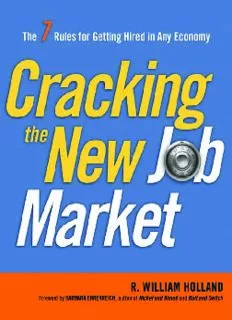
Cracking
the New
Job Market
The 7 Rules for Getting
Hired in Any Economy
R. WILLIAM HOLLAND
FOREWORD BY BARBARA EHRENREICH
AMERICAN MANAGEMENT ASSOCIATION
New York ◗ Atlanta ◗ Brussels ◗ Chicago ◗ Mexico City
San Francisco ◗ Shanghai ◗ Tokyo ◗ Toronto ◗ Washington, D.C.
American Management Association / www.amanet.org
Bulk discounts available. For details visit:
www.amacombooks.org/go/specialsales
Or contact special sales:
Phone: 800-250-5308
E-mail: [email protected]
View all the AMACOM titles at: www.amacombooks.org
This publication is designed to provide accurate and authoritative information in regard to the subject
matter covered. It is sold with the understanding that the publisher is not engaged in rendering legal,
accounting, or other professional service. If legal advice or other expert assistance is required, the ser-
vices of a competent professional person should be sought.
Library of Congress Cataloging-in-Publication Data
Holland, R. William.
Cracking the new job market : the 7 rules for getting hired in any economy / R. William Holland.
p. cm.
Includes index.
ISBN-13: 978-0-8144-1734-8 (pbk.)
ISBN-10: 0-8144-1734-5 (pbk.)
1. Job hunting—United States. 2. White collar workers—Employment—United States.
3. Professional employees—United States. 4. Labor market—United States. 5. Career develop-
ment—United States. I. Title.
HF5382.75.U6H65 2012
650.14—dc22
2011003880
© 2012 R. William Holland
All rights reserved.
Printed in the United States of America.
This publication may not be reproduced, stored in a retrieval system, or transmitted in whole or in
part, in any form or by any means, electronic, mechanical, photocopying, recording, or otherwise,
without the prior written permission of AMACOM, a division of American Management Association,
1601 Broadway, New York, NY 10019.
About AMA
American Management Association (www.amanet.org) is a world leader in talent development,
advancing the skills of individuals to drive business success. Our mission is to support the goals of
individuals and organizations through a complete range of products and services, including classroom
and virtual seminars, webcasts, webinars, podcasts, conferences, corporate and government solutions,
business books, and research. AMA’s approach to improving performance combines experiential
learning—learning through doing—with opportunities for ongoing professional growth at every step
of one’s career journey.
Printing number
10 9 8 7 6 5 4 3 2 1
American Management Association / www.amanet.org
TO THE FUTURE
Kasey, Sebastian, Leila, Preston, and Gabriela
American Management Association / www.amanet.org
This page intentionally left blank
CONTENTS
Foreword by Barbara Ehrenreich . . . . . . . . . . . . . . . . . . . . . . . . . . . . . . . . . . . . . . . . . . . . . . . IX
Preface. . . . . . . . . . . . . . . . . . . . . . . . . . . . . . . . . . . . . . . . . . . . . . . . . . . . . . . . . . . . . . . . . . . . XIII
RULE #1 Always Demonstrate Your Value . . . . . . . . . . . . . . . . . . . . . . . . . . . . . . . . . . . . . . . . 1
RULE #2 Your Résumé: It’s About the Value You Create. . . . . . . . . . . . . . . . . . . . . . . . . . . . 27
RULE #3 Use Social Media and Other Sites for Job Leads. . . . . . . . . . . . . . . . . . . . . . . . . . . 73
RULE #4 Interviews: They’re About the Value You Demonstrate. . . . . . . . . . . . . . . . . . . . 103
RULE #5 You Get What You Negotiate, Not What You Deserve. . . . . . . . . . . . . . . . . . . . . 135
RULE #6 Career Choice Is More Than Following Your Passion. . . . . . . . . . . . . . . . . . . . . 151
RULE #7 The Best Way to Reenter the Job Market Is to Never Leave It . . . . . . . . . . . . . . 165
American Management Association / www.amanet.org
VIII CONTENTS
Appendix A:Helicopter Parenting Is a Good Thing. . . . . . . . . . . . . . . . . . . . . . . . . . . . . . 181
Appendix B:Financial Planning for New Career Realities. . . . . . . . . . . . . . . . . . . . . . . . . 199
Appendix C:Applying the Job-Search Rules to Worldwide Employment . . . . . . . . . . . . 219
Appendix D:Example of a Functional Résumé. . . . . . . . . . . . . . . . . . . . . . . . . . . . . . . . . . 229
Index. . . . . . . . . . . . . . . . . . . . . . . . . . . . . . . . . . . . . . . . . . . . . . . . . . . . . . . . . . . . . . . . . . . . . 233
American Management Association / www.amanet.org
FOREWORD
I first met Bill Holland in 2005, in Chicago, at a book signing for Bait and Switch—
my attempt to understand and explain why otherwise perfectly qualified profes-
sionals were having difficulty finding work. Corporate downsizing was churning
out tens of thousands of white-collar workers every year, but the resources available
to people to help with the reemployment process didn’t make a lot of sense. It
seemed to me that most of the coaching, networking groups, and the unemploy-
ment industry in general were part and parcel of one gigantic “bait and switch”
scheme that too often did everything but help those who needed it the most.
Unemployed white-collar workers had become a market for a host of dubious
schemes, scams, and unhelpful self-help books and DVDs.
By the time my tour reached Chicago, it was clear that the themes of Bait and
Switchresonated with substantial numbers of people who otherwise had no outlet
for their concerns. Back then, no one wanted to believe that white-collar profession-
als were facing the same economic pressures more common to hourly workers. As
I talked to different groups around the country, I began to ask who in the audience
might be interested in organizing for purposes of giving voice to a new class of dis-
affected workers—white-collar America. That’s when United Professionals (UP)
was born and Bill Holland stepped forward to become its chairman of the board.
Between 2006 and late 2010, UP reached out and touched thousands of people,
many of whom shared their stories with us. Some had lost their homes, retirement
savings, and any hope things would eventually get better. Most of the younger ones
were laboring under more student debt than they could pay back in a lifetime.
Many had given up on their professional careers and landed in low-paid service
American Management Association / www.amanet.org