Table Of ContentTh e Contemporary Design in Detail series leads readers on a S C Yenna Chan
m o
n
highly visual tour of recent architectural investigations into
t
a e
residential design. Rather than take a project-based approach, ll m
p
E o
the volumes are organized according to the strategies by which n ra
v ry
architects are today exploring sustainability, small spaces, and i
r D
o e
prefabrication, among other forward-looking practices. Above n s
i
g
m
all, the series shows how these programs have inspired innovative n
e in
designs that off er both substance and style. n D
t e
Small Environments examines architecturally distinctive s t
a
i
l
residences under 1,300 square feet (120 square meters). Its four
central sections—Mediating the Outdoors, Spatial Boundaries,
Ordering of Contents, and Surfaces and Finishes—off er a
CCoonntteemmppoorraarryy DDeessiiggnn iinn DDeettaaiill
framework for the issues faced in creating small dwellings as
rigorously conceived as any larger space.
SSmmaallll
Drawing on projects from around the globe, Small
Environments includes work by both emerging and established
practitioners, including: Arakawa + Gins, Arts Corporation,
EEnnvviirroonnmmeennttss
Shigeru Ban, Marlon Blackwell, Barbara Bestor, Cell Space,
Jonathan Clark, Elliott + Associates, Endoh Design House, Jamie
Fobert, Dick van Gameren, Peter Gluck, Sean Godsell, Henning
Larsens Tegnestue, Horden Cherry Lee, i29 Offi ce for Spatial
Design, Kanner Architects, LOT-EK, noroof architects, Pool
Architektur, Joel Sanders, Kazuyu Sejima, Studio Aisslinger,
tonkin liu, Dennis Wedlick, Uni Architects, and Andrea Zittel.
Y
e
n
n
a
C
h
a
n
ISBN-13: 978-1-59253-231-5
Architecture ISBN-10: 1-59253-231-4
$50.00 US
C N
P £32.50 UK www.rockpub.com A
U $60.00 CAN E
SSmmaallll__CCoovveerr__003322110077__..iinndddd 11 33//2288//0077 77::0022::2299 PPMM
(Provision): Contemporary Design - Small & Environments CD307.148 / 3153
Small
Environments
000011--005511__..iinndddd 11 Small Environments 11//88//0077 33::2200::5511 PPMM
CD107-18/4271
CCDDDD__SSmmaallll__FFiinnaall__000011--005511..iinndddd 22 Small Environments 1111//1111//0066 77::5599::1199 AAMM
D1106-43/4271
Contemporary Design in Detail
Small
Environments
Yenna Chan
000011--005511__..iinndddd 33 Small Environments 11//88//0077 33::2200::5588 PPMM
CD107-18/4271
© 2007 by Rockport Publishers, Inc.
All rights reserved. No part of this book may be reproduced in any form without written
permission of the copyright owners. All images in this book have been reproduced with the
knowledge and prior consent of the artists concerned, and no responsibility is accepted by
producer, publisher, or printer for any infringement of copyright or otherwise, arising from
the contents of this publication. Every eff ort has been made to ensure that credits accurately
comply with information supplied.
First published in the United States of America by
Rockport Publishers, a member of
Quayside Publishing Group
33 Commercial Street
Gloucester, Massachusetts 01930-5089
Telephone: (978) 282-9590
Fax: (978) 283-2742
www.rockpub.com
Library of Congress Cataloging-in-Publication Data available
ISBN 13: 978-1-59253-231-5
ISBN 10: 1-59253-231-4
Series Editor and Art Director: Alicia Kennedy
Designer: Chris Grimley for over,under
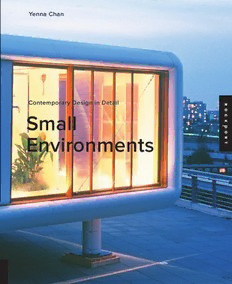
Cover image: Studio Aisslinger, Loftcube
Photograph by Steff an Jänicke
Printed in China
CCDDDD__SSmmaallll__FFiinnaall__000011--005511..iinndddd 44 Small Environments 1111//1111//0066 77::5599::1199 AAMM
D1106-43/4271
000011--005511__..iinndddd 55 Small Environments 1122//88//0066 33::4499::2244 PPMM
CD1206-49 / 4269
CCDDDD__SSmmaallll__FFiinnaall__000011--005511..iinndddd 66 Small Environments 1111//1111//0066 77::5599::3333 AAMM
D1106-43/4271
Contents
Introduction 8
Mediating the Outdoors 14
External/Internal Transitions 16
Luminance 40
Spatial Boundaries 62
Private/Public Functions 64
Circulation 84
Ordering of Contents 102
Capsules 104
Built-Ins and Convertibles 120
Surfaces and Finishes 144
Hue 146
Texture 170
Directory of Architects and Designers 186
Photographer Credits 190
000011--005511__..iinndddd 77 Small Environments 1122//88//0066 33::5511::1166 PPMM
CD1206-49 / 4269
nit
U
d
a
e
est
m
o
H
Z
A-
el,
Zitt
a
e
dr
n
A
Introduction
When a recent survey of Andrea Zittel’s work arrived at the New Mu-
seum in New York City, one wall of the exhibition was given over to the
artist’s manifesto “Th ese Th ings I Know for Sure.” Two assertions reso-
nate with the condition of living in a small space “It is a human trait to
want to organize things into categories. Inventing categories creates an
illusion that there is an overriding rationale in the way the world works.
What makes us feel liberated is not total freedom, but rather living in a
set of limitations that we have created and prescribed for ourselves.” Zit-
tel uses the home as a laboratory for experimenting with the questions
that arise from often self-imposed limitations. As such, her investigations
off er a paradigm for small residential spaces that turn constraints to an
advantage, that use the details of design to create a versatile and mean-
ingful living experience derived from a logic of compactness, effi ciency,
and discreteness.
8 Small Environments
000011--005511__..iinndddd 88 Small Environments 1122//88//0066 33::5533::1166 PPMM
CD1206-49 / 4269
Th e designers of the projects collected in this volume have treated size
as a condition like any other—topography, climate, density—that might
spark a creative response. Where no physical boundaries existed, the
designers have applied artifi cial parameters. And some limits, whether
fi nancial or aesthetic or cultural, are always present. Architecture is, in
one sense, just a way to organize our interaction with the environment
outside, to mark our daily routines, and to make sense of internal experi-
ences. Small spaces require a more rigorous way of thinking: In some of
the works featured, the categories of dwelling are distilled into a few
essential ideas and functions, establishing a set of boundaries with
which the design plays. All these projects show that smallness is not a
conceptual limit.
Today, more than ever, the small residential environment serves as
an arena for architectural innovation. But far from being a new move-
ment, small, well-designed residences have interested homeowners and
architects alike over the last two centuries. As mechanized convenience
gradually replaced human labor in the early and mid-nineteenth century,
activists like Catherine Beecher publicly advocated smaller and better
organized spaces for managing household tasks without domestic help.1
At the beginning of the twentieth century, the interior designer Elsie
de Wolfe dedicated a chapter of her book Th e House in Good Taste to
the subject of furnishing and decorating small rented apartments; in it,
she acknowledged the apartment typology as the answer to many of the
issues surrounding modern urban living.2 Th e social housing estates of
European modernism, such as the widely known 1927 Weissenhof Sied-
lung in Stuttgart, tied design to visions of effi ciency and modernization
to address substandard living conditions and aff ordable housing needs.
Starting in 1936, Frank Lloyd Wright’s Usonian houses demonstrated
new methods of construction and design to create simple, aff ordable
single-family homes. Th eir innovations allowed for the mass moderniza-
tion and standardization, to diff erent degrees, of suburban middle-class
housing that followed midcentury with the development of the compact
California Case Study Houses, the Eichler Homes, and Levittown.
Other typologies—suggesting ideas of domesticity, mobility, and ref-
uge—provide a historical context for the small architect-designed dwell-
ing as well: the traditional Japanese wood homes that transform space
through sliding screens and built-ins, the vacation houses and trailers
of mid-century America, and, not to be forgotten, the ubiquitous retreat
in the woods. Not surprisingly, the majority of the projects in this book
invoke the model of the individually designed modernist house or apart-
ment. Despite the size of the residences, however, which vary from a
6-foot (2-meter) cube to a 1,345-square-foot (125-square-meter) house,
the designers have avoided a reductive approach. Neither simply well-
designed sculptural objects nor miniaturized versions of a larger dwell-
ing, these spaces make manifest the inhabitants’ relation to their envi-
ronment, often encapsulated in a single room. With an immediacy more
9
CCDDDD__SSmmaallll__FFiinnaall__000011--005511..iinndddd 99 Small Environments 1111//1111//0066 77::5599::3388 AAMM
D1106-43/4271