
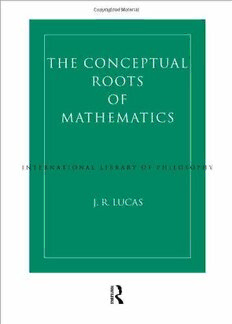
Download Conceptual Roots of Mathematics (International Library of Philosophy) PDF Free - Full Version
Download Conceptual Roots of Mathematics (International Library of Philosophy) by J.R. Lucas in PDF format completely FREE. No registration required, no payment needed. Get instant access to this valuable resource on PDFdrive.to!
About Conceptual Roots of Mathematics (International Library of Philosophy)
The price of this book appalls. Would someone please see to it that it remains in print as an affordable paperback edition? I begin by quoting from Lucas's Introduction: "To start from the absolutely incontestable is to start from nowhere... any actual starting point could be put into question by a skilful sceptic... a metaphor of Descartes metaphor is more appropriate: we should think of mathematics not as a building based on foundations, but as a tree grounded in the soil of our general conceptual structure, and growing both up and down." Thus the title of this book. Lucas, a fine British academic philosopher whose interests have ranged over mathematics, physics, classics, and political philosophy, is the author of a startling and very controversial 1961 article on the interface among philosophy, computer science, and the philosophy of mind: "Minds, Machines, and Godel." This article much influenced "Godel Escher Bach," and Howard DeLong's "Profile of Mathematical Logic." Dale Jacquette agrees with Lucas's thesis; Judson Webb does not. I share Lucas's skepticism re artificial intelligence. I think of Lucas's book as a recent and splendid addition to the saga begun by Russell's "Principles of Mathematics." Russell rightly believed that the philosophy of mathematics is fascinating, but his intellectual ethics left something to be desired. Frege and Brouwer fascinate as well, but are difficult. C S Peirce's contributions to logic and mathematics have only started to receive the detailed treatment they richly deserve, thanks to Geraldine Brady's 2000 book. Contemporary authors (e.g., Chihara, Hellman, Shapiro, Maddy, Crispin wright, Resnick, Detlefsen) are readable, but appreciating what they say requires knowing a lot about what their predecessors wrote. Such are the many pitfalls along the trail Russell blazed circa 100 years ago. Lucas' book is a major exception. Published in the author's 70th year, as he was ending a long and fruitful Oxford career, the book distills a lifetime of teaching and thinking about the philosophy of mathematics. Lucas advocates a chastened logicism, a stance with which I sympathize. But I admire this book not so much for its substantive conclusions but for its sound pedagogy and good humour. Unlike most books of its ilk, it contains diagrams, charts, tables, sidebar summaries, even cartoons, all to good pedagogic effect. Lucas rightly does not assume that every reader of his book is an experienced and polished intellectual. I invite the reader to peruse the "summaries" on pp. 435-41, and to ponder when she last saw something so pithy and useful in a philosophy text. I surmise that Lucas for many years taught undergrads, and these can leave something to be desired, even at Oxford! The references alone (footnotes only, alas no bibliography) make the book worthwhile. The result is a book written not to impress fellow dons, but to instruct the laity knowing some math and logic. Lucas tries hard to take the reader by the hand through Godel's famous results. He does not cite the simplified approach of George Boolos (reprinted in Reuben Hersh's "What Is Mathematics, Really?"). "Conceptual Foundations" was also finished just before David Berlinski published his related gentle treatment of Godel's results. Lucas inevitably slights some topics (e.g., model theory, Intuitionism) to which I would have given more airplay. Suppes's classic 1960 treatment of ZFC set theory is nowhere mentioned. Lucas argues that set theory is primarily transfinite arithmetic, which is not very relevant to mathematical practice; I concur. Indeed, only two infinities matter for nearly all of mathematics, aleph null, and the continuum. Lucas gives a convincing reason, drawn from Latin philology, for renaming the quantifiers as 'quotifiers.' He also proposes the notation 'V' for existential and 'A' for universal quantification. He did not know that, but for a minor detail, this is essentially the notation of Tarski and his Berkeley students! Lucas does discuss in some detail three topics I think insufficiently discussed elsewhere: 1. Godel proved that if Peano arithmetic (PA) is consistent, there are PA sentences that are true but unprovable, and that adding axioms does not alter this result. Hence PA (and all mathematics) is necessarily incomplete (and ipso facto undecidable). Now the only nontrivial PA axiom is a schema permitting induction over the naturals. Robinson showed in 1950 that a fragment of PA, whose axioms are (a) the usual recursive definitions of addition and multiplication, (b) "if x and y have equal successors, then x=y," and (c) "0 is the sole number that is not the successor of a number," is likewise incomplete. This fragment is elsewhere named Q but Lucas calls it "Sorites arithmetic." Q includes no schemata; hence the Godelian incompleteness of PA cannot be blamed on the principle of induction; 2. Lucas devotes a pleasant and discursive chapter to relations, culminating in the rich tree diagram on p. 270, and rightly arguing that transitive relations are central to mathematics. Add symmetry and reflexivity to obtain equivalence relations; these inturn give rise to groups, monoids, and category theory. Replace symmetry with antisymmetry and obtain partial orderings, giving rise to lattices, trees, logics, and mereology. Take reflexivity away and obtain strict orderings, which include the well-ordering beloved of set theorists. Let no one who has not mastered this material call himself an analytic philosopher! 3. Mereotopology, a marriage of geometry, mereology, and topology that began with Whitehead's "The Principles of Natural Knowledge" and "The Concept of Nature," and matured into the systems of Bowman Clarke and Casati & Varzi (1999). While the latter say much more about mereotopology than Lucas does, much of what he writes is novel because based on unpublished writing by David Bostock, his Merton College colleague and fellow classicist, whose ideas on logic and mathematics, like Lucas's, deserve more attention. Until Bostock publishes his own book on the foundations of mathematics, we will have to content ourselves with Lucas's version of Bostock's ideas. I close by quoting one of Lucas's last sentences: "...if these notes help towards informed disagreement, I shall be well content."
Detailed Information
| Author: | J.R. Lucas |
|---|---|
| Publication Year: | 2000 |
| Pages: | 471 |
| Language: | English |
| File Size: | 2.048 |
| Format: | |
| Price: | FREE |
Safe & Secure Download - No registration required
Why Choose PDFdrive for Your Free Conceptual Roots of Mathematics (International Library of Philosophy) Download?
- 100% Free: No hidden fees or subscriptions required for one book every day.
- No Registration: Immediate access is available without creating accounts for one book every day.
- Safe and Secure: Clean downloads without malware or viruses
- Multiple Formats: PDF, MOBI, Mpub,... optimized for all devices
- Educational Resource: Supporting knowledge sharing and learning
Frequently Asked Questions
Is it really free to download Conceptual Roots of Mathematics (International Library of Philosophy) PDF?
Yes, on https://PDFdrive.to you can download Conceptual Roots of Mathematics (International Library of Philosophy) by J.R. Lucas completely free. We don't require any payment, subscription, or registration to access this PDF file. For 3 books every day.
How can I read Conceptual Roots of Mathematics (International Library of Philosophy) on my mobile device?
After downloading Conceptual Roots of Mathematics (International Library of Philosophy) PDF, you can open it with any PDF reader app on your phone or tablet. We recommend using Adobe Acrobat Reader, Apple Books, or Google Play Books for the best reading experience.
Is this the full version of Conceptual Roots of Mathematics (International Library of Philosophy)?
Yes, this is the complete PDF version of Conceptual Roots of Mathematics (International Library of Philosophy) by J.R. Lucas. You will be able to read the entire content as in the printed version without missing any pages.
Is it legal to download Conceptual Roots of Mathematics (International Library of Philosophy) PDF for free?
https://PDFdrive.to provides links to free educational resources available online. We do not store any files on our servers. Please be aware of copyright laws in your country before downloading.
The materials shared are intended for research, educational, and personal use in accordance with fair use principles.

