
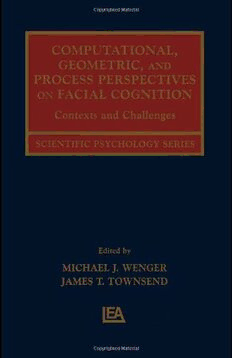
Download Computational, Geometric, and Process Perspectives on Facial Cognition: Contexts and Challenges (Scientific Psychology Series) PDF Free - Full Version
Download Computational, Geometric, and Process Perspectives on Facial Cognition: Contexts and Challenges (Scientific Psychology Series) by Michael J. Wenger, James T. Townsend in PDF format completely FREE. No registration required, no payment needed. Get instant access to this valuable resource on PDFdrive.to!
About Computational, Geometric, and Process Perspectives on Facial Cognition: Contexts and Challenges (Scientific Psychology Series)
Within the last three decades, interest in the psychological experience of human faces has drawn together cognitive science researchers from diverse backgrounds. Computer scientists talk to neural scientists who draw on the work of mathematicians who explicitly influence those conducting behavioral experiments. The chapters in this volume illustrate the breadth of the research on facial perception and memory, with the emphasis being on mathematical and computational approaches. In pulling together these chapters, the editors sought to do much more than illustrate breadth. They endeavored as well to illustrate the synergies and tensions that inevitably result from adopting a broad view, one consistent with the emerging discipline of cognitive science.
Detailed Information
| Author: | Michael J. Wenger, James T. Townsend |
|---|---|
| Publication Year: | 2001 |
| ISBN: | 9781410612328 |
| Pages: | 525 |
| Language: | English |
| File Size: | 31.359 |
| Format: | |
| Price: | FREE |
Safe & Secure Download - No registration required
Why Choose PDFdrive for Your Free Computational, Geometric, and Process Perspectives on Facial Cognition: Contexts and Challenges (Scientific Psychology Series) Download?
- 100% Free: No hidden fees or subscriptions required for one book every day.
- No Registration: Immediate access is available without creating accounts for one book every day.
- Safe and Secure: Clean downloads without malware or viruses
- Multiple Formats: PDF, MOBI, Mpub,... optimized for all devices
- Educational Resource: Supporting knowledge sharing and learning
Frequently Asked Questions
Is it really free to download Computational, Geometric, and Process Perspectives on Facial Cognition: Contexts and Challenges (Scientific Psychology Series) PDF?
Yes, on https://PDFdrive.to you can download Computational, Geometric, and Process Perspectives on Facial Cognition: Contexts and Challenges (Scientific Psychology Series) by Michael J. Wenger, James T. Townsend completely free. We don't require any payment, subscription, or registration to access this PDF file. For 3 books every day.
How can I read Computational, Geometric, and Process Perspectives on Facial Cognition: Contexts and Challenges (Scientific Psychology Series) on my mobile device?
After downloading Computational, Geometric, and Process Perspectives on Facial Cognition: Contexts and Challenges (Scientific Psychology Series) PDF, you can open it with any PDF reader app on your phone or tablet. We recommend using Adobe Acrobat Reader, Apple Books, or Google Play Books for the best reading experience.
Is this the full version of Computational, Geometric, and Process Perspectives on Facial Cognition: Contexts and Challenges (Scientific Psychology Series)?
Yes, this is the complete PDF version of Computational, Geometric, and Process Perspectives on Facial Cognition: Contexts and Challenges (Scientific Psychology Series) by Michael J. Wenger, James T. Townsend. You will be able to read the entire content as in the printed version without missing any pages.
Is it legal to download Computational, Geometric, and Process Perspectives on Facial Cognition: Contexts and Challenges (Scientific Psychology Series) PDF for free?
https://PDFdrive.to provides links to free educational resources available online. We do not store any files on our servers. Please be aware of copyright laws in your country before downloading.
The materials shared are intended for research, educational, and personal use in accordance with fair use principles.

