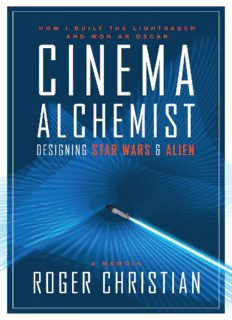
Table Of ContentCinema Alchemist
ISBN 9781783299003
eBook ISBN 9781785650857
Published by
Titan Books
A division of Titan Publishing Group Ltd.
144 Southwark Street
London
SE1 0UP
United Kingdom
First edition: October 2015
10 9 8 7 6 5 4 3 2 1
TM & © Roger Christian
Did you enjoy this book? We love to hear from our readers. Please e-mail us at:
[email protected] or write to Reader Feedback at the above address.
To receive advance information, news, competitions, and exclusive offers online, please sign up for the
Titan newsletter on our website: www.titanbooks.com
No part of this publication may be reproduced, stored in a retrieval system, or transmitted, in any form or by
any means without the prior written permission of the publisher, nor be otherwise circulated in any form of
binding or cover other than that in which it is published and without a similar condition being imposed on
the subsequent purchaser.
A CIP catalogue record for this title is available from the British Library.
CONTENTS
COVER
TITLE PAGE
COPYRIGHT
FOREWORD BY J.W. RINZLER
AUTHOR’S NOTE
PREFACE
CINEMA ALCHEMY
Lucky Lady—the road to Star Wars
Star Wars: how it all began
STAR WARS
Once Upon A Time In The West
Djerba
Tozeur
Final day’s prep for Tunisia
Star Wars first day shoot looms
Star Wars becomes a movie
British attitude at the time Star Wars was made
Twin suns—a hero’s journey moment
Problems mount for George
Star Wars summation
Marty Feldman’s Beau Geste and the Sex Pistols
MONTY PYTHON
ALIEN
Standby art director
Dan O’Bannon
Nick Allder and Brian Johnson; SFX
Nostromo bridge set
The crew fire up the Nostromo
Tension on the set
Ridley punches through the bridge ceiling
Jones the cat in the locker
Crew quarters
Nostromo commissary
Mother
BACK TO LIFE OF BRIAN
Back to film school
BLACK ANGEL
The script
Where do stories originate?
The true origin of my story
The script evolves
Vangelis
Giant heavy horses
Black Angel: Day 8
STAR WARS; RETURN OF THE JEDI
FINAL WORDS
Star Wars
Alien
Black Angel
ACKNOWLEDGMENTS
FOREWORD
BY JON RINZLER
I once came across an iconic photograph. At first I didn’t know the five people
in it, but there was an aura about the group. Sometimes an energy is present
when a photo is taken that can make itself felt many years later, even a century
beyond its time. In this case it was about thirty years later and the group soon
revealed itself to be the English art department core of the first Star Wars film:
production designer John Barry, art directors Norman Reynolds and Les Dilley,
construction supervisor Bill Welch—and one long-haired, twenty-something
who looked like he might be a visiting rock star: Roger Christian, set dresser and
provocateur.
It was Roger, in league with John Barry, who hit upon the idea of a used
universe.
This would be the ingenious answer to multiple questions, such as how on
earth could they build the visionary worlds George Lucas had dreamt up given
their inadequate budget? And how would they differentiate Star Wars from its
low-rent trashy sci-fi cousins? (2001 excepted, but that was an art film.)
Just before principal photography was to begin, almost on cue, Twentieth
Century-Fox, the very reluctant studio backer of the first film, had,
devastatingly, slashed the budget from $8.2 to $7.5 million, ten percent of which
reduction came directly out of the art department’s coffers. Christian’s work-
around brainstorm, based on years of experience under several brainy mentors,
was to source a cheap supply of odd materials, consisting of pre-fabricated
realistic shapes, forms, and ideas; that is, junk. Lots and lots of junk: airplane
junk, washing machine junk, plumbing junk. He would also sell Lucas on the
idea of real, but enhanced, weapons to stand in for the script’s blasters and
lightsabers.
I’ve written about some of this in The Making of Star Wars; it was while
doing research for that book that I found said photo, in an old binder. That book
was the best job I could do as an outsider, decades after the fact (though relying
on contemporary interviews). So when Roger told me he was writing his own
memoirs, and as I came to appreciate his phenomenal memory for both details
and the big picture, I was very excited. His account would be—and now is—the
story of someone who was right there: meeting with George in Mexico early in
preproduction; standing with him as the studio dithered, and, while prepping the
sets, watching Lucas’s back in Tunisia and at Elstree Studios. His account of the
uphill battles and challenges of the shoot are unrivaled.
Lucas rewarded Christian’s ingenuity and loyalty with matched loyalty,
helping him become a director, in turn, by backing his live-action short Black
Angel. Roger returned the favor, jumping in when needed as second-unit director
on Return of the Jedi and The Phantom Menace. In conversation Lucas would
refer to Christian, Barry, and a few others as those who had saved his quirky
little space fantasy, which no one ever dreamed would become the phenomenon
it is today (though they did think that it would be successful).
And Roger’s is more than a book about Star Wars. It is unlike any other film
book that I’ve come across in that it presents, unvarnished, the raw emotional
world of the craftspeople and artists, the producers and actors, who toil in often
impossible conditions under great duress—long hours, life-threatening sickness,
and internal foes—because they so love what they are doing.
This is never more evident than in Roger’s further adventures during the
making of the classic films Alien and Monty Python’s Life of Brian. His account
of low-budget independent filmmaking, as he cobbled together talent and
resources to make Black Angel, should be required reading for film students
(and, by the way, The Sender, Christian’s 1982 horror film, is original and scary
—and one of Quentin Tarantino’s favorites). The vicissitudes he colorfully
describes feel real; his portraits of his contemporaries are insightful and
compassionate (although a few receive naught but righteous wrath); and his
descriptions of London life during one of its creative peaks, during the 1960s,
70s, and early 80s, is a lot of fun, as he rubs shoulders with the Rolling Stones
and other luminaries.
So if you want to find out how a wily artist matched wits with the likes of
George Lucas, Ridley Scott and the Monty Python team, how integral art
departments functioned during a British heyday of film creation on the first Star
Wars and Alien, how an Academy-Award winning director crafted an enigmatic
tale from nothing, and how death was defied in devotional service to the silver
screen, then, by all means, read on…
J. W. Rinzler
AUTHOR’S NOTE
When I was having my first interview for a job in the film industry as tea boy to
the art department on Oliver!, production designer John Box gave me this
advice: “You are alone in the desert, standing next to a silver airplane with a
bottle of green ink in your pocket. A cloud of dust approaches nearer and nearer
as the director and producer arrive. The director looks at the plane and says
‘Great, this will work, can you have it red by tomorrow morning?’
You either do it or talk your way out of it there and then. That’s the film
industry.”
These wise words have served as my mantra throughout a long career and in
no small way came to full force when I was asked to set decorate Star Wars on a
budget that most people would have said, no; it cannot be done.
PREFACE
The title for this book came from my coming up with the idea to make all the
interiors of the sets and props on Star Wars from scrap metal and old airplane
parts, and being rewarded with an Academy Award for it. I signed on to set-
decorate Star Wars in August of 1975 having met George Lucas in Mexico
earlier that year while working on Lucky Lady. Being asked to come up with
props, guns and robots, new inventions in George’s script like a lightsaber,
Luke’s speeder and a diminutive robot called R2-D2 and the golden C-3PO took
a huge leap of faith and confidence. The initial budget at that time was four
million dollars and my set-dressing budget a tiny two hundred thousand.
Even at those times this was hardly enough for John Barry, Les Dilley and I to
create this world imagined and beautifully illustrated in Ralph McQuarrie’s
paintings. My first conversation with George Lucas in Mexico revolved around a
common language, that science-fiction films had portrayed unrealistic sets and
props that were all new and plastic-looking. We had a common goal—to make a
spaceship that looked oily and greasy, and held together like a very used second-
hand car. Thus the Millennium Falcon, looking like a cross between an old
submarine and a used spaceship, came about, a philosophy extending to every
detail, including the props and guns and all dressing.
My path to making Star Wars and my experiences made it possible to reach
far outside the conventional way I was brought up, and prepared me to go out on
a limb and suggest to George Lucas new ways to dress the sets, like buying old
airplane scrap and breaking it down and using it to create the Falcon’s interiors.
My pet peeve was sci-fi guns that looked and sounded like toys, so I suggested
using real guns and adapting their look for Star Wars. My luck was having a
director who was an independent filmmaker who, having made a very low
budget science-fiction film, THX 1138, did not flinch when I presented untried
solutions to the then insurmountable problem of making all the dressings and
props.
Alien was exactly the same and under director Ridley Scott I was able to take
further my ambition to make a spaceship that looked like we had rented an old
and used space truck.
Description:Christian, an Oscar-winning set decorator and director, tells the story of his breakthrough work on some iconic science fiction masterpieces of the 1970s. In doing so he delves into his relationships with legendary cinematic figures, and reveals many of the secrets of his work-- Abstract: For the fi