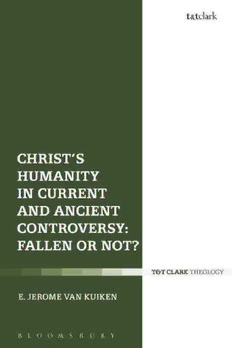
Table Of ContentChrist’s Humanity in Current
and Ancient Controversy:
Fallen or Not?
Christ’s Humanity in Current
and Ancient Controversy:
Fallen or Not?
E. Jerome Van Kuiken
Bloomsbury T&T Clark
An imprint of Bloomsbury Publishing Plc
LONDON • OXFORD • NEW YORK • NEW DELHI • SYDNEY
Bloomsbury T&T Clark
An imprint of Bloomsbury Publishing Plc
Imprint previously known as T&T Clark
50 Bedford Square 1385 Broadway
London New York
WC1B 3DP NY 10018
UK USA
www.bloomsbury.com
BLOOMSBURY, T&T CLARK and the Diana logo are trademarks
of Bloomsbury Publishing Plc
First published 2017
© E. Jerome Van Kuiken, 2017
E. Jerome Van Kuiken has asserted his right under the Copyright, Designs and
Patents Act, 1988, to be identified as Author of this work.
All rights reserved. No part of this publication may be reproduced or
transmitted in any form or by any means, electronic or mechanical,
including photocopying, recording, or any information storage or retrieval
system, without prior permission in writing from the publishers.
No responsibility for loss caused to any individual or organization acting
on or refraining from action as a result of the material in this publication
can be accepted by Bloomsbury or the author.
British Library Cataloguing-in-Publication Data
A catalogue record for this book is available from the British Library.
ISBN: HB: 978-0-5676-7555-2
ePDF: 978-0-5676-7557-6
ePub: 978-0-5676-7556-9
Library of Congress Cataloging-in-Publication Data
A catalog record for this book is available from the Library of Congress.
Typeset by Deanta Global Publishing Services, Chennai, India
Contents
Abbreviations ix
Acknowledgements xii
Introduction: The Falling Out Over Fallenness 1
0.1 Rationale, structure, and subjects of this study 2
0.2 Scholarly antecedents and contributions of this study 3
0.3 Overview of this study 8
0.4 Historical setting of the current debate 9
1 The Rise and Progress of the Fallenness View among Select
Modern Theologians 13
1.1 Heather and ‘heresy’: Edward Irving 13
1.1.1 Irving on Christ’s fallen flesh: Distinctions
and definitions 14
1.1.2 Irving’s support for his doctrine 19
1.2 Revolutionizing Christology: Karl Barth 21
1.2.1 Tradition, scripture, and theological reasoning 22
1.2.2 Sinful flesh and salvation 23
1.2.3 The ontology of the incarnation 27
1.2.4 A glance backward and forward 30
1.3 Theologian of mediation: Thomas F. Torrance 31
1.3.1 Torrance’s early Christology 32
1.3.2 Christology after Auburn 36
1.3.3 Appeal to scripture 40
1.3.4 Critical retrieval of tradition 41
1.4 The world, the flesh, and the Spirit: Colin Gunton 43
1.4.1 A fallen network 44
1.4.2 Flesh and Spirit 47
1.4.3 Renewing the world 49
1.4.4 A second glance backward and forward 49
vi Contents
1.5 Broadening consensus: Thomas Weinandy 49
1.5.1 Conceiving sinful flesh aright 50
1.5.2 The testimony of the New Testament 51
1.5.3 The testimony of tradition 53
1.5.4 Weinandy’s contributions 55
Conclusion 55
2 The Defence of the Unfallenness View among Select
Modern Theologians 59
2.1 Exposing Irving’s errings: Marcus Dods 59
2.1.1 Dods’s doctrinal logic 60
2.1.2 Dods’s scriptural support 62
2.1.3 Dods’s patristic support 63
2.2 Descent and development: A. B. Bruce 65
2.2.1 Bruce’s agenda and axioms 65
2.2.2 Christ’s humiliation in historical theology 66
2.2.3 Christ’s unfallen mortality, temptations, and infirmities 68
2.2.4 Bruce’s evolving explanation of flesh and sin 70
2.3 Catalyst for fallenness: H. R. Mackintosh 72
2.3.1 The Doctrine of the Person of Jesus Christ 73
2.3.2 The Christian Experience of Forgiveness 77
2.3.3 Types of Modern Theology 78
2.3.4 Taking stock of transition 79
2.4 The importance of image: Philip E. Hughes 80
2.4.1 Humanity made and marred in God’s image 81
2.4.2 Humanity restored by God’s image 82
2.4.3 Patristic and biblical support 83
2.5 Fallacious fallenness: Donald Macleod 84
2.5.1 Issues of interpretation 85
2.5.2 Faults in reasoning 86
Conclusion 89
3 The Greek Fathers on the Fallenness or Unfallenness
of Christ’s Humanity 91
3.1 Theology’s Trailblazer: Irenaeus 92
3.1.1 Creation and Fall in the divine economy 93
3.1.2 Salvation through recapitulation 95
Contents vii
3.1.3 Christ’s flesh and the Fall 96
3.1.4 Christ’s flesh and death 102
3.2 Defending the incarnate God: Athanasius 104
3.2.1 The Word and his flesh 105
3.2.2 Pseudo(?)-Athanasian writings 108
3.3 ‘The unassumed is the unhealed’: Gregory Nazianzen 112
3.3.1 The mind of Christ 113
3.3.2 The epithets of Christ 114
3.4 Imagining incarnation: Gregory Nyssen 117
3.4.1 Srawley’s thesis 118
3.4.2 A response to Srawley 119
3.5 ‘Seal of the Fathers’: Cyril of Alexandria 122
3.5.1 Christ’s ‘fallen body’ 123
3.5.2 Christ’s life-giving flesh 123
Conclusion 126
4 The Latin Fathers on the Fallenness or Unfallenness of
Christ’s Humanity 129
4.1 Pioneer in the West: Tertullian 129
4.1.1 Tertullian’s anthropology 130
4.1.2 Christ’s relation to sin and death 132
4.2 The passionlessness of the Christ: Hilary of Poitiers 134
4.2.1 Defence of Christ’s human impassibility 135
4.2.2 Pauline exegesis 137
4.3 The passions of the Christ: Ambrose 138
4.3.1 Incarnation as identification with our injured state 138
4.3.2 Incarnation as rectification of our fleshly state 141
4.4 Settler of the West’s opinion: Augustine 142
4.4.1 Humanity: Perfection, defection, infection 142
4.4.2 Christ: Originally sinless, actually sinless,
vicariously sinful 145
4.5 Chalcedon and context: Leo the Great 148
4.5.1 The Christmas sermons 149
4.5.2 The Paschal sermons 149
4.5.3 From the First to the Second Tome 151
Conclusion 153
viii Contents
5 The Fleshing Out of the Findings 155
5.1 Righting history: The modern debaters on the fathers 155
5.1.1 Edward Irving 156
5.1.2 Karl Barth 158
5.1.3 T. F. Torrance and Colin Gunton 159
5.1.4 Thomas Weinandy 160
5.1.5 The unfallenness theologians 161
5.1.6 Summary of findings concerning historical claims 162
5.2 Righting theology: Taxonomy 163
5.2.1 Sykes’ taxonomy 163
5.2.2 Hastings’ taxonomy 164
5.2.3 A Sykes-Hastings taxonomy 165
5.3 Righting theology: Terminology 167
5.3.1 ‘Assumed’ 167
5.3.2 ‘Unfallen’ 168
5.3.3 ‘Fallen’ 170
5.3.4 ‘Sinful’ 172
5.3.5 ‘Sinless’ 173
5.3.6 A case study as a summary 174
5.4 Further implications 175
5.4.1 Mariology 175
5.4.2 Hamartiology 176
5.4.3 Sanctification 178
5.4.4 Bibliology 181
5.5 A final word 182
Appendix: Edward Irving’s Patristic Sources 183
Bibliography 189
Index 216
Abbreviations
Agon. De agone christiano
AMOECT Adv. Marcionem (Oxford Early Christian Texts)
An. De anima
ANF The Ante-Nicene Fathers
Antirrh. adv. Apol. Antirrheticus adversus Apolinarium
CD Church Dogmatics
C. Apoll. Contra Apollinarem
C. Ar. Contra Arianos
C. Eunom. Contra Eunomium by Nyssen
C. Gent. Contra gentes
C. Jul. Contra Julianum
C. Jul. op. imp. Contra secundam Juliani responsionem imperfectum opus
Carn. Chr. De carne Christi
Coll. Max. Collatio cum Maximino Arianorum
CW The Collected Works of Edward Irving
Dial. Dialogus cum Tryphone
DSCHT Dictionary of Scottish Church History & Theology
Enchir. Enchiridion
Ep. Epistula
Ep. Adelph. Epistula ad Adelphium
Ep. Epict. Epistula ad Epictetum
Ep. Eust. Epistula ad Eustathiam
Ep. Max. Epistula ad Maximum
Ep. Serap. Epistula ad Serapionem
Ep. Theoph. Epistula ad Theophilum