
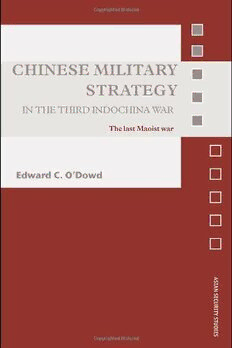
Download Chinese Military Strategy in the Third Indochina War: The Last Maoist War (Asian Security Studies) PDF Free - Full Version
Download Chinese Military Strategy in the Third Indochina War: The Last Maoist War (Asian Security Studies) by Edward O'dowd in PDF format completely FREE. No registration required, no payment needed. Get instant access to this valuable resource on PDFdrive.to!
About Chinese Military Strategy in the Third Indochina War: The Last Maoist War (Asian Security Studies)
This well-researched volume examines the Sino-Vietnamese hostilities of the late 1970s and 1980s, attempting to understand them as strategic, operational and tactical events. The Sino-Vietnamese War was the third Indochina war, and contemporary Southeast Asia cannot be properly understood unless we acknowledge that the Vietnamese fought three, not two, wars to establish their current role in the region. The war was not about the Sino-Vietnamese border, as frequently claimed, but about China’s support for its Cambodian ally, the Khmer Rouge, and the book addresses US and ASEAN involvement in the effort to support the regime. Although the Chinese completed their troop withdrawal in March 1979, they retained their strategic goal of driving Vietnam out of Cambodia at least until 1988, but it was evident by 1984-85 that the PLA, held back by the drag of its ‘Maoist’ organization, doctrine, equipment, and personnel, was not an effective instrument of coercion. Chinese Military Strategy in the Third Indochina War will be of great interest to all students of the Third Indochina War, Asian political history, Chinese security and strategic studies in general.
Detailed Information
| Author: | Edward O'dowd |
|---|---|
| Publication Year: | 2007 |
| ISBN: | 9780203088968 |
| Pages: | 257 |
| Language: | English |
| File Size: | 1.965 |
| Format: | |
| Price: | FREE |
Safe & Secure Download - No registration required
Why Choose PDFdrive for Your Free Chinese Military Strategy in the Third Indochina War: The Last Maoist War (Asian Security Studies) Download?
- 100% Free: No hidden fees or subscriptions required for one book every day.
- No Registration: Immediate access is available without creating accounts for one book every day.
- Safe and Secure: Clean downloads without malware or viruses
- Multiple Formats: PDF, MOBI, Mpub,... optimized for all devices
- Educational Resource: Supporting knowledge sharing and learning
Frequently Asked Questions
Is it really free to download Chinese Military Strategy in the Third Indochina War: The Last Maoist War (Asian Security Studies) PDF?
Yes, on https://PDFdrive.to you can download Chinese Military Strategy in the Third Indochina War: The Last Maoist War (Asian Security Studies) by Edward O'dowd completely free. We don't require any payment, subscription, or registration to access this PDF file. For 3 books every day.
How can I read Chinese Military Strategy in the Third Indochina War: The Last Maoist War (Asian Security Studies) on my mobile device?
After downloading Chinese Military Strategy in the Third Indochina War: The Last Maoist War (Asian Security Studies) PDF, you can open it with any PDF reader app on your phone or tablet. We recommend using Adobe Acrobat Reader, Apple Books, or Google Play Books for the best reading experience.
Is this the full version of Chinese Military Strategy in the Third Indochina War: The Last Maoist War (Asian Security Studies)?
Yes, this is the complete PDF version of Chinese Military Strategy in the Third Indochina War: The Last Maoist War (Asian Security Studies) by Edward O'dowd. You will be able to read the entire content as in the printed version without missing any pages.
Is it legal to download Chinese Military Strategy in the Third Indochina War: The Last Maoist War (Asian Security Studies) PDF for free?
https://PDFdrive.to provides links to free educational resources available online. We do not store any files on our servers. Please be aware of copyright laws in your country before downloading.
The materials shared are intended for research, educational, and personal use in accordance with fair use principles.

