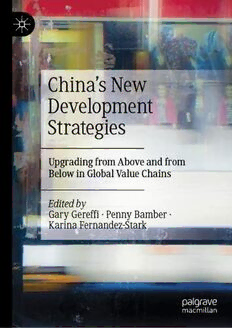
Table Of ContentChina’s New
Development
Strategies
Upgrading from Above and from
Below in Global Value Chains
Edited by
Gary Gereffi · Penny Bamber ·
Karina Fernandez-Stark
China’s New Development Strategies
· ·
Gary Gereffi Penny Bamber
Karina Fernandez-Stark
Editors
China’s New
Development
Strategies
Upgrading from Above and from Below in Global
Value Chains
Editors
Gary Gereffi Penny Bamber
Department of Sociology Duke Global Value Chain Center
Duke University Durham, NC, USA
Durham, NC, USA
Karina Fernandez-Stark
Duke Global Value Chain Center
Durham, NC, USA
ISBN 978-981-19-3007-2 ISBN 978-981-19-3008-9 (eBook)
https://doi.org/10.1007/978-981-19-3008-9
© The Editor(s) (if applicable) and The Author(s), under exclusive license to Springer
Nature Singapore Pte Ltd. 2022
This work is subject to copyright. All rights are solely and exclusively licensed by the
Publisher,whetherthewholeorpartofthematerialisconcerned,specificallytherightsof
reprinting,reuseofillustrations,recitation,broadcasting,reproductiononmicrofilmsorin
any other physical way, and transmission or information storage and retrieval, electronic
adaptation, computer software, or by similar or dissimilar methodology now known or
hereafter developed.
The use of general descriptive names, registered names, trademarks, service marks, etc.
in this publication does not imply, even in the absence of a specific statement, that such
namesareexemptfromtherelevantprotectivelawsandregulationsandthereforefreefor
general use.
Thepublisher,theauthors,andtheeditorsaresafetoassumethattheadviceandinforma-
tion in this book are believed to be true and accurate at the date of publication. Neither
the publisher nor the authors or the editors give a warranty, expressed or implied, with
respecttothematerialcontainedhereinorforanyerrorsoromissionsthatmayhavebeen
made.Thepublisherremainsneutralwithregardtojurisdictionalclaimsinpublishedmaps
and institutional affiliations.
Cover credit: Alex Linch/shutterstock.com
This Palgrave Macmillan imprint is published by the registered company Springer Nature
Singapore Pte Ltd.
Theregisteredcompanyaddressis:152BeachRoad,#21-01/04GatewayEast,Singapore
189721, Singapore
Contents
China’s Evolving Role in Global Value Chains: Upgrading
Strategies in an Era of Disruptions and Resilience 1
Gary Gereffi, Penny Bamber, and Karina Fernandez-Stark
Digital Technologies and China’s New Development
Strategies
China’sIndustrialInternet:Platform-BasedManufacturing
and Restructuring of Value Chains 33
Boy Lüthje
Alibaba’s Distribution-Centered Approach Towards
the Industrial Internet: A Chinese Version of Industry 4.0? 61
Lea Schneidemesser and Florian Butollo
Subjective Social Upgrading and Downgrading
of Technical Workers in China’s High-Tech Economy:
A Company Case Study 85
Xia Yan
Active Local Governments and Firm Upgrading in China
Active Local Governments and New Chinese Firms
in Emerging Industries in Kunshan and Dongguan 113
Xun Zhang, Gary Gereffi, and Cassandra C. Wang
v
vi CONTENTS
Whither Global Value Chains: The Shifting Role
of Taiwanese FDI in Mainland China 141
Michael Murphree
Industrial Upgrading from Below: Can Chinese Local
Manufacturing Firms Reconfigure Global Value Chains? 167
Wei Zhao
Upgrading of Chinese Domestic Firms in Advanced
Manufacturing: Evidence from Industrial Robots
and High-Tech Medical Devices 195
Jing Zhao and Gary Gereffi
China’s Shifting Role in Regional and Global Value Chains
China’s Shifting Roles in Asian Electronics Trade
Networks: Implications for Regional Value Chains 237
Joonkoo Lee
The Reconfiguration of Global Value Chains in the Digital
Economy: Recent Trends and China’s New Agenda 267
Ying Qiu
Notes on Contributors
BamberPenny isaglobalvaluechainspecialist,withmorethanadecade
of experience working at the Duke Global Value Chains Center. She has
contributed significantly to the development of the global value chain
framework, particularly with respect to the intersection between interna-
tional business and country-level development policy. She has published
extensively, contributing to numerous books, reports, and journal arti-
cles on economic growth and development, technology and skills for
the future, and the role of gender among others. Penny has consulted
and provided policy analysis widely for national and international orga-
nizations, including the World Bank, the Organization for Economic
Cooperation, UNCTAD, ILO, the African Development Bank, and the
Inter-American Development Bank.
Dr. Butollo Florian is head of the research group “Working in highly-
automated digital-hybrid processes” at the Weizenbaum Institute for the
NetworkedSocietyandleaderoftheresearchproject“IndustrialInternet
Platforms, Restructuring of Production Networks, and Work in China
andGermany”bothatBerlinSocialScienceCenter.Hisresearchinterests
are digitalization and work, work in global production networks, and the
transformation of work in China.
Fernandez-Stark Karina is an international consultant and a Duke
Global Value Chains Center affiliate, who has led numerous research
projects related to economic development and competitiveness around
vii
viii NOTESONCONTRIBUTORS
theworld.ShehasconsultedfortheAfricanDevelopmentBank,ECLAC,
Inter-American Development Bank, OECD, UNCTAD, and the World
Bank, among others. Together with Gary Gereffi, Karina authored the
highly cited book Global Value Chain Analysis: A Primer. She has
published several research reports and articles on industrial upgrading
and social and economic development. Her research continuously brings
a policy focus on advising country governments on different continents.
KarinahasconductedGlobalValueChainsworkshopsinAfrica,Asia,and
the Americas.
Gereffi Gary is Emeritus Professor at Duke University in Durham, NC,
and Founding Director of the Duke Global Value Chains Center. He is
one of the originators of the global value chains framework, and he has
published over a dozen books and numerous articles on globalization,
industrialupgrading,anddevelopmentstrategiesinvariousregionsofthe
world. Recent books include Handbook on Global Value Chains (Stefano
Ponte, Gary Gereffi, and Gale Raj-Reichert, co-editors) (Edward Elgar
Publishing, 2019); Global Value Chains and Development: Redefining the
Contoursof21stCenturyCapitalism (CambridgeUniversityPress,2018);
and Global Value Chains in a Postcrisis World: A Development Perspective
(Olivier Cattaneo, Gary Gereffi, and Cornelia Staritz, co-editors) (The
World Bank, 2010).
Lee Joonkoo is Associate Professor of Organization Studies, School of
Business at Hanyang University in Seoul, Republic of Korea. Prior to
joining Hanyang, he was a Postdoctoral Research Scholar at the Social
Science Research Institute at Duke University from 2011 to 2012. He
was a visiting research fellow at Seoul National University Asia Center
from 2014 to 2015. His main areas of research include globalization and
development, specifically global and regional value chains, value chain
governance, and economic and social upgrading in apparel, electronics,
andcultural/creativeindustries,focusingonAsia.Heco-authoredabook
titled Mobile Asia Capitalisms, Value Chains and Mobile Telecommuni-
cation in Asia (Seoul National University Press, 2018). His work has
appeared in Proceedings of the National Academy of Sciences of the United
States of America, Journal of Business Ethics, Industrial and Corporate
Change, and International Labour Review among others.
Prof. Lüthje Boy is Director of the Technology and Industry Research
Center at the Institute of Public Policy (IPP) at South China University
NOTESONCONTRIBUTORS ix
of Technology in Guangzhou. He held the Volkswagen Endowed Chair
Industrial Relations and Social Development at Sun Yat-sen University
School of Government from 2015 to 2019. Lüthje is a noted expert
on global production networks and the digitalization of manufacturing
in the electronics, automotive, and other manufacturing industries. He
is the author of numerous papers and books on these topics as well as
on industrial relations in China. He received his Ph.D. from the Univer-
sity of Frankfurt in Germany in 1991, where he became an assistant
professor. Since 1999, he has worked as a senior research fellow at the
Frankfurt Institute for Social Research. He held appointments as visiting
scholar at the University of California Berkeley, the East-West Center,
Honolulu, Hawaii, Renmin University of China in Beijing, the Global
Labor University and others.
Murphree Michael is Assistant Professor of International Business in the
Darla Moore School of Business at the University of South Carolina.
He earned his Ph.D. in Science Technology and International Affairs
at the Georgia Institute of Technology in 2014. Professor Murphree’s
primary research interests include global value chains, industrialization,
andeconomicupgrading,innovationinemergingeconomies,technology
standards,andintellectualpropertyrights.HespeaksfluentMandarinand
has conducted field research in the Greater China Region since 2007.
His China-based research has been widely published and his 2011 book
(co-authored with Dan Breznitz), The Run of the Red Queen: Govern-
ment, Innovation, Globalization, and Economic Growth in China, was
the winner of the 2012 British International Studies Association Susan
Strange Best Book Award and bronze medalist for the 2012 Axiom
Business Book Award for International Business/Globalization.
Schneidemesser Lea is a research fellow at the Weizenbaum Institute for
the Networked Society where she is part of the research project “Indus-
trialInternetPlatforms,RestructuringofProductionNetworks,andWork
in China and Germany” and at the Max Weber Center at Erfurt Univer-
sity where she researches Chinese outbound foreign direct investment
(OFDI) in Germany and the European Union (EU). Her research inter-
estsarethedigitalizationandapplicationofplatformsinindustrialsectors,
workinglobalproductionnetworks,andChineseOFDIinGermanyand
the EU.
x NOTESONCONTRIBUTORS
Dr. Wang Cassandra C. is Professor in the School of Earth Sciences,
ZhejiangUniversity.Herresearchinterestsincludetransboundaryknowl-
edge/technology spillovers and firm innovation, industrial and regional
development, e-commerce adoption, and rural development, etc. Her
work widely appears in the peer-reviewed international journals such as
Journal of Economic Geography, Economic Geography, Journal of Rural
Studies, International Business Review, Environment and Planning A,
Urban Studies, among many others.
Yan Xia is a postdoctoral fellow at the School of Sociology and Anthro-
pology of Sun Yat-sen University. She gained her Ph.D. from the
University of Hong Kong. Her research interests include the gover-
nance of R&D in China’s high-tech industry, the work and social
mobilityofhigh-skilledknowledgeworkers,andChinesegovernanceand
consumption.
Qiu Ying is Associate Professor and Associate Dean of the School of
Economics, Jiangxi University of Finance and Economics. She is also a
postdoctoral fellow at the Research Institute for Global Value Chains,
University of International Business and Economics. Her main research
areas are the digital economy and global value chains. She has published
widely both within China and abroad. She has led and participated in
multiple national, provincial, and ministerial-level research projects in
China, including for the National Natural Science Foundation of China.
She is the recipient of several prestigious awards, including the Chinese
Enterprises’ Reform and Development Achievement Award. She holds
leadership positions in a number of local government and academic asso-
ciations, including the Deputy Secretary-General of China Digital Trade
30 Forum.
Zhang Xun is currently a researcher at a non-governmental organization
(NGO) in China. He was previously a fellow at Teach for China from
2020 to 2022 and earned his master’s degree in public policy from Duke
University in 2020. His research interests include global value chains and
international development.
Zhao Jing is an Associate Professor in the Research Institute for Global
Value Chains at the University of International Business and Economics
(UIBE) in Beijing. She received her Ph.D. degree from Tsinghua
University. She was a visiting scholar at UC Berkeley and the Organi-
sation for Economic Co-operation and Development (OECD) in Paris.