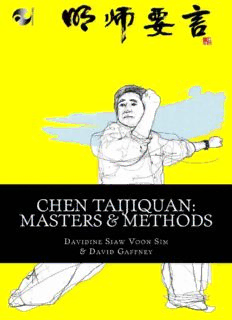
Table Of ContentChen Taijiquan:
Masters and Methods
DAVIDINE SIAW-VOON SIM
& DAVID GAFFNEY
Copyright © 2018 Davidine Siaw-Voon Sim & David Gaffney
All rights reserved.
ISBN: 1720938288
ISBN-13: 978-1720938286
FOR OUR PARENTS
CONTENTS
Acknowledgments
Foreword
Introduction
1. Chen Xiaoxing – Your Biggest Opponent is Yourself
2. wang Xian – The Triple Principles of Chen Taijiquan
3. Feng Zhiqiang - Practical ways To Develop Internal Skill
4. Chen Xiaowang – The True Nature of Taijiquan
5. Chen Zhenglei – Understanding Taijiquan
6. C hen Yu – The Importance of Total Body Integration
7. Zhu Tiancai - In Pursuit of Harmony
8. Yu Gongbao – Cultural Elements of Taijiquan
Appendix
Artist Bios
Acknowledgments
We would like to thank the individuals featured in this book. Combined, they
represent a remarkable repository of knowledge of which a work like this can
only hope to scratch the surface. Their generosity in sharing hard-earned insights
made it possible to write Chen Taijiquan: Master and Methods . It is important
to record their understanding of the true nature of Chen Taijiquan, all of them
having had a foot in an earlier time, before Taijiquan became a discipline for
mass participation, and before teachers of the art became celebrities. This project
has been ongoing for several decades and with an increasing sense of urgency as
time gallops by. Sadly Master Feng Zhiqiang has now passed away and several
of the others have experienced health issues highlighting the importance of
documenting their unique and shared understanding of Chen Taijiquan. Several
of the masters articulated their desire to point out the correct way to train, so
those coming after them can avoid errors they have made and deviations taken in
their own journeys. Even with clear instructions, it is still the responsibility of
learners to put in the necessary effort, transferring knowledge to practice and
realising skill from intellectual understanding.
As far as possible we have recorded the words of the masters. There are certain
areas of overlap and also much new material. For all their cooperation,
encouragement and time, and for the inspiring calligraphy, a deep bow! Finally,
a big thank you to all the talented artists who provided the illustrations.
Foreword
“Honing gives a sharp edge to a sword; bitter cold adds keen fragrance to
the plum blossom s”.
This verse best describes the Taijiquan journey of Davidine Siaw-Voon Sim and
David Gaffney these twenty plus years. In their search for authentic traditional
Taijiquan, they came to Chenjiagou for the first time in the summer of 1997. In
the ensuing years they continued to commit to arduous study and rigorous
practice, coming to Chenjiagou every year, and have come to regard Chenjiagou,
the birthplace of Taijiquan, as their second home. Resident in the UK, they have
made it their mission to propagate Chinese culture and transmit Chen Taijiquan.
Through their books, articles and blogs they have played a significant role in the
transmission and spread of Chen Taijiquan.
Chen Xiaoxing
June 25 th 2018
Honing gives a sharp edge to a sword; bitter cold adds keen fragrance to the
plum blossom s.
Calligraphy by Du Min
Introduction
The origin of Chinese martial arts is antiquated, its traditional systems having
undergone many centuries of evolution and refinement. For their continued
survival, the most important factor is the uninterrupted transmission of skill,
knowledge and practice methods from master to disciple: Masters having
grasped the essence of their respective art through years of apprenticeship and
long study and practice; Disciples, receiving the baton and following on in the
same manner to ensure the continuity and endurance of the art. The more
standard and complete the transmission the greater the likelihood of its
continued existence. Historically it was acknowledged that “failing to honour
your master is to invoke the wrath of heaven and earth; misleading your students
is to be worse than thieves and whores”! The words may seem harsh but they
illustrate the importance of a correct relationship between teacher and student. A
person's quan - literally fist, meaning martial practice - invariably contains not
only the physical shape but also the mind of the teacher. Some masters transmit
movements and routines, others transmit techniques and skill. The best masters
also transmit the spirit and soul of their art. Beyond techniques and skills of
movements and routines, the broader origins of the martial arts can be glimpsed
through their teaching. At the highest level, serving as a torch that can light the
pathway to an earlier form of knowledge. Martial arts are physical conduits
through which to study and understand a culture and provide a route to accessing
its wisdom.
Taijiquan is one of China’s ancient martial arts. Yet in the twenty-first century
few arts are more misunderstood than Taijiquan. In the world of martial arts
cinema, “masters” are portrayed as almost superhuman individuals capable of
defeating opponents with little more than a touch, or with no touch at all!
Alternatively, it is perceived as a kind of esoteric slow motion health exercise
Description:Few arts are more misunderstood in today’s fast-paced digital age than Taijiquan. Typically it is represented in one of two diametrically opposed, but equally misleading ways. In the world of martial arts movies Taijiquan masters are portrayed as almost supernatural individuals capable of defeatin