Table Of ContentThe angry protests that shook Bulgaria in recent years were fueled by
SPPS
a widespread belief that, after 25 years of transition, a new base for 145
the political process is required. In this important new study, Popivanov
provides a critical re-assessment of the role of the Bulgarian Socialist SOVIET AND POST-SOVIET POLITICS AND SOCIETY
Party—arguably, the single most important political entity in Bulgaria’s Edited by Dr. Andreas Umland
post-com munist history.
Assessing its internal problems and the challenges it faces from a new P
o
and radical grassroots Left and emerging leftist political projects, Pop- p Boris Popivanov
i
ivanov asks why and how Bulgaria’s Socialist Party was the only one v
a
in the Eastern bloc to remain an important political organization, after n
o Changing Images of the Left
the end of com munism. This timely book skillfully analyzes the cur rent v
societal and political situation in Bulgaria that threatens the Socialists
in Bulgaria
and argues for a complete reformulation of the concept of the ‘Bulgar-
C
ian Left’. h
a
The Challenge of Post-Communism
n
g
in in the Early 21st Century
g
“Boris Popivanov’s new book is an insightful and knowledgable analy-
I
m
sis of the Bulgarian left; it is mandatory reading for those who seek
a
primary information on the recent history of political transformations in g
e
the third wave democracies, especially as it also offers an international s
o
comparative perspective. Highly recommended.”
f
Peter Bajomi-Lazar, th
e
Associate Professor of Mass Communication at the Budapest Business School
L
e
f
t
“Is Bulgaria’s Left heading towards decomposition or to a new identity?
in
Popivanov offers an excellent analytical answer.” B
Georgi Karasimeonov, Professor of Political Science at Sofia University u
lg
a
r
ia
The author:
Boris Popivanov is Assistant Professor of Political Systems and Ideolo-
gies at the St. Kliment Ohridski University of Sofia, Bulgaria.
ISBN: 978-3-8382-0717-9
ibidem ibidem
ibd
Soviet and Post-Soviet Politics and Society (SPPS)
ISSN 1614-3515
General Editor: Andreas Umland, Commissioning Editor: Max Jakob Horstmann,
Kyiv-Mohyla Academy, [email protected] London, [email protected]
EDITORIAL COMMITTEE*
DOMESTIC & COMPARATIVE POLITICS FOREIGN POLICY & INTERNATIONAL AFFAIRS
Prof. Ellen Bos, Andrássy University of Budapest Dr. Peter Duncan, University College London
Dr. Ingmar Bredies, FH Bund, Brühl Dr. Taras Kuzio, Johns Hopkins University
Dr. Andrey Kazantsev, MGIMO (U) MID RF, Moscow Prof. Gerhard Mangott, University of Innsbruck
Prof. Heiko Pleines, University of Bremen Dr. Diana Schmidt-Pfister, University of Konstanz
Prof. Richard Sakwa, University of Kent at Canterbury Dr. Lisbeth Tarlow, Harvard University, Cambridge
Dr. Sarah Whitmore, Oxford Brookes University Dr. Christian Wipperfürth, N-Ost Network, Berlin
Dr. Harald Wydra, University of Cambridge Dr. William Zimmerman, University of Michigan
SOCIETY, CLASS & ETHNICITY HISTORY, CULTURE & THOUGHT
Col. David Glantz, “Journal of Slavic Military Studies” Dr. Catherine Andreyev, University of Oxford
Dr. Marlène Laruelle, George Washington University Prof. Mark Bassin, Södertörn University
Dr. Stephen Shulman, Southern Illinois University Prof. Karsten Brüggemann, Tallinn University
Prof. Stefan Troebst, University of Leipzig Dr. Alexander Etkind, University of Cambridge
POLITICAL ECONOMY & PUBLIC POLICY Dr. Gasan Gusejnov, Moscow State University
Prof. em. Marshall Goldman, Wellesley College, Mass. Prof. em. Walter Laqueur, Georgetown University
Dr. Andreas Goldthau, Central European University Prof. Leonid Luks, Catholic University of Eichstaett
Dr. Robert Kravchuk, University of North Carolina Dr. Olga Malinova, Russian Academy of Sciences
Dr. David Lane, University of Cambridge Prof. Andrei Rogatchevski, University of Tromsø
Dr. Carol Leonard, University of Oxford Dr. Mark Tauger, West Virginia University
Dr. Maria Popova, McGill University, Montreal Dr. Stefan Wiederkehr, BBAW, Berlin
ADVISORY BOARD*
Prof. Dominique Arel, University of Ottawa Dr. Luke March, University of Edinburgh
Prof. Jörg Baberowski, Humboldt University of Berlin Prof. Michael McFaul, US Embassy at Moscow
Prof. Margarita Balmaceda, Seton Hall University Prof. Birgit Menzel, University of Mainz-Germersheim
Dr. John Barber, University of Cambridge Prof. Valery Mikhailenko, The Urals State University
Prof. Timm Beichelt, European University Viadrina Prof. Emil Pain, Higher School of Economics, Moscow
Dr. Katrin Boeckh, University of Munich Dr. Oleg Podvintsev, Russian Academy of Sciences
Prof. em. Archie Brown, University of Oxford Prof. Olga Popova, St. Petersburg State University
Dr. Vyacheslav Bryukhovetsky, Kyiv-Mohyla Academy Dr. Alex Pravda, University of Oxford
Prof. Timothy Colton, Harvard University, Cambridge Dr. Erik van Ree, University of Amsterdam
Prof. Paul D’Anieri, University of Florida Dr. Joachim Rogall, Robert Bosch Foundation Stuttgart
Dr. Heike Dörrenbächer, DGO, Berlin Prof. Peter Rutland, Wesleyan University, Middletown
Dr. John Dunlop, Hoover Institution, Stanford, California Prof. Marat Salikov, The Urals State Law Academy
Dr. Sabine Fischer, SWP, Berlin Dr. Gwendolyn Sasse, University of Oxford
Dr. Geir Flikke, NUPI, Oslo Prof. Jutta Scherrer, EHESS, Paris
Prof. David Galbreath, University of Aberdeen Prof. Robert Service, University of Oxford
Prof. Alexander Galkin, Russian Academy of Sciences Mr. James Sherr, RIIA Chatham House London
Prof. Frank Golczewski, University of Hamburg Dr. Oxana Shevel, Tufts University, Medford
Dr. Nikolas Gvosdev, Naval War College, Newport, RI Prof. Eberhard Schneider, University of Siegen
Prof. Mark von Hagen, Arizona State University Prof. Olexander Shnyrkov, Shevchenko University, Kyiv
Dr. Guido Hausmann, University of Freiburg i.Br. Prof. Hans-Henning Schröder, SWP, Berlin
Prof. Dale Herspring, Kansas State University Prof. Yuri Shapoval, Ukrainian Academy of Sciences
Dr. Stefani Hoffman, Hebrew University of Jerusalem Prof. Viktor Shnirelman, Russian Academy of Sciences
Prof. Mikhail Ilyin, MGIMO (U) MID RF, Moscow Dr. Lisa Sundstrom, University of British Columbia
Prof. Vladimir Kantor, Higher School of Economics Dr. Philip Walters, “Religion, State and Society”, Oxford
Dr. Ivan Katchanovski, University of Ottawa Prof. Zenon Wasyliw, Ithaca College, New York State
Prof. em. Andrzej Korbonski, University of California Dr. Lucan Way, University of Toronto
Dr. Iris Kempe, “Caucasus Analytical Digest” Dr. Markus Wehner, “Frankfurter Allgemeine Zeitung”
Prof. Herbert Küpper, Institut für Ostrecht Regensburg Dr. Andrew Wilson, University College London
Dr. Rainer Lindner, CEEER, Berlin Prof. Jan Zielonka, University of Oxford
Dr. Vladimir Malakhov, Russian Academy of Sciences Prof. Andrei Zorin, University of Oxford
* While the Editorial Committee and Advisory Board support the General Editor in the choice and improvement of manuscripts
for publication, responsibility for remaining errors and misinterpretations in the series’ volumes lies with the books’ authors.
Soviet and Post-Soviet Politics and Society (SPPS)
ISSN 1614-3515
Founded in 2004 and refereed since 2007, SPPS Recent Volumes
makes available affordable English-, German-,
and Russian-language studies on the history of 137 Kristin Schreiter
Stellung und Entwicklungspotential zivilgesell-
the countries of the former Soviet bloc from the
schaftlicher Gruppen in Russland
late Tsarist period to today. It publishes be- Menschenrechtsorganisationen im Vergleich
tween 5 and 20 volumes per year and focuses ISBN 978-3-8382-0673-8
on issues in transitions to and from democracy
138 David R. Marples, Frederick V. Mills (Eds.)
such as economic crisis, identity formation, civil Ukraine’s Euromaidan
society development, and constitutional reform Analyses of a Civil Revolution
ISBN 978-3-8382-0700-1 (Paperback edition)
in CEE and the NIS. SPPS also aims to high-
ISBN 978-3-8382-0740-7 (Hardcover edition)
light so far understudied themes in East Europe-
an studies such as right-wing radicalism, reli- 139 Bernd Kappenberg
Setting Signs for Europe
gious life, higher education, or human rights
Why Diacritics Matter for European Integration
protection. The authors and titles of all previ- With a foreword by Peter Schlobinski
ously published volumes are listed at the end of ISBN 978-3-8382-0703-2
this book. For a full description of the series and
140 René Lenz
reviews of its books, see Internationalisierung, Kooperation und Transfer
www.ibidem-verlag.de/red/spps. Externe bildungspolitische Akteure
in der Russischen Föderation
Mit einem Vorwort von Frank Ettrich
Editorial correspondence & manuscripts ISBN 978-3-8382-0751-3
should be sent to: Dr. Andreas Umland,
DAAD, German Embassy, vul. Bohdana 141 Juri Plusnin, Yana Zausaeva, Natalia Zhidkevich,
Artemy Pozanenko
Khmelnitskoho 25, UA-01901 Kyiv, Ukraine.
Wandering Workers
e-mail: [email protected] Mores, Behavior, Way of Life, and Political Status of
Domestic Russian Labor Migrants
Business correspondence & review copy Translated by Julia Kazantseva
ISBN 978-3-8382-0713-1
requests should be sent to: ibidem Press,
Leuschnerstr. 40, 30457 Hannover, Germany; 142 Matthew Kott, David J. Smith (eds.)
tel.: +49 511 2622200; fax: +49 511 2622201; Latvia – A Work in Progress?
[email protected]. 100 Years of State- and Nation-building
ISBN 978-3-8382-0718-6
Authors, reviewers, referees, and editors 143 Инна Чувычкина (ред.)
for (as well as all other persons sympathetic Экспортные нефте- и газопроводы на
to) SPPS are invited to join its networks at постсоветском пространстве
Aнализ трубопроводной политики в свете теории
www.facebook.com/group.php?gid=52638198614
международных отношений
www.linkedin.com/groups?about=&gid=103012 ISBN 978-3-8382-0822-0
www.xing.com/net/spps-ibidem-verlag/
144 Johann Zajaczkowski
Russland – eine pragmatische Großmacht?
Eine rollentheoretische Untersuchung russischer Außen-
politik am Beispiel der Zusammenarbeit mit den USA
nach 9/11 und des Georgienkrieges von 2008
Mit einem Vorwort von Siegfried Schieder
ISBN 978-3-8382-0837-4
Boris Popivanov
CHANGING IMAGES OF
THE LEFT IN BULGARIA
The Challenge of Post-Communism
in the Early 21st Century
ibidem- Verlag
Stuttgart
Bibliographic information published by the Deutsche Nationalbibliothek
Die Deutsche Nationalbibliothek lists this publication in the Deutsche Nationalbibliografie;
detailed bibliographic data are available in the Internet at http://dnb.d-nb.de.
Bibliografische Information der Deutschen Nationalbibliothek
Die Deutsche Nationalbibliothek verzeichnet diese Publikation in der Deutschen
Nationalbibliografie; detaillierte bibliografische Daten sind im Internet über http://dnb.d-nb.de
abrufbar.
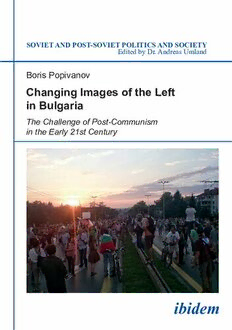
Cover picture: Protest in Sofia against the Oresharski cabinet, 8 July 2013. © Luchesar
ILIEV. Source: Wikimedia Commons. Licensed under CC-BY-SA 3.0 (s.
http://creativecommons.org/licenses/by-sa/3.0/deed.en).
ISSN: 1614-3515
ISBN-13: 978-3-8382-6717-3
© ibidem-Verlag / ibidem Press
Stuttgart, Germany 2015
Alle Rechte vorbehalten
Das Werk einschließlich aller seiner Teile ist urheberrechtlich geschützt. Jede Verwertung außerhalb der
engen Grenzen des Urheberrechtsgesetzes ist ohne Zustimmung des Verlages unzulässig und strafbar.
Dies gilt insbesondere für Vervielfältigungen, Übersetzungen, Mikroverfilmungen und elektronische
Speicherformen sowie die Einspeicherung und Verarbeitung in elektronischen Systemen.
All rights reserved
No part of this publication may be reproduced,
stored in or introduced into a retrieval system, or transmitted, in any form,
or by any means (electronical, mechanical, photocopying, recording or otherwise)
without the prior written permission of the publisher.
Any person who does any unauthorized act in relation to this publication may be liable to
criminal prosecution and civil claims for damages.
Contents
Abbreviations of political parties and organizations VI
Preface IX
1 Contextualizing the Bulgarian Left:
The Communist Successor Parties in Central and Eastern Europe 1
1.1 The Post-Communist Left in Central and Eastern Europe 1
1.2 Programmatic and Structural Change within
CEE Communist Parties 16
1.3 Programmatic and Structural Transformation of BCP 43
2 The Complex Historical Pathways of the Bulgarian Socialist Party 57
2.1 A Proletarian Party with no Proletariat 57
2.2 BCP in its Attempt to be Party of the Entire People 77
2.3 The Party in the Transition and the Transition in the Party 91
3 Leftist Elite and Leftist Supporters: An Emerging Divide 113
3.1 Has the Socialist Leadership been Sliding 'Right'? 113
3.2 Has the Socialist Electorate been Sliding 'Left'? 127
4 The Bulgarian Post-Communist Left in Crisis.
Is a New Left on the Way? 145
4.1 The Challenge of New Leftist Projects 145
4.2 The Challenge of New Leftist Groups 160
4.3 The Challenge of the 'Protest Year' 2013 177
In Lieu of a Conclusion 193
Bibliography 195
V
Abbreviations of political parties and
organizations
Abbreviation Full name of the Full name of the or- Country of origin
organization in the ganization in Eng-
original language lish
BCP Balgarska komunis- Bulgarian Com- Bulgaria
ticheska partija munist Party
BSP Balgarska socialisti- Bulgarian Socialist Bulgaria
cheska partija Party
BZNS Balgarski zemedels- Bulgarian Agrarian Bulgaria
ki naroden sajuz National Union
DPS Dvijenie za prava i Movement for Bulgaria
svobodi Rights and
Freedoms
FSN Frontul Salvǎrii National Salvation Romania
Naţionale Front
GERB Grajdani za evrope- Citizens for the Eu- Bulgaria
jsko razvitie na Bal- ropean Develop-
garija ment of Bulgaria
KSČ Komunistická strana Communist Party of Czechoslovakia
Československa Czechoslovakia
KSČM Komunistická strana Communist Party of Czech Republic
Čech a Moravy Bohemia and
Moravia
KSS Komunistická strana Communist Party of Slovakia
Slovenska Slovakia
MSzMP Magyar Szocialista Hungarian Socialist Hungary
Munkáspárt Workers' Party
MSzP Magyar Szocialista Hungarian Socialist Hungary
Párt Party
OSD Obedinenie za sozi- Union for Social Bulgaria
alna demokracija Democracy
VI
PCR Partidul Comunist Romanian Com- Romania
Român munist Party
PD Partidul Democrat Democratic Party Romania
PDS Partei des demokra- Party of Democratic German Democrat-
tischen Sozialismus Socialism ic Republic
PES --- Party of the Euro- European Union
pean Socialists
PRM Partidul România Greater Romania Romania
Mare Party
PSD Partidul Social De- Social Democratic Romania
mocrat Party
PZPR Polska Zjednoczona Polish United Poland
Partia Robotniczej Workers'Party
SDL' Strana demokrati- Party of the Demo- Slovakia
ckej l'avice cratic Left
SdRP Socjaldemocracja Social Democracy Poland
Rzeczypospolitej of the Republic of
Polskiej Poland
SDS Sajuz na demokra- Union of the Demo- Bulgaria
tichnite sili cratic Forces
SED Sozialistische Ein- Socialist Unity Party German De-
heitspartei Deutsch- of Germany mocratic Republic
lands
SPD Sozialdemokratische German Social Germany
Partei Deutschlands Democratic Party
SPS Socjalistička partija Socialist Party of Serbia
Srbije Serbia
SSRNJ Socjalistički savez Socialist Alliance of Yugoslavia
radnog naroda Ju- Working People of
goslavije Yugoslavia
VII
Other important abbreviations
Abbreviation Full name
CEE Central and Eastern Europe
Comecon Council for Mutual Economic Assistance
CSP Communist Successor Party
GDR German Democratic Republic (East
Germany)
VIII
Preface
It is now 11 years since Bulgaria became a full NATO member, and 8
years since the country acceded to the European Union. Yet Bulgaria is
still receiving relatively weak coverage in the annals of the European and
global social sciences—a situation evident both from the limited number of
special editions devoted to the country, and from the gaps in the literature
to which scholars often explicitly refer. There are diverse reasons for this
state of affairs. The socialist period of Bulgaria's history is not to be re-
membered for an impressive resistance against the regime or for strong
expressions of discontent against the Soviet domination. Later, in the pro-
cesses of transition to democracy in Central and Eastern Europe, Bulgaria
did not come to present a success story or model for emulation. On the
other hand, there was no dramatic failure, such as, say, a triumph of au-
thoritarian trends, to be observed in the country, either. In the context of
the Balkans, Bulgaria happily avoided the fate of neighbouring Yugoslavia
and did not get tangled in the quagmire of civil wars. Markedly positive or
resolutely negative cases usually tend to attract greater attention. Bulgar-
ia's case did not fall in either of those categories. Nevertheless, unique his-
torical experience could be found here. It is an experience which relates to
the peculiarly intertwined roles of Europe and Russia in the national devel-
opment as well as to the anti-fascist resistance and the social struggles of
the contemporary world.
Those introductory remarks are needed as initial steps to motivate interest
in one of the important manifestations of the Bulgarian political process for
many decades: the functioning of the Bulgarian left. This interest can be
positioned in a twofold context. The first aspect of this context is the back-
ground of the transition to post-socialist democracy and the specific role of
the principal organizational agent of the Bulgarian left, the former Com-
munist Party. In contrast with its counterparts in the other former Eastern
Bloc countries, the party maintained its unity and influence in a pluralist po-
litical model from the very start of transitions, and remained the only one
among them to maintain emotional closeness to Russia. The second as-
pect of the context is the perspective of the current situation, in which the
Bulgarian left can become the object of interest given the serious crisis it is
IX