
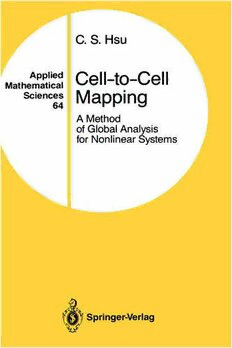
Download Cell-to-Cell Mapping: A Method of Global Analysis for Nonlinear Systems PDF Free - Full Version
Download Cell-to-Cell Mapping: A Method of Global Analysis for Nonlinear Systems by C. S. Hsu (auth.) in PDF format completely FREE. No registration required, no payment needed. Get instant access to this valuable resource on PDFdrive.to!
About Cell-to-Cell Mapping: A Method of Global Analysis for Nonlinear Systems
For many years, I have been interested in global analysis of nonlinear systems. The original interest stemmed from the study of snap-through stability and jump phenomena in structures. For systems of this kind, where there exist multiple stable equilibrium states or periodic motions, it is important to examine the domains of attraction of these responses in the state space. It was through work in this direction that the cell-to-cell mapping methods were introduced. These methods have received considerable development in the last few years, and have also been applied to some concrete problems. The results look very encouraging and promising. However, up to now, the effort of developing these methods has been by a very small number of people. There was, therefore, a suggestion that the published material, scattered now in various journal articles, could perhaps be pulled together into book form, thus making it more readily available to the general audience in the field of nonlinear oscillations and nonlinear dynamical systems. Conceivably, this might facilitate getting more people interested in working on this topic. On the other hand, there is always a question as to whether a topic (a) holds enough promise for the future, and (b) has gained enough maturity to be put into book form. With regard to (a), only the future will tell. With regard to (b), I believe that, from the point of view of both foundation and methodology, the methods are far from mature.
Detailed Information
| Author: | C. S. Hsu (auth.) |
|---|---|
| Publication Year: | 1987 |
| ISBN: | 9780387965208 |
| Pages: | 367 |
| Language: | English |
| File Size: | 5.366 |
| Format: | |
| Price: | FREE |
Safe & Secure Download - No registration required
Why Choose PDFdrive for Your Free Cell-to-Cell Mapping: A Method of Global Analysis for Nonlinear Systems Download?
- 100% Free: No hidden fees or subscriptions required for one book every day.
- No Registration: Immediate access is available without creating accounts for one book every day.
- Safe and Secure: Clean downloads without malware or viruses
- Multiple Formats: PDF, MOBI, Mpub,... optimized for all devices
- Educational Resource: Supporting knowledge sharing and learning
Frequently Asked Questions
Is it really free to download Cell-to-Cell Mapping: A Method of Global Analysis for Nonlinear Systems PDF?
Yes, on https://PDFdrive.to you can download Cell-to-Cell Mapping: A Method of Global Analysis for Nonlinear Systems by C. S. Hsu (auth.) completely free. We don't require any payment, subscription, or registration to access this PDF file. For 3 books every day.
How can I read Cell-to-Cell Mapping: A Method of Global Analysis for Nonlinear Systems on my mobile device?
After downloading Cell-to-Cell Mapping: A Method of Global Analysis for Nonlinear Systems PDF, you can open it with any PDF reader app on your phone or tablet. We recommend using Adobe Acrobat Reader, Apple Books, or Google Play Books for the best reading experience.
Is this the full version of Cell-to-Cell Mapping: A Method of Global Analysis for Nonlinear Systems?
Yes, this is the complete PDF version of Cell-to-Cell Mapping: A Method of Global Analysis for Nonlinear Systems by C. S. Hsu (auth.). You will be able to read the entire content as in the printed version without missing any pages.
Is it legal to download Cell-to-Cell Mapping: A Method of Global Analysis for Nonlinear Systems PDF for free?
https://PDFdrive.to provides links to free educational resources available online. We do not store any files on our servers. Please be aware of copyright laws in your country before downloading.
The materials shared are intended for research, educational, and personal use in accordance with fair use principles.

