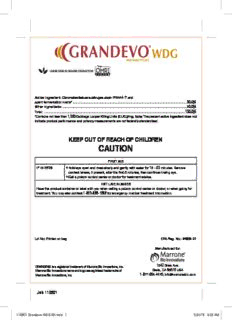
Table Of ContentActive Ingredient: Chromobacterium subtsugae strain PRAA4-1T and
spent fermentation media* .................................................................................................................................30.0%
Other Ingredients: ............................................................................................................................................70.0%
Total: ...............................................................................................................................................................100.0%
*Contains not less than 1,000 Cabbage Looper Killing Units (CLKU)/mg. Note: The percent active ingredient does not
indicate product performance and potency measurements are not federally standardized.
KEEP OUT OF REACH OF CHILDREN
CAUTION
FIRST AID
IF IN EYES • Hold eye open and rinse slowly and gently with water for 15 – 20 minutes. Remove
contact lenses, if present, after the first 5 minutes, then continue rinsing eye.
• Call a poison control center or doctor for treatment advice.
HOT LINE NUMBER
Have the product container or label with you when calling a poison control center or doctor, or when going for
treatment. You may also contact 1-800-222-1222 for emergency medical treatment information.
Lot No: Printed on bag EPA Reg. No.: 84059-27
Manufactured for:
GRANDEVO is a registered trademark of Marrone Bio Innovations, Inc. 1540 Drew Ave.
Marrone Bio Innovations name and logo are registered trademarks of Davis, CA 95618 USA
Marrone Bio Innovations, Inc. 1-877-664-4476; [email protected]
Job 116301
116301 Grandevo WDG BK.indd 1 5/20/16 9:05 AM
PRECAUTIONARY STATEMENTS
HAZARDS TO HUMANS AND DOMESTIC ANIMALS
CAUTION: Causes moderate eye irritation. Avoid contact with eyes or clothing. Wash thoroughly with soap
and water after handling and before eating, drinking, chewing gum, using tobacco or using the toilet.
PERSONAL PROTECTIVE EQUIPMENT (PPE)
Applicators and other handlers must wear:
• long-sleeved shirt and long pants
• waterproof gloves
• shoes plus socks
• protective eyewear
• A NIOSH-approved particulate respirator with any R or P filter with NIOSH approval number prefix
TC-84A; or a NIOSH-approved powered air purifying respirator with an HE filter with NIOSH approval
number prefix TC-21C. (Repeated exposure to high concentrations of microbial proteins can cause
allergic sensitization.)
Follow the manufacturer’s instructions for cleaning/maintaining PPE. If no such instructions for washables
are available, use detergent and hot water. Keep and wash PPE separately from other laundry.
Engineering Controls: When handlers use closed systems, enclosed cabs or aircraft in a manner that
meets the requirements listed in the Worker Protection Standard (WPS) for agricultural pesticides [40 CFR
170.240(d)(4-6)], the handler PPE requirements may be reduced or modified as specified in the WPS.
IMPORTANT: When reduced PPE is worn because a closed system is being used, handlers must be
provided all PPE specified above for “applicators and other handlers” and have such PPE immediately
available for use in an emergency, such as a spill or equipment breakdown.
USER SAFETY RECOMMENDATIONS
Users should:
• Remove clothing/PPE immediately if pesticide gets inside. Then wash thoroughly and put on clean
clothing.
• Remove PPE immediately after handling this product. Wash the outside of gloves before removing.
As soon as possible, wash thoroughly and change into clean clothing.
ENVIRONMENTAL HAZARDS
This product is toxic to aquatic invertebrates. Drift and runoff may be hazardous to aquatic organisms in
water adjacent to treated areas.
This product is toxic to certain nontarget terrestrial arthropods. Minimize spray drift away from target area
to reduce effects to nontarget insects.
This product is toxic to bees exposed to direct treatment or residues on blooming crops or weeds. Do not
apply this product if bees are visiting the treatment area.
For terrestrial uses: Do not apply directly to water, or to areas where surface water is present or to intertidal
areas below the mean high water mark. Do not contaminate water when disposing of equipment washwater
or rinsate.
DIRECTIONS FOR USE
It is a violation of Federal law to use this product in a manner inconsistent with its labeling. Do not apply this
product in a way that will contact workers or other persons, either directly or through drift. Only protected
handlers may be in the area during application. For any requirements specific to your State or Tribe, consult
the State or Tribal agency responsible for pesticide regulation.
2
116301 Grandevo WDG BK.indd 2 5/20/16 9:05 AM
AGRICULTURAL USE REQUIREMENTS
Use this product only in accordance with its labeling and with the Worker Protection Standard, 40
CFR Part 170. This Standard contains requirements for the protection of agricultural workers on farms,
forests, nurseries, and greenhouses, and handlers of agricultural pesticides. It contains requirements for
training, decontamination, notification, and emergency assistance. It also contains specific instructions
and exceptions pertaining to the statements on this label about personal protective equipment (PPE) and
restricted-entry interval. The requirements in this box only apply to uses of this product that are covered
by the Worker Protection Standard.
Do not enter or allow worker entry into treated areas during the restricted-entry interval (REI) of 4 hours.
PPE required for early entry to treated areas (that is permitted under the Worker Protection Standard and
that involves contact with anything that has been treated, such as plants, soil or water) is:
• Coveralls
• Waterproof gloves
• Shoes plus socks
• Protective eyewear
EXCEPTION: If the product is soil incorporated or soil injected, the Worker Protection Standard, under
certain circumstances, allows workers to enter the treated area if there will be no contact with anything
that has been treated.
NON-AGRICULTURAL USE REQUIREMENTS
The requirements in this box apply to uses of this product that are not within the scope of the Worker
Protection Standard for agricultural pesticides (40 CFR Part 170). The WPS applies when this product is
used to produce agricultural plants on farms, forests, nurseries or greenhouses.
Keep unprotected persons out of treated areas until sprays have dried.
PRODUCT INFORMATION
GRANDEVO WDG is a biological insecticide/miticide containing cells of Chromobacterium subtsugae strain
PRAA4-1T and spent fermentation media, for use on ornamental plants and edible crops against the pests
listed in the APPLICATION RATES FOR SELECTED CROPS section. GRANDEVO WDG functions primarily
as a stomach poison for use in the control or suppression of many foliar-feeding pests, including caterpillars,
and certain Coleoptera. GRANDEVO WDG has multiple effects, including reducing fecundity and oviposition,
deterring feeding and acting as a stomach poison on Homoptera and Hemiptera, such as aphids, psyllids,
whiteflies, Lygus, mealybugs, thrips, certain fruit flies, and phytophagous mites infesting labeled crops or
use sites. GRANDEVO WDG must be mixed with water and applied as a foliar spray with ground or aerial
equipment equipped for conventional pesticide spraying or by chemigation.
GRANDEVO WDG can be used in the field, in hoop houses, or in greenhouses for the control or suppression
of any labeled pest.
GROUND AND AERIAL APPLICATIONS
Apply GRANDEVO WDG in ground and aerial equipment with quantities of water sufficient to provide
thorough coverage of infested plant parts. The amount of water needed per acre will depend upon crop
development, weather, application equipment, and local experience.
Do not spray when wind speed favors drift beyond the area intended for use.
Avoiding spray drift is the responsibility of the applicator.
3
116301 Grandevo WDG BK.indd 3 5/20/16 9:05 AM
Mixing directions
Important - Do not add GRANDEVO WDG to the tank mix before introducing 3/4 of the desired amount of
water. Add water to the mix tank. Start the mechanical or hydraulic agitation to provide moderate circulation
before adding GRANDEVO WDG. Add the desired volume of GRANDEVO WDG to the mix tank and continue
circulation while adding the remainder of the water. Maintain circulation while loading and spraying. Do not
mix more GRANDEVO WDG than is needed for immediate use. Do not let the spray mixture stand overnight
in the spray tank. Use a strainer no finer than 50 mesh in conventional spray systems.
Spray volume
For conventional air and ground applications, use at least 10 gallons of total volume per acre in water-based
sprays. Use a minimum of 50 gallons per acre (GPA) carrier volume for all established orchard and vine
crops. For concentrated ground applications, use at least 10 gallons of carrier volume for all labeled crops.
Tank mixing
Do not combine GRANDEVO WDG in the spray tank with other pesticides, surfactants, adjuvants, or
fertilizers if there has been no previous experience or use of the combination to show it is physically
compatible, effective, and non-injurious under your use conditions. Observe the most restrictive of the
labeling limitations and precautions of all products used in mixtures.
To ensure compatibility of tank mix combinations, they must be evaluated prior to use. To determine
the physical compatibility of this product with other products, use a jar test. Using a quart jar, add the
proportionate amounts of the products to one quart of water with agitation. Add dry formulations first,
then flowables, and then emulsifiable concentrates last. After thoroughly mixing, let this mixture stand for
5 minutes. If the combination remains mixed or can be readily remixed, it is physically compatible. Once
compatibility has been proven, use the same procedure for adding required ingredients to the spray tank.
AERIAL DRIFT REDUCTION INFORMATION
GENERAL: Avoiding spray drift at the application site is the responsibility of the applicator (specifically, see
SENSITIVE AREAS section for the requirement regarding spray drift and honey bees). The interaction of
many equipment- and weather-related factors determine the potential for spray drift. The applicator and the
grower are responsible for considering all these factors when making decisions. Where states have more
stringent regulations, they should be observed.
BUFFER ZONE FOR AERIAL APPLICATION: Do not apply within 40 feet of aquatic habitats (such as but
not limited to, lakes, reservoirs, rivers, streams, marshes, ponds, estuaries, and commercial fish ponds).
INFORMATION ON DROPLET SIZE: Use only medium or coarser spray nozzles according to ASAE (S572)
definition for standard nozzles. In conditions of low humidity and high temperatures, applicators should use
a coarser droplet size. The most effective way to reduce drift potential is to apply large droplets. The best
drift management strategy is to apply the largest droplets that will provide sufficient coverage and control
or suppression. Applying larger droplets reduces drift potential, but will not prevent drift if applications are
made improperly, or under unfavorable environmental conditions (see Wind, Temperature and Humidity,
and Temperature Inversions).
CONTROLLING DROPLET SIZE: Volume - Use high flow rate nozzles to apply the highest practical spray
volume. Nozzles with higher rated flows produce larger droplets. Pressure - Do not exceed the nozzle
manufacturer’s specified pressures. For many nozzle types, lower pressure produces larger droplets. When
high flow rates are needed, use higher flow rate nozzles instead of increasing pressure. Number of Nozzles
- Use the minimum number of nozzles that provide uniform coverage. Nozzle Orientation - Orienting nozzles
so that the spray is released parallel to the airstream produces larger droplets than other orientations and is
the recommended practice. Significant deflection from horizontal will reduce droplet size and increase drift
potential. Nozzle Type - Use a nozzle type that is designed for the intended application. With most nozzle
types, narrower spray angles produce larger droplets. Consider using low-drift nozzles. Solid stream nozzles
oriented straight back produce the largest droplets and the lowest drift.
BOOM WIDTH: For aerial applications, the boom width must not exceed 75% of the wingspan or 90% of
the rotary blade.
APPLICATION HEIGHT: Do not make applications at a height greater than 10 feet above the top of the
largest plants unless a greater height is required for aircraft safety. Making applications at the lowest height
that is safe reduces exposure of droplets to evaporation and wind. If application includes a no-spray zone,
do not release spray at a height greater than 10 feet above the ground or crop canopy.
4
116301 Grandevo WDG BK.indd 4 5/20/16 9:05 AM
SWATH ADJUSTMENT: When applications are made with a crosswind, the swath will be displaced
downward. Therefore, on the upwind and downwind edges of the field, the applicator must compensate for
this displacement by adjusting the path of the aircraft upwind. Swath adjustment distance should increase
with increasing drift potential (higher wind, smaller drops, etc.).
WIND: Only apply this product if the wind direction favors on-target deposition. Do not apply when the wind
velocity exceeds 15 mph. Drift potential is lowest between wind speeds of 2 - 10 mph. However, many
factors, including droplet size and equipment type, determine drift potential at any given speed. Application
should be avoided below 2 mph due to variable wind direction and high inversion potential. NOTE: Local
terrain can influence wind patterns. Every applicator should be familiar with local wind patterns and how
they affect spray drift.
TEMPERATURE AND HUMIDITY: When making applications in low relative humidity, set up equipment to
produce larger droplets to compensate for evaporation. Droplet evaporation is most severe when conditions
are both hot and dry.
TEMPERATURE INVERSIONS: Do not apply during a temperature inversion because drift potential is
high. Temperature inversions restrict vertical air mixing, which causes small, suspended droplets to remain
in a concentrated cloud. This cloud can move in unpredictable directions due to the light variable winds
common during inversions. Temperature inversions are characterized by increasing temperatures with
altitude and are common on nights with limited cloud cover and light to no wind. They begin to form as the
sun sets and often continue into the morning. Their presence can be indicated by ground fog; however, if
fog is not present, inversions can also be identified by the movement of smoke from a ground source or an
aircraft smoke generator. Smoke that layers and moves laterally in a concentrated cloud (under low wind
conditions) indicates an inversion, while smoke that moves upward and rapidly dissipates indicates good
vertical air mixing.
SENSITIVE AREAS: The pesticide should only be applied when the potential for drift to adjacent sensitive
areas (e.g., residential areas, bodies of water, known habitat for threatened or endangered species, non-
target crops) is minimal (e.g., when wind is blowing away from the sensitive areas). Do not allow spray to
drift from the application site and contact people, structures people occupy at any time and the associated
property, parks and recreation areas, non-target crops, blooming crops or weeds that bees are visiting,
aquatic and wetland areas, woodlands, pastures, rangelands, or animals.
CHEMIGATION USE DIRECTIONS
Spray preparation
First, prepare a suspension of GRANDEVO WDG in a mix tank. Fill tank with ¾ of the amount of water for the
area to be treated. Start mechanical or hydraulic agitation. Add the required amount of GRANDEVO WDG,
and then the remaining volume of water. Then, set the system to deliver a minimum of 0.1 to 0.3 inch of water
per acre. Start system and uniformly inject the suspension of GRANDEVO WDG into the irrigation water line
so as to deliver the desired rate of GRANDEVO WDG per acre. Inject the suspension of GRANDEVO WDG
with a positive displacement pump into the main line ahead of a right angle turn to ensure adequate mixing.
GRANDEVO WDG is to be metered continuously for the duration of the water application.
Do not combine GRANDEVO WDG with other pesticides, surfactants, adjuvants, or fertilizers for application
through chemigation equipment unless prior experience has shown the combination to be physically
compatible, effective and non-injurious under your conditions of use.
General Requirements -
1) Apply this product only through sprinkler, including center pivot, lateral move, end tow, side (wheel) roll,
traveler, big gun, solid set, or hand move, or drip (trickle) irrigation systems. Do not apply this product
through any other type of irrigation system.
2) Crop injury, lack of effectiveness, or illegal pesticide residues in the crop can result from non-uniform
distribution of treated water.
3) If you have questions about calibration, you should contact State Extension Service specialists,
equipment manufacturers or other experts.
4) Do not connect an irrigation system (including greenhouse systems) used for pesticide application to a public
water system unless the pesticide label-prescribed safety devices for public water systems are in place.
5) A person knowledgeable of the chemigation system and responsible for its operation, or under the
supervision of the responsible person, shall shut the system down and make necessary adjustments
should the need arise.
5
116301 Grandevo WDG BK.indd 5 5/20/16 9:05 AM
Specific Requirements for Chemigation Systems Connected to Public Water Systems -
1) Public water system means a system for the provision to the public of piped water for human
consumption if such system has at least 15 service connections or regularly serves an average of at least
25 individuals daily at least 60 days out of the year.
2) Chemigation systems connected to public water systems must contain a functional, reduced-pressure
zone, backflow preventer (RPZ) or the functional equivalent in the water supply line upstream from the
point of pesticide introduction. As an option to the RPZ, the water from the public water system should
be discharged into a reservoir tank prior to pesticide introduction. There shall be a complete physical
break (air gap) between the flow outlet end of the fill pipe and the top or overflow rim of the reservoir tank
of at least twice the inside diameter of the fill pipe.
3) The pesticide injection pipeline must contain a functional, automatic, quick-closing check valve to
prevent the flow of fluid back toward the injection pump.
4) The pesticide injection pipeline must contain a functional, normally closed, solenoid-operated valve
located on the intake side of the injection pump and connected to the system interlock to prevent fluid
from being withdrawn from the supply tank when the irrigation system is either automatically or manually
shut down.
5) The system must contain functional interlocking controls to automatically shut off the pesticide injection
pump when the water pump motor stops, or in cases where there is no water pump, when the water
pressure decreases to the point where pesticide distribution is adversely affected.
6) Systems must use a metering pump, such as a positive displacement injection pump (e.g., diaphragm
pump) effectively designed and constructed of materials that are compatible with pesticides and capable
of being fitted with a system interlock.
7) Do not apply when wind speed favors drift beyond the area intended for treatment.
Specific Requirements for Sprinkler Chemigation -
1) The system must contain a functional check valve, vacuum relief valve and low-pressure drain
appropriately located on the irrigation pipeline to prevent water source contamination from backflow.
2) The pesticide injection pipeline must contain a functional, automatic, quick-closing check valve to
prevent the flow of fluid back toward the injection pump.
3) The pesticide injection pipeline must also contain a functional, normally closed, solenoid-operated valve
located on the intake side of the injection pump and connected to the system interlock to prevent fluid
from being withdrawn from the supply tank when the irrigation system is either automatically or manually
shut down.
4) The system must contain functional interlocking controls to automatically shut off the pesticide injection
pump when the water pump motor stops.
5) The irrigation line or water pump must include a functional pressure switch, which will stop the water
pump motor when the water pressure decreases to the point where pesticide distribution is adversely
affected.
6) Systems must use a metering pump, such as a positive displacement injection pump (e.g., diaphragm
pump) effectively designed and constructed of materials that are compatible with pesticides and capable
of being fitted with a system interlock.
7) Do not apply when wind speed favors drift beyond the area intended for treatment.
Specific Requirements for Drip (Trickle) Chemigation -
1) The system must contain a functional check valve, vacuum relief valve and low-pressure drain
appropriately located on the irrigation pipeline to prevent water source contamination from backflow.
2) The pesticide injection pipeline must contain a functional, automatic, quick-closing check valve to
prevent the flow of fluid back toward the injection pump.
3) The pesticide injection pipeline must also contain a functional, normally closed, solenoid-operated valve
located on the intake side of the injection pump and connected to the system interlock to prevent fluid
from being withdrawn from the supply tank when the irrigation system is either automatically or manually
shut down.
4) The system must contain functional interlocking controls to automatically shut off the pesticide injection
pump when the water pump motor stops.
6
116301 Grandevo WDG BK.indd 6 5/20/16 9:05 AM
5) The irrigation line or water pump must include a functional pressure switch, which will stop the water pump
motor when the water pressure decreases to the point where pesticide distribution is adversely affected.
6) Systems must use a metering pump, such as a positive displacement injection pump (e.g., diaphragm
pump) effectively designed and constructed of materials that are compatible with pesticides and capable
of being fitted with a system interlock.
Application Instructions for All Types of Chemigation -
1) Remove scale, pesticide residues, and other foreign matter from the chemical supply tank and entire
injector system. Flush with clean water. Failure to provide a clean tank, void of scale or residues, may
cause product to lose effectiveness or strength.
2) Determine the treatment rates as indicated in the directions for use and make proper dilutions.
3) Prepare a solution in the chemical tank by filling the tank with the required water and then adding product
as required. Utilize agitation to keep solution in suspension.
Application Instructions for Drip Chemigation -
1) Check to be sure that the system provides a uniform waterflow.
2) Irrigate crop with sufficient water to wet the root zone. Then, begin flow of the solution containing product
solution from the chemical tank for a period to uniformly distribute the material. Discontinue flow of the
GRANDEVO WDG mixture and let the system continue to run only as necessary to purge the line with
fresh water. Let the GRANDEVO WDG solution remain in the root zone of the crop.
USE INSTRUCTIONS
GRANDEVO WDG is a biological insecticide/miticide for use against listed insects and mites. Close scouting
and early attention to infestations is highly recommended. For insects and mites, proper timing of application
targeting new populations or recently hatched larvae and nymphs is important for optimal results. Applying
GRANDEVO WDG when pest populations are low is recommended.
For insects and mites, thorough coverage of infested plant parts is necessary for effective control or
suppression. GRANDEVO WDG does not have systemic activity. For some crops, directed drop nozzles by
ground machine are required.
Under heavy pest populations, apply a knockdown insecticide prior to or in a tank mix with GRANDEVO WDG,
use the higher label rates, shorten the spray interval, and/or increase the spray volume to improve coverage.
Repeat applications at an interval sufficient to maintain control or suppression, depending upon plant growth
rate, insect and mite activity, and other factors. If attempting to control or suppress an insect population with
a single application, make the treatment when egg hatch is essentially complete but when larvae or nymphs
are young and before economic damage occurs.
To enhance population management, consider tank mixing with contact insecticides/miticides. Use the lower
label rates of GRANDEVO WDG when populations are low and when tank mixing with other insecticides/
miticides. Use the higher rates of GRANDEVO WDG when applied stand-alone, when populations are high
or when egg numbers are high.
For hard-to-wet crops, consider using a spreader/sticker or adjuvant, which has been approved for use on
the targeted crop, to enhance coverage and adhesion of GRANDEVO WDG to the crop.
GRANDEVO WDG has been evaluated for phytotoxicity on a variety of crops under various normal growing
conditions. However, testing all crop varieties, in all mixtures and combinations, is not feasible. Prior to
treating an entire crop, test a small portion of the crop for sensitivity.
GENERAL SPRAY CONSIDERATIONS
GRANDEVO WDG performs best under certain conditions. To preserve product spray characteristics and
overall efficacy, consider the following spray parameters:
Tank-Mixing
GRANDEVO WDG does not have ovicidal activity. When significant insect or mite population
or eggs are present, consider tank mixing with a complementary ovicidal/contact insecticide.
pH
To maintain product properties, the pH of the mixed spray solution should be between 6-8,
with the most desirable level being neutral.
7
116301 Grandevo WDG BK.indd 7 5/20/16 9:05 AM
Water Hardness
If you know or suspect you have hard water, add ammonium sulfate (AMS) at levels of 1-2%
(w/w) or 8.5 to 17 pounds per 100 gallons of water to help maintain efficacy. Add AMS
together with GRANDEVO WDG or add it to the water and thoroughly dissolve before adding
GRANDEVO WDG. Conduct a spray test to determine if your crop/variety is compatible with
these AMS levels before adding GRANDEVO WDG to the tank for spraying. For organic
production, use an approved water conditioner to address suspected hard water.
Adjuvants/Carrier Volume
Avoid carrier volumes and/or adjuvants alone or in combinations that result in spray runoff or
a drip accumulation.
Some adjuvants have been shown to increase or decrease the effectiveness of GRANDEVO
WDG. Use of a quality adjuvant or crop oil is highly recommended.
APPLICATION RATES FOR SELECTED CROPS
For greenhouse applications on the crops and pests listed, use 1-3 pounds of GRANDEVO WDG in 100
gallons of water sprayed until just before point of runoff.
See specific application rates for each crop for additional details on greenhouse applications and for all
other application types.
FOR USE ON THE FOLLOWING CROPS FOR CONTROL OR SUPPRESSION OF SPECIFIED INSECTS
AND MITES:
Pre-harvest Interval (PHI) = 0 days
Alfalfa (Hay and Seed), Hay and Other Forage Crops
1-3 pounds of GRANDEVO WDG per acre
Alfalfa webworm, alfalfa caterpillar, alfalfa and cabbage loopers, armyworms, cutworms, European skipper,
and sod webworm
2-3 pounds of GRANDEVO WDG per acre
Plant bugs, spittle bugs, aphids, alfalfa weevil, billbugs, chinch bug, mites (such as clover, Bermuda grass
stunt, two-spotted, and winter grain), leafhoppers, and Lygus (such as tarnished plant bug)
Artichoke (Globe)
1-3 pounds of GRANDEVO WDG per acre
Armyworms, artichoke plume moth, and loopers
2-3 pounds of GRANDEVO WDG per acre
Aphids and whiteflies
Asparagus
2-3 pounds of GRANDEVO WDG per acre
Aphids, armyworms, asparagus beetle, cutworms, and spotted asparagus beetle
Asparagus beetle and spotted asparagus beetle: Apply when adults or larvae are seen feeding on new
spears and during the fern stage when field counts or crop injury indicate damaging populations.
Suppression – Stink bugs. Tank mix GRANDEVO WDG with a contact insecticide for control or improved
suppression of stink bugs.
Bananas
2-3 pounds of GRANDEVO WDG per acre
Banana skipper, banana rust thrips, and Hawaiian flower thrips
Suppression – Stink bugs. Tank mix GRANDEVO WDG with a contact insecticide for control or improved
suppression of stink bugs.
Brassica (Cole) Leafy Vegetables
Broccoli, Broccoli Raab, Brussels Sprouts, Cabbage, Chinese Broccoli, Chinese Cabbage (Bok
Choy), Chinese Cabbage (Napa), Chinese Mustard Cabbage (Gai Choy), Cauliflower, Cavalo Broccolo,
Collards, Kale, Kohlrabi, Mizuna, Mustard Greens, Mustard Spinach, and Rape Greens
8
116301 Grandevo WDG BK.indd 8 5/20/16 9:05 AM
1-3 pounds of GRANDEVO WDG per acre
Diamondback moth, cabbage looper, imported cabbageworm, cabbage webworm, cross-striped
cabbageworm, beet armyworm, armyworms, light brown apple moth, and cutworms
2-3 pounds of GRANDEVO WDG per acre
Whiteflies, thrips, aphids, leafhoppers, plant bugs, mites, billbugs, and yellow-margined leaf beetle larvae
Yellow-margined leaf beetle larvae – Apply to newly hatched to 2nd instar. If adult beetles are also present,
tank mix with a knockdown insecticide.
Suppression – Flea beetles, stink bugs, and bagrada bug. Tank mix GRANDEVO WDG with a contact
insecticide for control or improved suppression.
Bulb Vegetables
Leek, Garlic, Onion (Bulb and Green), and Shallot
1-3 pounds of GRANDEVO WDG per acre
Loopers, omnivorous leafroller, hornworm, imported cabbageworm, diamondback moth, green cloverworm,
webworms, saltmarsh caterpillar, armyworms, cutworms, cross-striped cabbageworm, Heliothis, European
corn borer, and leek moth
2-3 pounds of GRANDEVO WDG per acre
Suppression – Aphids and thrips.
Bushberries
Blueberry, Currant, Gooseberry, Huckleberry, Elderberry, Juneberry, Lingonberry, and Salal
1-3 pounds of GRANDEVO WDG per acre
Armyworms, cherry fruitworm, cranberry fruitworm, fireworms, leafrollers, and loopers
2-3 pounds of GRANDEVO WDG per acre
Aphids, thrips, blueberry maggot, spotted wing drosophila, and fruit flies – Begin applications as soon as
adult flies are active and continue until adult activity is no longer present. Use GRANDEVO WDG as part of an
integrated management program for control of spotted wing drosophila that includes tank mixes and rotation
with other products labeled for control of spotted wing drosophila. During periods of adult fly activity, make
applications on no more than a 7-day interval and more frequently if necessary to maintain control.
Suppression – Stink bugs, Japanese beetles, and flea beetle. Tank mix GRANDEVO WDG with a contact
insecticide for control or improved suppression.
Caneberries
Blackberry, Loganberry, Red and Black Raspberry, and Cultivars, Varieties and/or Hybrids of These
1-3 pounds of GRANDEVO WDG per acre
Beet armyworm, bertha armyworm, green fruitworm, leafrollers, loopers, western raspberry fruitworm, and
armyworms
2-3 pounds of GRANDEVO WDG per acre
Aphids and thrips
Spotted wing drosophila and fruit flies – Begin applications as soon as adult flies are active and continue
until adult activity is no longer present. Use GRANDEVO WDG as part of an integrated management program
for control of spotted wing drosophila that includes tank mixes and rotation with other products labeled for
control of spotted wing drosophila. During periods of adult fly activity, make applications on no more than
a 7-day interval and more frequently if necessary to maintain control.
Suppression – Stink bugs, Japanese beetles, and flea beetle. Tank mix GRANDEVO WDG with a contact
insecticide for control or improved suppression.
Cereal Grains
Barley, Buckwheat, Oats, Pearl Millet, Proso Millet, Rye, Sorghum (Milo), Triticale, and Wheat
1-3 pounds of GRANDEVO WDG per acre
Armyworms, corn earworm (headworm), southwestern corn borer, and webworms
2-3 pounds of GRANDEVO WDG per acre
Aphids (including greenbug), thrips, cereal leaf beetle larvae, chinch bugs, and mites
9
116301 Grandevo WDG BK.indd 9 5/20/16 9:05 AM
Citrus Fruit
Grapefruit, Lemons, Limes, Oranges, and Tangerines
1-3 pounds of GRANDEVO WDG per acre
Fruit tree leafroller, orangedog, citrus cutworm, and citrus leafminer
2-3 pounds of GRANDEVO WDG per acre
Aphids, two-spotted spider mite, Texas citrus mite, citrus red mite, citrus rust mite, six-spotted spider mite,
Asian citrus psyllid, citrus whitefly, cloudy-winged whitefly, citrus blackfly, citrus thrips, mealybugs, and
glassy-winged sharpshooter
California red scale and Florida red scale – Make a minimum of two applications of GRANDEVO WDG per
generation, targeting the crawler stage.
Spotted wing drosophila and fruit flies – Begin applications as soon as adult flies are active and continue until
adult activity is no longer present. Use GRANDEVO WDG drosophila as part of an integrated management
program for control of spotted wing drosophila that includes tank mixes and rotation with other products
labeled for control of spotted wing drosophila. During periods of adult fly activity, make applications on no
more than a 7-day interval and more frequently if necessary to maintain control.
Suppression – Stink bugs, Japanese beetles, and flea beetle. Tank mix GRANDEVO WDG with a contact
insecticide for control or improved suppression.
Corn (Field Corn, Sweet Corn, Popcorn and Corn Grown for Seed)
1-3 pounds of GRANDEVO WDG per acre
Armyworms, European corn borer, southwestern corn borer, western bean cutworm, corn earworm,
webworms, common stalk borer, and lesser cornstalk borer
2-3 pounds of GRANDEVO WDG per acre
Corn leaf aphid, stink bugs, thrips, mites, chinch bugs, and corn rootworm beetles
Cotton
1-3 pounds of GRANDEVO WDG per acre
European corn borer, cotton bollworm, tobacco budworm, loopers (soybean and cabbage), saltmarsh
caterpillar, fall armyworm, and yellow-striped armyworm
2-3 pounds of GRANDEVO WDG per acre
Cotton aphid, leafhoppers, thrips, cotton fleahopper, silverleaf whitefly, and mites
Suppression – Stink bugs and Lygus. Tank mix GRANDEVO WDG with a contact insecticide for control or
improved suppression.
Cranberry
1-3 pounds of GRANDEVO WDG per acre
Armyworms, brown spanworm, cranberry fruitworm, cutworms, leafrollers, fireworms, loopers, sparganothis
fruitworm, aphids, thrips, mites, and cranberry blossom weevil
Spotted wing drosophila and fruit flies – Begin applications as soon as adult flies are active and continue
until adult activity is no longer present. Use GRANDEVO WDG as part of an integrated management program
for control of spotted wing drosophila that includes tank mixes and rotation with other products labeled for
control of spotted wing drosophila. During periods of adult fly activity, make applications on no more than
a 7-day interval and more frequently if necessary to maintain control.
Suppression – Stink bugs, Japanese beetles, and flea beetle. Tank mix GRANDEVO WDG with a contact
insecticide for control or improved suppression.
Do not apply to flooded fields.
Cucurbit Vegetables
Cucumber, Edible Gourds, Muskmelon, Cantaloupe, Pumpkin, Watermelon, and Winter and Summer
Squash
1-3 pounds of GRANDEVO WDG per acre
Armyworms, cabbage looper, melonworm, pickleworm, rindworm complex, corn earworm, and cutworms
10
116301 Grandevo WDG BK.indd 10 5/20/16 9:05 AM
Description:Artichoke (Globe). 1-3 pounds of GRANDEVO WDG per acre. Armyworms, artichoke plume moth, and loopers. 2-3 pounds of GRANDEVO WDG per