Table Of ContentThis publication is designed to provide accurate and authoritative information
in regard to the subject matter covered. It is sold with the understanding that
the publisher is not engaged in rendering legal, accounting, or other profes-
sional service. If legal advice or other expert assistance is required, the services
of a competent professional should be sought.
Vice President and Publisher: Cynthia A. Zigmund
Editorial Director: Donald J. Hull
Senior Acquisitions Editor: Jean Iversen
Senior Managing Editor: Jack Kiburz
Interior Design: Lucy Jenkins
Cover Design: Design Solutions
Typesetting: Elizabeth Pitts
Portions of Chapter 5, “September 11, 2001,” appeared in another form in the
November-December 2001 issue of Interface, a publication of the American
Marketing Association, Chicago, and is used with permission.
© 2002 by by Joe Marconi
Published by Dearborn Trade Publishing, a Kaplan Professional Company
All rights reserved. The text of this publication, or any part thereof, may not
be reproduced in any manner whatsoever without written permission from the
publisher.
Printed in the United States of America
02 03 04 10 9 8 7 6 5 4 3 2 1
Library of Congress Cataloging-in-Publication Data
Marconi, Joe.
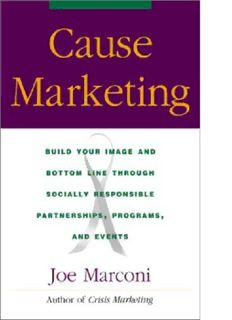
Cause marketing : build your image and bottom line through socially
responsible partnerships, programs, and events / by Joe Marconi.
p. cm.
Includes bibliographical references and index.
ISBN 0-7931-5258-5 (6 × 9 hardcover)
1. Social marketing. I. Title.
HF5414 .M37 2002
658.8—dc21
2002004699
Dearborn Trade books are available at special quantity discounts to use for sales
promotions, employee premiums, or educational purposes. Please call our Special
Sales Department to order or for more information, at 800-621-9621, ext. 4410, or
e-mail Mindi Rowland at [email protected].
DEDICATION
For Todd and Kristin and Emily
and for Karin
F O R E W O R D
This book about cause marketing appears in print when com-
pany policies and practices are being scrutinized more closely than
at any time in recent history. This has led to a rich and healthy
debate about the role of business in our society, the way business
costs and benefits are allocated, and the best way to ensure that
business operates for the benefit of everyone.
While there are widely diverging views about how business may
benefit and harm local communities and the global economy, there
is also a growing consensus that the measure of these impacts must
take into account the consequences of not just philanthropy but all
business activities. These include the operations of a company and
all of its business partners in every part of the world.
Company executives face a daunting challenge as they seek to
get their arms around and manage strategically their company’s
corporate social responsibility activities. As is true for all other
business issues of fundamental importance, this means gathering
information, setting goals, defining measures, establishing systems
for accountability, and assessing progress. In the case of corporate
social responsibility, it also means doing this in a way that engages
stakeholders and incorporates a commitment to transparency.
As the links between corporate responsibility and business per-
formance become more irrefutable, there is a growing awareness
on the part of business leaders that the most effective way to sus-
tain commercial success involves creating corporate cultures that
inspire trust and attract support from all key stakeholders. This
cannot be done without a thorough consideration of the social, eth-
ical, and environmental consequences of business decisions. These
include the following: how capital is acquired and invested; what
products and services are offered to the market; where facilities are
v
vi FOREWORD
sited and how they are constructed; who is hired and how these
employees are treated; and how a company behaves as a participant
in the global marketplace.
All of these traditional business decisions have as much or more
to do with how a company affects the community and how it is per-
ceived as do the more traditional investments companies make in
providing cash, products, or employee volunteers for community-
based charitable organizations.
As companies have begun to understand the potential benefits
and costs associated with the full array of their business activities,
there has been a dramatic increase in the allocation of funds from
marketing budgets that provide some benefit to nonprofit organi-
zations. The expenditure of these funds to serve the interests of
both the company and the community has come to be known as
cause marketing.
When properly planned and executed, cause marketing can ben-
efit a company by boosting sales, increasing market share, and
strengthening brand image and loyalty. At the same time, such ini-
tiatives also can deliver substantial benefit to the public, including
access to new financial support, increased visibility, and new and
effective mission-related strategies for specific nonprofit organiza-
tions and social causes.
If cause-related marketing is not done well, however, both the
community and the company can be damaged. Nonprofit organi-
zations can compromise their purpose, launch initiatives that are
not sustainable, and skew their priorities to accommodate business
interests. Companies can make investments that do not show a sub-
stantial return, help sales or brand image, and even stir up contro-
versies that claim valuable management time.
Effective cause marketing must be viewed by all parties as serv-
ing a beneficial purpose. These partnerships must be characterized
by integrity and mutual respect. Everyone must share a commit-
ment to clear, timely, and honest communications, and there must
FOREWORD vii
be effective mechanisms to address any issues that raise trouble-
some questions for any of the collaborators.
A cause marketing initiative alone will not persuade the public
that a company is a good corporate citizen. Nor will a campaign
that seeks to wrap an otherwise offensive company in a cloak of
virtue alter the views of any key stakeholders—except perhaps to
make them more cynical.
However, a carefully crafted cause marketing campaign, executed
well, can make an important contribution to a company’s overall
objectives and provide unique benefits to communities where it
operates.
This book offers a thoughtful and practical approach to cause-
related marketing for large and small enterprises. We at BSR are
pleased to have contributed to the content of this book and encour-
age readers to take its solid advice to heart—and action.
Robert H. Dunn
CEO, Business for Social Responsibility
C O N T E N T S
PREFACE xi
ACKNOWLEDGMENTS xiii
1. Understanding Cause Marketing 1
2. When the Cause Fits the Company 27
3. The Company, the Cause, the Community, and the World 49
4. Damage Control: Responding to Crises Relating to
Your Cause 81
5. September 11, 2001 109
6. The Cause Marketing Casebook 133
Philip Morris, ConAgra Foods, Eddie Bauer, Liz Claiborne, Taco
Bell, Target Stores, Timberland Company, General Mills, UPS,
Ford Motor Company, Grabber Performance Group, Compaq,
Mattel, Wal-Mart, and snapshots of other cause marketing cases.
7. A Crash Course in Cause Marketing 203
BIBLIOGRAPHY 213
INDEX 215
ix
Description:Your company's a success, thank you, and now you want to give something back. What should you do? Write a check? Start a foundation? Joe Marconi explains that cause marketing is all this and more. In cause marketing, you identify how your company can best make a contribution while leveraging its goo